A balanced FinTech workplace often needs about 150 to 200 rentable square feet per peak office employee. Dense teams may use less. Privacy-heavy operations can require more.
That calculation should influence lease length.
A company expecting rapid hiring might take less space now and protect expansion rights. Another business may lease additional capacity from day one.
Neither approach works without considering the term.
Funding runway creates another boundary.
A company should hesitate before signing a lease that extends far beyond its credible financial planning horizon.
That does not mean every startup needs a one-year office.
Very short terms can produce poor economics. They can also restrict buildout contributions and renewal certainty.
Instead, compare the financial commitment against cash reserves, projected revenue, future fundraising, and downside scenarios.
A five-year lease may still work for a venture-backed business. Strong flexibility rights can make that term considerably safer.
The lease term and the flexibility inside that term must work together.
That distinction explains why two five-year leases can carry completely different risks.
One may include expansion rights, assignment rights, and a strong renewal option.
Another may provide none of those protections.
The headline duration looks identical. The actual business flexibility does not.
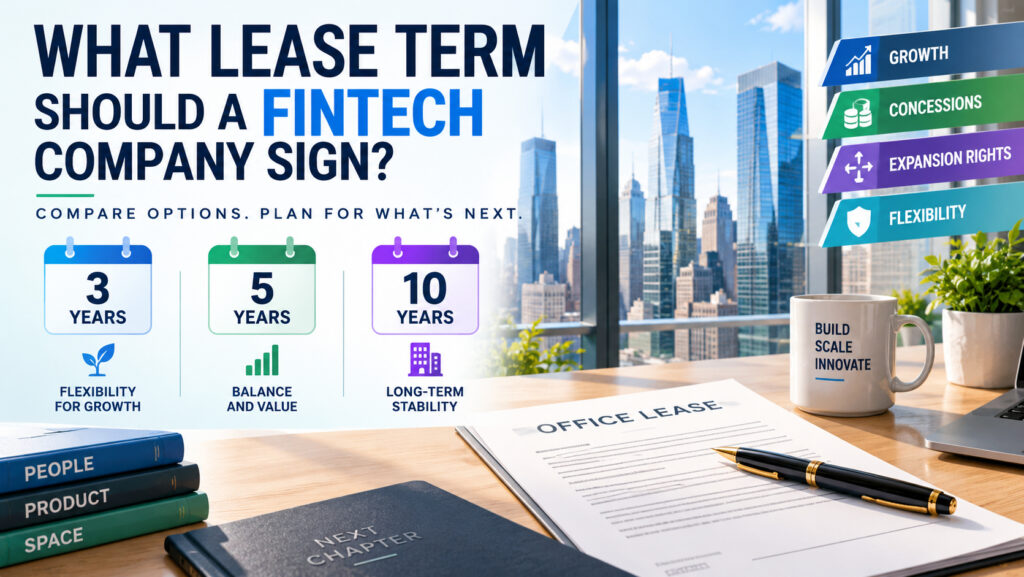
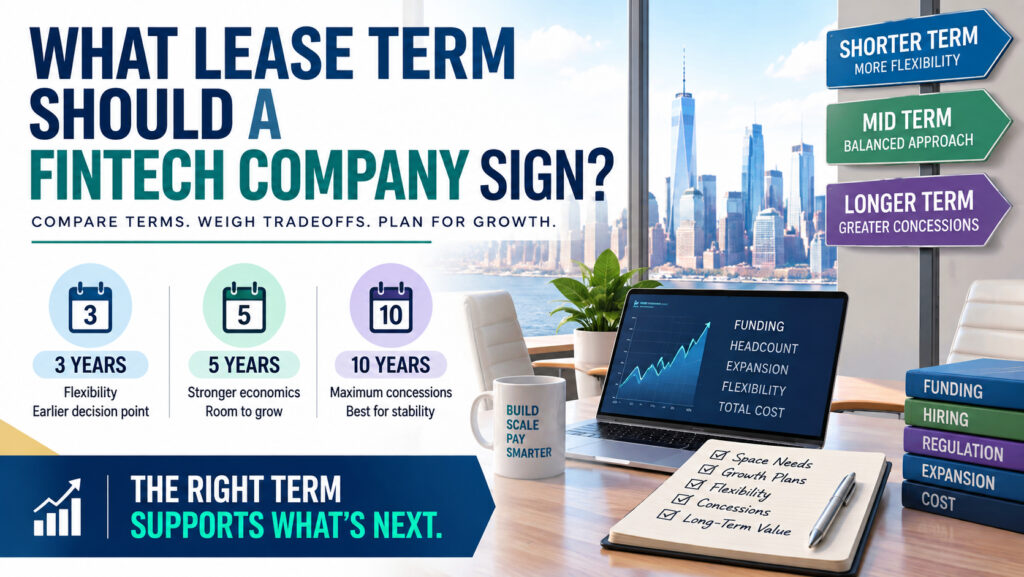
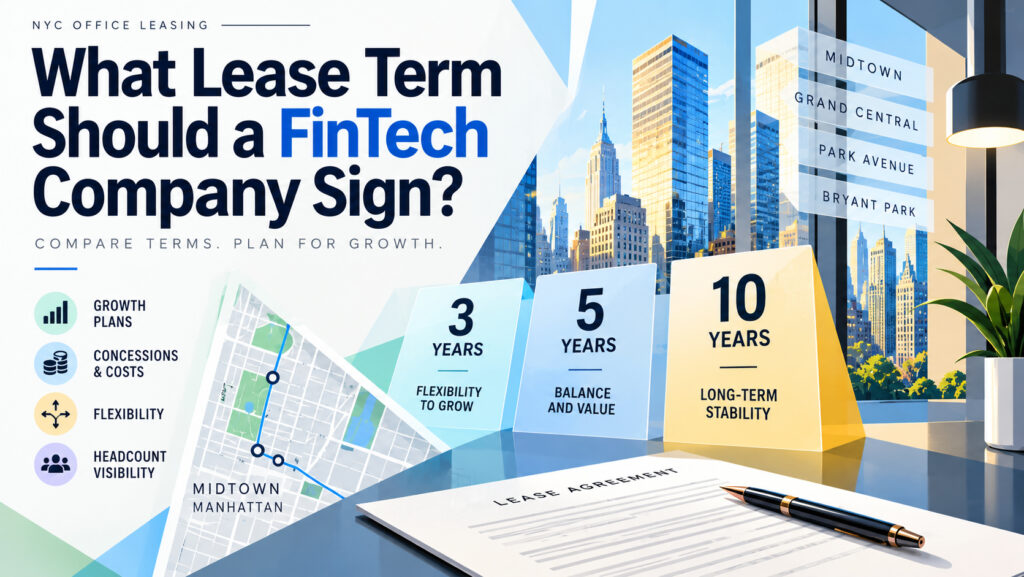
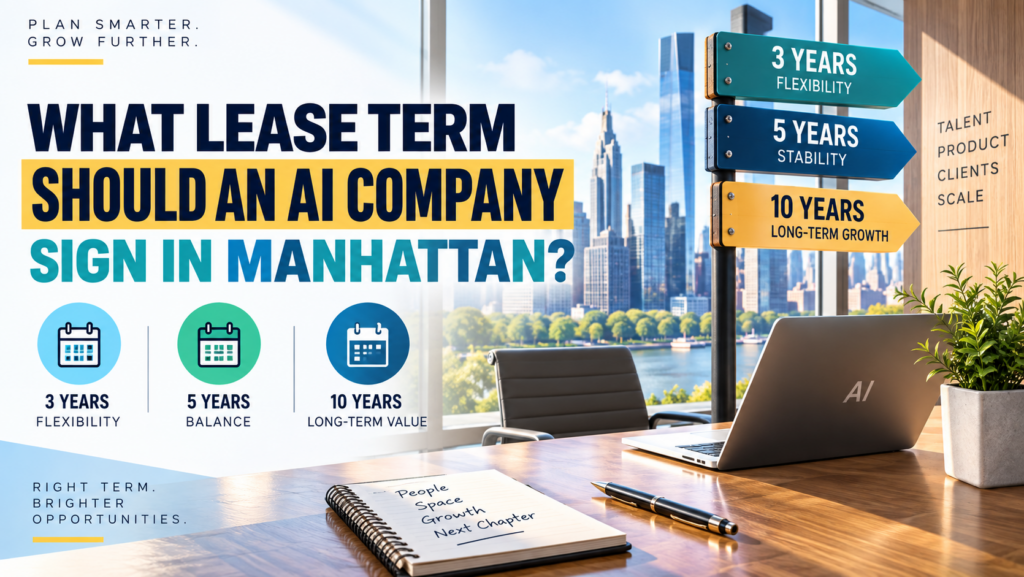
Should You Sign a Three-Year, Five-Year, or Ten-Year Office Lease?
There is no universal winning number.
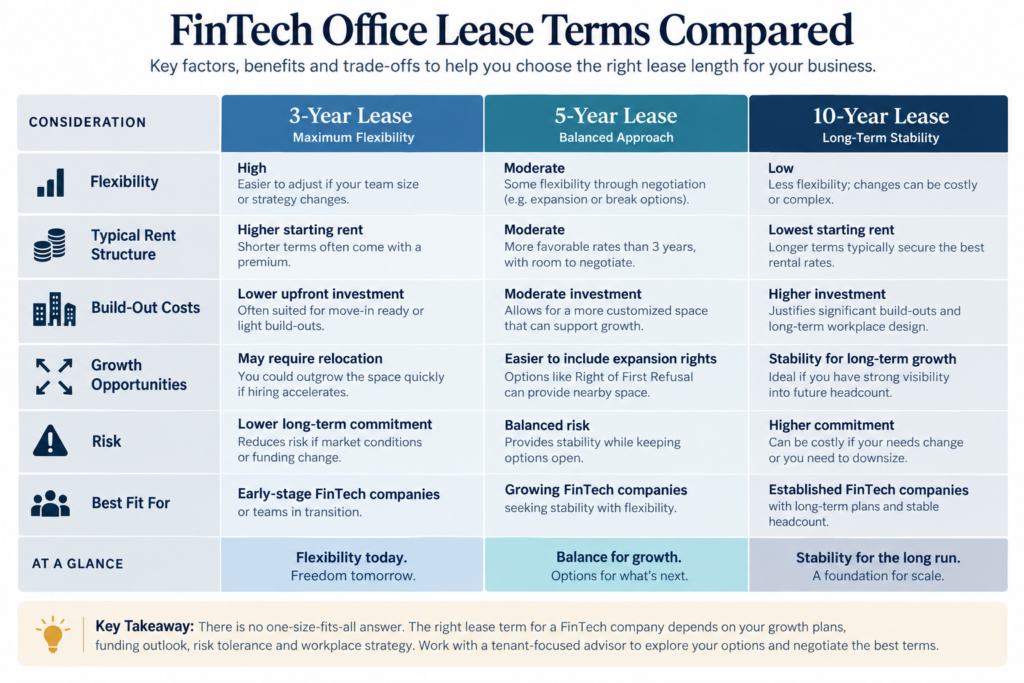
However, three-, five-, and ten-year terms solve different problems.
That furnished space advertises lease flexibility from one through ten years. The range lets a tenant compare shorter flexibility against longer-term economics.
A five-year lease often creates the middle ground.
Five years can give ownership enough term to justify meaningful transaction costs.
Meanwhile, the tenant gets another major decision point before a decade passes.
That structure often suits a funded business with several years of operating visibility.
The company should still negotiate flexibility.
A five-year deal without expansion or assignment rights can become restrictive.
Conversely, a carefully structured five-year term can support several growth outcomes.
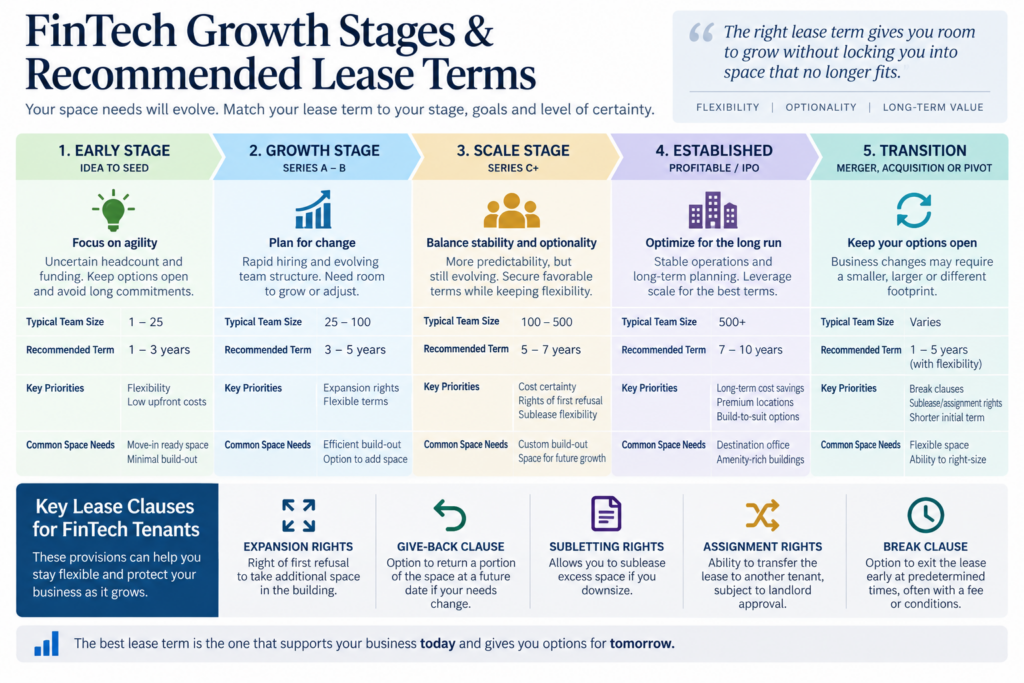
Consider pairing the term with:
A renewal option. The company can stay if the office continues working.
Expansion rights. The company can grow inside the building.
Sublease rights. Excess space can reach another user.
Assignment rights. A corporate transaction has a clearer path.
A defined termination right. Certain deals can include an early exit.
A ten-year lease solves a different problem.
A long term can work exceptionally well when the company knows its requirements.
Perhaps the office includes expensive infrastructure.
The company may need specialized security, significant cabling, dedicated systems, or a custom executive area.
A large buildout also changes the economics.
Moving every three years would waste time and capital.
Consequently, a longer lease may produce the better long-term result.
However, a ten-year lease should not simply represent the price of receiving a larger concession package.
Free rent eventually ends.
The liability remains.
Tenants should therefore model years six through ten as carefully as year one.
New York Market Conditions Change the Lease-Term Decision
Lease strategy does not operate separately from the market.
Manhattan’s office market tightened materially during 2026.
One major August 2026 market report measured availability at 12.5%. Available supply reached its lowest level since September 2020.
Another major methodology measured Manhattan availability at 14.4% during the second quarter. Its average asking rent reached $80.17 per square foot.
Different research systems classify inventory differently.
However, both describe a market with stronger demand and tightening quality supply.
That matters for lease length.
Tenants may still find meaningful choices across Manhattan. Yet the best built spaces can attract faster competition.
Premium space can exceed that range. Downtown can price materially below several Midtown submarkets.
Location can therefore change the term you can justify.
A company might afford five years in Midtown South but choose seven years Downtown.
Alternatively, it may accept a shorter furnished sublease in Midtown.
The correct answer depends on occupancy cost and business priorities.
As of late summer 2026, our FinTech leasing analysis showed meaningful pricing differences across Manhattan.
Midtown averaged roughly $85.55 per square foot. Midtown South averaged approximately $86.26.
Downtown averaged about $62.01.
Those averages do not represent every building.
They illustrate why location and term belong in the same analysis.
Strong space can disappear before weak space does.
Headline availability may look generous.
However, a tenant often excludes much of that inventory after touring.
Some buildings lack the required infrastructure.
Others have inefficient floors, poor light, outdated improvements, weak amenities, or unsuitable locations.
Therefore, the effective inventory for a particular FinTech company can become much smaller.
That issue matters when choosing a short lease.
A company may assume it can simply move after three years.
Yet future replacement space carries unknown costs.
Relocation also requires time, legal work, construction planning, technology installation, and operational coordination.
The shortest commitment does not automatically create the lowest risk.
Concessions also respond to lease length.
Landlords evaluate how long they can recover upfront transaction costs.
Those costs can include brokerage, legal work, free rent, construction, and tenant improvement dollars.
Current Manhattan data also shows that concession conditions have tightened.
One first-half 2026 analysis measured average rental abatement for new deals at 12.4 months. It measured average tenant improvement allowances near $140 per square foot.
Those figures cover broad market activity.
A small five-year lease should not automatically expect the same package.
Instead, concession levels depend on term, credit, building, size, condition, and competition.
What lease red flags matter most when reviewing term?
Watch for unclear renewal language.
Review assignment and sublease restrictions.
Check restoration obligations.
Understand rent increases and additional rent.
Read default provisions carefully.
Confirm holdover penalties.
Examine termination rights.
Finally, make sure every negotiated business point reaches the final lease.
Can a company simply back out after signing?
Do not assume so.
A signed commercial lease creates contractual obligations.
Any termination right must come from the document or applicable law.
Legal counsel should review exit rights before execution.
What is the best preferred lease length for a FinTech company?
There is no universal term.
For many growth-stage Manhattan FinTech companies, three to five years creates the most useful comparison range.
A five-year lease often improves direct-lease economics.
Three years can offer a faster reset.
Seven to ten years can fit stable companies making substantial long-term investments.
The best term gives the company enough certainty to operate without sacrificing necessary flexibility.
What should the final lease accomplish?
It should let your company operate effectively today.
It should also provide realistic paths for tomorrow.
That means balancing occupancy security with growth, contraction, renewal, and exit possibilities.
The smartest lease term does not predict the future perfectly.
It limits the damage when the prediction changes.
We work as tenant brokers, so our analysis starts with the tenant’s business plan rather than a landlord’s preferred term. We compare direct leases, furnished offices, subleases, concessions, and contractual flexibility across Manhattan. Compare flexible Manhattan office lease options before deciding whether three, five, seven, or ten years gives your company the strongest position.
Receive a Broker Report
Our role is to compare spaces, terms, concessions, and flexibility before a FinTech company commits. The goal is to match the lease term to runway, headcount visibility, infrastructure needs, and the real cost of changing course.
Fill out our 📋online form or give us a call today 📞212-967-2061 — let’s find the right options for your business.