Office Space for AI Startups in Manhattan
An AI startup rarely needs “special” office space because it uses artificial intelligence. Instead, it needs space that matches rapid hiring, technical work, capital discipline, and uncertain growth.
That distinction matters in Manhattan. A six-person seed team should not solve the same real estate problem as a 100-person growth company.
Likewise, an applied-AI company using cloud infrastructure needs different facilities from a team running substantial hardware onsite. The office must serve the business model, not a technology label.
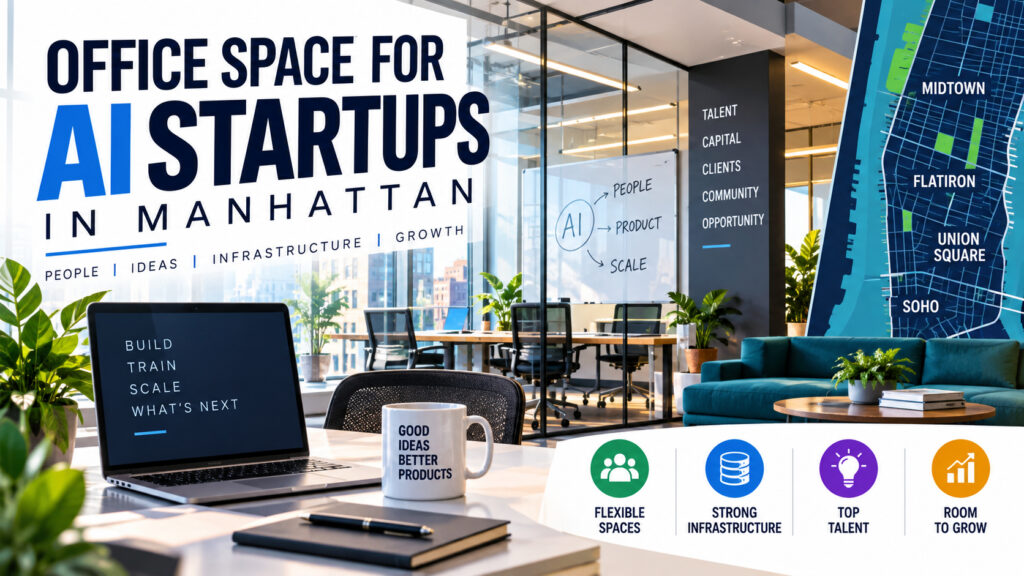
People exploring office space for AI startups in Manhattan usually need answers across several connected topics. They want neighborhoods, costs, lease structures, current spaces, infrastructure requirements, and growth options. Others want private offices, flexible terms, incubator-style environments, or headquarters planning.
The best decision starts with the company’s next operating stage. Then the lease should protect the company if that plan changes.
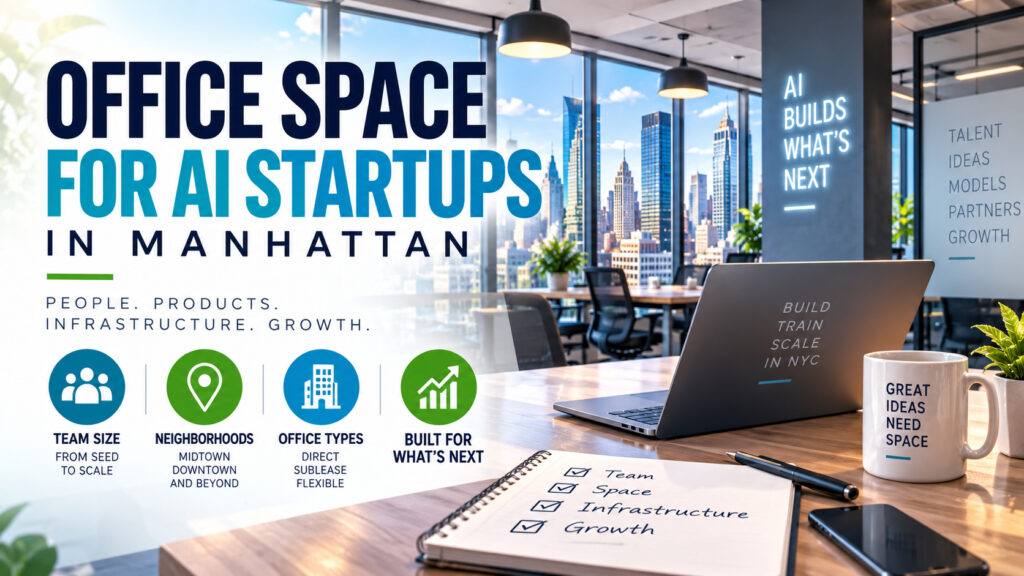
What AI Startup Office Space in Manhattan Actually Means
There is no legal or commercial real estate category called “AI office space.” Landlords generally lease the same office inventory to technology, finance, media, consulting, and other companies.
However, AI companies often share a distinct operating profile. Many grow quickly after financing. Headcount can change between the first tour and lease signing.
Engineering teams also value uninterrupted work. Product groups need collaborative rooms, while founders need spaces for recruiting, investors, clients, and interviews.
Therefore, good AI startup office space usually combines several characteristics:
| Requirement | Why it matters |
|---|---|
| Flexible capacity | Hiring plans can change quickly |
| Fast occupancy | Construction consumes time and capital |
| Reliable connectivity | Cloud tools and distributed development require dependable internet |
| Private meeting rooms | Teams discuss products, data, customers, and strategy |
| Strong HVAC | Dense teams and equipment increase cooling needs |
| After-hours access | Technical teams may work outside traditional business hours |
| Expansion options | A successful fundraising cycle can change headcount quickly |
| Sublease rights | A pivot can reduce space requirements |
| Recruiting appeal | Candidates evaluate the workplace during interviews |
| Transit access | Broader commute coverage enlarges the hiring pool |
“AI-ready” should describe operating fitness, not marketing language.
A beautiful loft with weak cooling may create problems for a dense engineering group. Conversely, a premium tower can waste capital for eight people working hybrid schedules.
Most startups should first define headcount, peak attendance, growth expectations, runway, and occupancy date. Those inputs determine almost everything else.
A company using cloud computing may need only excellent commercial office infrastructure. Teams hosting substantial equipment onsite require deeper technical review.
That review should cover electrical capacity, cooling, emergency power, network diversity, physical security, and equipment placement. A normal office floor does not automatically function like a data center.
Individual AI company headquarters also influence this topic. Recent large leases show where technology demand concentrates. However, another company’s headquarters does not automatically identify your best neighborhood.
Treat those addresses as evidence of market clustering. Do not treat them as a leasing blueprint.
Current leasing data reinforces that distinction. AI companies completed about 1.50 million square feet across 63 Manhattan transactions during 2026’s first half. Midtown South captured 75.1% of all technology leasing during that period.
Meanwhile, Manhattan availability continues to tighten. By August, overall availability had fallen to 12.5%, while sublet inventory reached about 10.07 million square feet.
That tightening market makes preparation more valuable. A startup should know its acceptable size, term, geography, and economics before touring.
Match the Office to Your Startup Stage
Where should an AI startup lease its first Manhattan office?
Start with the company stage rather than the neighborhood.
A first office should usually preserve optionality. At that point, hiring projections carry more risk than established occupancy patterns.
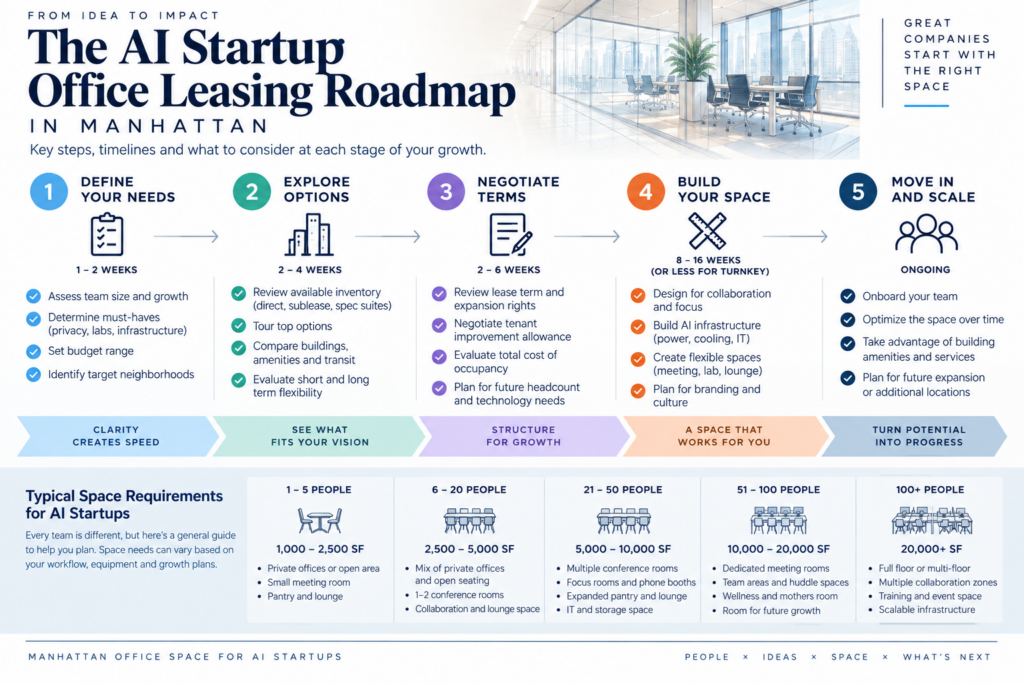
Our current AI startup office roadmap starts many seed-stage companies around 2,000 to 3,500 square feet. That footprint can support roughly eight to 15 employees with meeting and breakout space.
However, every company uses space differently. A meeting-heavy enterprise sales team requires more enclosed rooms than a product-focused engineering group.
Hybrid attendance changes the calculation again. Ten employees on payroll do not necessarily require ten permanently assigned workstations.
A practical Manhattan roadmap looks like this:
| Company phase | Working size range | Typical priority | Often suitable |
|---|---|---|---|
| Founder or very small team | 1,000–2,500 SF | Low commitment | Small prebuilt or short sublease |
| Seed | 2,000–3,500 SF | Speed and flexibility | Furnished sublease or small direct suite |
| Post-seed | 3,500–6,000 SF | Recruiting and growth | Turnkey loft or spec suite |
| Early growth | 5,000–10,000 SF | Departmental separation | Full floor or larger prebuilt |
| Scaling company | 12,000–20,000 SF | Expansion and infrastructure | Direct lease or major sublease |
| Emerging headquarters | 25,000–40,000+ SF | Control and long-term growth | Large direct lease or multi-floor strategy |
Our internal roadmap places the next major growth band around 5,000 to 10,000 square feet. Companies at that stage often need several conference rooms and quieter work areas.
Once requirements approach 12,000 to 20,000 square feet, the search changes materially. Larger engineering teams need stronger departmental zoning, IT rooms, and substantial shared space.
At 25,000 square feet and above, tenants should examine the entire building strategy. Adjacent floors, elevators, power, amenity capacity, and expansion rights become increasingly important.
Do not size the lease only around today’s desks.
Instead, model three attendance cases: current staff, likely staff, and plausible upside. Then identify the month when each scenario reaches practical capacity.
A startup also needs enough meeting capacity. Remote calls, candidate interviews, customer demonstrations, and investor meetings can overwhelm an open floor.
Phone rooms help, but they cannot replace every conference room. Likewise, a huge boardroom wastes space if teams rarely need it.
Density matters more than a generic square-feet-per-person rule.
For example, two 5,000-square-foot offices can support very different headcounts. One may contain many private offices, while another dedicates most space to desks.
Therefore, compare actual test fits whenever possible. Ask how many usable workstations remain after conference rooms, kitchens, circulation, and support areas.
A startup approaching its first dedicated office can review a 3,150-square-foot Flatiron turnkey space. Its layout includes open workstations, a conference room, phone booths, and breakout areas.
For a larger seed or post-seed team, this 5,000-square-foot furnished NoMad office supports more than 35 seats. It also includes six windowed offices, conference space, and tenant-controlled cooling.
That is the right comparison method. Start with the operating pattern, then judge each floor against it.
Choose the Right Manhattan Neighborhood
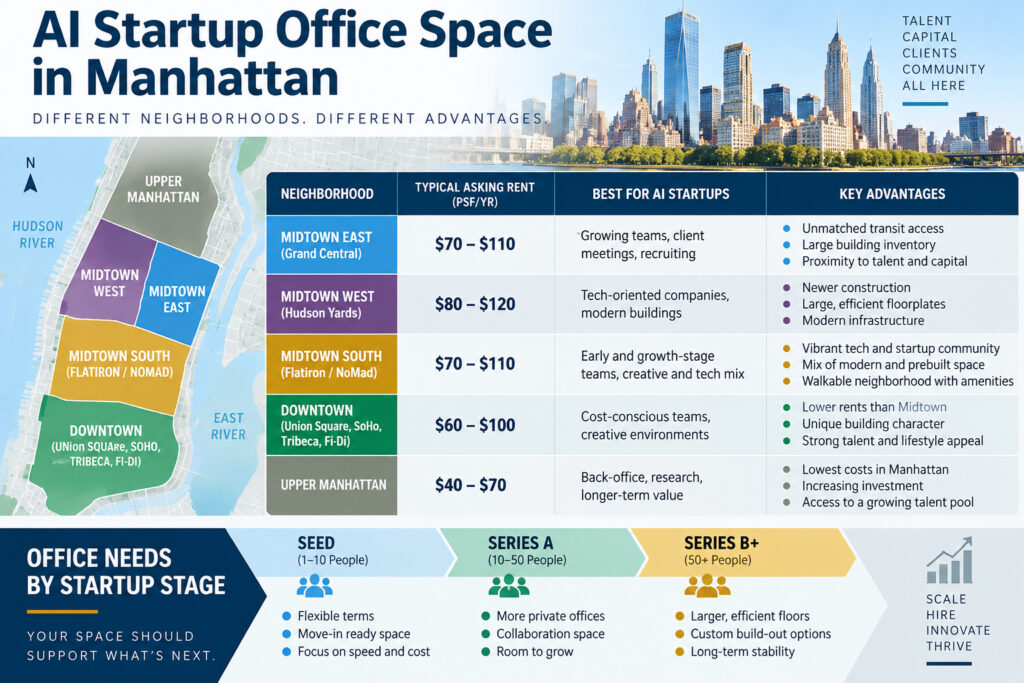
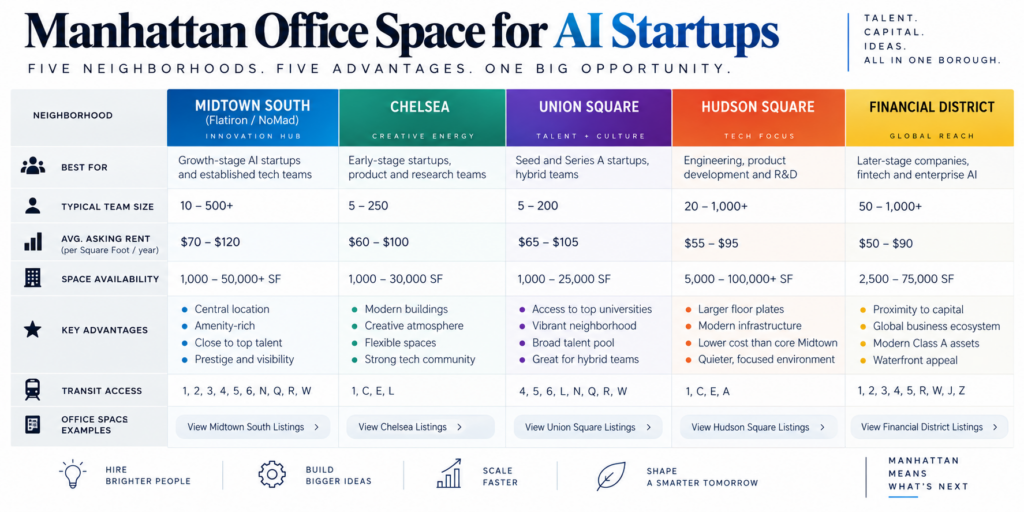
Manhattan does not have one official AI district. However, technology demand concentrates heavily across Midtown South.
That broad corridor includes Flatiron, NoMad, Union Square, Chelsea, Hudson Square, SoHo, and nearby neighborhoods. Each location solves a different tenant problem.
Flatiron and Madison Square offer one of the strongest starting points for funded startups. The area combines technology density, loft inventory, central transit, and varied floor sizes.
Seed teams can find boutique spaces there. Growth companies can pursue full floors, larger prebuilts, and premium buildings.
For example, this 5,594-square-foot Flatiron prebuilt office provides an entire floor with several meeting rooms. It also offers individual cooling control and round-the-clock access.
A larger organization can examine an 18,500-square-foot furnished Flatiron full floor. Its current configuration includes open seating, private offices, and conference space.
NoMad works particularly well for companies entering a headquarters phase. It sits between Midtown South’s startup environment and major Midtown transportation.
Teams can reach Penn Station, Herald Square, Madison Square, and east-side transit without choosing a traditional Midtown address.
This 8,390-square-foot Madison Avenue sublease illustrates that middle scale. The current layout supports roughly 50 people and includes 24/7 building access.
Union Square favors commute flexibility. Its transit network works especially well for teams drawing employees from several boroughs.
The district also provides lofts, modernized commercial buildings, and private full floors.
A 7,687-square-foot furnished Union Square office combines open seating, private rooms, conference facilities, and immediate occupancy characteristics.
Larger teams can consider this 14,005-square-foot Union Square full floor. The office offers an open loft layout with several private functional areas.
For additional scale, 30,450 square feet near Union Square spans two approximately 15,250-square-foot floors.
Hudson Square becomes compelling when scale matters. Larger floor plates and modernized former industrial properties suit expanding technology groups.
Smaller companies can still participate in that market. This 2,530-square-foot furnished Hudson Square office supports a compact team in a loft-style setting.
Another 3,191-square-foot Varick Street office gives a growing team a furnished, direct-lease alternative.
SoHo and NoHo appeal strongly to product-led and design-conscious companies. Historic loft architecture can create memorable recruiting and client environments.
However, tenants should investigate expansion before falling in love with a floor. Boutique buildings do not always provide adjacent growth space.
A 7,000-square-foot furnished SoHo penthouse currently includes open desks, conference rooms, private offices, and lounge areas. Its published sublease term extends through August 2027.
Larger groups can examine a 14,739-square-foot furnished NoHo full floor. The office supports up to 98 employees and offers a private terrace.
Chelsea mixes creative character with broader inventory choices. East Chelsea connects naturally with Flatiron and NoMad.
West Chelsea provides larger industrial properties and contemporary buildings. That diversity helps companies compare image against cost.
This 4,722-square-foot furnished Chelsea penthouse supports roughly 31 people. It also includes skylights, conference space, and roof access.
Midtown East and Grand Central solve another problem: regional access. Connecticut, Westchester, Long Island, and other commuter patterns can influence recruiting.
Enterprise-facing startups may also prefer proximity to major corporate customers. In that case, ecosystem density matters less than access.
The Financial District deserves serious consideration for value. It offers extensive transit, larger floor plates, and many furnished sublease opportunities.
A current 5,606-square-foot furnished Downtown office includes an expansion path reaching 15,752 square feet. Its published sublease term runs through September 2029.
The neighborhood decision should therefore follow four questions: Where does your team live, where do you recruit, who visits, and how fast might you grow?
Everything else comes second.
Budget for the Full Occupancy Cost
Manhattan does not charge an “AI premium” because a company develops artificial intelligence.
The building, location, condition, lease structure, size, term, and credit determine the economics.
For practical planning, many AI companies encounter asking rents around $45 to $120+ per rentable square foot annually. Premium trophy inventory can exceed that range materially.
Current market reports show why a single Manhattan average can mislead tenants.
During 2026’s second quarter, several major reports placed broad Manhattan asking rents around the high-$70s to low-$80s. Methodologies differ across brokerage surveys.
Midtown South shows even wider variation. One report placed its second-quarter asking average at $79.41 per square foot.
A September report covering August activity placed Midtown South’s average at $86.26 per square foot.
Those figures do not conflict as much as they appear. Each researcher can define inventory, classes, and calculations differently.
More importantly, neither average prices the actual office you want.
A renovated boutique loft may exceed its submarket average. Meanwhile, an older direct suite can fall far below that level.
The following examples illustrate annual base-rent arithmetic:
| Example requirement | Illustrative rent | Annual base rent | Monthly base rent |
|---|---|---|---|
| 3,000 SF | $75/SF | $225,000 | $18,750 |
| 5,000 SF | $85/SF | $425,000 | about $35,417 |
| 10,000 SF | $90/SF | $900,000 | $75,000 |
| 15,000 SF | $95/SF | $1,425,000 | $118,750 |
These examples show base rent only. Real occupancy costs require a broader model.
Electricity can sit outside the quoted rent. The lease may use direct metering, submetering, or another billing method.
Internet costs vary with carrier choice, redundancy, installation, and service level. Furniture can add another significant upfront requirement.
Cleaning, insurance, legal review, moving, security, and technology installation also affect the budget.
Direct leases can include operating expense escalations or tax obligations. Therefore, tenants should compare deals across the entire expected term.
A $75 asking rent can cost more than an $80 alternative after concessions and capital costs.
Free rent matters. So do tenant improvement allowances.
However, early-stage companies should not automatically choose the largest concession package. A long lease creates risk even when the landlord offers generous economics.
Cash preservation also matters differently at every funding stage. A seed company may value furnished space more than a lower face rent.
Why? Furniture, cabling, construction, and project management consume capital before employees produce anything inside the office.
Subleases can transfer much of that investment to the incoming tenant. Consequently, a furnished floor can outperform a cheaper unfinished floor.
Security deposits also deserve attention.
Startups without long financial histories may face substantial deposit requests. Strong financial information can help negotiations.
A parent guaranty, letter of credit, or other security mechanism changes risk. Counsel should review those provisions before signature.
Finally, model the office against runway rather than fundraising optimism.
Real estate commitments continue even when hiring pauses. The right lease should still make sense under a slower growth case.
Compare Lease Structures Without Losing Flexibility
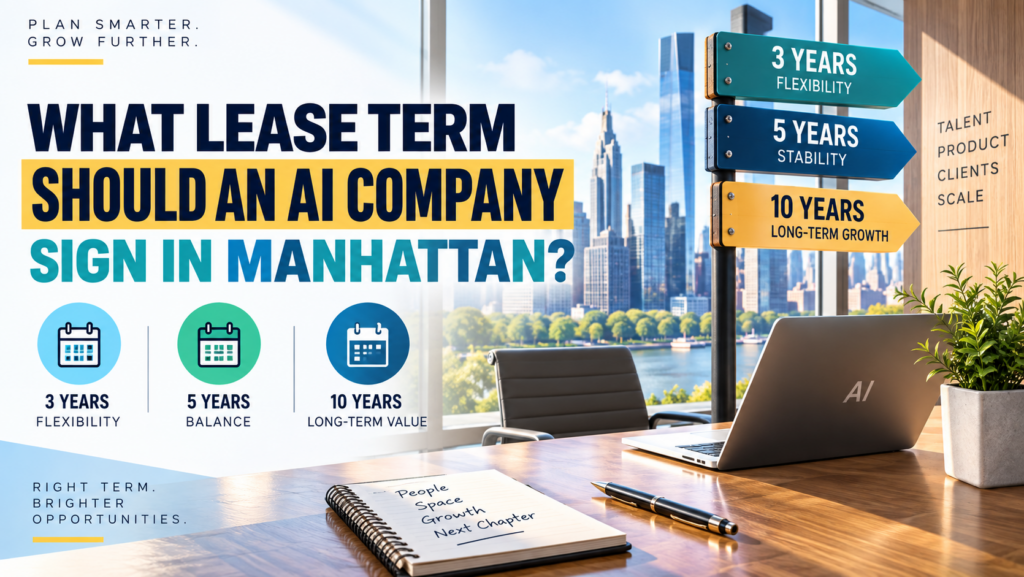
The best lease structure depends on what the startup knows today.
More importantly, it depends on what the startup does not know.
A company with uncertain headcount should purchase flexibility before custom finishes.
| Space structure | Best fit | Main advantage | Main tradeoff |
|---|---|---|---|
| Private flexible office | Tiny or temporary teams | Fastest setup | Higher effective cost |
| Furnished sublease | Seed and growth startups | Built infrastructure | Fixed expiration |
| Spec suite | Teams wanting turnkey quality | Minimal construction | Limited customization |
| Short direct lease | Stable smaller company | More control | Negotiation takes longer |
| Traditional direct lease | Growth-stage headquarters | Maximum control | Longer commitment |
| Full-floor lease | Scaling organization | Privacy and identity | Larger capital exposure |
Coworking and flexible offices can make sense at the beginning. They reduce setup friction and simplify monthly budgeting.
However, coworking should not become the default answer for every startup. Privacy, branding, meeting access, noise, and effective cost can eventually outweigh convenience.
A company may also outgrow flex space before it outgrows its desks. Conference demand often creates the first pressure point.
Furnished subleases solve a different problem.
They can provide desks, conference rooms, kitchens, cabling, and finished offices immediately. That makes them attractive for startups trying to occupy quickly.
However, subleases come with an expiration clock. The underlying lease also limits what a subtenant can negotiate.
Therefore, review the remaining term carefully. A seemingly perfect office may create another relocation within twelve months.
Also examine restoration obligations, furniture ownership, consent requirements, and any security deposit.
Spec suites can bridge the gap between subleases and traditional leases.
A landlord has already completed much of the construction. The incoming tenant can often avoid a lengthy design process.
Yet the landlord selected the layout. Moving walls can erase the time and cost advantage.
Direct leases offer greater control.
They work increasingly well as the startup establishes predictable revenue, staffing, and capital resources.
Longer commitments can also unlock better concession packages. Still, the lease should protect against unexpected growth.
Expansion rights deserve serious attention. A right of first offer on adjacent space may prevent an expensive relocation.
Likewise, assignment and sublease language affects future flexibility. Companies should negotiate those rights before circumstances create urgency.
Our startup roadmap also emphasizes expansion options, early renewal triggers, restoration limits, and landlord-funded improvements.
Good Guy guarantees require legal review rather than assumptions.
The business concept can help reduce personal exposure under certain structures. However, exact lease language controls the outcome.
A startup should never rely on a casual description of a guaranty. Commercial lease counsel should review it.
The same applies to operating expenses, casualty clauses, insurance, defaults, and assignment provisions.
Flexibility has economic value.
A slightly higher rent may justify itself when the tenant can exit sooner. Conversely, longer stability may justify a commitment for a predictable team.
The cheapest face rent rarely determines the best startup lease.
Evaluate AI-Ready Infrastructure and Layout
An AI company should separate office technology requirements from compute infrastructure requirements.
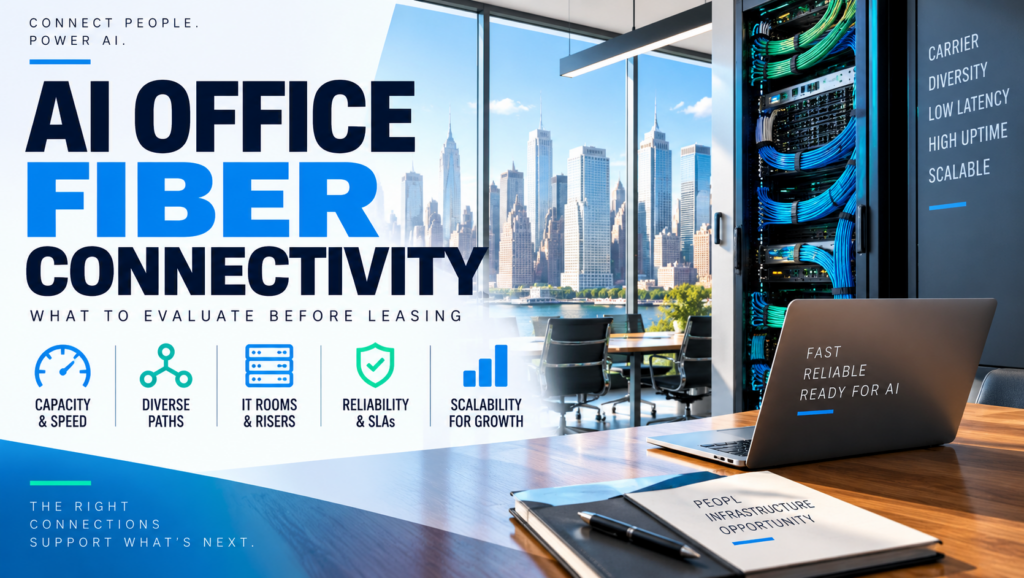
Most cloud-first startups do not need extraordinary electrical service at every desk. They need reliable connectivity, strong cooling, and functional IT infrastructure.
On-premises compute changes that equation quickly.
Start with internet connectivity.
Ask which carriers currently serve the building. Then confirm whether service reaches the specific floor.
A carrier inside the building does not guarantee an immediate connection to your suite.
For mission-critical work, consider redundant paths. Two services using the same physical pathway may not create meaningful redundancy.
Then examine cooling.
Dense engineering areas can run warmer than conventional office layouts. Supplemental equipment adds heat.
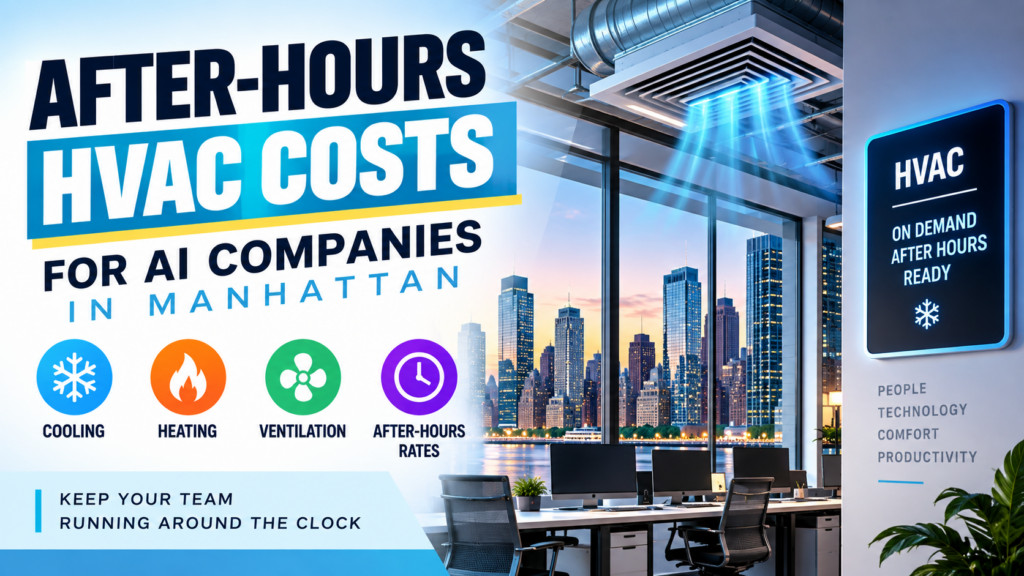
After-hours work creates another issue. Central building HVAC may not operate continuously.
Therefore, ask when base building cooling runs. Also ask what after-hours service costs.
Tenant-controlled systems can solve part of the problem. Supplemental units may solve another part.
However, every installation needs engineering review and landlord approval.
Power requires the same discipline.
Laptop-heavy teams usually fit ordinary commercial office infrastructure. Large server racks or specialized equipment may not.
Before committing, identify expected loads. Then ask an engineer to confirm available service and distribution.
Do not turn an office into an improvised server room. High-density compute brings cooling, fire protection, electrical, structural, and operational issues.
Privacy matters more than an open-plan photograph suggests.
Engineers need uninterrupted focus. Sales teams need private calls.
Founders may discuss financing. Product teams may review confidential customer data.
Therefore, strong AI office layouts usually blend open seating with enclosed rooms.
A useful floor should include several room types:
| Space function | Practical purpose |
|---|---|
| Open engineering area | Team communication and desk density |
| Small meeting rooms | Two-to-four-person working sessions |
| Phone booths | Calls without occupying conference rooms |
| Medium conference rooms | Interviews and team discussions |
| Larger presentation room | Demos, investors, and company meetings |
| Quiet room | Concentrated individual work |
| IT room | Organized networking and equipment |
| Pantry or lounge | Informal collaboration |
| Reception zone | Controlled visitor arrival |
The ratio matters more than simply having each room.
Twenty engineers with one phone booth may create constant conflict. Conversely, eight people rarely need five formal conference rooms.
Acoustics deserve physical testing during a tour.
Glass walls can look impressive while transmitting conversations. Open ceilings can also spread sound.
Stand inside a room while someone speaks outside. That simple exercise often reveals more than a brochure.
Physical security also matters.
Ask how visitors reach the floor. Determine whether employees can restrict suite access after hours.
Companies handling sensitive information may require stronger controls. Those controls can include electronic entry, visitor records, cameras, or dedicated reception.
Biotech and life-science AI companies need an additional distinction.
Software teams conducting computational research can occupy conventional offices. Wet-lab work creates an entirely different requirement.
Laboratory use can involve ventilation, plumbing, gases, waste handling, floor loads, and regulatory issues. A standard office lease should not substitute for a proper lab search.
Therefore, an AI-driven biotech company should separate its office and laboratory needs early. Some teams can colocate them, while others need distinct facilities.
Finally, consider employee experience.
Natural light, bathrooms, elevators, bike storage, showers, outdoor areas, food access, and neighborhood amenities still matter.
AI does not remove ordinary workplace needs.
Explore Current Manhattan Offices by Startup Profile
A useful office search should show contrasting choices, not ten versions of the same space.
The right shortlist might include a smaller Flatiron loft, a polished NoMad floor, and a value option elsewhere.
That contrast helps leadership understand which priorities cost money.
For a seed-stage team seeking roughly 3,000 square feet, start with a flexible turnkey floor.
The 3,150-square-foot Flatiron office supports up to 39 people under its published configuration. It includes workstations, a meeting room, phone booths, kitchen space, and breakout areas.
A different startup may prefer Hudson Square. The 2,530-square-foot furnished Hudson Square loft offers open seating and a conference room in a direct lease format.
Around 5,000 square feet, the choices broaden significantly.
The 5,000-square-foot furnished NoMad office offers a full-floor layout with 35-plus seats. Its published term currently runs through September 2027.
Chelsea offers another approach. A 5,000-square-foot furnished Chelsea full floor supports approximately 33 employees with private rooms and open workspace.
For a slightly larger requirement, the 5,331-square-foot furnished Flatiron office includes 20 workstations, several private offices, conference space, and breakout areas.
Teams approaching 6,000 to 9,000 square feet gain more headquarters-style choices.
This 6,500-square-foot furnished Union Square office includes 28 wired desks, meeting rooms, private offices, and an eat-in pantry.
The 7,000-square-foot SoHo penthouse provides a much different environment. It combines loft architecture with sit-stand desks, private rooms, conference areas, and lounge space.
NoMad offers greater density through this 8,390-square-foot Madison Avenue sublease. The published capacity reaches approximately 50 people.
Around 12,000 to 15,000 square feet, evaluate whole-floor functionality.
A 12,500-square-foot furnished SoHo office supports a published capacity of about 83 people. The space includes high ceilings, natural light, and tenant-controlled HVAC.
This 14,005-square-foot Union Square full floor offers another scaling option. Its open loft layout gives a tenant greater freedom over workstation planning.
The 14,739-square-foot NoHo full floor adds a furnished layout, private terrace, wellness amenities, and flexible sublease timing.
Above 15,000 square feet, expansion strategy becomes central.
An 18,500-square-foot furnished Flatiron floor includes 102 open seats and 17 offices under its current configuration.
Meanwhile, 30,450 square feet near Union Square gives a larger growth-stage company two substantial floors.
The purpose of these examples is not to crown one “best AI office.”
Instead, they show how Manhattan inventory changes with headcount, stage, layout, neighborhood, and term.
Availability can also change quickly. Confirm current status, pricing, furniture, possession, and deal terms before relying on any listing.
Decide, Negotiate, and Move In With Fewer Mistakes
A Manhattan office search works best when leadership agrees on priorities before touring.
Start with four hard constraints: maximum occupancy cost, target size, acceptable geography, and required possession date.
Then identify negotiable preferences.
Natural light may matter greatly. An expensive roof terrace may not.
A premium lobby might support enterprise sales. Another startup may prefer an unremarkable entrance and lower rent.
Build a scorecard before seeing spaces.
Rate every office against the same questions. That prevents the newest tour from automatically becoming the favorite.
A useful scorecard can cover commute, cost, seats, meeting rooms, condition, cooling, connectivity, term, expansion, and overall fit.
Next, compare at least two lease structures whenever possible.
For example, place a furnished sublease against a direct prebuilt. The sublease may win on cash and speed.
However, the direct lease may provide longer stability and better expansion.
A third option in another neighborhood can reveal the real location premium.
Negotiate the business points before treating the asking terms as fixed.
Base rent matters, but so do free rent, construction obligations, security, escalations, possession, and renewal rights.
For startups, assignment and sublease provisions deserve special attention. Expansion rights can matter just as much.
Likewise, clarify who owns existing furniture. Determine what must remain when the lease expires.
Plan internet immediately after selecting a finalist.
Carrier installation can outlast the lease negotiation. A finished office without connectivity still cannot support an engineering team.
Insurance, access credentials, furniture, movers, security, and IT need parallel schedules.
Our current Manhattan guidance finds that a prepared AI company can sometimes sign within roughly two to four weeks. Furnished and prebuilt spaces create the fastest paths.
Actual occupancy can take longer. Internet installation, insurance, building approvals, and minor work can delay move-in.
What should an AI startup prioritize in its first Manhattan office?
Prioritize flexibility, usable layout, dependable infrastructure, commuting access, and low setup friction. Prestige should follow those fundamentals.
Where are most AI startups leasing in Manhattan?
Midtown South currently carries the deepest concentration of technology leasing. Flatiron, NoMad, Union Square, SoHo, Chelsea, and Hudson Square all play distinct roles.
Is Flatiron always the best neighborhood for an AI startup?
No. Flatiron provides a strong ecosystem, but budget and hiring geography can favor other areas.
Hudson Square can work better for larger teams. Union Square can improve cross-borough access.
NoMad offers a polished headquarters environment. Downtown can provide stronger economics for certain requirements.
How much Manhattan office space should a seed-stage AI startup lease?
Our working roadmap often starts around 2,000 to 3,500 square feet for eight to 15 people.
However, attendance patterns and meeting requirements can change that number. A hybrid company may need fewer desks but more shared rooms.
Should an AI startup choose coworking or a private office?
Coworking works well when uncertainty dominates the decision. Private office space gains value when privacy, identity, or meeting demand increases.
The crossover depends on team size and utilization. It also depends on the effective monthly cost.
Is a furnished sublease better than a direct lease?
Not automatically. Furnished subleases generally win on speed and upfront cost.
Direct leases offer stronger control and potentially longer stability. Compare total economics and flexibility rather than lease labels.
Do AI companies require more electrical power than ordinary office tenants?
Cloud-first teams may not. Companies running meaningful onsite compute should conduct a detailed engineering review.
Never assume standard office power can support server-intensive operations.
Does an AI office need special cooling?
Dense teams and equipment can increase cooling demand. After-hours schedules can also expose limitations in central HVAC.
Confirm operating hours, supplemental options, controls, and costs before signing.
Can a startup negotiate room to grow?
Yes. Explore adjacent availability, expansion options, rights of first offer, renewal rights, and assignment flexibility.
A building with growth paths can outperform a slightly better floor without them.
Why do large AI headquarters appear so often when researching this topic?
Their leases reveal where technology companies place substantial bets. Those transactions can signal neighborhood momentum and building quality.
However, a 10-person startup should not copy a 500-person company’s real estate strategy.
What about AI startups working in biotechnology?
Computational teams can often use normal office inventory. Wet-lab operations require a specialized facilities analysis.
Determine whether the business needs office, laboratory, or both before touring conventional spaces.
What makes an office genuinely startup-ready?
A startup-ready office reduces irreversible costs. It should allow the team to start working without unnecessary construction.
Strong examples include furniture, usable conference rooms, reliable internet pathways, adequate cooling, and sensible lease flexibility.
How early should a startup begin looking?
Move-in-ready searches can run quickly when requirements stay simple. More complex direct leases require additional time.
Begin earlier when construction, substantial cabling, engineering, or custom security enters the plan.
Should a startup take extra space for future employees?
Take enough space to protect reasonable growth, but do not lease fantasy headcount.
A large unused office consumes runway every month. Expansion rights often provide a safer alternative.
What is the most important question during a Manhattan office tour?
Ask whether the floor can support the company’s next operating stage without creating unnecessary fixed costs.
Every attractive feature should follow that question.
Ready to Review Options
Let’s talk and we’ll setup a customized office space report tailored to your requirements.
We represent Manhattan office tenants, not landlords, throughout the search, negotiation, and move-in process. Our service helps startups compare live inventory, model true occupancy costs, and protect flexibility before signing. Get startup-ready spaces and tell us your headcount, timing, budget, and preferred neighborhoods.
Fill out our 📋 online form or give us a call today 📞 212-967-2061 — let’s find the right options for your business.