FinTech Office Lease Security Deposits in Manhattan
A FinTech office security deposit in Manhattan can represent several months of rent and hundreds of thousands of dollars. The amount depends on far more than the office size or asking rent. Landlords examine your company, financial strength, lease economics, buildout costs, guarantees, and the security structure itself.
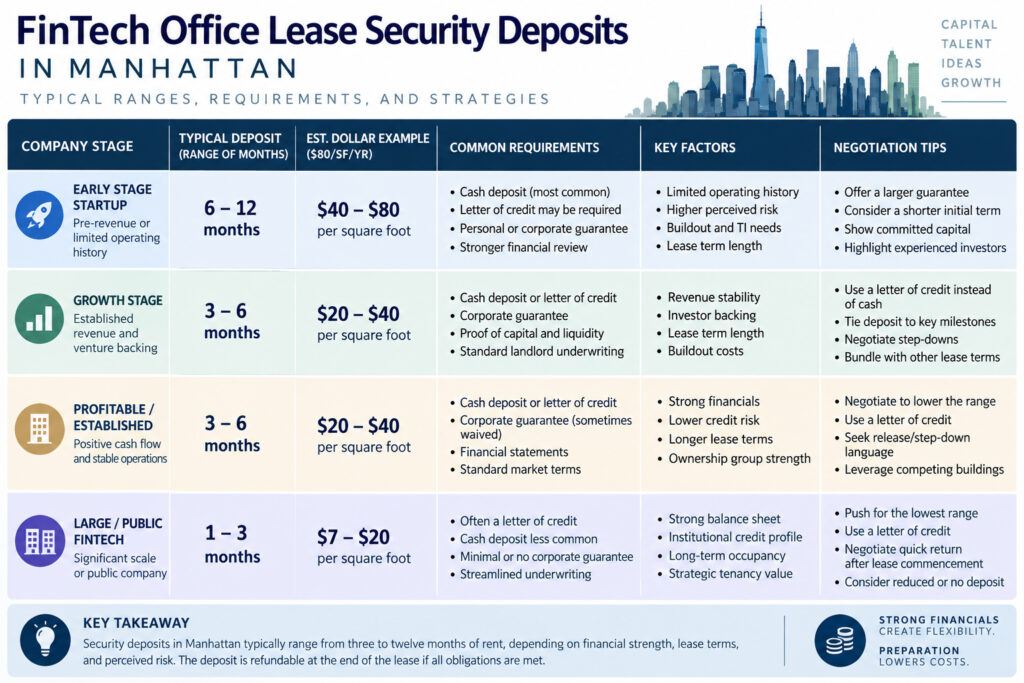
For established companies with strong financials, three to six months of rent provides a useful planning range. Early-stage startups can encounter requests for six to twelve months, especially when operating history remains limited. Those figures represent market benchmarks, not legal limits or automatic requirements.
A FinTech tenant should therefore treat security as a major financial term. It belongs beside rent, free rent, tenant improvements, expansion rights, and lease flexibility. A carefully structured package can protect liquidity without making the offer unattractive to ownership.
What a FinTech Office Security Deposit Actually Does
A Manhattan office security deposit protects the landlord against defined lease risks. Those risks can include unpaid rent, additional rent, property damage, restoration obligations, and other defaults. The lease determines exactly when ownership can apply the security.
The deposit does not represent a purchase price for the office. Nor does it normally function as prepaid final rent.
Your company supplies the security because the landlord assumes financial exposure when signing your lease. That exposure can start before your first rent payment.
Ownership may fund construction. It may provide free rent. Brokerage commissions can become payable. Legal costs also arise during documentation.
Meanwhile, the landlord removes the premises from active availability.
For that reason, landlords evaluate the whole transaction. They do not simply multiply monthly rent by a universal number.
Tenant rule: Never treat the first security-deposit request as an automatic requirement. Treat it as an underwriting decision you can influence.
FinTech companies create a particular underwriting challenge.
Many technology-driven financial companies hold substantial cash while remaining unprofitable. Others have excellent revenue growth but limited operating history.
A recently funded company may therefore look strong from one perspective. However, a landlord can still question its long-term ability to perform a ten-year lease.
That distinction matters.
A headline funding round does not tell ownership how quickly the company spends cash. Likewise, a strong investor roster does not automatically obligate those investors to fund lease liabilities.
Your runway after signing the lease often matters more than your bank balance before signing it.
Security deposit versus other lease security
Several financial concepts can appear together during the negotiation. They do not mean the same thing.
| Lease protection | What it does | Main tenant concern |
|---|---|---|
| Cash security deposit | Gives ownership cash collateral | Ties up working capital |
| Letter of credit | Gives ownership a bank-backed payment mechanism | Banking fees, collateral, renewal obligations |
| Corporate guaranty | Adds another company behind the tenant | Expands corporate liability |
| Parent guaranty | Adds the parent company’s credit | Parent must accept exposure |
| Personal guaranty | Adds an individual’s assets | Creates personal financial risk |
| Good Guy Guaranty | Limits personal exposure after qualifying surrender | Conditions and notice can become restrictive |
| Capped guaranty | Limits liability to an agreed amount | Cap must cover every relevant obligation clearly |
| Burn-down | Reduces security after milestones | Conditions can prevent the reduction |
| Security replacement product | Substitutes another risk instrument | Landlord must accept the product |
A landlord can request more than one structure.
For example, ownership might request six months of security plus a limited guaranty. Another landlord may accept a larger letter of credit without personal liability.
The correct comparison therefore concerns total exposure, not merely deposit months.
Why the tenant entity matters
Landlords usually underwrite the entity that will sign the lease.
A newly created subsidiary can look weak even when its founders have substantial resources. Likewise, a special-purpose entity may hold little cash outside the office obligation.
Ownership will often ask what stands behind that entity.
Possible answers include consolidated financials, a parent guaranty, funded capital, or another agreed credit enhancement.
A FinTech tenant should settle the entity structure early. Changing tenants late can trigger another credit review.
Manhattan commercial deposits differ from apartment deposits
Office tenants should avoid applying residential deposit rules to commercial leases.
New York law treats money deposited as security for real property as trust money. The money remains the depositor’s property until repayment or permitted application. The recipient cannot simply mingle that security with personal funds.
However, the familiar residential one-month limit does not create the same commercial office ceiling. Manhattan commercial parties negotiate the amount through their lease. Current office-market guidance therefore shows deposits extending across several months of rent.
That difference explains why a startup can face a six-month request without anything unusual occurring.
It also explains why negotiation matters so much.
How Much Security Deposit Will a Manhattan Landlord Require From a FinTech Startup?
There is no single correct number.
Still, tenants need a working budget before negotiating.
For planning purposes, an established and financially strong tenant often models three to six months. A startup or higher-risk company should prepare for a possible six-to-twelve-month request. Exceptional credit can produce less security, while unusual risk can produce more.
These ranges describe practical deal expectations. They do not create entitlements.
A company should never conclude, “six months is standard, so six months is fair.”
Instead, ask why ownership wants six months.
That question usually reveals the real negotiation.
Deposit size starts with monthly rent
Consider a 5,000-square-foot office.
Current September 2026 market figures report a Manhattan average asking rent of $80.05 per square foot annually. Midtown averaged $85.55, Midtown South $86.26, and Downtown $62.01. These figures reflect August activity and broad market averages.
A specific suite can price far above or below those averages.
| 5,000 RSF illustration | Annual asking rent | Approximate monthly base rent | Six months | Twelve months |
|---|---|---|---|---|
| Downtown average | $62.01/SF | $25,838 | $155,025 | $310,050 |
| Manhattan average | $80.05/SF | $33,354 | $200,125 | $400,250 |
| Midtown average | $85.55/SF | $35,646 | $213,875 | $427,750 |
| Midtown South average | $86.26/SF | $35,942 | $215,650 | $431,300 |
Those examples show why security belongs in the location decision.
Two comparable 5,000-square-foot offices can create very different upfront cash requirements. The rent difference becomes more pronounced when ownership requests nine or twelve months.
For more complete occupancy budgeting, see our FinTech office cost guide.
A deposit should not surprise you after selecting the office
A FinTech company should establish an acceptable security range before falling in love with a space.
Suppose your company targets 5,000 square feet near the Midtown South average.
Six months of base rent approaches $216,000. Twelve months approaches $431,000.
That money sits outside furniture, legal costs, technology, insurance, moving expenses, and other occupancy costs.
Consequently, the “best” office can become the wrong office after credit terms appear.
Current Manhattan conditions make early planning more important
Manhattan office availability has continued tightening during 2026.
One major market report measured August availability at 12.5%. Total available inventory fell to 65.40 million square feet. That represented its lowest total since September 2020.
Another major dataset measured average Manhattan asking rent at $80.05 per square foot. Its availability methodology produced a 13.7% rate for the same period.
Different research firms use different inventory methodologies.
For tenants, the practical point remains straightforward. Quality space has become more competitive in several Manhattan segments.
A weak or incomplete financial package can therefore hurt more than the deposit negotiation. It can reduce the landlord’s willingness to hold the space.
What could produce a three-month deposit?
Three months becomes more realistic when several favorable conditions converge.
The company may have meaningful operating history. Financial statements may show substantial liquidity and sustainable operations.
Additionally, ownership may have limited capital invested in the premises.
An existing installation can help.
The tenant might take the office largely as-is. Therefore, the landlord avoids a large custom construction expenditure.
A guaranty could provide additional comfort.
Likewise, a parent company with substantial credit can materially change the conversation.
What could produce a six-month deposit?
Six months often becomes the middle ground for a promising company without conventional corporate credit.
The tenant may have strong cash reserves but limited profitability. Perhaps the business recently completed institutional financing.
A landlord might also spend meaningful money preparing the office.
In that situation, six months can become a compromise between rejection and stronger guarantees.
The tenant should immediately ask about a burn-down.
What could produce nine or twelve months?
Large security requirements usually signal substantial perceived risk.
The tenant could lack operating history. Cash burn may remain high.
Perhaps ownership will fund expensive construction. A long free-rent period can increase landlord exposure further.
Another possibility involves the guaranty.
A principal who refuses any personal exposure can sometimes face a larger security request instead.
The negotiating question then changes.
Would you rather tie up another $150,000 of corporate capital or accept narrowly limited guaranty exposure?
Neither answer fits every FinTech company.
Security deposit and lease incentives interact
A tenant should never negotiate security in isolation.
Free rent, construction, rent, security, guaranties, and term all influence the owner’s economics.
A landlord contributing substantial tenant improvements can resist a low deposit. Conversely, an as-is installation may support a lower request.
The same relationship applies to concessions.
Our FinTech office lease incentives guide explains the broader concession package.
A lower security deposit can sometimes create more real value than another concession.
Cash availability matters immediately to a growing FinTech company.
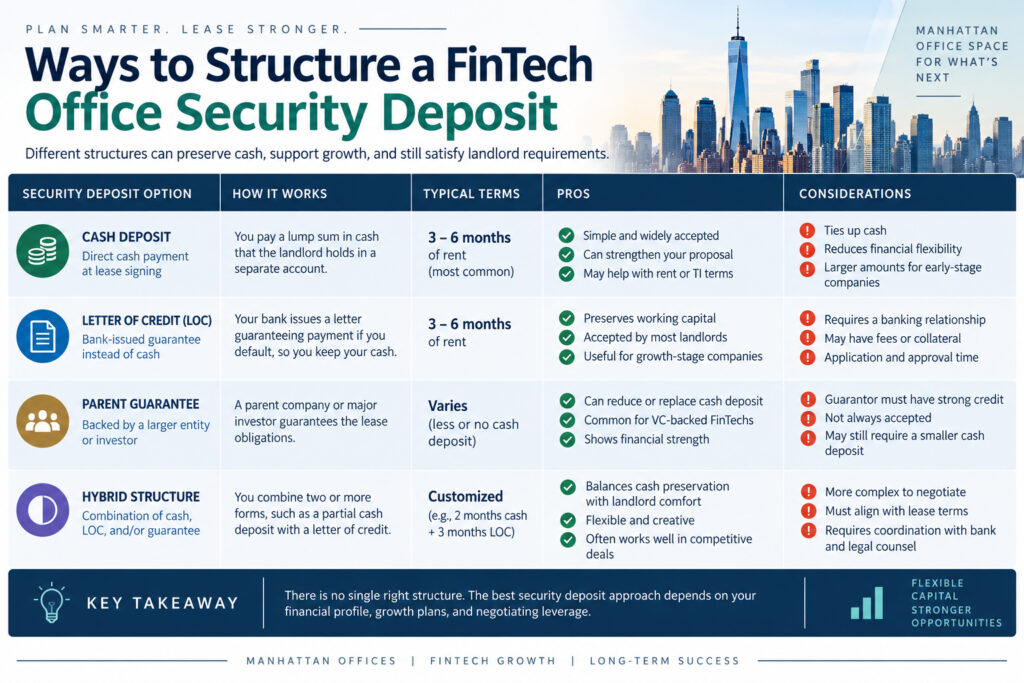
What Manhattan Landlords Examine When They Underwrite a FinTech Tenant
A landlord does not underwrite the word “FinTech.”
Ownership underwrites the company that must pay rent.
That distinction protects strong tenants.
Two businesses can occupy the same industry while presenting completely different credit profiles.
Operating history
Years in business still matter.
A company with five years of operating history provides evidence that a newly incorporated startup cannot provide.
Historical statements show how management handled growth, losses, financing, and market changes.
Yet operating history alone never guarantees favorable security.
A mature company with deteriorating liquidity can look riskier than a well-funded younger company.
Cash and unrestricted liquidity
Cash provides one of the clearest underwriting signals.
However, gross cash can mislead.
Landlords may consider how much liquidity remains after the move, deposit, construction, hiring, and recurring operating expenses.
A $10 million balance sounds impressive.
If the company spends $2 million monthly, that cash tells a different story.
FinTech tenants should therefore present liquidity within a broader financial narrative.
Burn rate and runway
Startup office underwriting often turns into a runway discussion.
How long can the company satisfy obligations without another financing round?
That question matters because the landlord signs a multi-year contract.
A company should understand its runway before submitting financials.
Moreover, calculate runway after the lease transaction.
Include security, furniture, technology, moving costs, and other major cash requirements.
Revenue quality
Revenue deserves context.
Recurring contractual revenue can tell a different story from volatile transactional revenue.
Likewise, one large customer creates different risk from a diversified customer base.
A landlord rarely needs your complete sales strategy.
However, management should know which financial characteristics strengthen the credit story.
Profitability and cash flow
Profitable companies usually present an easier underwriting case.
Still, many growth-stage FinTech companies intentionally invest ahead of profitability.
That situation does not automatically produce poor credit.
The company must instead explain how it funds losses.
Recent financing, substantial unrestricted cash, recurring revenue, or reliable parent support can matter.
Funding history
Institutional funding can strengthen credibility.
Nevertheless, financing announcements do not equal landlord guarantees.
Ownership wants evidence that capital entered the company.
The landlord may therefore request current statements or bank evidence.
A tenant should provide necessary proof without circulating unnecessary confidential material.
Investor support
An impressive investor list can help establish institutional credibility.
It does not automatically lower the deposit.
Investors generally do not guarantee office leases merely because they own shares.
Therefore, distinguish investor reputation from contractual financial support.
The latter provides stronger lease security.
Parent-company strength
A parent entity can materially improve a lease package.
This approach becomes especially relevant when the Manhattan tenant uses a new subsidiary.
Ownership may accept the subsidiary if a stronger parent stands behind defined obligations.
However, the parent should understand that a guaranty creates real exposure.
Counsel should negotiate its duration, amount, and release mechanics.
Existing lease history
A positive Manhattan occupancy record can help.
Previous landlords may show that the company paid consistently and maintained its space responsibly.
Payment history will not replace financial capacity.
Still, it can support a broader package.
Tax returns and financial statements
Expect landlords to request formal financial information.
The requested materials vary with company size and structure.
A mature private company may supply historical tax returns and financial statements. A venture-backed company may use current statements and funding documentation instead.
The important goal involves clarity.
Your package should explain the entity, liquidity, operations, and financial trajectory.
Audited versus internal financials
Audited statements generally carry more weight than internally prepared reports.
Not every startup has audited financials.
In that case, organize the strongest credible alternative package.
Possible materials include accountant-prepared statements, tax returns, bank evidence, and recent financing documentation.
Do not wait for a landlord to identify every missing document.
The landlord’s construction exposure
Credit represents only half the discussion.
Ownership also asks, “How much money are we investing in this particular tenant?”
A custom buildout can increase that amount substantially.
Free rent adds another cost.
Brokerage and legal costs add more.
Accordingly, the same FinTech company can receive different security requests for two different offices.
An existing installation can improve the equation
A furnished or prebuilt office reduces several capital requirements.
The landlord may avoid extensive construction.
Meanwhile, the tenant can avoid a major fit-out.
That structure can support a different security discussion.
FinTech companies considering this route can review our Manhattan FinTech sublease guide.
A sublease creates its own credit questions, however.
The overtenant may request security. Consent requirements can also affect timing.
Lease length
Term influences both sides of the risk equation.
A longer lease creates more total contractual obligation.
Yet it also gives ownership more time to amortize improvements and transaction costs.
Therefore, never assume a shorter or longer lease automatically produces lower security.
The entire economic package matters.
Building ownership and lender requirements
Not every deposit decision rests with the leasing representative.
Institutional ownership may follow formal credit policies.
Building lenders can also influence acceptable lease terms.
A privately controlled property may offer more flexibility.
However, that does not mean private owners always require less security.
The owner’s financial position and risk tolerance matter.
The useful question is not, “What is standard?” Ask, “What risk does this owner believe this security covers?”
Once you know that answer, you can address the concern directly.
Cash, Letters of Credit, Guarantees, and Burn-Downs
The amount represents only one part of the security negotiation.
Structure can matter just as much.
A six-month cash deposit and six-month letter of credit do not create identical consequences. Likewise, six months plus a broad guaranty can create much more exposure.
Cash security deposit
Cash offers simplicity.
The tenant wires the agreed security at signing. Ownership then holds the money according to the lease and applicable New York law.
New York General Obligations Law states that covered security money remains the depositor’s money. The recipient holds that money in trust until repayment or permitted application.
For tenants, cash creates an obvious disadvantage.
The money cannot fund hiring, technology, marketing, product development, or other operations.
A $300,000 cash deposit therefore costs more than $300,000 psychologically.
It removes liquidity from strategic use.
Does a commercial cash deposit earn interest?
Do not assume it does.
New York’s statutory framework discusses interest-bearing requirements specifically for rental property containing six or more family dwelling units. A conventional office tenant should therefore review the lease rather than assuming residential interest rules apply.
The lease should also identify the account treatment and return mechanics.
Letter of credit
A letter of credit for an office lease substitutes a bank obligation for a cash deposit.
The tenant arranges the instrument with an acceptable bank. The landlord receives draw rights under agreed conditions.
For a deeper discussion, review our Manhattan letter-of-credit guide.
An LC can improve liquidity in some situations.
However, tenants should reject the simplistic idea that an LC always “saves cash.”
Your bank might require full cash collateral.
Alternatively, it may use part of your credit capacity.
The economics depend on your banking relationship.
Model the actual LC cost
Ask the bank for a written estimate.
Include issuance charges, annual fees, amendment fees, transfer fees, and collateral requirements.
Some Manhattan leasing guides use roughly 1% to 2% annually as a working fee assumption. Actual pricing depends on the bank, credit profile, and instrument.
A company should compare those costs against the opportunity cost of posting cash.
For a well-capitalized FinTech company, cash might prove cheaper.
For another company, preserving liquidity can justify recurring bank fees.
Negotiate the LC form early
Do not wait until lease execution.
A landlord may insist on its preferred form.
Your bank may reject certain provisions.
That conflict can delay signing.
Important LC points include the issuing bank, amount, expiration, renewal, transfer rights, drawing conditions, and replacement requirements.
Watch the expiry mechanics
Many landlords require an evergreen structure or advance renewal.
The lease may permit a draw if the tenant fails to renew before a specified deadline.
That provision can create an avoidable crisis.
Calendar the renewal date months in advance.
A FinTech company should treat LC administration as a treasury responsibility.
Watch bank-rating requirements
Some lease forms require a bank meeting defined financial standards.
The lease may force replacement if that bank later falls below the required standard.
Such language can cause problems outside the tenant’s control.
Negotiate practical replacement periods.
Do not accept an immediate default for events involving the issuing bank.
Watch transfer provisions
Buildings get sold.
A successor owner may need the right to receive or transfer the LC.
Your bank may charge for that process.
Address those mechanics during negotiation.
New York law separately addresses transfers of cash security when ownership changes. Clear lease drafting still matters.
Good Guy Guaranty
A Good Guy Guaranty does not mean the tenant can cancel the lease whenever it chooses.
That distinction deserves emphasis.
The guaranty limits the guarantor’s personal liability after the tenant satisfies specific surrender conditions. The lease itself can remain enforceable against the tenant entity.
Those surrender conditions matter enormously.
They can include advance notice, payment through surrender, vacant possession, key delivery, required restoration, and freedom from existing defaults.
A badly drafted Good Guy Guaranty can provide much less protection than its name suggests.
Notice period under a Good Guy Guaranty
The landlord usually wants advance notice.
A tenant wants the shortest practical period.
Long notice extends personal exposure.
It can also delay the company’s ability to exit during financial stress.
Therefore, negotiate the notice period together with the deposit.
A landlord receiving substantial security may have less reason to demand prolonged guarantor exposure.
Full personal guaranty
A full personal guaranty creates a different risk.
The guarantor may remain responsible after the company vacates.
That exposure can extend into future rent or other lease obligations.
Founders should not treat this language casually.
A corporate lease can become a personal balance-sheet obligation.
Commercial real estate counsel should review the guaranty independently from the lease.
Capped guaranty
A cap can create a useful compromise.
For example, the principal might guarantee an agreed dollar amount rather than every remaining lease obligation.
Another structure limits liability to a defined number of months.
The drafting must remain precise.
Ask what happens to legal fees, additional rent, restoration costs, and holdover obligations.
A headline cap can become misleading if exclusions sit outside it.
Parent or corporate guaranty
A well-capitalized parent can sometimes replace personal exposure.
This structure suits FinTech groups using subsidiaries.
It can also work for international companies entering Manhattan through a U.S. entity.
Ownership will underwrite the guarantor.
Consequently, a weak affiliate provides little benefit.
Burn-down provision
A security deposit burn-down reduces security after the tenant proves performance.
This tool becomes especially valuable for startups.
A company may look risky at lease signing but very different two years later.
For example:
| Lease point | Security |
|---|---|
| At signing | 6 months |
| After year one | 5 months |
| After year two | 4 months |
| Later negotiated floor | 3 months |
That schedule is only an illustration.
The actual reduction can occur annually or after longer milestones.
Current Manhattan leasing guidance recognizes burn-downs as a common negotiation strategy for higher initial deposits.
The burn-down conditions matter more than the headline
Avoid language that makes the reduction practically impossible.
A landlord may condition release on “no default.”
That sounds simple.
However, an immaterial technical default years earlier could potentially block the reduction under broad drafting.
Tenants should seek objective conditions.
Examples include timely rent payment and no continuing material default.
Financial milestone burn-downs
Time does not need to provide the only trigger.
A FinTech company could propose a reduction after meeting financial milestones.
Possible triggers include minimum unrestricted cash or sustained profitability.
Another approach uses a successful financing event.
Objective measurements work better than vague landlord satisfaction.
Partial cash plus LC
Hybrid structures can solve difficult negotiations.
Perhaps the tenant posts three months in cash and three months through an LC.
Another transaction could shift from LC to cash after the deposit burns down.
No universal structure wins.
The best package matches the tenant’s treasury priorities.
Deposit replacement products
Commercial deposit alternatives also exist.
These products can use insurance or another third-party risk mechanism instead of traditional cash.
Landlord acceptance remains the key issue.
A tenant should never assume ownership will accept an unfamiliar instrument.
Compare premium cost, claim rights, cancellation terms, landlord protections, and tenant obligations.
Most importantly, determine whether the product truly replaces collateral.
Flexible office agreements are different products
Some tenants encounter flexible offices while researching security deposits.
Those agreements can require less upfront security.
However, they often operate through licenses or service agreements rather than conventional direct leases.
That difference affects control, term, economics, privacy, expansion, and termination rights.
FinTech companies should compare those products honestly.
A lower deposit does not automatically create a better occupancy structure.
How to Negotiate a Startup Office Security Deposit Before Lease Signing
Security negotiations work best when they start early.
Waiting until the lease arrives gives away leverage.
A tenant should introduce the credit discussion while business terms still remain open.
Prepare your financial story before tours become serious
Start by identifying the lease entity.
Next, assemble financial material before submitting serious proposals.
A typical package may include recent financial statements, historical statements, tax returns, and cash evidence.
Venture-backed companies may also provide financing information.
Parent financials can support a guaranty.
Keep confidential information controlled.
Use secure document delivery where appropriate.
Determine your maximum acceptable cash exposure
Management should establish a limit before negotiations.
Consider security alongside first rent, legal costs, technology, furniture, moving expenses, and other move-in requirements.
The correct question is not merely whether your company has the money.
Ask whether tying up that money represents intelligent capital allocation.
Ask about security policy before submitting the final offer
Different owners have different preferences.
One may strongly prefer an LC.
Another may prefer cash.
Some buildings can accommodate a guaranty structure.
Knowing that preference changes how you construct the proposal.
Put the security term in the proposal
Do not leave “security deposit: TBD.”
That omission allows the hardest financial issue to surface after other terms become settled.
Instead, propose the amount and form.
Also propose the burn-down.
Address guaranties at the same time.
Our office lease proposal and term-sheet checklist explains why security should enter the business negotiation early.
Negotiate the entire security package together
Suppose ownership requests eight months plus a Good Guy Guaranty.
Do not negotiate each item separately.
Offer alternatives.
Perhaps six months plus the guaranty works.
Maybe an eight-month LC eliminates personal exposure.
Another option could start at eight months and burn down to four.
The landlord’s underlying risk stays central.
You are changing the mechanism that covers it.
Use strong financials immediately
Do not hide your strongest credit evidence until later.
A landlord pricing risk without complete information may anchor on excessive security.
Correcting that anchor takes work.
Present the strongest organized package that confidentiality permits.
Explain the financing position clearly
Venture-backed FinTech companies should make funding understandable.
State when financing closed.
Show the resulting liquidity through appropriate documentation.
Explain material changes since the last formal financial statement.
Avoid promotional language.
The landlord wants credit evidence, not a pitch deck.
Demonstrate post-lease runway
This point can distinguish a sophisticated package.
Show that the company remains well-capitalized after committing to the office.
A landlord may care less about today’s bank balance than tomorrow’s obligations.
The same analysis helps management.
An office lease should not shorten runway beyond a comfortable threshold.
Use the physical space as a negotiating lever
An as-is office reduces landlord construction risk.
A prebuilt suite can produce the same benefit.
Existing furniture can reduce tenant costs too.
Therefore, compare spaces according to total capital requirements.
A more expensive prebuilt office could require less overall cash than a cheaper raw office.
Use the term intelligently
A longer commitment can improve certain concessions.
However, it also creates more total liability.
Do not extend a lease solely to lower the deposit.
First model the entire obligation.
Expansion, contraction, assignment, and sublease rights may matter more.
Consider a sublease when direct-lease security becomes inefficient
A sublease can solve certain startup timing problems.
Many subleases include existing improvements and furniture.
That can reduce move-in capital.
However, a sublandlord may still request significant security.
The prime lease, remaining term, consent process, and holdover exposure can influence that request.
Therefore, “sublease” does not automatically mean “small deposit.”
Compare Downtown, Midtown, and Midtown South economics
Location changes the dollar value of every deposit month.
Using current averages, a 5,000-square-foot Downtown office produces much lower base rent than equivalent Midtown averages.
That can materially reduce security.
Yet neighborhood selection should not revolve around the deposit alone.
Talent access, clients, building quality, infrastructure, transit, and lease flexibility all matter.
Negotiate the burn-down before lawyers draft
The business terms should state the starting amount and reduction.
Include timing.
Also include objective conditions.
Waiting until the lease can turn a business agreement into a prolonged legal negotiation.
Ask whether rent escalation increases security
Do not assume the deposit remains fixed.
Some leases state a fixed dollar amount.
Others can require additional security as rent increases.
Clarify that issue early.
A FinTech company should know its maximum future security exposure before signing.
Negotiate replenishment rights carefully
Suppose the landlord applies part of the security after a default.
The lease may require immediate replenishment.
That obligation can worsen a liquidity crisis.
Counsel should review timing, notice, cure rights, and replenishment language.
Separate a deposit burn-down from guaranty release
These concepts can have different triggers.
The cash deposit might decline after two years.
A guaranty could continue much longer.
That result may defeat part of the negotiation.
Track every security element through the entire lease term.
Compare security to rent concessions
A tenant may focus heavily on free rent.
However, reducing security can sometimes create better near-term liquidity.
Consider a company choosing between another free month and a three-month deposit reduction.
Both matter.
Their value depends on timing and cash priorities.
Model the cash flows rather than chasing the most visible concession.
Keep an issue sheet
Security negotiations contain many moving parts.
Create a simple internal schedule covering:
| Issue | Tenant position |
|---|---|
| Initial security | Agreed months and dollars |
| Form | Cash, LC, or combination |
| Guaranty | None, Good Guy, capped, parent |
| Burn-down | Dates and amounts |
| Reduction conditions | Objective requirements |
| LC bank standard | Confirmed with bank |
| LC renewal | Calendar requirement |
| Replacement rights | Reasonable cure period |
| Security top-up | Limited or eliminated |
| Return deadline | Stated clearly |
| Deduction rights | Defined by lease |
| Sale of building | Transfer and notice mechanics |
| Surrender | Objective requirements |
That schedule prevents economic terms from disappearing during legal drafting.
Lease Clauses That Determine Whether Your Deposit Really Comes Back
Negotiating four months instead of six means little if the lease makes recovery uncertain.
The security clause deserves careful review.
New York law provides an important trust framework for cash security. Yet the lease controls many operational details.
Define the security amount precisely
Use a dollar amount.
Do not rely only on “three months’ rent.”
That phrase can create questions after escalations.
Clarify whether the amount tracks initial base rent, current rent, or another formula.
Define what the landlord can secure
The clause should identify the obligations covered.
Landlord forms often use broad language covering every lease covenant.
Commercial counsel should review that scope.
A tenant should understand whether security covers rent, additional rent, restoration, damages, legal costs, or other obligations.
Do not assume security pays the final month
A commercial tenant should continue paying rent through the required period.
Using the deposit as the final month’s rent without written agreement can create a lease default.
The correct treatment depends on the lease.
Therefore, obtain explicit written consent before applying security against rent.
Negotiate the return deadline
Commercial tenants should not assume residential return deadlines control their office deposit.
Instead, write a clear return period into the lease.
A negotiated deadline might run from proper surrender and satisfaction of outstanding obligations.
Counsel should tailor that language to the transaction.
Avoid indefinite final reconciliation
Landlords sometimes want to retain security for expenses that remain unbilled.
That can delay return.
A tenant can negotiate procedures for estimated charges or partial retention.
There is little reason to trap the entire deposit over a small unresolved reconciliation.
Document the condition of the office
Move-in records matter.
Photographs, plans, construction documents, and written condition reports can reduce later disputes.
The surrender clause should also identify required restoration.
Do not wait until the final month to understand those obligations.
Clarify restoration requirements
FinTech offices can contain substantial infrastructure.
Server equipment, supplemental cooling, cabling, access control, soundproofing, trading equipment, and specialty power can create removal questions.
The lease should identify what stays.
It should also identify what ownership can require you to remove.
Restoration costs can affect security recovery.
Understand holdover exposure
Remaining after lease expiration can produce expensive consequences.
The lease may impose substantial holdover rent.
That exposure can also interact with guaranties and security.
Plan the move months before expiration.
Never treat surrender as an administrative afterthought.
Define Good Guy surrender carefully
A Good Guy release often depends on proper surrender.
Therefore, every condition deserves attention.
Avoid vague language wherever possible.
The guarantor needs an objective path to release.
A condition based entirely on landlord satisfaction weakens that protection.
Watch “no default” conditions
The phrase sounds harmless.
Yet a historical technical issue might create disagreement.
Better drafting can focus on no continuing material default.
Specific language depends on counsel and transaction leverage.
Coordinate the Good Guy notice with business reality
Imagine a company suddenly faces funding pressure.
A 180-day notice requirement could provide little practical relief.
The business may not have six months of liquidity.
Accordingly, the notice period should reflect the purpose of the guaranty.
Protect the burn-down
Specify the exact reduction mechanism.
Will the landlord return cash?
Does the tenant reduce the LC?
How quickly must ownership cooperate?
Who pays amendment fees?
Does the tenant need to request the reduction?
Automatic mechanics offer more certainty.
Address partial draws under an LC
A landlord may want partial-draw rights.
The lease might then require restoration of the face amount.
Understand that cycle.
Otherwise, one dispute can recreate the original security requirement.
Address LC nonrenewal
An expiring letter can trigger landlord draw rights.
That structure protects ownership.
However, the tenant needs a realistic renewal schedule.
Treasury teams should calendar deadlines long before expiration.
Address an issuing bank problem
Banks can merge, fail ratings, or leave an approved category.
A tenant needs time to replace the instrument.
Immediate lease default creates unnecessary risk.
Negotiate a reasonable replacement mechanism.
Address a sale of the building
New York law contains specific provisions concerning transfer of security deposits when property changes hands.
Tenants should still keep records.
Retain the lease, amendments, deposit evidence, notices, and payment records.
When ownership changes, confirm where the cash security sits.
For an LC, coordinate any beneficiary transfer promptly.
Preserve evidence of every burn-down
Do not assume the landlord’s accounting system reflects the new amount.
Request written confirmation.
For cash, keep evidence of every returned amount.
With an LC, retain each amendment.
That documentation can matter years later.
Keep security separate from lease renewal assumptions
A renewal can reopen credit discussions.
The existing deposit does not guarantee identical renewal security.
Likewise, an expansion can produce another requirement.
Model those possibilities before committing to growth rights.
Questions FinTech Tenants Ask About Manhattan Office Security Deposits
What is the average security deposit for a Manhattan office lease?
No single average applies to every transaction.
A practical planning range runs around three to six months for established creditworthy companies. Early-stage or higher-risk tenants can encounter six to twelve months.
Strong corporate credit can achieve less.
Unusual risk can require more.
The correct benchmark depends on the actual tenant and deal.
Does a FinTech startup automatically need twelve months of security?
No.
Startup status increases underwriting questions, but it does not dictate twelve months.
Strong liquidity, institutional financing, a low-risk buildout, a guaranty, or an LC can change the result.
A burn-down can also reduce long-term exposure.
Does a recent funding round reduce my office security deposit?
It can help.
The landlord will usually care whether the financing creates meaningful unrestricted liquidity.
However, investor participation alone does not guarantee the lease.
Show the financial effect of the funding rather than relying on the announcement.
Will a profitable FinTech company receive lower security?
Profitability usually strengthens the credit presentation.
Still, ownership also considers liquidity, existing liabilities, lease economics, and operating history.
A profitable company with weak cash can still create concerns.
Can I negotiate the deposit?
Yes.
Commercial office security represents a negotiable business term.
The amount, form, burn-down, and guaranty package can all become part of negotiations.
Can I negotiate security before supplying financials?
You can propose a number.
However, ownership may refuse final approval until reviewing financial information.
A strong tenant often benefits from providing an organized package early.
Should the LOI state the security deposit?
Yes.
Leaving security open can create a major economic disagreement after the parties settle other terms.
Include amount, form, guaranty, and burn-down wherever possible.
Is a letter of credit always better than cash?
No.
An LC can preserve liquidity when the bank provides favorable credit terms.
Yet full cash collateral can eliminate much of that benefit.
Fees also increase total cost.
Compare real bank terms against cash opportunity cost.
How much does a letter of credit cost?
Pricing varies.
Market leasing guides commonly model roughly one to two percent of the face amount annually. Your bank’s quote controls the real cost.
Also check collateral, amendment fees, transfer fees, and renewal expenses.
Does a letter of credit count as debt?
Accounting and credit treatment depend on the arrangement.
Ask your accounting team and bank.
More importantly, determine how the LC affects borrowing capacity and restricted cash.
What happens if my bank requires full collateral?
Your cash may remain tied up.
The money simply sits under bank control rather than landlord control.
In that situation, compare fees and administrative burden against a conventional cash deposit.
Can I combine cash with an LC?
Yes, if ownership accepts the structure.
A hybrid can reduce bank requirements while limiting direct cash exposure.
Document exactly how each portion burns down.
What is a FinTech lease guarantee?
The term can describe several structures.
A parent company might guarantee the tenant.
A founder might provide personal liability.
Another transaction can use a capped or Good Guy structure.
Always identify the exact guaranty.
Is a Good Guy Guaranty the same as an early termination right?
No.
A Good Guy Guaranty limits the guarantor’s exposure after satisfying negotiated surrender conditions.
It does not automatically release the tenant entity from the underlying lease.
That distinction carries major financial importance.
Can a Good Guy Guaranty reduce the deposit?
It can.
The guaranty gives ownership another form of protection.
That can support a smaller deposit in some transactions.
The result depends on landlord acceptance and guaranty terms.
Should a founder accept a full personal guaranty to reduce security?
Only after comparing the risks carefully.
Saving corporate cash can create much larger personal exposure.
A capped or Good Guy structure may offer a better compromise.
Experienced commercial lease counsel should review that decision.
What is a security deposit burn-down?
A burn-down reduces the required security after agreed milestones.
The trigger often includes time and payment performance.
A six-month deposit might eventually decline to four or three months.
When should the first burn-down happen?
That depends on leverage.
A tenant can request the first reduction after one year.
Ownership may prefer two or more years.
The starting deposit size should influence that discussion.
Can a burn-down depend on fundraising?
Yes, if both parties agree.
Still, objective financial measurements work better than vague conditions.
Another financing round alone may not improve credit if spending rises simultaneously.
Can a burn-down depend on profitability?
Yes.
However, define the accounting standard and measurement period.
Avoid ambiguous terms such as “financially satisfactory.”
Objective thresholds reduce future disputes.
Can my deposit increase later?
It can if the lease requires increases.
Potential triggers include rent escalations, landlord draws, amendments, expansions, or credit events.
Negotiate that exposure before signing.
Can ownership require me to replenish security after a draw?
Many lease forms include replenishment provisions.
Review notice and cure mechanics.
A tenant should understand how quickly it must restore the amount.
Can a security deposit cover the last month’s rent?
Do not assume that right.
Commercial lease language often treats security separately from current rent.
Using the deposit without written approval can create a default.
Obtain written consent before applying security as rent.
Does Manhattan have a maximum commercial office security deposit?
Commercial office tenants should not rely on the residential one-month deposit limit.
Security amounts in commercial leases remain heavily dependent on negotiation and contract terms.
That reality explains the broad two-to-twelve-month range found across Manhattan office transactions.
Who pays the security deposit?
The tenant entity generally supplies the lease security.
A parent, affiliate, founder, or bank may separately provide another credit enhancement.
Keep those obligations distinct.
When do I pay the deposit?
Landlords commonly require security when the lease gets signed and delivered.
An LC may require extra lead time.
Start bank documentation before the targeted execution date.
Do I also need the last month’s rent?
Not automatically.
Do not import residential assumptions into commercial office transactions.
The lease and signing requirements control the actual payments.
Ask for a complete funding schedule before execution.
When should the landlord return my commercial deposit?
Your lease should state the timing.
Commercial tenants should not assume residential security-return deadlines govern office leases.
Negotiate a specific return mechanism tied to proper surrender and final obligations.
Can the landlord deduct damages?
The lease can permit application against covered defaults and obligations.
Therefore, document the move-in condition and understand restoration requirements.
Address disputed deductions through the lease language.
What happens to my deposit if the building sells?
New York law addresses the transfer of security when ownership changes.
Tenants should still retain documentation and confirm the transfer.
LC beneficiaries may also need formal changes.
Is my cash deposit legally the landlord’s money after I pay it?
New York General Obligations Law says qualifying security money continues as the depositor’s money until repayment or permitted application.
The recipient holds that money in trust.
Can ownership commingle my cash deposit with its own money?
New York’s statutory trust language states that covered security money shall not mingle with the recipient’s personal money.
The lease and account records should reflect proper treatment.
Does my commercial deposit have to earn interest?
Do not assume so for a conventional office lease.
The statute contains a specific interest-bearing rule for properties containing six or more family dwelling units.
Counsel can confirm treatment for a particular mixed-use property.
Will taking a prebuilt office lower security?
It can strengthen the argument.
A prebuilt or as-is transaction can reduce landlord capital exposure.
However, tenant credit still matters.
Compare both economics before assuming a lower deposit.
Will a raw office increase security?
Possibly.
Large landlord-funded construction can increase money at risk.
That exposure can influence underwriting.
A strong tenant may still negotiate favorable terms.
Does free rent affect the security deposit?
It can.
More upfront concession increases the landlord’s unrecovered transaction cost.
That can influence credit approval.
Negotiate free rent and security as parts of one package.
Does a longer lease require more security?
Not automatically.
A longer term creates more total contractual exposure.
It can also support better amortization of landlord costs.
Credit and overall economics decide the result.
Do subleases require security deposits?
Usually some security exists.
The amount varies.
A sublandlord evaluates your credit while considering its own continuing obligation under the prime lease.
Holdover risk and remaining term can also matter.
Are sublease deposits always smaller?
No.
A furnished sublease can reduce tenant capital needs.
Yet the overtenant can still seek substantial security.
Compare actual terms rather than relying on the product label.
Do flexible offices require less security?
Many flexible arrangements require lower upfront deposits than conventional leases.
However, those agreements can provide different contractual rights.
Compare term, control, privacy, termination, pricing, and operating restrictions.
A lower deposit alone should not determine the decision.
What financial documents should a FinTech startup prepare?
Start with current financial statements and credible liquidity evidence.
Include historical statements when available.
Recent financing materials can help.
Parent financials matter when another entity provides support.
The exact package depends on ownership’s underwriting process.
Should we provide our cap table?
Only when relevant and appropriate.
A landlord may want evidence of institutional backing.
However, tenants should control sensitive data.
Provide enough information to establish credit without unnecessarily distributing confidential records.
Does regulatory status improve our landlord credit?
It can support the company’s institutional profile.
It does not replace financial capacity.
Ownership still cares whether the tenant can perform the lease.
Do FinTech companies pay a special Manhattan security deposit?
No.
There is no special FinTech tariff.
Industry characteristics affect underwriting because many FinTech businesses grow quickly and use venture funding.
The deposit still reflects company-specific risk and transaction economics.
Which Manhattan neighborhood creates the lowest deposit?
No neighborhood guarantees a lower number of months.
However, lower rent reduces the dollar amount represented by each month.
Current broad averages make Downtown materially less expensive than Midtown or Midtown South.
The building and landlord still control the credit decision.
Should we choose an office based on security deposit alone?
No.
Compare total occupancy cost, term, construction, infrastructure, location, employee access, expansion rights, and exit flexibility.
Security represents one important part of that equation.
What should we negotiate first?
Start with amount and form.
Then address the guaranty.
Next, negotiate the burn-down and release conditions.
Finally, make sure lease drafting preserves every agreed economic point.
For additional detail, review our guide to negotiating Manhattan security deposits and personal guarantees and our broader Manhattan security deposit guide.
What is the most important question for a FinTech startup?
Ask how much company liquidity remains after signing and opening the office.
Then compare that number against operating runway.
An impressive office should support growth rather than constrain it.
Review Today’s Lease Options
We represent office tenants and approach security from the tenant’s side of the transaction. Our role includes testing the landlord’s request, comparing structures, and protecting working capital throughout lease negotiations. Review your Manhattan lease security options before accepting a deposit or guaranty structure that exceeds your actual risk profile.
Fill out our 📋 online form or give us a call today 📞 212-967-2061 — let’s find the right options for your business.