What Does Office Space Cost for a FinTech Company in Manhattan?
How Much Does Manhattan Office Space Cost for a FinTech Company?
Budget answer: Most FinTech tenants should model Manhattan office rent from about $60 to $110+ per square foot annually.
Premium Class A and trophy space can move substantially higher.
Downtown opportunities can price materially below Midtown and Midtown South.
FinTech companies do not pay a special industry rent. Instead, the cost follows location, building quality, size, condition, term, and negotiation. Infrastructure needs can then change the total occupancy cost beyond base rent.
The market has tightened during 2026. Manhattan availability fell sharply as leasing activity remained strong through August. Therefore, the best built and well-located offices carry more pricing power than weaker inventory.
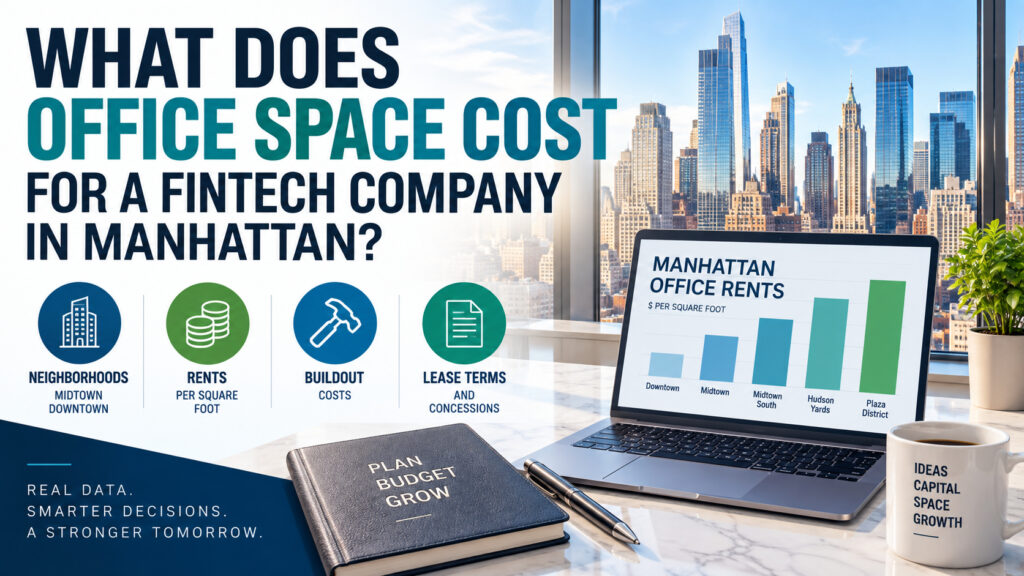
Here are useful August 2026 asking-rent benchmarks:
| Manhattan market | Average asking rent | What that means for a FinTech tenant |
|---|---|---|
| Manhattan overall | $80.05/SF/year | Useful citywide benchmark |
| Midtown | $85.55/SF/year | Strong client access and institutional inventory |
| Midtown South | $86.26/SF/year | Major technology and growth-company market |
| Downtown | $62.01/SF/year | Lower-cost finance-adjacent alternative |
These figures measure broad asking rents, not specific available suites. A turnkey sublease can price below them. A premium floor can price far above them.
That distinction matters.
A FinTech company searching for 4,000 square feet should not simply multiply 4,000 by a Manhattan average. First, determine the right neighborhood and product type. Then compare actual spaces on equal financial terms.
For example, current inventory includes a 4,125-square-foot furnished Flatiron office marketed from $60 per square foot. Another current option offers a 2,573-square-foot furnished Financial District sublease at $39 per square foot.
Those two spaces illustrate why averages can mislead tenants.
Your real question should be: What does the right office cost after location, efficiency, concessions, infrastructure, and lease structure?
What Should a FinTech Company Budget for Office Space?
Start with one simple formula:
Monthly base rent = rentable square feet × annual rent per square foot ÷ 12
A 5,000-square-foot office at $86 per square foot produces $430,000 in annual base rent. That equals about $35,833 per month before other costs.
However, the square footage comes first.
A lean FinTech team may use an open workplace with shared meeting rooms. Another company may need private rooms for executives, calls, compliance functions, and client meetings.
Our NYC office headcount planner provides a useful starting point. Dense layouts can begin around 100–125 usable square feet per peak attendee. Balanced offices often need about 125–175 usable square feet.
For quick budgeting, 150 rentable square feet per planned seat gives a simple preliminary model. A test fit should replace that shortcut before lease negotiations.
Using roughly $62, $86, and $105 per square foot creates three useful pricing scenarios. The first reflects current Downtown averages. The middle tracks current core-market averages. The premium model approximates high-quality Midtown South Class A pricing.
| Peak office team | Illustrative RSF | At $62/SF | At $86/SF | At $105/SF |
|---|---|---|---|---|
| 10 people | 1,500 | $7,750/month | $10,750/month | $13,125/month |
| 25 people | 3,750 | $19,375/month | $26,875/month | $32,813/month |
| 50 people | 7,500 | $38,750/month | $53,750/month | $65,625/month |
| 100 people | 15,000 | $77,500/month | $107,500/month | $131,250/month |
Those figures represent base-rent illustrations only.
Your FinTech office budget may also include electricity, telecom, after-hours HVAC, insurance, additional rent, furniture, and security systems. Construction can create another major expense.
For standard professional construction, our 2026 NYC office buildout guide currently models about $90–$140 per square foot. High-end custom work can reach roughly $140–$225+ per square foot.
Therefore, prebuilt space deserves serious consideration.
A FinTech team that values speed can avoid months of construction through existing installations. Current examples include a 5,594-square-foot Flatiron prebuilt sublease. It already includes several offices, conference rooms, a kitchen, and individual climate control.
Meanwhile, a smaller team can consider a 3,150-square-foot turnkey Flatiron office. Its current configuration includes open seating, meeting space, phone booths, and a kitchen.
Do not compare rent alone. Compare the capital required to make each office operational.
That calculation often changes the winner.
Where Can a FinTech Company Get the Best Manhattan Office Value?
FinTech sits between two Manhattan office cultures.
One side values financial-market access, institutional buildings, security, and client proximity. The other values technology talent, flexible layouts, creative buildings, and growth-company ecosystems.
Consequently, several neighborhoods can make sense.
Flatiron and Park Avenue South suit companies that want a strong technology and finance crossover. Midtown South demand remained elevated during 2026, while available inventory continued tightening.
However, Flatiron does not have one price.
A polished Park Avenue South office can command a meaningful premium. Older side-street lofts and subleases can create better value.
For a growing team, compare the current 8,064-square-foot Park Avenue South loft with the 10,439-square-foot furnished Park Avenue South sublease.
Larger FinTech requirements can also examine a 17,500-square-foot full-floor Flatiron opportunity. The suite offers a furnished, wired, full-floor format near Park Avenue South.
The Financial District offers a different value proposition.
Downtown averaged about $62.01 per square foot during August 2026. Midtown averaged $85.55 during the same period.
That spread matters.
A FinTech company can sometimes upgrade building quality Downtown without increasing its Midtown-equivalent budget. Teams also gain access to large floorplates and extensive transit.
Current inventory demonstrates the range. A 2,573-square-foot furnished Financial District office targets smaller teams. An 8,755-square-foot Water Street office can support a much larger requirement.
Our broader Financial District office overview explains the district’s inventory mix.
Midtown works differently again.
FinTech companies with enterprise customers may prioritize Grand Central, Madison Avenue, Fifth Avenue, or the Plaza District. These areas offer strong transportation access and extensive institutional-quality inventory.
A smaller company can examine a 3,100-square-foot Midtown prebuilt office. Client-facing firms can compare that option with a 4,072-square-foot furnished Plaza District office.
Midtown costs more on average. Yet an efficient prebuilt can still outperform a cheaper, poorly configured alternative.
NoMad and Union Square create a useful middle ground.
They connect technology-oriented Midtown South inventory with several major transit corridors. Growing companies can also access larger blocks around the district.
For example, a current 30,450-square-foot Union Square full-floor option can support a substantial headquarters requirement.
Therefore, choose the neighborhood after defining the business requirement.
Do not choose the address first and force the budget around it.
Should a FinTech Company Lease Directly, Sublease, or Use Flexible Space?
The phrase “office space cost” can describe several completely different products.
That explains why tenants encounter conventional leases, furnished suites, flexible offices, shared environments, and subleases while researching costs.
These options use different pricing systems.
| Office structure | How pricing usually works | Strongest advantage | Main limitation |
|---|---|---|---|
| Direct lease | Annual rent per RSF | Control and concessions | Longer commitment |
| Sublease | Annual rent per RSF | Furnished value and speed | Fixed remaining term |
| Prebuilt direct suite | Annual rent per RSF | Fast occupancy | Less customization |
| Flexible private office | Monthly price per person | Short commitment | Higher unit cost |
| Shared desk environment | Monthly membership | Maximum flexibility | Limited privacy |
A direct lease makes sense when headcount looks predictable. It also suits companies that need branding, dedicated infrastructure, and long-term control.
Moreover, longer direct terms can support larger landlord construction contributions. They may also unlock better expansion and renewal rights.
A sublease solves a different problem.
FinTech companies often use subleases when they need privacy without a long construction cycle. Existing furniture, wiring, conference rooms, and offices can reduce upfront capital.
The 5,594-square-foot Flatiron prebuilt sublease shows that format. Another option provides 9,979 square feet of furnished Flatiron full-floor space.
Flexible private offices occupy another pricing lane.
Current September 2026 priced inventory showed median flexible-office costs near $970 per desk around Chelsea and Flatiron. Midtown sat near $750 per desk, while Downtown and FiDi averaged about $650.
Those figures should not anchor a conventional lease comparison.
A $750 monthly desk may include furniture, internet, utilities, reception, and meeting-room access. A $75-per-square-foot lease usually includes none of those items automatically.
Therefore, compare all-in annual occupancy costs.
Small teams can accept a higher per-person price for flexibility. Larger teams often gain better economics through private leased space.
The crossover point depends on attendance, term, growth, and required privacy.
Most importantly, do not assume “flexible” always means better for a startup.
FinTech companies with stable headcount can quickly overpay for bundled workspace. Conversely, a young company can waste capital by taking a ten-year lease too early.
The correct product should match the company’s planning horizon.
How Do Building Class and Infrastructure Affect FinTech Office Rent?
Building class changes pricing, but the letter alone does not determine value.
Current Q2 2026 data showed Manhattan Class A asking rents near $84.79 per square foot. Midtown Class A averaged approximately $88.50. Midtown South Class A reached about $104.50, while Downtown Class A averaged about $63.60.
Those numbers reveal an important pricing gap.
A FinTech company can sometimes occupy Class A Downtown space near the cost of older Midtown inventory.
However, the most expensive office is not automatically the best office.
Trophy space typically places tenants at the highest end. It may offer premium amenities, building systems, views, security, and high-profile locations. Current market evidence also shows very strong pricing for newly renovated premium Manhattan buildings.
Class A space often provides the strongest balance for established FinTech companies. Modern HVAC, elevators, management, access control, and telecom infrastructure can reduce operational friction.
Class B space can provide excellent value.
A renovated loft may offer high ceilings, strong natural light, efficient floorplates, and upgraded systems. That combination often matters more than the class label.
Class C and value inventory lowers face rent further.
Yet a cheap floor can become expensive when it needs substantial electrical, HVAC, cabling, bathroom, or accessibility work.
FinTech tenants should therefore compare building capability, not just building class.
Pay particular attention to telecom.
Ask which carriers already serve the building. Then determine whether those carriers actually use diverse pathways.
Two internet contracts provide limited redundancy when both services enter through one vulnerable route.
Next, examine electrical capacity.
A normal software-focused FinTech office may not need unusual power. Trading operations, dense technology teams, or specialized equipment can change that equation.
After-hours HVAC creates another hidden cost.
Engineering, operations, or international teams may work outside normal building schedules. Accordingly, confirm overtime HVAC charges before agreeing on economics.
Security deserves similar scrutiny.
Look at 24-hour access, visitor procedures, lobby controls, elevator access, and suite-level systems. Confidential meetings may also require better acoustic separation.
The right building helps solve those requirements before construction begins.

How Do You Calculate the Real Rent After Concessions and Hidden Costs?
The asking rent is only the starting number.
A 5,000-square-foot office asking $86 per square foot produces $430,000 annual base rent. That equals about $35,833 each month.
Now assume an 84-month term with eight free months.
Ignoring escalations, the average base-rent burden falls near $32,421 monthly across the full term.
That is why effective rent matters more than face rent.
However, free rent does not eliminate electricity, internet, insurance, moving expenses, or construction costs.
Tenant improvement money also needs careful treatment.
A large Manhattan office owner’s first-half 2026 leases averaged 8.8 free months and about $91.89 per square foot in improvements. Those figures describe one major portfolio, not the entire Manhattan market.
The lesson remains useful.
Negotiate rent, free rent, buildout money, commencement timing, and lease flexibility together.
Loss factor also changes the calculation.
Manhattan leases generally quote rentable square footage. Your team actually works inside usable square footage.
Our office-space sizing guide explains that distinction. Manhattan loss factors commonly create a meaningful difference between USF and RSF.
Therefore, never compare two offices using asking rent alone.
A $70 office with poor efficiency can cost more per usable square foot than an $80 competitor.
Escalations matter next.
Your first-year base rent will rarely remain static for the whole term. Compare every proposed rent year rather than multiplying year one forever.
Operating and tax escalations also require review.
Ask for the expense structure and applicable base years. Then model those charges under realistic assumptions.
Security deposits affect cash flow rather than occupancy expense.
Established tenants often receive different security terms from young or lightly capitalized companies. Startups may face larger deposits or guarantee requests.
Our Manhattan security deposit and guarantee guide explains those structures. It also covers negotiated reductions and burn-down provisions.
Finally, account for furniture and technology.
A beautiful raw office can require substantial capital before one employee sits down.
Conversely, a furnished office can reduce startup costs despite a higher face rent.
That tradeoff makes turnkey inventory particularly relevant for FinTech growth companies.
What Should a FinTech Company Check Before Signing a Manhattan Office Lease?
FinTech companies should treat physical due diligence as part of financial due diligence.
A lower-rent space loses its advantage when infrastructure creates unexpected capital costs.
| Requirement | What to verify | Why it can change cost |
|---|---|---|
| Internet | Carriers, pathways, installation timing | New circuits can delay occupancy |
| Power | Existing service and panel capacity | Upgrades can require major work |
| Cooling | Office and telecom-room coverage | Supplemental systems cost money |
| After-hours HVAC | Schedule and hourly charge | Extended operations raise occupancy costs |
| Access | Nights, weekends, visitors | Restrictions can disrupt operations |
| Security | Lobby and suite controls | Upgrades require hardware and wiring |
| Privacy | Acoustics and room placement | Confidential work may need construction |
| Growth | Adjacent space and expansion rights | Moving mid-term costs more |
| Subletting | Consent and assignment provisions | Important if headcount changes |
| Business continuity | Backup systems and building procedures | Downtime carries operating risk |
Start with internet infrastructure.
Ask which providers currently serve the building. Then request estimated installation dates before signing.
Next, confirm whether a dedicated telecom room already exists.
A properly located equipment room can simplify cabling, cooling, and access. Poor placement can force an expensive redesign.
Do not assume a building generator powers your office.
Many backup systems support elevators, life-safety equipment, or common areas only. Ask exactly which tenant systems receive emergency power.
Similarly, test the layout before negotiating the final economics.
A FinTech team may need open engineering areas alongside quiet rooms. Sales teams may need call rooms and several smaller conference spaces.
Client-facing groups may need reception and boardroom space.
Meanwhile, hybrid companies should size for peak attendance, not payroll headcount.
Leasing for 100 employees makes little sense when only 55 people attend simultaneously. The opposite mistake creates painful overcrowding.
Growth rights can protect both scenarios.
Consider a right of first offer on adjacent space. Also negotiate assignment and sublease rights that preserve exit flexibility.
A current Park Avenue South 8,064-square-foot prebuilt office demonstrates how a ready layout can reduce construction needs. Meanwhile, the 30,450-square-foot Union Square option shows how larger requirements can secure contiguous scale.
Ultimately, the cheapest viable office often wins over the cheapest advertised office.
Those are not always the same thing.
Common Questions About FinTech Office Space Costs in Manhattan
How much does Manhattan office space cost for a FinTech company?
A realistic planning range starts near $60 per square foot and runs above $110 per square foot for premium space. Current broad market averages sit near $80 Manhattan-wide. Midtown and Midtown South currently average in the mid-$80s, while Downtown sits near the low-$60s.
Specific subleases can fall much lower.
For example, a current 2,573-square-foot furnished Financial District sublease lists a $39-per-square-foot asking rent.
How much does a 4,000-square-foot Manhattan office cost each month?
At $62 per square foot, base rent equals about $20,667 monthly.
At $86 per square foot, it equals about $28,667 monthly.
At $105 per square foot, the same office costs about $35,000 monthly before additional expenses.
Therefore, neighborhood and building quality can move a 4,000-square-foot budget by more than $14,000 each month.
Is the Financial District cheaper for FinTech companies?
Usually, yes, when comparing broad market averages.
Downtown averaged about $62.01 per square foot in August 2026. Midtown averaged about $85.55.
However, a new Downtown tower can still cost more than an older Midtown building.
Compare actual suites rather than neighborhood labels.
Is Flatiron worth paying more for?
It can be.
Flatiron places a FinTech company inside one of Manhattan’s strongest technology-oriented office markets. Midtown South demand and leasing activity have remained strong during 2026.
Yet location value depends on talent, customers, commuting patterns, and recruiting.
A company serving financial institutions may find Midtown or Downtown more useful.
How much space does a 25-person FinTech company need?
A balanced first-pass estimate might target roughly 3,000 to 4,500 square feet.
Dense open layouts can land lower. Private-office-heavy requirements can move higher.
Run peak attendance through our NYC office space per employee planner before touring.
Should a FinTech startup choose a sublease or direct lease?
Choose a sublease when speed and short-term flexibility matter most.
Consider a direct lease when headcount looks stable and control matters more. Direct leases can provide stronger expansion rights and landlord-funded improvements.
A furnished sublease can also preserve capital.
That benefit matters when the existing furniture, cabling, and layout already fit your operation.
How much does FinTech office buildout cost in Manhattan?
A standard professional office buildout can start around $90–$140 per square foot under current budgeting assumptions. Higher-end customization can move toward $140–$225+.
Existing conditions make the biggest difference.
Taking a well-built second-generation office may reduce tenant spending dramatically.
Does Class A office space always make sense for FinTech?
No.
Class A can provide strong systems, management, security, and customer-facing presentation. Yet a renovated Class B loft can deliver better economics and greater layout efficiency.
Judge the floor on infrastructure and usable value.
The building label comes second.
What is the most expensive FinTech office option?
Premium trophy space usually occupies the highest pricing tier. New or heavily renovated buildings with scarce inventory command the strongest rents.
However, excessive square footage can cost more than an expensive building.
A tightly planned premium office may cost less than an oversized value lease.
How much should a company spend on office space?
There is no universal percentage.
Start with an occupancy budget that protects operating runway and supports planned attendance. Then model the full lease term.
Include base rent, escalations, utilities, technology, furniture, construction, insurance, and security.
Most importantly, compare those costs against productivity, recruiting, client access, and flexibility.
Are flexible private offices cheaper than leasing?
Not necessarily.
Current flexible-office medians range widely by neighborhood. Downtown currently offers materially lower per-desk pricing than Chelsea and Flatiron.
Small teams can save capital because furniture and services come bundled.
As headcount grows, the per-desk premium can make conventional space more economical.
How early should a FinTech company begin looking?
Start early enough to compare alternatives without deadline pressure.
Move-in-ready spaces can shorten the process substantially. Custom construction adds design, approvals, procurement, and buildout time.
Larger requirements need more lead time because fewer contiguous options exist.
Our commercial leasing guide walks through planning, touring, negotiation, legal review, buildout, and occupancy.
What should matter more than the asking rent?
Focus on effective rent, usable efficiency, existing condition, infrastructure, concessions, and flexibility.
Those variables determine what the office really costs.
A lower asking rent can hide a larger construction bill. A higher asking rent can include a better installation and stronger landlord contribution.
Get Current Manhattan FinTech Rent Comparisons
Manhattan now offers FinTech tenants several distinct pricing lanes.
Downtown can deliver finance adjacency at a lower average cost. Midtown provides institutional inventory and excellent regional access. Midtown South combines technology-oriented locations with some of Manhattan’s strongest current demand.
The right choice starts with your team size, peak attendance, preferred location, and target lease term.
From there, compare actual offices rather than generic averages. Current inventory can range from small furnished Financial District space to prebuilt Flatiron offices, Park Avenue South lofts, and large Union Square floors.
We represent tenants throughout that comparison and negotiation process.
Browse current Manhattan office inventory or request current rent comparisons for your exact FinTech requirement. The inventory covers more than 1,400 Manhattan commercial building listings and changes as spaces enter or leave the market.
Review Office Costs Today
We represent office tenants, not landlords. Our job is to compare Manhattan options, model true occupancy costs, and negotiate around your business plan. In most Manhattan office transactions, the landlord pays the brokerage commission, so tenant representation usually carries no direct fee.
Fill out our 📋 online form or give us a call today 📞 212-967-2061 — let’s find the right options for your business.