Office Technology and Security Requirements for FinTech Companies
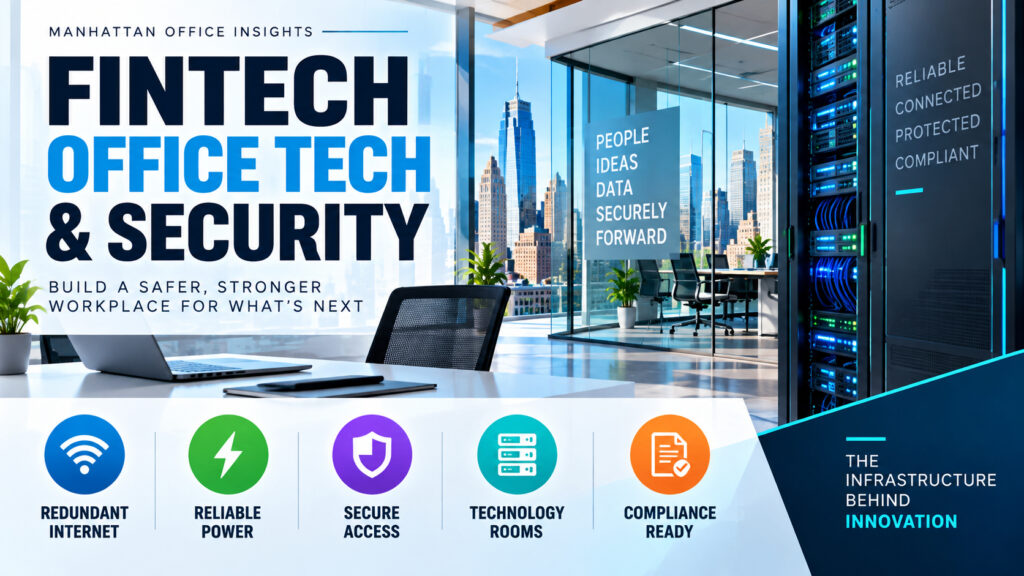
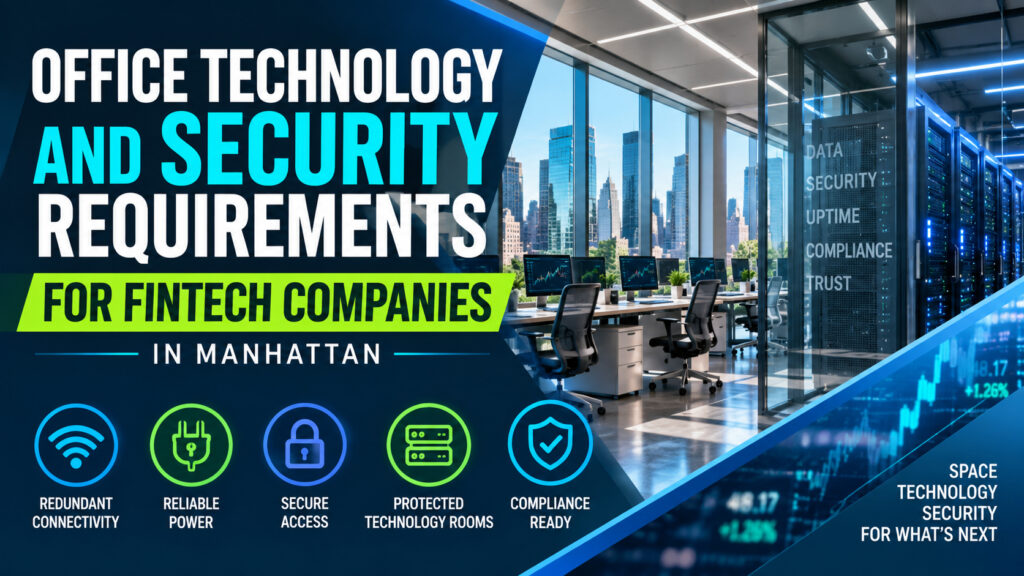
A FinTech office cannot succeed on location, finishes, and headcount planning alone. The workplace must support secure systems, resilient connectivity, controlled access, privacy, and uninterrupted operations. Those requirements can materially narrow the Manhattan buildings that deserve serious consideration.
For most FinTech tenants, the right office combines redundant connectivity, reliable power, secure access, protected technology rooms, and operational flexibility. Lease rights matter just as much as physical infrastructure. A technically strong building becomes far less useful when the lease prevents necessary upgrades.
Cloud-based operations do not eliminate these concerns. Employees still connect through office networks, endpoints, conferencing systems, wireless infrastructure, printers, and access-control devices. Those physical systems become part of the wider security environment.
The practical rule: Never evaluate a FinTech office as ordinary office space with faster internet. Evaluate the building, suite, lease, and operating procedures as one connected technology environment.
This guide focuses on Manhattan office selection and infrastructure planning. It does not provide legal, regulatory, or cybersecurity advice. Your legal, compliance, risk, and security teams should determine which obligations apply.
What FinTech Office Requirements Mean in Manhattan
A FinTech office requirement is any building, suite, technology, security, or lease condition needed to support safe operations.
That definition reaches much further than bandwidth.
A suitable office may need diverse internet pathways, backup power, after-hours cooling, secure visitor handling, and controlled equipment rooms. Other companies may need private executive areas, segregated teams, specialized trading infrastructure, or more stringent physical access controls.
The exact standard depends on what your company does.
Different FinTech businesses create different office requirements
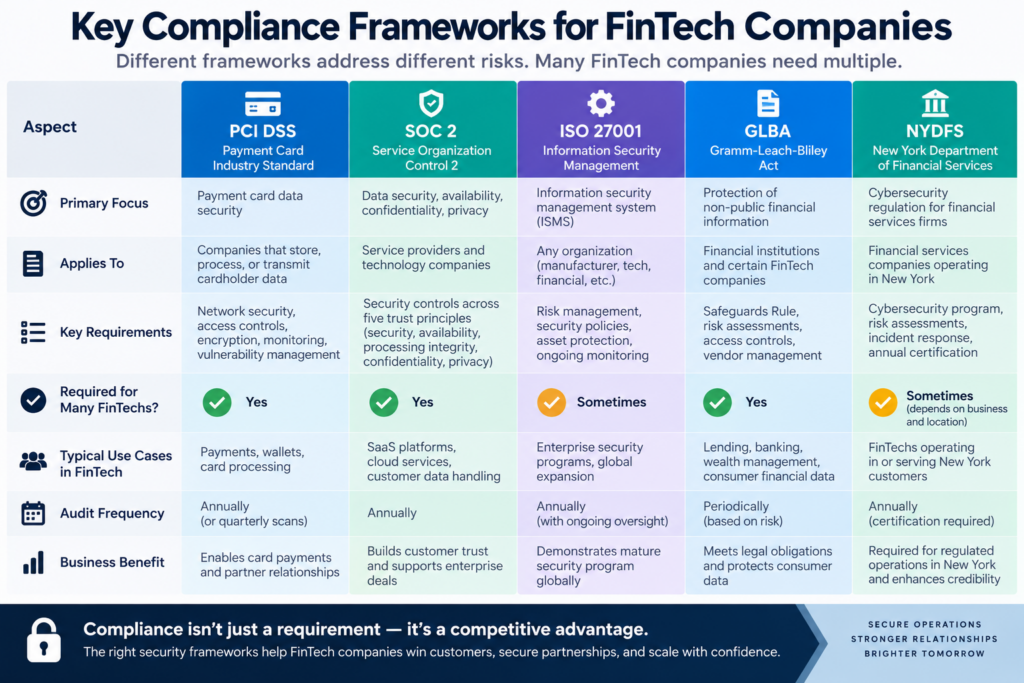
A payment company may focus heavily on controlling systems that interact with payment-card information. PCI DSS scope can expand when cardholder data enters messaging systems or connected technology. Encryption alone also does not automatically remove encrypted cardholder data from PCI DSS scope.
A lending platform may place greater emphasis on consumer information, privacy, document handling, and call confidentiality.
Investment technology businesses may prioritize low-latency connectivity, uptime, trading-floor infrastructure, and secure communications.
Digital-asset businesses may need especially rigorous access controls, restricted operational zones, and strong business-continuity procedures.
Banking-technology providers often face extensive security reviews from institutional customers. Their office environments may therefore need to support contractual control requirements.
Data and artificial-intelligence companies can introduce another set of concerns. Those include high-compute workloads, data governance, restricted training datasets, and third-party technology dependencies.
Consequently, there is no universal FinTech office specification.
The correct specification starts with the company’s risk profile. It then translates that profile into real estate requirements.
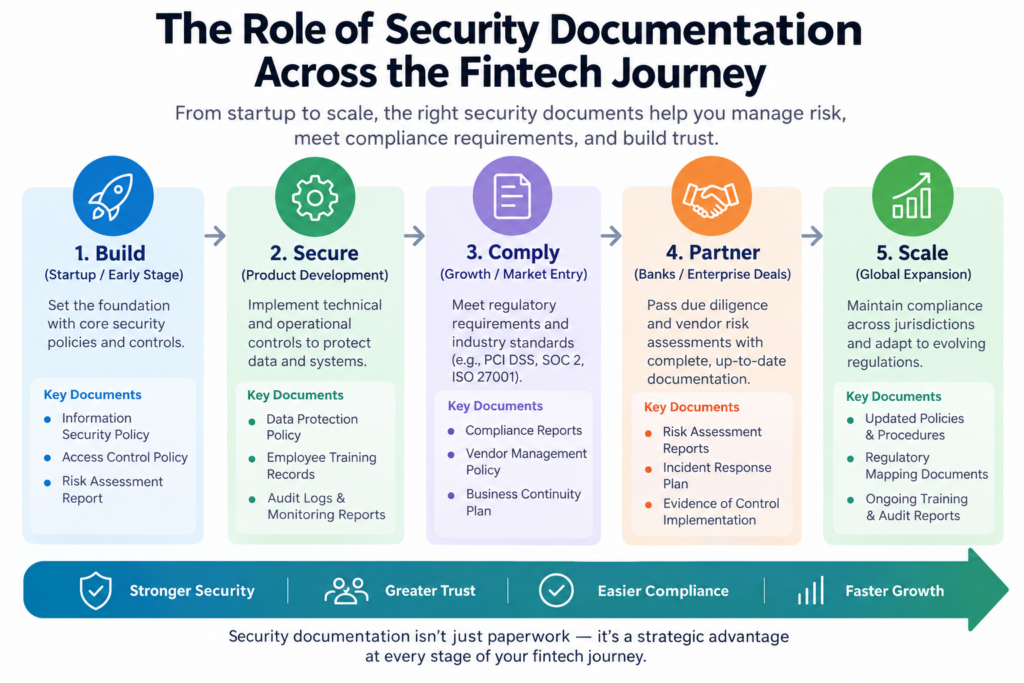
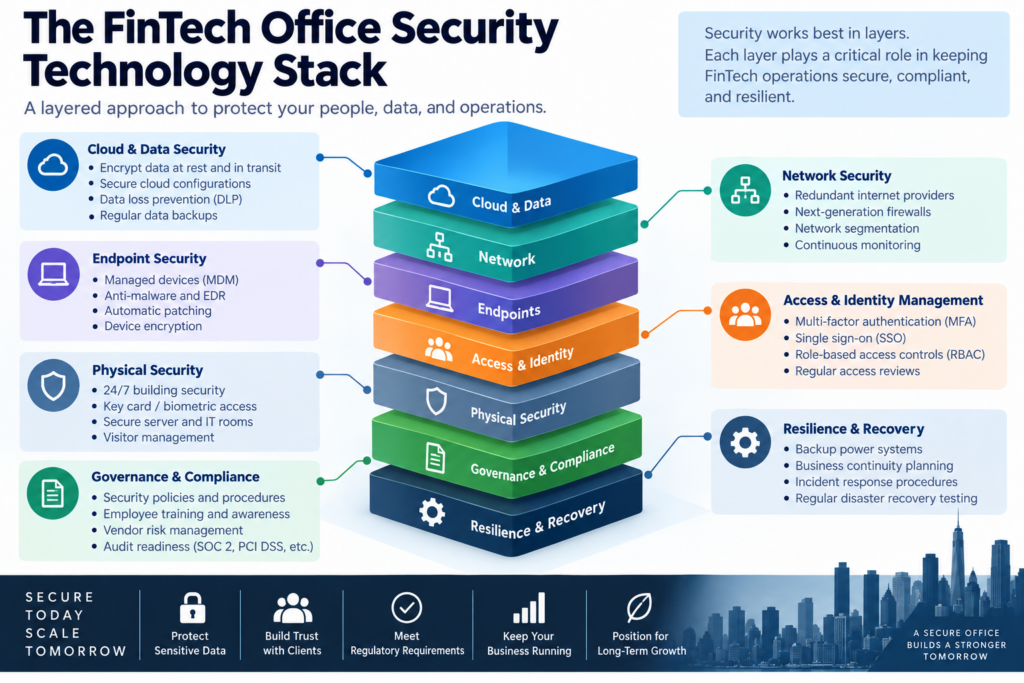
Four pillars of a secure FinTech office
A useful way to organize those requirements involves four connected pillars.
| Pillar | What the tenant should evaluate |
|---|---|
| Infrastructure resilience | Internet diversity, power capacity, backup systems, cooling, telecom pathways, and recovery options |
| Physical protection | Lobby security, visitor controls, suite access, IT rooms, sensitive-team zoning, and document protection |
| Technology security | Identity controls, segmented networks, secure wireless, endpoint management, monitoring, and protected communications |
| Operational resilience | Vendor controls, incident response, remote-work continuity, building procedures, testing, and lease rights |
These pillars should work together.
A secure network cannot compensate for an unlocked telecommunications room. Likewise, excellent lobby security cannot compensate for one fragile internet connection.
Strong backup power offers limited protection when the cooling system stops during an outage.
A sophisticated security program also struggles when building contractors can enter sensitive areas without suitable controls.
Building capability and tenant control are different
This distinction matters throughout the office search.
A building may advertise multiple telecommunications carriers. That does not prove your suite can receive truly diverse connections.
Likewise, a building may have emergency generation. That does not confirm your employee workstations or network equipment receive generator power.
Twenty-four-hour building access does not automatically mean employees can reach every required floor after hours.
An attended lobby does not replace suite-level access control.
Therefore, every important feature needs two questions:
What can the building provide?
Then ask:
What can our company actually control, use, document, and maintain?
That second question separates a promising building from a technically suitable one.
A Manhattan office should support the security program
Certain covered financial institutions must maintain written information-security programs containing administrative, technical, and physical safeguards. Federal guidance specifically treats physical safeguards as part of that broader information-security program.
New York’s cybersecurity regulation also applies to covered entities operating under specified financial-services authorizations. Its requirements use a risk-based approach and include access, governance, system, and third-party controls.
Not every FinTech company falls under every financial regulation.
However, office selection should never work against the controls your company already needs.
A useful building makes those controls easier.
A poor building forces security teams to compensate for structural weaknesses throughout the lease.
Start with operational requirements before touring
Create an office technology brief before scheduling serious tours.
That document should identify:
| Requirement area | Questions to answer internally |
|---|---|
| Headcount | How many people will attend during peak occupancy? |
| Hours | Will teams operate evenings, weekends, or overnight? |
| Connectivity | How many independent connections does the business require? |
| Critical systems | Which office systems cannot tolerate an extended outage? |
| Power | What equipment requires UPS or generator support? |
| Cooling | Which rooms need cooling outside normal business hours? |
| Access | Which employees, contractors, and visitors can enter each zone? |
| Privacy | Which teams discuss or display sensitive information? |
| Compliance | Which controls must the physical office support? |
| Recovery | How long can the office become unavailable before operations suffer? |
| Growth | What additional seats, circuits, bandwidth, or rooms may become necessary? |
Headcount should not drive this process by itself.
A 40-person FinTech company can have more demanding technical requirements than a conventional 150-person tenant.
For occupancy planning, our FinTech office space planning guide explains density and growth scenarios. Current planning often centers around roughly 150–200 rentable square feet per peak in-office employee. More privacy-intensive layouts can require substantially more room.
Once the operational brief exists, unsuitable buildings become easier to eliminate.
Connectivity, Power, HVAC, and Critical Infrastructure
Internet access represents only one layer of a secure FinTech office.
The broader infrastructure question concerns continuity.
What happens when a carrier experiences trouble?
What happens when a riser fails?
How does the company operate during a building power interruption?
Can critical technology remain cool overnight?
A strong building provides good answers before lease execution.
Redundant internet requires more than two provider names
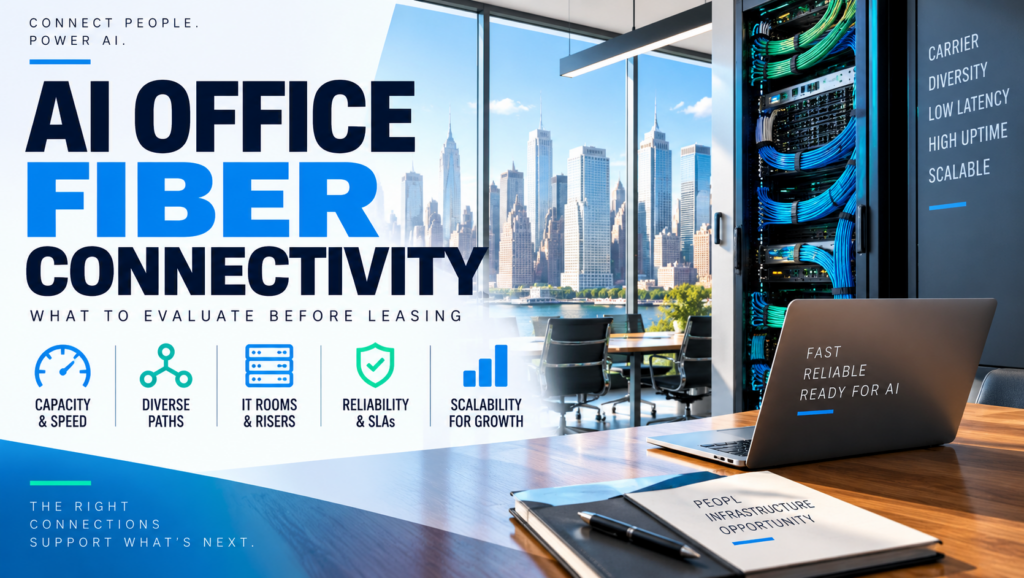
A redundant internet office in NYC should offer more than access to two telecommunications companies.
True resilience depends on physical diversity.
Two services can still share the same building entrance, conduit, riser, or upstream infrastructure. A single physical failure could therefore interrupt both circuits.
Ask the landlord or building engineer where each carrier enters the property.
Next, identify how those services travel to your floor.
Then determine whether meaningful route diversity exists.
Useful due-diligence questions include:
| Connectivity question | Why it matters |
|---|---|
| Which carriers currently serve the building? | Confirms available choices |
| Which carriers already serve the exact floor? | Reduces installation uncertainty |
| Where are the service entrances? | Helps evaluate physical diversity |
| Which risers reach the premises? | Identifies shared infrastructure |
| Is riser capacity currently available? | Prevents unexpected installation problems |
| Where is the demarcation point? | Clarifies cabling responsibility |
| Can the tenant install a second pathway? | Preserves future redundancy |
| Can fixed wireless serve as another path? | Creates another potential failover route |
| Who approves telecom contractors? | Exposes process constraints |
| Are after-hours installations permitted? | Affects implementation schedules |
Do not accept “fiber-ready” as the final answer.
Likewise, “wired” can describe many different conditions.
A fully wired suite may contain useful cabling from the prior tenant. That cabling still needs inspection before reliance.
Carrier certification can help identify well-connected buildings. However, your team must still verify suite-level availability and physical route diversity.
For example, this 16,515-square-foot full-floor Midtown office sits in a building with multiple fiber and fixed-wireless options. The property also carries a high-level connectivity certification.
A Flatiron full-floor office of 11,239 square feet provides another useful comparison. The listing includes existing wiring, around-the-clock lobby attendance, and certified building connectivity.
Neither example removes the need for technical due diligence.
Instead, those features create a stronger starting point.
How many internet connections does a FinTech office need?
There is no universal number.
A smaller cloud-first company might use one primary fiber connection and one independent failover service.
A larger operation may require two diverse fiber circuits plus another emergency path.
Trading, payments, support, and real-time operations can justify additional resilience.
The decisive question concerns business impact.
How much does one hour without office connectivity cost the company?
Then ask how that answer changes during a market opening, payment cycle, customer incident, or regulatory deadline.
Bandwidth and resilience also solve different problems.
A 10 Gbps circuit does not automatically provide better continuity than a smaller service with genuine redundancy.
For critical environments, diversity often deserves priority over raw headline speed.
Test failover rather than assuming it works
Redundant circuits have limited value when nobody tests them.
The secondary connection should carry business traffic when the primary connection fails.
Routing, firewall rules, identity services, voice systems, and cloud access must continue correctly.
Therefore, test failover before opening the office.
Repeat those tests on a defined schedule afterward.
Document the results.
This approach aligns with broader resilience principles that emphasize preparation, detection, response, and recovery rather than prevention alone. The current NIST framework organizes cybersecurity around Govern, Identify, Protect, Detect, Respond, and Recover.
Electrical capacity deserves early attention
Modern offices can hide electrical limitations behind beautiful finishes.
Start by understanding the existing electrical service.
Review panel capacity, available circuits, dedicated power, and expansion potential.
Next, identify the equipment that must remain online.
Typical critical loads can include network switches, firewalls, access-control systems, security devices, wireless infrastructure, communications equipment, and selected workstations.
Specialized operations may require much more.
Trading desks, dense monitor configurations, local compute, lab environments, or equipment rooms can materially increase demand.
Do not wait for construction drawings to discover insufficient electrical capacity.
Ask exactly what the generator supports
A Manhattan office building may have an emergency generator.
That fact alone says little about the tenant’s usable backup power.
Some systems primarily support life-safety infrastructure.
Others may support elevators, critical building equipment, tenant systems, or separately arranged loads.
Ask for the actual scope.
Key questions include:
Which systems receive generator power?
Can tenants connect critical loads?
How much tenant capacity remains available?
What equipment transfers during an outage?
How does building management test the system?
What happens during an extended interruption?
Who manages fuel and maintenance?
Can the tenant add dedicated backup equipment?
A 5,750-square-foot Midtown sublease provides an example of why this issue deserves investigation. The listing notes building generator capability and strong security.
Those features make the space worthy of technical review. They do not define which tenant loads receive power.
That detail requires verification.
UPS protection solves a different problem
A generator and an uninterruptible power supply perform different jobs.
Network equipment usually should not rely solely on a building generator strategy.
A UPS can bridge interruptions and protect equipment from power events.
It can also support orderly shutdown when longer outages exceed available runtime.
Size UPS equipment around actual critical loads.
Include future growth.
Maintenance and battery replacement also need ownership.
Most importantly, know the expected runtime.
“Battery backup” without a runtime calculation offers little planning value.
HVAC can become a technology requirement
Standard office HVAC often follows normal business hours.
FinTech operations may not.
Network equipment continues generating heat when employees leave.
After-hours teams also need reliable conditioning.
Consequently, ask exactly when base-building HVAC operates.
Then determine the cost of extended service.
A tenant-controlled system can improve flexibility. This 5,606-square-foot furnished Downtown office combines existing wiring, tenant-controlled HVAC, and a continuously attended lobby.
Another Flatiron office of 4,125 square feet offers existing wiring, tenant-controlled cooling, 24/7 access, and on-site security.
Again, the important distinction concerns control.
Can the tenant cool technology equipment after midnight?
What does that cooling cost?
Can supplemental cooling enter the premises?
Where can condensers, piping, or associated equipment go?
Those questions belong in lease and construction discussions.
Build the IT room like critical infrastructure
Many FinTech companies do not need an onsite data center.
Most still need a properly designed telecommunications or network room.
The room should not double as general storage.
It should also avoid unrestricted staff traffic.
Ideally, the design includes controlled access, suitable power, organized cabling, and appropriate cooling.
Environmental monitoring can add useful protection.
Depending on equipment density, consider temperature, humidity, water, and power monitoring.
Wet infrastructure above critical equipment deserves careful examination.
When practical, avoid placing sensitive racks underneath plumbing or other water sources.
Cable pathways need equal attention.
Confirm where carrier circuits enter.
Map routes between the building demarcation point and the tenant room.
Then preserve enough capacity for future services.
Building systems can also become information systems
Modern offices increasingly connect access control, environmental equipment, communications, and other operational technology.
Federal security guidance recognizes that information systems can include telephone switching and environmental control systems when connected to protected information systems.
That does not make every thermostat a regulated device.
It does mean the security team should understand connected building technology.
Ask who administers tenant-facing access systems.
Determine whether landlord systems integrate with tenant identity platforms.
Review vendor access to any connected equipment.
Separate business networks from building and miscellaneous connected devices where appropriate.
A sleek “smart office” should never create unnecessary access paths.
Physical Security, Privacy, and Access Design
Physical security should work in layers.
The strongest arrangement begins before a visitor reaches the suite.
It then continues through the lobby, elevators, floor, reception area, internal zones, and restricted technology rooms.
No single layer replaces another.
Start at the building entrance
An attended lobby can add human oversight.
Electronic turnstiles can strengthen credential control.
Visitor management can create better accountability.
However, the exact operating procedures matter more than the amenity list.
During a tour, ask how visitors enter.
Watch the process.
Determine whether the security desk checks identification.
Find out how hosts receive visitor notifications.
Next, examine elevator controls and after-hours procedures.
A 4,230-square-foot Grand Central area office illustrates several features worth examining. The building lists 24/7 security, a lobby attendant, touchless turnstiles, a loading dock, and onsite management.
Those features can support a secure-office plan.
Your internal controls still determine how people move beyond the lobby.
Our guides to 24/7 Manhattan office access and office building security provide additional building-level considerations.
Twenty-four-hour access needs operational verification
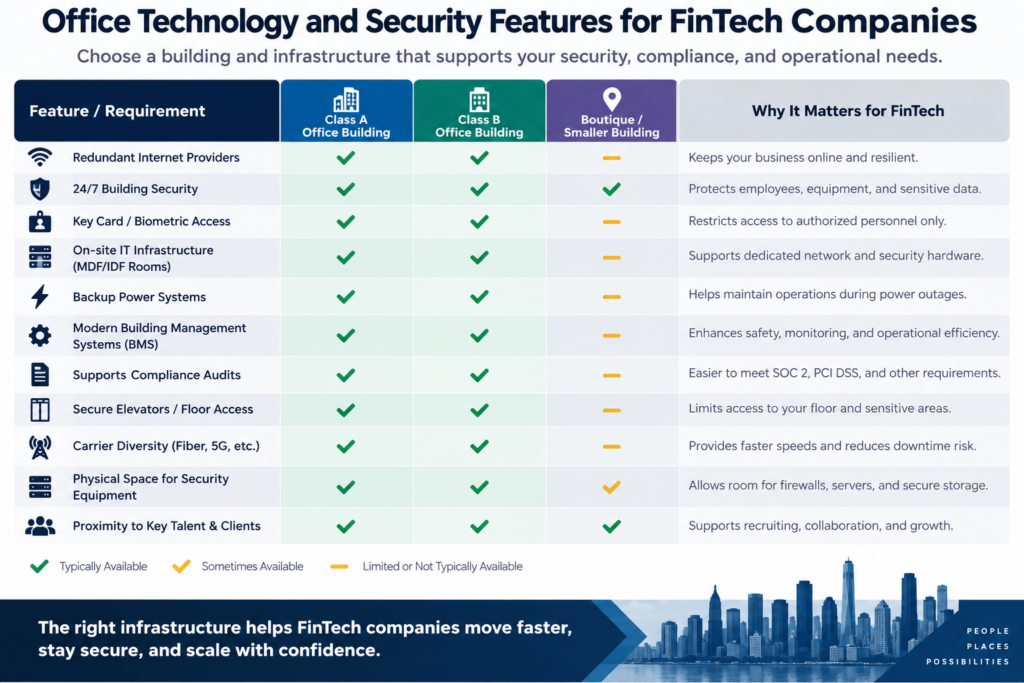
Many Class A buildings accommodate around-the-clock access.
Yet after-hours procedures vary.
Employees might need building credentials, security-desk approval, elevator authorization, or advance visitor registration.
Freight and messenger access can follow different rules.
Weekend HVAC can involve separate scheduling.
Therefore, map the complete after-hours journey.
An employee working at 2:00 a.m. should know exactly how to enter and leave.
A technician responding to a network failure needs an equally clear process.
Emergency vendor access matters too.
A strong technical lease becomes less useful when critical contractors cannot reach equipment quickly.
Design reception as a security boundary
Reception should do more than create a first impression.
It can separate the public side of the office from protected work areas.
Place visitor meeting rooms near the entrance when possible.
That layout reduces unnecessary visitor movement through employee space.
Sensitive operational teams can sit deeper within the premises.
Technology rooms should sit behind another restricted boundary.
Legal, compliance, finance, and human-resources functions may also benefit from controlled areas.
The resulting workplace can remain open and collaborative without treating every square foot equally.
Create security zones inside the office
Think about the suite as several access zones.
A practical layout might include:
| Zone | Typical users | Typical controls |
|---|---|---|
| Reception | Visitors and employees | Staff oversight and visitor registration |
| Client meeting area | Escorted guests | Controlled connection to workplace |
| General employee space | Authorized workforce | Employee credentials |
| Sensitive operating area | Designated teams | Role-based physical access |
| Executive or confidential rooms | Selected personnel | Additional door control |
| IT and telecom rooms | Technical staff | Highly restricted access |
| Records or secure storage | Approved personnel | Locked storage and access procedures |
The exact boundaries should follow risk.
A developer does not necessarily need access to every finance room.
A cleaning contractor does not necessarily need unrestricted technology-room access.
Likewise, a visiting client should not pass employee monitors simply to reach a conference room.
Protect screens, conversations, and whiteboards
Data leakage does not always involve sophisticated intrusion.
Someone can see information through glass.
A visitor can overhear a sensitive call.
A whiteboard can retain confidential architecture after a meeting.
Conference rooms facing public corridors deserve careful positioning.
Privacy film, blinds, room orientation, or screen placement can reduce exposure.
Phone rooms also help sensitive conversations.
Acoustic privacy matters for compliance, finance, human resources, legal, and customer-support teams.
Open offices can still work for FinTech companies.
However, the layout should provide enough enclosed space for confidential communication.
Separate guest connectivity
Guest wireless should not provide a direct route into sensitive business networks.
Likewise, building devices and miscellaneous connected equipment should not receive broader access than necessary.
Network segmentation remains a widely used risk-reduction principle. New York cybersecurity guidance specifically discusses network segregation as a useful defense-in-depth measure.
The precise architecture belongs to your security team.
Real estate still influences whether that architecture works.
Sufficient telecom closets, pathways, access-point locations, power, and equipment space all matter.
Printers and paper still create risk
FinTech security discussions often focus exclusively on digital systems.
Paper deserves attention too.
Some teams still print contracts, customer records, financial material, diligence packages, or legal documents.
Place shared printers where authorized employees can control output.
Avoid leaving sensitive print jobs near reception or public meeting areas.
Secure disposal should also fit the layout.
Locked shredding consoles can provide a controlled collection point.
Storage rooms containing sensitive records need suitable locks and procedures.
Federal safeguards guidance expressly covers customer information in paper and electronic forms.
Plan package, messenger, and loading access
New York offices receive constant deliveries.
That creates another route into the workplace.
Determine where couriers stop.
Ask whether messengers reach tenant floors.
Find out how building staff handle packages after hours.
Review freight-elevator procedures too.
Companies shipping hardware may need controlled staging space.
Replacement laptops, networking equipment, and security devices should not sit unattended near reception.
A secure office treats logistics as part of access management.
Building staff and contractors need consideration
Landlord employees, engineers, cleaners, cabling technicians, HVAC contractors, and security vendors may need suite access.
That access deserves a defined process.
Determine who holds master keys.
Ask who can override electronic credentials.
Clarify whether the tenant receives notice before non-emergency access.
Sensitive zones may require escorts or additional restrictions.
Third-party cyber risk rules do not automatically govern every building contractor.
However, the broader principle remains important.
A covered entity cannot ignore third-party risk simply because another organization performs the work. New York guidance emphasizes due diligence, access controls, monitoring, contracts, and ongoing oversight for relevant technology service providers.
Onsite building management can improve response
A sophisticated office building can still become frustrating when nobody can resolve an urgent issue.
Onsite management can shorten communication paths.
That matters during access failures, leaks, power events, HVAC problems, and contractor coordination.
Review our explanation of onsite building management when comparing otherwise similar properties.
An attended lobby can also support visitor control and after-hours operations.
Neither feature guarantees security.
Both can become useful layers within a stronger operating model.
Cybersecurity, Compliance, and Office Operations
FinTech office planning should translate cybersecurity requirements into physical and operational decisions.
The lease does not replace a security program.
Conversely, the security program cannot fix every weakness in a poorly chosen building.
Not every FinTech company follows the same regulation
The term “FinTech” describes many business models.
A software provider serving banks may face different obligations from a licensed financial company.
A payments company can encounter different requirements from a lending platform.
Public companies, investment businesses, virtual-asset companies, and consumer financial services can each face distinct obligations.
Therefore, avoid statements such as “all FinTech companies must comply with X.”
Instead, identify the company’s products, licenses, jurisdictions, data, customers, and counterparties.
Then determine the applicable requirements.
For covered financial institutions under the federal Safeguards Rule, required programs include administrative, technical, and physical protections. The required program must reflect business size, complexity, activities, and information sensitivity.
New York requirements can materially affect covered entities
New York’s Part 500 applies to entities operating under specified licenses, registrations, charters, certificates, permits, or similar authorizations.
For covered entities, cybersecurity obligations now reach deeply into identity, systems, vendors, governance, monitoring, and resilience.
As of November 2025, Part 500 requires MFA for authorized users accessing covered entities’ information systems or nonpublic information, subject to the regulation’s provisions.
That requirement primarily concerns cybersecurity.
However, it reinforces an important office principle.
Physical access and digital access should support the same identity philosophy.
A company should know who enters sensitive systems.
It should also know who enters sensitive rooms.
Identity and access management should connect to employment processes
Employee onboarding needs fast, consistent access provisioning.
Offboarding deserves even greater urgency.
When someone leaves, digital permissions and physical credentials should follow a coordinated process.
That can include:
employee badges, suite access, privileged technology accounts, corporate applications, VPN access, wireless credentials, and equipment returns.
Role changes deserve similar attention.
An employee moving between teams should not accumulate unnecessary access indefinitely.
Least privilege provides a useful operating principle.
People should receive the access necessary for their work.
That principle can apply to both systems and rooms.
Strong authentication has become foundational
Password-only protection offers an inadequate baseline for many sensitive environments.
Current federal safeguards guidance includes multi-factor authentication among its required controls for covered financial institutions, subject to the Rule’s provisions.
New York requirements also emphasize MFA for covered entities.
Office design should make secure authentication convenient.
Employees need practical places to use security keys, managed devices, and authentication workflows.
Shared workstations deserve careful control.
Reception kiosks, conference systems, and communal technology need separate consideration.
Convenience should not create permanent shared credentials.
Encryption does not solve every office-security problem
Encryption plays an important role in protecting sensitive data.
Yet encryption should not become an excuse for weak physical controls.
A stolen unlocked laptop can create problems.
An exposed session can create problems.
A poorly controlled conference room can reveal information without decrypting anything.
PCI DSS provides another useful example.
Strong encryption can protect payment-card data, but encryption alone does not automatically remove that data from PCI scope.
The practical lesson extends beyond payment cards.
Use encryption as one layer.
Do not treat it as the entire security architecture.
Communication channels can expand risk
Customer information may flow through email, chat, voice, video, ticketing systems, and support tools.
That flow matters.
For organizations handling cardholder data, PCI guidance states that messaging systems can enter PCI scope when they transmit or receive account numbers.
Office operations should therefore support approved communication channels.
Employees need clear places for sensitive calls.
Support teams need properly configured systems.
Conference technology should follow company security standards.
Personal devices and unapproved tools should not become the easiest way to work around inadequate office systems.
Endpoint security starts before an employee reaches the desk
Managed laptops commonly form the center of the modern FinTech workplace.
However, endpoint security also intersects with physical office design.
Consider device storage.
Plan secure laptop staging for new hires.
Determine how teams handle spare devices.
Provide controlled storage for replacement equipment.
Decide how employees secure laptops during overnight absences.
Remote and hybrid work add another layer.
A laptop may move between a Manhattan office, employee home, client site, and airport within one week.
Endpoint controls must travel with the device.
The office should reinforce those controls rather than becoming a trusted exception.
Logging and monitoring should cover meaningful events
Cybersecurity teams need visibility into important system activity.
Physical-security teams may also rely on access records.
Those systems should serve defined operational purposes.
Ask how long the building retains relevant access logs.
Determine whether tenant administrators can obtain reports when necessary.
Clarify what happens when a badge fails or appears in an unexpected location.
Inside the company, monitoring should follow the applicable security program and legal requirements.
Avoid collecting data simply because a system can collect it.
Instead, link monitoring to risk, investigation, compliance, and incident response.
Third-party access extends into the office
Technology vendors do not interact only through cloud platforms.
A managed service provider may dispatch technicians.
Cabling contractors may enter telecom rooms.
Access-control vendors may administer credential systems.
Conference-room technicians may connect maintenance devices.
Security installers may configure cameras or door systems.
These interactions deserve the same disciplined thinking used for other vendors.
New York’s current third-party guidance emphasizes due diligence, access controls, contractual protections, encryption, monitoring, and orderly offboarding for covered service-provider relationships.
For real estate purposes, ask one simple question:
Which outside parties can physically or digitally touch our office technology?
Then document the answer.
Incident response needs a building component
A cyber incident can quickly become a workplace incident.
Ransomware may force teams to disconnect systems.
A power event may take network equipment offline.
A water leak can threaten the telecom room.
An access-control failure may lock employees out.
A carrier outage can disable office operations without affecting cloud systems.
Therefore, the incident-response plan should include building contacts and workplace contingencies.
Create an escalation list for:
building management, building engineering, security, telecom providers, electricians, low-voltage vendors, access-control support, and critical technology suppliers.
Keep that information available outside the affected systems.
Business continuity should assume the office can become unavailable
A technically excellent office can still become inaccessible.
Weather, transit disruption, localized emergencies, building events, construction incidents, or infrastructure failures can interrupt occupancy.
FinTech businesses should determine how long operations can continue without the physical workplace.
Then align remote-work capability accordingly.
New York guidance emphasizes reviewing and testing incident-response and business-continuity plans against cyber disruption.
The real estate plan should complement that work.
A secondary office location may help certain organizations.
Remote operations may be sufficient for others.
Some businesses may require specialized recovery arrangements.
The important step involves deciding before a disruption.
How to Evaluate Manhattan Buildings and Available Office Space
A strong FinTech search should eliminate technical mismatches before executives become attached to a view or address.
That requires a different tour process.
Do not inspect only the reception area, workstations, pantry, and conference rooms.
Inspect the infrastructure supporting them.
What should a FinTech company look for in a Manhattan office building?
At minimum, evaluate these areas:
Connectivity: multiple viable services, pathway diversity, usable riser capacity, and practical installation rights.
Power: adequate service, expansion capacity, critical-load planning, and clearly documented backup capabilities.
Cooling: reliable business-hours HVAC plus workable options for after-hours equipment and staff.
Security: controlled building entry, visitor procedures, reliable after-hours access, and suite-level security flexibility.
Technology space: a secure location for networking and telecommunications equipment.
Operations: responsive management, clear contractor rules, workable loading procedures, and emergency contacts.
Lease flexibility: rights to install, maintain, replace, and expand critical infrastructure.
A beautiful office that fails two of those tests may create years of operational friction.
Tour the building behind the office
FinTech due diligence should include technical areas when the opportunity becomes serious.
Ask to understand the building’s:
telecommunications entry points, risers, electrical infrastructure, freight access, security desk, loading arrangements, and HVAC capabilities.
You may not receive unrestricted access to every building system.
That is normal.
Still, qualified representatives should obtain enough information to assess suitability.
The same principle applies to documentation.
Marketing materials provide a starting point.
Engineering answers provide better evidence.
Lease language provides enforceable rights.
A practical building scorecard
The following model can help tenants compare buildings consistently.
It is not a regulatory standard.
Rather, it creates a practical framework for office selection.
| Category | Suggested weighting | What earns a high score |
|---|---|---|
| Connectivity | 25% | Multiple viable services with meaningful pathway diversity |
| Power and resilience | 20% | Capacity, expansion options, UPS planning, useful backup provisions |
| Physical security | 20% | Strong entrance, visitor, after-hours, suite, and vendor controls |
| HVAC and IT-room fit | 15% | Reliable cooling and practical technology-room conditions |
| Lease and alteration rights | 10% | Clear rights for telecom, security, electrical, and HVAC work |
| Operating fit | 10% | Responsive management, logistics, access, growth, and continuity |
Change the percentages around your business.
A latency-sensitive trading company might give connectivity more weight.
A consumer-information business could place greater emphasis on privacy and physical controls.
A 24-hour support organization may increase the weighting for after-hours systems.
Consistency matters more than the exact percentage.
Current spaces illustrate different technical starting points
Manhattan contains a wide range of existing installations.
The listings below illustrate features worth investigating. They should not be read as compliance certifications.
For smaller Downtown requirements, a 2,573-square-foot furnished Financial District office offers a compact existing installation.
A larger tenant could investigate this 6,517-square-foot furnished Downtown office, which includes an existing technology-oriented build-out.
Companies seeking Downtown operational flexibility can also examine this 5,606-square-foot Pine Street office. Existing wiring and tenant-controlled HVAC provide useful starting features.
For Midtown requirements, this 4,230-square-foot Grand Central area office combines existing wiring with 24/7 security and controlled building entry.
A financial company needing more specialized infrastructure could inspect this 5,750-square-foot Madison Avenue sublease. Its building offers generator capability and a security-oriented operating environment.
Growing teams can compare the 11,239-square-foot Flatiron full-floor opportunity and its existing wired installation.
Larger users can examine this 16,515-square-foot Midtown full-floor office. Its building supports multiple fiber and fixed-wireless choices.
These examples demonstrate why technical screening works better than searching by neighborhood alone.
Connectivity certifications help, but they are not the finish line
A connectivity certification can provide useful evidence about building-level telecommunications infrastructure.
Several current Manhattan listings highlight these credentials.
For example, this Midtown office tower opportunity sits within a property listing numerous service-provider options and high-level connectivity certification.
A Grand Central office opportunity combines similar connectivity credentials with 24/7 security and tenant-controlled HVAC.
Nevertheless, your carrier still needs to reach your premises.
Available riser capacity matters.
Installation timing matters.
Physical diversity matters.
Contract terms matter.
Use certification to improve screening, not replace engineering review.
Direct leases and subleases create different technology questions
A direct lease often gives the tenant more time and flexibility for major infrastructure work.
A sublease can provide faster occupancy and valuable inherited technology.
Neither structure automatically wins.
With a direct lease, examine landlord contribution, installation rights, construction timing, and long-term expansion.
For a sublease, inspect inherited cabling, equipment ownership, carrier contracts, access systems, furniture, and restoration obligations.
Determine which technology remains after the prior occupant leaves.
Do not assume every device shown during a tour transfers with the premises.
Our Manhattan FinTech office sublease guide provides a deeper look at that option. Manhattan availability stood near 12.5% in August 2026, while sublease inventory had tightened materially from earlier levels.
Existing wiring can save time only when it fits
A plug-and-play office can shorten a move.
However, inherited technology needs inspection.
Test copper cabling where it matters.
Confirm fiber condition and termination points.
Understand rack ownership.
Review network-room power.
Identify abandoned equipment.
Determine whether existing wireless cabling matches the planned access-point design.
Document every carrier circuit that transfers.
Sometimes an existing installation saves substantial time.
Other times, removing old infrastructure creates the cleaner solution.
Current asking costs require infrastructure budgeting
Rent represents only part of FinTech occupancy cost.
Current Manhattan planning guidance suggests many FinTech tenants should model approximately $60 to $110+ per rentable square foot annually, depending on location and building quality. Recent broad market averages have also varied substantially between Midtown and Downtown.
For a complete occupancy budget, add technology and resilience costs.
Potential items include:
low-voltage cabling, carrier installations, security systems, access control, supplemental cooling, electrical work, UPS equipment, specialized furniture, acoustic work, and professional engineering.
The exact cost can vary dramatically.
An existing installation can reduce some expenses.
A technically deficient building can increase them.
Our FinTech office cost guide provides a fuller Manhattan budgeting framework.
Neighborhood comes after technical fit
FinTech companies often gravitate toward several Manhattan districts.
Downtown can offer competitive economics and substantial financial-sector infrastructure.
Midtown provides proximity to major transportation hubs and institutional business communities.
Midtown South can support recruiting, technology culture, and more creative building types.
No neighborhood guarantees technical suitability.
Evaluate the building first.
Then evaluate the exact premises.
Finally, confirm the lease.
A technically strong Downtown office can outperform an unsuitable trophy address elsewhere.
The reverse can also occur.
Lease, Fit-Out, and Move-In Due Diligence
The best time to discover a technical requirement comes before lease execution.
The worst time comes two weeks before move-in.
For FinTech tenants, technology due diligence should run beside financial and legal negotiation.
Put critical technical requirements into the transaction early
Do not assume the lease will naturally accommodate your systems.
Identify major infrastructure needs during proposal and letter-of-intent discussions.
Material requirements can include:
telecom riser access, additional carrier installation, supplemental HVAC, electrical upgrades, security devices, additional cabling, rooftop equipment, fixed-wireless equipment, generator connections, and after-hours access.
Negotiating leverage usually works better before the parties finalize economics.
A late technology request can create cost or delay.
A prohibited technology request can make the entire location unsuitable.
Our Manhattan commercial leasing guide covers the broader transaction process.
Review telecom rights carefully
The lease should support the connectivity strategy.
Your legal and technical teams may need to examine rights concerning:
carrier entry, riser use, cabling, conduits, telecommunications closets, rooftop equipment, and contractor access.
Determine who pays recurring riser charges.
Clarify whether the landlord can require specific vendors.
Understand removal obligations at lease expiration.
Also confirm whether future circuits require new approvals.
A flexible clause can matter years after occupancy.
Review electrical and backup-power rights
Ask whether the premises can accept additional electrical capacity.
Confirm who performs the work.
Determine the associated cost.
Then address backup systems.
If generator service matters, document what the tenant actually receives.
If a dedicated UPS installation needs special ventilation or electrical work, resolve that early.
Critical infrastructure should never depend on an informal touring comment.
Address after-hours HVAC in the lease
Twenty-four-hour businesses can accumulate substantial HVAC charges.
Technology rooms can create similar costs even when employees go home.
Understand:
normal operating hours, overtime rates, minimum call-outs, request procedures, seasonal limitations, and supplemental cooling rights.
A low rent can lose some advantage when after-hours systems become expensive.
Likewise, a higher-quality building may improve overall economics through more efficient operations.
Compare total occupancy cost.
Construction sequencing matters
Technology work cannot simply happen at the end of a build-out.
A better sequence starts early.
First, complete the network and security design.
Next, establish equipment-room needs.
Coordinate electrical capacity and cooling before ceilings close.
Then reserve cable pathways.
Place wireless infrastructure intentionally.
Coordinate doors, locks, and access-control hardware with architectural plans.
Order carrier services early enough to protect the opening date.
Finally, test every critical system before staff arrive.
This sequence prevents attractive finishes from obstructing essential infrastructure.
Internet installation can control the move date
Carrier installation timing varies by building, service, construction condition, and provider.
Therefore, avoid relying on a universal lead time.
Start carrier diligence during the real estate process.
Place orders as early as the transaction allows.
Track building approvals and riser work.
Do not schedule the operational move solely around furniture delivery.
A finished office without production-ready connectivity is not finished.
Create a pre-occupancy acceptance test
Before opening day, test the workplace under realistic conditions.
Verify both internet services.
Simulate primary-circuit failure.
Check wireless coverage.
Test conference-room systems.
Validate badge access.
Review visitor workflows.
Confirm after-hours entry.
Test technology-room cooling.
Check UPS status.
Validate critical electrical circuits.
Confirm monitoring alerts.
Run remote-work fallback.
Document emergency contacts.
This process turns assumptions into evidence.
Inspect the prior tenant’s technology in a sublease
Sublease furniture can look turnkey.
Technology needs a more skeptical review.
Inventory switches, racks, access points, screens, cameras, access systems, audiovisual devices, and cabling.
Identify what belongs to the sublandlord.
Determine what belongs to outside vendors.
Confirm what stays.
Then decide what your security team will reuse.
Prior credentials must disappear before occupancy.
Existing technology should receive proper reset, configuration, and ownership transfer.
Old wireless networks should not remain active without approval.
Document every material technology representation
A useful due-diligence file can contain:
carrier availability, building contacts, telecom diagrams, electrical information, generator scope, HVAC terms, access procedures, approved contractors, and construction rules.
Maintain records of important landlord representations.
Your legal team can determine which items require lease language.
Technical teams should determine which need independent verification.
That division of work protects against a common mistake.
Real estate teams should not decide security architecture alone.
Security teams should not negotiate real estate rights alone.
Both sides need each other.
Watch for technical red flags
Certain conditions deserve immediate attention.
A building may have only one practical carrier path.
Another property may advertise a generator that supports only building systems.
Some suites offer no workable after-hours cooling.
Others contain a shared or poorly secured telecom closet.
Riser pathways can also lack capacity.
Visitor circulation might pass directly through sensitive work areas.
Landlord restrictions may prevent supplemental systems.
Access records may be difficult to obtain.
Cleaning and contractor access can lack useful controls.
None of these issues always kills a deal.
However, each deserves a deliberate risk decision.
Think about expansion before signing
Growth changes technology requirements.
Additional people consume more bandwidth.
They need more wireless capacity.
New desks add electrical demand.
Expanded teams require more meeting privacy.
Mergers can introduce new systems.
New regulated products may increase security requirements.
Consequently, evaluate infrastructure headroom alongside square-footage headroom.
A neighboring suite does not solve much when the electrical and telecom infrastructure cannot support expansion.
FinTech Office Requirements FAQ and Tenant Representation
What are the essential FinTech office requirements?
A strong FinTech office typically needs resilient internet, adequate power, reliable HVAC, controlled access, and suitable technology rooms.
The lease must also permit required infrastructure.
Cybersecurity controls then operate across that physical foundation.
Requirements should reflect the company’s products, data, regulations, operational hours, and recovery objectives.
What IT services does a FinTech company require in its office?
Common needs include business internet, network switching, secure wireless, firewalls, managed endpoints, identity services, and secure communications.
Many companies also require endpoint monitoring, centralized logging, access control, audiovisual systems, backup connectivity, and UPS protection.
Cloud-first organizations may host little data onsite.
Their office network still provides an access path to cloud systems.
Therefore, physical infrastructure remains important.
Does every FinTech office need redundant internet?
No universal rule requires identical redundancy for every FinTech company.
Still, many companies should evaluate it seriously.
The decision depends on downtime tolerance and operational dependency.
A company unable to work without connectivity has a strong business case for independent failover.
Where resilience matters, verify route diversity rather than buying two services blindly.
What is the difference between backup internet and redundant internet?
Backup internet provides an alternative connection when the primary service fails.
True redundancy goes further.
It seeks to reduce common failure points across providers, pathways, equipment, and building infrastructure.
Two carriers sharing one conduit may provide less resilience than expected.
Physical architecture matters as much as the invoices.
Does a FinTech company need an onsite data center?
Usually not.
Many modern FinTech companies rely heavily on cloud infrastructure.
However, most still require a secure networking or telecom room.
That room can house switching, firewalls, carrier equipment, UPS systems, and related infrastructure.
Companies running substantial local compute or specialized systems need additional power and cooling analysis.
What makes a FinTech data security office different from an ordinary office?
A FinTech data security office treats space, systems, and operations as connected controls.
Visitors follow controlled routes.
Sensitive teams receive suitable privacy.
Technology rooms have restricted access.
Networks support separation.
Building vendors follow defined access procedures.
Critical systems receive resilience planning.
These measures support the company’s wider information-security program.
What cybersecurity requirements apply to FinTech companies?
There is no single cybersecurity law covering every FinTech business in exactly the same way.
Requirements depend on business activity, licensing, geography, customer relationships, and the data involved.
Covered financial institutions can face federal safeguards requirements. Certain New York-regulated businesses also fall under Part 500.
Payment-card operations can create PCI DSS obligations.
Contractual customers may impose additional controls.
Determine applicability with qualified legal, compliance, and security professionals.
What are FinTech enterprise security requirements?
Enterprise security usually extends across governance, identity, devices, networks, applications, data, vendors, monitoring, incident response, and recovery.
Physical safeguards also belong in that environment.
Larger organizations commonly require stronger segregation, formal vendor controls, extensive logging, and tested continuity arrangements.
Office real estate should support those controls rather than forcing exceptions.
Is SOC 2 required for every FinTech company?
No.
SOC 2 is an assurance framework rather than a universal FinTech law.
Customers, financial institutions, investors, or business partners may still expect relevant assurance.
The resulting controls can influence office policies and technology.
Determine contractual and customer requirements before building the workplace specification.
Is ISO 27001 mandatory for a FinTech office?
Not universally.
Some companies pursue the standard because customers, contracts, or internal governance make it valuable.
Its relevance depends on the organization.
A building itself does not make a company compliant.
Office controls instead form part of a wider information-security management environment.
How can PCI DSS affect office design?
Companies handling payment-card information should understand where that data enters, moves, and appears.
Payment information entering email or messaging can expand the systems subject to PCI requirements.
That possibility can affect support workflows, communication tools, printers, call processes, and workstations.
Good office design helps keep approved workflows easy to follow.
Does New York cybersecurity regulation apply to every Manhattan FinTech company?
No.
Part 500 applies to defined covered entities operating under specified New York financial-services authorizations.
A Manhattan address alone does not establish coverage.
Companies should determine their legal status with qualified counsel.
Covered businesses should ensure their office strategy supports applicable cybersecurity requirements.
What are the main physical security requirements for a FinTech office?
Start with controlled building entry.
Next, add appropriate visitor management and suite-level credentials.
Protect IT rooms and sensitive areas.
Control contractor access.
Plan document handling and secure disposal.
Provide private rooms for confidential discussions.
Finally, align physical access with employee onboarding and offboarding.
Is a 24/7 attended lobby necessary?
Not for every FinTech business.
However, an attended lobby can add useful oversight for around-the-clock operations.
The actual procedure matters more than the label.
Ask how employees, guests, contractors, messengers, and emergency technicians enter after hours.
Review 24/7 access considerations before relying on building marketing.
Should a FinTech company prioritize Class A buildings?
Not automatically.
Class A buildings often provide sophisticated infrastructure, management, security, and telecommunications.
Still, some well-operated Class B buildings can support demanding technology users.
Technical suitability should decide the question.
A less prestigious building with strong infrastructure can outperform a trophy property with restrictive systems.
Is a connectivity-certified building automatically suitable?
No.
Certification can help identify stronger building-level connectivity.
Your exact premises still require verification.
Confirm carrier availability, pathway diversity, riser capacity, installation rights, and demarcation arrangements.
Treat certification as screening information.
Do not treat it as a substitute for due diligence.
How much office space does a FinTech company need?
Space depends on peak attendance, work style, privacy, meeting demand, technical rooms, and growth.
A practical planning range for many companies falls around 150–200 rentable square feet per peak employee.
Dense layouts can use less.
Privacy-intensive organizations can require materially more.
Use our FinTech office sizing guide to model the requirement.
How much does Manhattan FinTech office space cost?
Building quality, neighborhood, term, condition, floor, size, and timing all affect rent.
Current planning guidance places many FinTech searches around $60–$110+ per rentable square foot annually before all additional occupancy costs.
Technology infrastructure can add meaningful expenses.
Review the current FinTech Manhattan office cost guide before setting the total budget.
Is a sublease suitable for a FinTech company?
It can work extremely well.
A strong sublease may provide existing cabling, furniture, conference technology, private rooms, and fast occupancy.
The technical inheritance still requires careful inspection.
Review equipment ownership, cabling, carrier contracts, access systems, security configuration, and remaining lease term.
Our FinTech sublease guide covers those tradeoffs.
When should a FinTech company order internet for a new office?
Start carrier investigation during office due diligence.
Do not wait until construction finishes.
Installation timing can vary widely.
Building approvals, riser work, construction, and carrier infrastructure all affect delivery.
The confirmed service date should influence the move schedule.
What should a FinTech tenant request before signing a lease?
Request enough information to understand telecommunications, electrical service, HVAC, access control, security, construction rules, and building operations.
Where material, ask about generator coverage and telecom pathways.
Review landlord restrictions on low-voltage, access-control, electrical, and cooling work.
Then convert critical business requirements into suitable transaction documents with counsel.
What should a technical team inspect during a second tour?
Inspect more than the suite.
Review the proposed IT-room location.
Understand carrier pathways.
Ask about telecom risers.
Check electrical panels where appropriate.
Discuss after-hours HVAC.
Walk visitor and delivery routes.
Review loading access.
Test mobile reception where relevant.
Discuss overnight contractor entry.
The second tour should answer operational questions that the first tour could not.
What should disqualify a Manhattan office for a FinTech company?
No single issue creates an automatic universal rejection.
However, several conditions deserve serious concern.
Those include inadequate connectivity, no viable failover path, insufficient power, unusable cooling, or restrictive telecom rights.
Poor visitor control can also create trouble.
An unsuitable IT-room location deserves attention.
Inflexible landlord procedures can undermine otherwise good infrastructure.
When the cost of compensating controls becomes excessive, move to another building.
What is the most important FinTech office requirement?
Operational fit.
The office should let the company implement its security, resilience, privacy, and technology standards without constant workarounds.
That requires coordination between real estate, technology, security, compliance, legal, finance, and operations.
The best address cannot compensate for an office that obstructs the company’s operating model.
Customized Office Space Report
We represent Manhattan office tenants, not landlords, throughout building selection, technical due diligence, and commercial negotiation. We can screen available offices around connectivity, power, security, privacy, HVAC, growth, and operating requirements before tours consume valuable time. Find technically suitable buildings that match the way your FinTech company actually operates.
Fill out our 📋 online form or give us a call today 📞 212-967-2061 — let’s find the right options for your business.