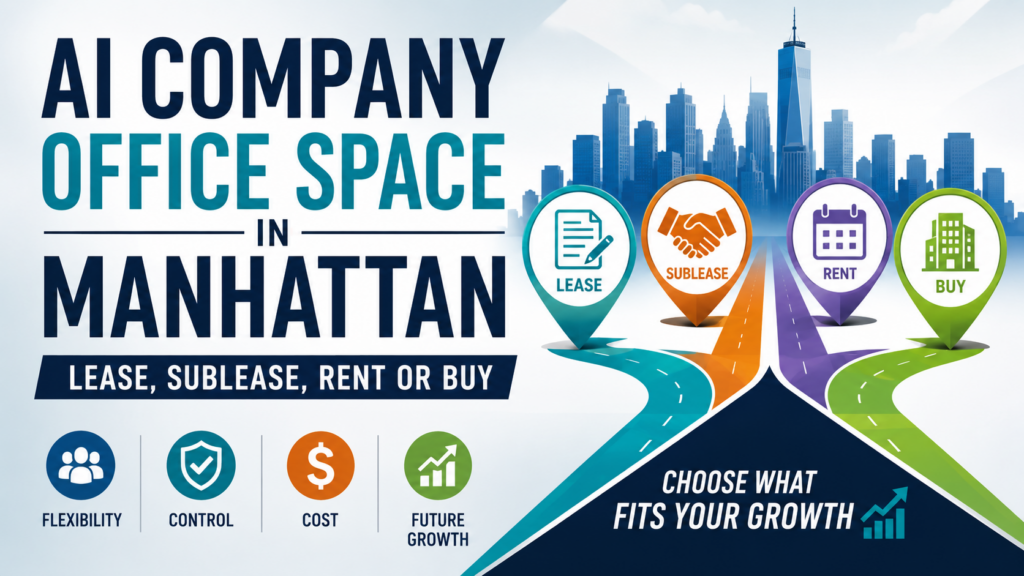
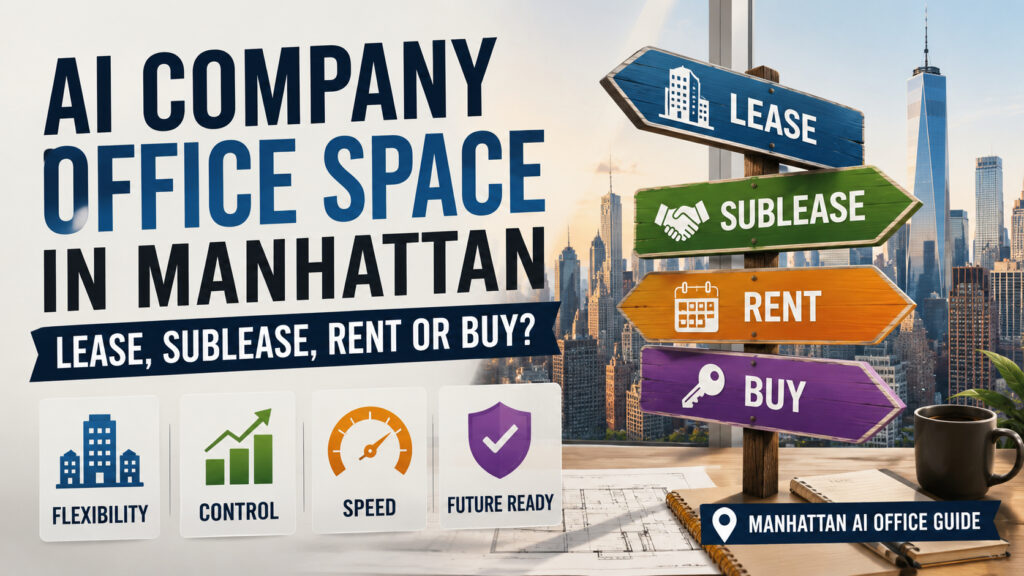
AI Company Office Space in Manhattan: Lease, Sublease, Rent or Buy
AI companies need office space that can keep pace with hiring, funding, product development, and changing workplace plans.
For most teams, the real decision involves a direct lease, sublease, flexible rental, or office purchase. Each choice changes cost, control, speed, risk, and future flexibility.
We represent Manhattan office tenants throughout the search, touring, negotiation, and occupancy process. Our job is to protect your budget, flexibility, timing, and leverage. We can build a curated shortlist across direct leases, subleases, rentals, and purchase opportunities.
This guide explains how those choices work in Manhattan. It also covers pricing, neighborhoods, office size, infrastructure, lease terms, and current inventory.
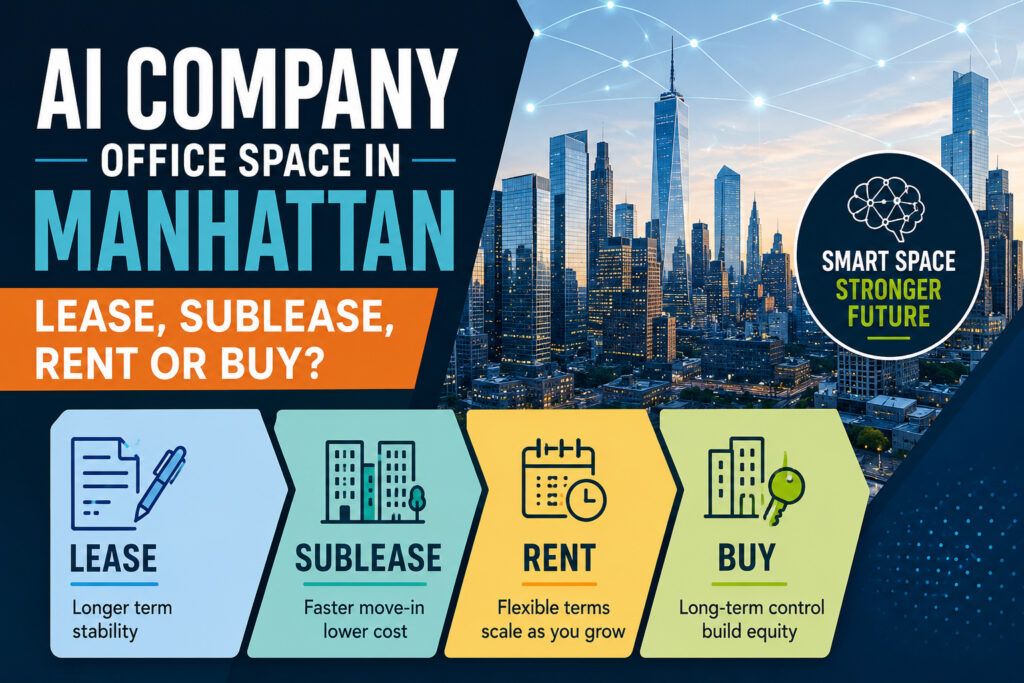
The Manhattan AI Office Decision in 2026
For most AI companies, leasing makes more sense than buying. A direct lease works well when growth appears predictable. A sublease can offer faster occupancy and lower initial capital.
Flexible rentals suit very young teams or short planning horizons. Buying can fit mature companies with stable capital and long-term location needs.
The correct answer depends less on the label “AI company.” Instead, your answer starts with six practical questions:
How many people need desks today?
How quickly could headcount change?
How much capital should remain outside real estate?
How quickly must the office open?
What technical infrastructure does the team require?
How long can management predict the Manhattan footprint?
Those questions should control the transaction.
Manhattan no longer offers unlimited tenant choice
Office tenants still have options across Manhattan. However, the best fitted space has tightened materially.
One major Q2 2026 market report placed Manhattan availability at 14.4%. Availability fell 310 basis points from one year earlier. The same report measured average asking rent at $80.17 per square foot. Sublease availability had fallen to 2.6% of inventory.
Different market researchers use different building universes and methodologies. Consequently, their averages do not match perfectly.
Another Q2 report placed Midtown South availability at 12.7%. That report measured average asking rent at $79.41 per square foot. Midtown South also recorded its strongest quarterly leasing volume since 2001.
A separate report measured Manhattan overall asking rent at $72.83 per square foot. It placed Class A asking rent at $84.79 per square foot. Midtown South Class A reached $104.50 per square foot under that methodology.
Therefore, a citywide average can mislead an AI tenant.
A furnished loft near Union Square may price differently from a Midtown tower. Meanwhile, a Downtown sublease could cost far less.
AI companies compete inside a much larger technology labor market
New York became the largest North American technology talent market by headcount in 2025. The metropolitan technology workforce reached about 394,300 workers.
AI-related office demand has also expanded. Research found New York AI-company office footprints grew 31% during a recent two-year period.
That demand matters for a practical reason.
Many growing technology teams pursue the same office characteristics. They want light, good transit, fitted interiors, reliable connectivity, and room for hiring.
Those requirements concentrate competition around specific Manhattan buildings.
Quality matters more than theoretical vacancy
A vacancy statistic counts space that may never fit your team.
One floor may need extensive construction. Another could lack sufficient conference rooms. A third may offer poor natural light.
Some floors deliver attractive economics but require twelve months of commitment. Others offer immediate occupancy at a higher effective cost.
Therefore, evaluate usable inventory, not abstract inventory.
Your actual market consists only of spaces that meet your:
size + budget + location + term + timing + infrastructure + layout requirements.
That intersection can become much smaller than headline availability suggests.
Fast-growing companies should buy flexibility before they buy extra square footage
Growth creates a special problem for AI firms.
A company can double headcount during the wrong portion of its lease. Conversely, hiring can slow after management commits to excess capacity.
Taking 50% more space does not automatically solve that risk.
Instead, compare several forms of flexibility:
Adjacent expansion rights can preserve access to neighboring space.
Shorter lease terms can create an earlier reset.
Sublease rights can provide an exit route.
Assignment rights matter during mergers or reorganizations.
Renewal options can protect a strong location.
Flexible possession can bridge a near-term hiring surge.
The best transaction often creates several paths forward.
That approach can beat simply renting the largest floor management can afford.
For a broader transaction overview, our Manhattan commercial leasing guide explains the full leasing process.
Lease, Sublease, Rent or Buy: What Each Choice Actually Means
The words often appear together, yet they do not describe four equivalent legal structures.
Rent describes what an occupant pays. A tenant can pay rent under several different agreements.
A direct lease creates a relationship between the tenant and building ownership.
A sublease creates a relationship between the incoming occupant and an existing tenant.
A purchase creates an ownership interest rather than a temporary occupancy right.
Understanding that distinction prevents many expensive mistakes.
| Option | Best fit | Typical control | Initial speed | Capital requirement | Main flexibility issue |
|---|---|---|---|---|---|
| Direct lease | Scaling or established team | High | Moderate | Moderate to high | Longer commitment |
| Sublease | Fast-moving growth team | Medium | Fast | Low to moderate | Existing lease controls many rights |
| Flexible rental | Early team or temporary need | Low to medium | Very fast | Lower upfront | Higher unit cost and less control |
| Purchase | Stable long-term occupier | Very high | Slow | High | Capital becomes tied to property |
These categories overlap in practice. For example, a furnished direct lease can move faster than a complicated sublease.
Direct leasing gives an AI company the most control
A direct lease usually offers the broadest negotiation.
You negotiate the term, rent structure, construction, commencement date, and security. Other subjects can include expansion, renewal, signage, power, HVAC, and subleasing rights.
Longer commitments usually justify larger landlord investments.
That matters when your office needs major construction.
A direct lease may suit a company that wants:
a branded headquarters, substantial conference space, customized security, controlled IT rooms, or dedicated employee amenities.
It also works when management expects a stable Manhattan presence.
However, every extra year creates exposure.
A ten-year lease can outlive several funding cycles. The same agreement can also outlive management’s current workplace strategy.
For that reason, term length should follow business visibility.
Our guide to common Manhattan office lease terms discusses shorter, intermediate, and long commitments. Current market structures commonly span from short arrangements through ten years or longer.
Subleasing can exchange control for speed
A sublease can work exceptionally well for an AI company.
Someone else may already have paid for offices, conference rooms, cabling, furniture, pantries, and lighting. Consequently, a subtenant can sometimes occupy much sooner.
Pricing can also become compelling.
An existing tenant may care more about reducing carrying costs than maximizing rent. That motivation can create opportunities below comparable direct space.
Yet the discount comes with structural tradeoffs.
The subtenant receives rights through the existing tenant’s lease. Landlord consent often matters. The remaining term also sets a hard outside boundary.
Furniture ownership requires confirmation.
Restoration obligations require review.
Early termination rights in the underlying lease deserve close attention.
Most importantly, management should understand what happens if the original tenant defaults.
Our Manhattan office sublease guide covers the business case. Our direct lease versus sublease comparison explains the structural differences.
“Rent” can mean several different products
A team searching for office space “for rent” may encounter several products.
Some listings represent traditional direct leases. Other listings represent subleases.
A furnished private suite might also use rental language.
Therefore, never compare options from the headline alone.
Instead, ask:
Who signs the agreement with us?
Who controls the underlying lease?
How long can we remain?
What services does the quoted price include?
Can we alter the space?
Can we expand?
What happens if we leave early?
Those questions reveal the actual product.
Flexible office rental has a real use case
Flexible office space can make sense before a dedicated lease.
For example, six founders may not need a 3,000-square-foot private floor. A company entering Manhattan for one year may also value flexibility.
The economics change as the team expands.
Per-person pricing can eventually exceed conventional lease economics. Privacy can also become harder to manage.
In addition, a company may control fewer elements.
Management might not control the lobby experience, neighboring occupants, conference capacity, branding, HVAC, or physical security.
Consequently, flexible space works best as a business tool, not a default answer.
Our short-term office guide for AI startups examines that stage in more detail.
Buying means something very different in Manhattan
Buying office space can involve a commercial condominium, cooperative interest, or an entire property.
For most AI startups, buying creates too much capital concentration.
Equity tied to Manhattan property cannot simultaneously fund hiring, product development, sales, or acquisitions.
However, ownership can become rational for a mature company.
The strongest candidate usually expects a long stay. It also wants greater premises control and can comfortably fund the transaction.
A commercial condominium owner generally controls a defined unit. The owner also shares building-level expenses through common charges.
Financing, taxes, building documents, capital plans, title, and resale liquidity all deserve review.
Our guide to commercial office ownership explains longer-term ownership considerations. The Manhattan commercial property buying guide covers the acquisition process.
The decision becomes clearer when you match property structure to company risk
Consider four companies with identical headcounts.
One just closed funding and plans aggressive hiring.
Another has predictable revenue and wants headquarters control.
A third needs Manhattan space for eighteen months.
The final company expects to occupy the same premises for fifteen years.
Those companies should not sign the same deal.
Uncertain headcount favors optionality.
Stable occupancy favors control.
Urgent occupancy favors existing buildout.
Long ownership horizons can justify acquisition analysis.
The lease structure should mirror business risk rather than corporate prestige.
How Much Space and Budget an AI Company Should Plan
Square footage should follow how your company actually works.
Headcount alone does not provide enough information.
Twenty engineers in quiet individual offices need different space from twenty people using an open plan. Client-facing teams also require more conference space.
Hybrid attendance changes the equation again.
Start with usable space, then translate into rentable space
A tenant experiences usable square footage.
The lease usually charges rent against rentable square footage.
Those numbers can differ materially in Manhattan.
Common-area allocations and building measurement conventions create that difference. Our explanation of why Manhattan office leasing can feel complicated discusses loss factors that can reach roughly 25% to 40% or more.
Therefore, never compare two floors using rentable area alone.
Ask for the floor plan.
Test the desk count.
Count enclosed rooms.
Review circulation.
Measure how much of the space actually supports your team.
Use operating scenarios instead of one headcount forecast
An AI company should model at least three occupancy cases.
Current case: people who need the office now.
Expected case: reasonable headcount during the next 12 to 24 months.
High-growth case: hiring that could occur after a strong funding or revenue event.
Then determine whether the lease can handle all three scenarios.
Suppose your current team fits 5,000 square feet.
Management expects 7,500 square feet within eighteen months. The upside case requires 11,000.
Signing an 11,000-square-foot lease immediately solves only one problem. It creates another problem if hiring arrives slowly.
A better structure might combine a smaller floor with expansion rights.
Alternatively, a short sublease could bridge the company into a larger direct lease.
Practical planning bands
No universal square-footage formula fits every AI company.
However, these planning bands can help frame an initial search:
| Operating team | Initial office search band | Common situation |
|---|---|---|
| 5–15 people | 1,000–3,000 SF | Founders and early hiring |
| 15–35 people | 2,500–7,000 SF | Dedicated team office |
| 35–75 people | 6,000–15,000 SF | Growth-stage workplace |
| 75–150 people | 12,000–30,000 SF | Larger departmental layout |
| 150+ people | 25,000 SF and above | Multi-floor or headquarters search |
These ranges should start a conversation, not settle one.
Our AI startup office roadmap examines how requirements can evolve from small suites toward much larger footprints.
Manhattan asking rent needs context
As of Q2 2026, reputable market reports show a wide spread.
One report measured overall Manhattan asking rent at $80.17 per square foot.
Another placed the average at $72.83 per square foot. Class A averaged $84.79 under that dataset.
Midtown South produced similarly important differences.
One report measured $79.41 per square foot across Midtown South.
Another measured $81.14, while its Class A subset reached $104.50.
Therefore, use market averages as orientation.
Do not use them as a quote.
Rent changes dramatically within the same neighborhood
Two offices can sit one block apart and carry very different economics.
The difference may reflect:
building quality, floor height, natural light, lease term, renovation quality, ownership, views, furniture, and mechanical systems.
Timing also matters.
An owner with one remaining premium suite can negotiate differently from an owner carrying several vacant floors.
Sublandlords follow a separate economic logic.
A company exiting quickly may accept a larger discount. Another sublandlord may insist on recovering most remaining rent.
Those differences make live inventory comparisons more useful than neighborhood averages.
Our regularly updated 2026 Manhattan office lease tracker provides additional context on leasing conditions.
Calculate annual rent before falling in love with the office
The basic calculation remains simple.
Rentable square feet × annual rent per square foot = annual base rent.
For example:
5,000 rentable square feet at $70 per square foot equals $350,000 annual base rent.
That equals about $29,167 monthly before additional occupancy costs.
A $10 difference in asking rent equals $50,000 annually on that same floor.
Over five years, the simple difference reaches $250,000 before escalations.
Yet base rent still tells only part of the story.
Model the total occupancy cost
An AI company should budget beyond face rent.
Potential expenses include:
annual rent increases
electricity
supplemental cooling
internet and telecommunications
cleaning
insurance
furniture
moving costs
architectural work
legal expenses
construction beyond allowances
security systems
IT installation
access control
restoration obligations
Certain Manhattan tenants may also face Commercial Rent Tax.
New York City applies that tax to qualifying commercial occupants south of 96th Street. The city currently uses annual gross-rent thresholds and exemptions.
Have tax counsel or an accountant confirm your situation.
Security affects cash requirements
Young companies often focus only on first-year rent.
Landlords also focus on credit.
A company with limited operating history can face greater security requirements than an established profitable tenant.
Negotiators may discuss cash deposits or letters of credit. The final structure depends on credit, term, landlord policy, and financial strength.
Our Manhattan commercial security deposit guide explains the issue in greater detail.
Raise security before final lease documentation.
A low rent means little if excessive security immobilizes working capital.
Construction can overwhelm the apparent rent discount
Raw space can look inexpensive.
Then architecture, electrical work, HVAC, cabling, partitions, furniture, permits, and delays enter the budget.
A more expensive prebuilt suite can sometimes deliver lower total occupancy cost.
Conversely, a longer direct lease can justify meaningful landlord construction support.
The correct comparison therefore uses effective cost, not advertised rent.
Build a side-by-side occupancy model before choosing the winner.
Where AI Companies Fit Best Across Manhattan
There is no single “AI neighborhood.”
Different Manhattan districts solve different problems.
A company should choose location using talent access, commute patterns, office product, budget, clients, and expansion plans.
Flatiron and Park Avenue South fit teams seeking the deepest technology-office pattern
Flatiron combines established loft inventory with strong transportation and a central Midtown South location.
The area works particularly well for companies seeking full-floor offices between several thousand and several tens-of-thousands square feet.
Creative buildings often provide generous windows, exposed structures, and adaptable plans.
Current inventory shows the range.
A team can compare a 5,200 RSF Flatiron floor that supports up to 47 people.
Larger companies can examine a two-floor Union Square option totaling about 30,450 RSF. Each floor measures approximately 15,250 RSF.
Teams seeking a smaller footprint can consider a 2,500 SF West 19th Street option.
Another 2,400 SF West 18th Street office provides another smaller Flatiron comparison.
Growth companies can also review a 5,000 SF furnished option or a 5,040 SF move-in-ready loft.
The district’s drawback follows from its popularity.
Well-built floors can attract several interested tenants.
Therefore, prepare decision criteria before touring.
Union Square can reduce commute friction
Union Square gives employers unusually broad transit connectivity.
That matters when employees live across several boroughs or commute from regional rail connections.
The office product includes traditional lofts, renovated creative floors, and larger institutional buildings.
A 6,500 SF renovated full-floor option illustrates the middle of that range.
Companies seeking more space can compare the larger Union Square inventory mentioned above.
Location alone should not settle the decision.
Check elevator service, HVAC schedules, power, fiber, and usable layout.
A great transit location cannot compensate for a floor that fails technically.
NoMad can bridge Flatiron, Penn, and Midtown
NoMad gives technology teams access to Midtown South without requiring a Flatiron address.
It can also work well for employees using Penn Station.
Current inventory includes a 6,800 RSF plug-and-play NoMad floor. It includes tenant-controlled HVAC and flexible collaboration areas.
A larger team can also compare an 8,390 SF furnished Madison Avenue sublease.
NoMad often deserves consideration when a Flatiron search becomes too narrow.
The blocks can also provide a useful bridge between creative lofts and Midtown-style buildings.
Chelsea works for companies that value larger creative floors
Chelsea offers several different office environments.
Eastern Chelsea provides loft inventory near Midtown South. Western Chelsea adds larger creative buildings and proximity to the West Side.
A company seeking scale can examine a 17,610 SF Chelsea full floor. The marketed layout includes open workspace, enclosed rooms, and large conference areas.
Smaller teams can review a 3,699 SF Chelsea office.
Another 4,279 SF furnished Chelsea option provides a different fitted alternative.
Chelsea becomes especially useful when a company wants creative character without narrowing the search to Flatiron.
SoHo and NoHo favor design-conscious teams
SoHo attracts tenants that place unusual weight on environment and brand experience.
The neighborhood’s office stock varies significantly.
Some floors occupy older loft buildings. Others offer newer construction and high-end contemporary finishes.
A current 8,000 SF SoHo direct-lease option can divide to approximately 5,000 SF. The marketed floor includes dedicated IT space and tenant-controlled conditioning.
Smaller teams can compare a 2,691 SF turnkey SoHo office.
Another option provides 3,807 SF of SoHo office space.
Mid-sized searches can include a 5,115 SF Broadway office and a 6,400 SF SoHo sublet.
A 7,184 SF prebuilt Broadway office adds another larger comparison.
SoHo can command a premium.
Therefore, decide whether the address contributes measurable recruiting, culture, client, or brand value.
Hudson Square works for creative technology and larger office planning
Hudson Square combines former industrial architecture with substantial modern office investment.
It can fit companies seeking larger floorplates or a quieter environment than core Midtown.
Smaller companies should not automatically dismiss the area.
Current inventory includes a 1,211 SF Hudson Square office.
Another 2,530 SF furnished Hudson Square space provides a larger small-office alternative.
For an AI team, building-level infrastructure matters more than neighborhood reputation.
Confirm fiber, HVAC, electrical capacity, access hours, and future expansion before comparing finishes.
Grand Central and Midtown East solve a different commute problem
Not every AI company should sit in Midtown South.
Midtown East can outperform it when employees commute through Grand Central.
The area also offers deeper Class A inventory.
That can matter for companies with client-facing operations, larger conference requirements, or formal headquarters needs.
Current options include a 6,058 SF Grand Central office.
A company needing more room can examine an 11,841 SF Grand Central office.
Another 7,518 SF full-floor Midtown East option expands the comparison.
Do not reject Midtown simply because another district has a stronger startup identity.
Commute convenience can influence attendance more than neighborhood fashion.
Midtown West can create value near major transportation
Midtown West includes a broad range of building quality.
That diversity creates opportunities.
A current 5,999 SF Midtown West direct lease has marketed pricing of $62 per square foot.
Teams using Penn Station, regional rail, or West Side transportation should compare this corridor.
The savings can become meaningful against premium Midtown South alternatives.
Use that difference to improve the office, conserve cash, or lease more expansion room.
The Financial District deserves serious consideration for value
Downtown often gives tenants more square footage per occupancy dollar.
Q2 2026 research placed Downtown asking rents materially below Midtown and Midtown South averages. Depending on the methodology, overall Downtown asking rent sat roughly in the upper-$50s to low-$60s per square foot.
Live sublease opportunities can fall lower.
For example, a current 5,560 SF Financial District sublease carries marketed pricing of $36 per square foot.
Another 6,517 SF furnished Downtown sublease has marketed pricing of $39 per square foot.
A direct option can also compete aggressively.
One 6,100 SF prebuilt Downtown office has marketed pricing of $39 per square foot.
That difference can change the economics for a cash-conscious AI startup.
Neighborhood should follow the workforce
Before choosing an address, map employee origins.
Identify the subway lines and regional transportation your staff actually uses.
Then model travel time to several neighborhoods.
The “best” district may change quickly.
A Flatiron address means little if most employees face a difficult commute. Conversely, a less fashionable location can improve attendance.
Treat commute quality as an economic variable.
Employee time has value.
So does retention.
What Makes a Manhattan Office AI-Ready
An AI-ready office does not need to resemble a data center.
For most software-focused AI companies, the office still serves people first.
However, those people may depend heavily on connectivity, video collaboration, dense computing equipment, secure information, and extended work hours.
Therefore, “AI-ready” should mean operationally ready for your actual technical load.
Our guide to AI-optimized Manhattan office space emphasizes connectivity, power, cooling, security, and flexible layouts.
Start with connectivity
Ask which carriers serve the building.
Then determine whether your intended floor can connect efficiently.
A building may advertise fiber without answering the harder questions.
Where does service enter?
How does it reach your floor?
Can you obtain redundant service?
How quickly can carriers install circuits?
Does the building provide suitable riser capacity?
Your IT team should review those answers before lease execution.
Examine electrical capacity before cosmetics
A beautiful loft can become expensive when power proves inadequate.
Count workstations, monitors, conference systems, network hardware, kitchen equipment, and specialized devices.
Then discuss current and planned electrical loads with qualified professionals.
Do not assume an older floor can support every future configuration.
The lease should also clarify responsibility for upgrades.
Landlord work, tenant work, and building work can involve different approval paths.
Cooling can become a hidden operating constraint
Dense workstations produce heat.
Server or network rooms can require cooling outside normal office hours.
Conference technology also adds heat.
Ask about base-building HVAC hours.
Then price overtime service.
Determine whether the suite includes tenant-controlled equipment.
Also investigate supplemental cooling where necessary.
A low rent can lose its advantage after significant mechanical work.
Confirm twenty-four-hour access requirements
Software companies do not always operate between 9:00 a.m. and 5:00 p.m.
Product launches, international teams, deployments, and incidents can create unusual hours.
Confirm after-hours access before signing.
Also review freight access, visitor procedures, security staffing, and HVAC policies.
Twenty-four-hour door access does not necessarily mean twenty-four-hour comfort.
Plan secure rooms deliberately
Confidentiality requirements vary among AI companies.
A consumer application team may need ordinary corporate security.
A company handling sensitive enterprise information may need considerably more.
Decide whether you need:
controlled server rooms, restricted research rooms, secure conference rooms, private call spaces, or enhanced access systems.
Then identify who can access mechanical, electrical, and communications areas.
Your internal security team should establish the standard.
The building should satisfy it.
Acoustic privacy matters more than many founders expect
Open offices work well for collaboration.
They perform poorly when every employee joins video calls simultaneously.
AI companies can have engineers, product teams, salespeople, recruiters, and executives sharing one floor.
That mix creates competing acoustic needs.
Plan enough small meeting rooms.
Add phone rooms where practical.
Preserve quiet areas for concentrated work.
Test walls and doors for sound transmission.
A workplace can look excellent while performing badly.
Look for floorplates that can change
Today, your company may want sixty desks and six conference rooms.
Next year, it may want forty desks and twelve project rooms.
Rigid construction makes every workplace change expensive.
Simple rectangular plans usually provide more adaptability.
Movable partitions can help.
Furniture systems also matter.
Moreover, column placement can affect density.
The best office should survive several reorganizations without major construction.
Expansion rights can matter more than the perfect first floor
Suppose an 8,000-square-foot floor fits today.
The building also contains adjacent space that might open next year.
That circumstance deserves attention.
An expansion option, first offer right, or negotiated preference can create strategic value.
Exact language matters.
A vague conversation with ownership creates little protection.
Your lawyer should document any important rights.
Tour the building systems, not only the suite
Founders naturally focus on the office interior.
A proper technical tour goes deeper.
Review the telecom room.
Ask about building electrical systems.
Understand HVAC service.
Inspect loading and freight procedures.
Discuss emergency power if your operations require it.
Check access controls.
Ask about planned building work.
Technical due diligence should occur before the company becomes emotionally committed to the space.
Current Manhattan Office Options Worth Comparing
Inventory changes constantly. The following spaces illustrate options recently marketed through our inventory. Confirm current status, pricing, term, and possession before relying on any listing.
The purpose of comparing several spaces is not to create the longest tour.
Instead, each option should answer a specific question.
What does another neighborhood buy?
How much does furniture save?
What does a longer term unlock?
How much does Downtown reduce occupancy cost?
Could ownership outperform leasing for this company?
Smaller offices for early and compact teams
A company below roughly 35 employees can often keep the search focused.
Useful comparisons include:
| Approximate size | Area | Structure | Why compare it |
|---|---|---|---|
| 1,211 SF | Hudson Square | Direct | Small dedicated Manhattan footprint |
| 2,400 SF | Flatiron | Direct | Compact Midtown South option |
| 2,500 SF | Flatiron | Direct | Small creative-office comparison |
| 2,530 SF | Hudson Square | Furnished direct | Lower move-in work |
| 2,691 SF | SoHo | Turnkey direct | Design-focused small office |
| 3,038 SF | Flatiron | Furnished direct | Ready-built Midtown South option |
| 3,138 SF | Financial District | Furnished sublease | Downtown flexibility |
| 3,592 SF | SoHo | Boutique office | Distinctive smaller workplace |
| 3,699 SF | Chelsea | Direct | West Side creative option |
| 3,807 SF | SoHo | Direct | Mid-sized SoHo alternative |
These listings demonstrate how quickly product type changes within a narrow size range.
Do not choose by square footage alone.
A smaller efficient rectangle may seat more people than a larger irregular loft.
The 4,000-to-8,000-square-foot range offers deep variety
This band fits many scaling teams.
It also exposes the largest differences between neighborhoods and transaction structures.
Current comparisons include:
| Approximate size | Area | Structure | Useful comparison |
|---|---|---|---|
| 4,279 SF | Chelsea | Furnished | Creative building alternative |
| 5,000 SF | Flatiron | Furnished | Growth-stage Midtown South floor |
| 5,040 SF | Flatiron | Direct | Move-in-ready loft |
| 5,115 SF | SoHo | Direct | SoHo pricing comparison |
| 5,200 SF | Flatiron | Direct | Flexible full-floor planning |
| 5,560 SF | Financial District | Sublease | Marketed at $36/SF |
| 5,999 SF | Midtown West | Direct | Marketed at $62/SF |
| 6,058 SF | Grand Central | Direct | East Side commute option |
| 6,100 SF | Financial District | Prebuilt direct | Marketed at $39/SF |
| 6,250 SF | Flatiron | Direct | Larger Midtown South comparison |
| 6,400 SF | SoHo | Sublease | Shorter-term comparison |
| 6,500 SF | Flatiron / Union Square | Full floor | Renovated creative layout |
| 6,517 SF | Financial District | Furnished sublease | Marketed at $39/SF |
| 6,800 SF | NoMad | Plug-and-play | Tenant-controlled HVAC |
| 6,900 SF | Flatiron | Penthouse | Distinctive full-floor alternative |
| 7,184 SF | SoHo | Prebuilt | Larger fitted SoHo option |
| 7,518 SF | Midtown East | Full floor | Class A Midtown comparison |
| 7,561 SF | Financial District | Furnished sublease | Downtown turnkey alternative |
| 8,000 SF | SoHo | Direct | IT room and controlled cooling |
Several linked listings show the substantial price and configuration differences available inside this size band.
This range deserves a disciplined comparison.
Moving five blocks may change the rent.
Moving two neighborhoods can change it dramatically.
Larger growth-stage searches should focus on configuration and expansion
Beyond approximately 8,000 square feet, companies should examine the whole building more closely.
Elevator capacity starts to matter.
So do security, amenity capacity, freight access, and expansion possibilities.
Current options include:
| Approximate size | Area | Structure | Why compare it |
|---|---|---|---|
| 8,390 SF | NoMad | Sublease | Furnished growth option |
| 8,755 SF | Financial District | Direct | Downtown full-office alternative |
| 9,042 SF | Financial District | Direct | Larger Downtown comparison |
| 11,000 SF | Financial District | Direct | Headquarters-scale Downtown floor |
| 11,534 SF | Financial District | Direct | Another large Downtown choice |
| 11,841 SF | Grand Central | Direct | Midtown headquarters comparison |
| 15,250 SF floor | Union Square | Direct | One or two contiguous floors |
| 17,610 SF | Chelsea | Direct | Large creative full floor |
The Union Square option can combine two floors for roughly 30,450 RSF.
The Chelsea option provides a marketed 17,610-square-foot full floor.
At this size, tour strategy should include multiple deal structures.
Compare one premium direct lease against a fitted sublease.
Then compare both against a lower-cost district.
The contrast creates negotiating leverage.
Purchase options can create a fourth column in the analysis
Long-term occupiers should sometimes model ownership alongside leasing.
Current Manhattan opportunities include a 14,939 SF Flatiron office property offered around $13 million.
Smaller ownership candidates can review a 2,450 SF Grand Central office condominium.
Another 5,122 SF East 40th Street office condominium provides a larger Midtown comparison.
A company seeking more space can consider an 11,252 SF Midtown West office condominium.
Downtown buyers can examine an 8,813 SF Financial District sale-or-lease opportunity.
Larger acquisition searches include an 18,201 SF Downtown condominium office and a 44,779 SF full-floor Midtown condominium.
Ownership should never win merely because the company can afford the down payment.
Model financing, taxes, common charges, improvements, opportunity cost, and exit value.
Then compare that total against leasing.
How to Negotiate an AI Office Deal Without Losing Flexibility
The best office can still produce a poor transaction.
Lease negotiation should begin before formal lease documents arrive.
Your business terms belong in the letter of intent.
That document usually carries less legal detail. However, it establishes the economic framework for later documentation.
Negotiate the complete package
Rent receives too much attention.
A $3 reduction can matter.
So can several additional months of free rent.
Construction dollars may matter more.
Security can matter even more for a venture-backed company.
Key business terms often include:
base rent
annual increases
free rent
tenant improvement allowance
landlord construction
lease commencement
early access
security
term length
renewal rights
expansion rights
assignment rights
sublease rights
HVAC charges
electricity structure
restoration obligations
signage rights
Compare packages using present-value economics whenever the stakes justify it.
Make commencement depend on something concrete
An office lease can create timing risk.
Management may expect possession on one date.
Construction then extends beyond it.
Furniture arrives later.
Internet installation slips again.
A poorly structured commencement provision can leave the tenant paying before it operates fully.
Therefore, coordinate:
possession, construction completion, permits, furniture, IT, and employee move-in.
Your attorney should align legal commencement with the negotiated transaction.
New York City advises businesses to consult counsel before signing commercial leases. The city also offers qualifying businesses commercial lease assistance.
Discuss credit before the landlord writes the lease
A young company can lose time by avoiding credit discussions.
Landlords want to understand financial durability.
Prepare an organized package.
Depending on the situation, that package may include financial statements, cash balances, funding information, and corporate structure.
Confidential materials can require controlled handling.
The goal is not to overshare.
It is to address risk directly.
Better credit presentation can support negotiations around security and concessions.
Negotiate expansion before growth makes it urgent
Expansion rights cost little to discuss early.
They become expensive after your team runs out of desks.
Ask about adjoining floors.
Review upcoming expirations in the building.
Understand whether ownership controls nearby spaces.
Then negotiate meaningful language where possible.
Different rights provide different protection.
A first-offer right differs from a fixed expansion option.
Your real estate lawyer should explain that distinction.
Protect corporate flexibility
AI companies can reorganize quickly.
Funding can introduce new entities.
A strategic transaction can alter ownership.
A merger can change the occupying company.
Lease language should anticipate reasonable corporate evolution.
Discuss assignment provisions early.
Review affiliate transfers and ownership-change clauses.
Also examine restrictions on subleasing.
A company should not discover these limitations during a financing event.
Treat a sublease like a three-party transaction
A sublease involves more than the incoming tenant and outgoing tenant.
Building ownership can retain consent rights.
The prime lease can contain additional restrictions.
Therefore, review the underlying lease.
Confirm landlord consent requirements.
Identify which lease obligations flow through.
Understand the remaining term.
Document furniture.
Confirm utility arrangements.
Address restoration.
Investigate default consequences.
Our guide to triggering landlord consent for a sublease explores that process.
Never assume the furniture stays
A furnished office can save substantial capital.
However, “furnished” does not always mean the incoming tenant owns everything.
Some furniture belongs to the sublandlord.
Other items may belong to building ownership.
Certain equipment may leave before possession.
Inventory the items.
Attach a schedule where appropriate.
Confirm condition.
Also establish who removes unwanted furniture.
A hundred unwanted desks can become a moving expense.
Review HVAC in business terms
HVAC language can look operational.
It can become highly economic.
Ask when normal service runs.
Then ask what after-hours service costs.
Determine whether charges apply by hour, floor, or zone.
Confirm whether the system can support your expected density.
Supplemental systems create another issue.
Someone must maintain and eventually remove them.
Those obligations belong in the negotiation.
Test the internet before the move
Do not wait until lease signing to order connectivity.
Carrier lead times can affect move-in.
Determine available service during the diligence period.
Request installation timelines.
Plan temporary connectivity where necessary.
A functioning office without reliable internet is not move-in ready for an AI company.
Understand construction responsibility
“Turnkey” can mean different things.
Ask who designs the office.
Confirm who selects finishes.
Determine which party hires contractors.
Review change-order procedures.
Set a construction budget.
Define substantial completion.
Create punch-list procedures.
Also address delays.
The city recommends reviewing plans and permit requirements when businesses alter professional office space.
Accessibility and code responsibilities deserve attention
Office alterations can trigger responsibilities beyond aesthetics.
New York City specifically advises commercial tenants to review accessibility obligations before signing. The city notes that leases can allocate responsibilities between parties.
Have qualified counsel and design professionals review those requirements.
Do not rely on assumptions from a previous tenant’s occupancy.
Buying requires a different diligence list
An office purchase shifts many responsibilities to the buyer.
Review the condominium or cooperative documents.
Study common charges.
Investigate building capital plans.
Examine financial statements where available.
Understand permitted use.
Review insurance requirements.
Confirm mechanical systems.
Analyze property taxes.
Investigate financing.
Check title.
Model resale liquidity.
Ownership also changes the expansion question.
A tenant may simply lease another floor.
A condominium owner cannot create adjacent inventory.
Therefore, growth planning deserves special attention before purchase.
Questions AI Companies Ask Before Taking Manhattan Office Space
Should an AI startup lease or sublease office space in Manhattan?
A sublease often fits companies that prioritize speed, existing furniture, and shorter commitments. A direct lease provides more control and customization.
Choose the structure that matches your planning horizon.
Do not treat the lower headline rent as the only factor.
Is renting office space different from leasing it?
“Renting” often describes the broad act of paying for occupancy.
A direct lease, sublease, license, and flexible office arrangement can all involve rent.
Ask what legal agreement actually controls the premises.
That answer matters more than the marketing label.
When should an AI company buy Manhattan office space?
Buying deserves analysis when management expects a stable, long-term Manhattan footprint.
The company should also have sufficient capital after the acquisition.
Ownership makes less sense when headcount, neighborhood, or funding remains uncertain.
Compare the full occupancy cost against leasing.
How much does Manhattan AI office space cost in 2026?
There is no single AI-specific rent.
Q2 2026 Manhattan office reports place broad asking-rent averages from the low $70s to roughly $80 per square foot. Class A averages run higher.
Individual spaces can price far below or above those levels.
Neighborhood, building quality, floor condition, term, and transaction type drive the difference.
Is Midtown South still important for AI companies?
Yes, particularly for companies seeking creative office stock and technology-oriented locations.
Q2 2026 research measured Midtown South availability at 12.7%. Leasing activity reached the submarket’s highest quarterly level since 2001.
However, not every company should pay a Midtown South premium.
Midtown and Downtown can produce better outcomes for certain teams.
Which Manhattan neighborhood should an AI startup choose?
Start with employees, budget, and office type.
Flatiron suits teams seeking Midtown South loft inventory.
NoMad can combine similar access with Penn-area convenience.
Chelsea offers creative buildings.
SoHo emphasizes design.
Hudson Square supports several office styles.
Grand Central works well for East Side commuters.
Downtown can create substantial value.
How much office space does an AI company need?
Model present attendance and future scenarios.
Then test real floor plans.
Do not multiply headcount by a single generic factor.
Conference rooms, private calls, circulation, kitchens, IT areas, and collaboration zones all consume space.
Usable layout matters more than nominal square footage.
Should we lease extra space for future hiring?
Sometimes.
However, excess space creates carrying cost.
First examine expansion rights, adjacent floors, shorter terms, and sublease flexibility.
Those tools can preserve growth capacity without paying immediately for every future desk.
Can an AI startup get a short direct lease?
Sometimes.
Landlords may offer shorter direct terms in certain prebuilt spaces.
Other owners favor longer commitments.
Inventory, credit, building strategy, and construction requirements influence the answer.
Our guide to shorter and more flexible Manhattan leases explores current flexibility trends.
Is a three-year lease always better for a startup?
No.
A short lease limits long-term exposure.
It can also reduce construction economics or future certainty.
A company expecting rapid growth may outgrow the space quickly.
Meanwhile, a stable team may secure better economics through a longer commitment.
Match the term to business visibility.
What is a prebuilt office?
A prebuilt office already contains a landlord-created interior.
It may include offices, meeting rooms, pantry space, lighting, and finished surfaces.
That structure can reduce move-in time.
Our prebuilt office guide explains the advantages and tradeoffs.
Is a furnished sublease automatically cheaper?
No.
Furniture can reduce setup costs.
However, the sublease rent, remaining term, security, and restoration obligations still matter.
Compare total cost against fitted direct leases.
A stronger direct deal can sometimes produce better economics.
Can we take a sublease and later expand?
Possibly.
However, the sublandlord can only provide rights it controls.
Building ownership may control adjacent direct space.
Therefore, discuss expansion with both transaction structure and building inventory in mind.
A short sublease can also serve as a bridge into a later direct lease.
What technical requirements should an AI office have?
Start with fiber, electrical capacity, HVAC, after-hours service, and access.
Then evaluate IT-room requirements and physical security.
Teams with greater confidentiality needs should add appropriate controls.
The technical checklist should reflect your real operating environment.
Do we need special power because we are an AI company?
Not necessarily.
Many AI companies use ordinary office computing while running intensive workloads elsewhere.
Other teams maintain more equipment onsite.
Calculate actual office loads rather than relying on the company category.
Then have appropriate professionals verify capacity.
Should we put GPU servers in a normal Manhattan office?
That depends on the hardware load and building systems.
High-density equipment can create substantial electrical and cooling demands.
A conventional office may not support data-center-like requirements economically.
Your infrastructure team should define the load before real estate selection.
What should we ask about fiber?
Ask which carriers currently serve the property.
Confirm service to the premises.
Investigate redundancy.
Understand riser paths.
Request installation timing.
Also identify any building charges or approvals.
Do that before final lease execution.
How important is twenty-four-hour HVAC?
It depends on your operation.
Regular after-hours work can make HVAC charges significant.
A server room may need cooling even when employees leave.
Price those requirements during the office comparison.
Do not discover them after move-in.
How many conference rooms does an AI company need?
The answer depends on call volume and work style.
Hybrid teams often use rooms differently from fully in-office teams.
Client-facing companies may need more enclosed space.
Test utilization assumptions before selecting a floor.
Phone rooms can reduce demand on larger conference rooms.
Do we need a server room?
Not every AI company does.
Some teams need only networking equipment.
Others require secure local hardware.
Define the requirement with your technology team.
Then plan cooling, power, access, and fire-safety considerations accordingly.
Can a Manhattan landlord accommodate rapid growth?
Sometimes.
The building may have adjacent inventory.
Future vacancies can also create expansion paths.
Discuss growth during the initial search.
A building with several suitable floors can offer more strategic flexibility than a single isolated suite.
What happens if our company shrinks?
The lease does not automatically shrink with your headcount.
That risk makes assignment and sublease rights important.
Shorter commitments can also help.
Flexible layouts may allow the company to consolidate teams before pursuing an exit.
Think about the downside case before signing.
How should we compare a $60 office with a $90 office?
Start with annual base rent.
Then add construction, furniture, electricity, HVAC, internet, escalations, and other occupancy costs.
Subtract negotiated concessions where appropriate.
Finally, consider employee commute and move-in timing.
The cheaper asking rent does not always produce the cheaper transaction.
How much does a $10-per-square-foot rent difference matter?
On 10,000 square feet, it equals $100,000 annually before other lease economics.
Over five years, the simple difference reaches $500,000 before escalations.
That makes neighborhood comparison worthwhile.
However, construction and concessions can reverse the apparent advantage.
Should we choose Class A office space?
Choose the building that meets your objectives.
Class A can provide stronger building systems, amenities, and presentation.
Yet a renovated loft can outperform a tower for some teams.
Building classification should remain a filter.
It should not become the decision.
Does an AI company need a trophy building?
No.
A premium building may support recruiting, clients, security, amenities, or corporate positioning.
Those benefits can justify the cost for some companies.
Other teams gain more value from additional runway.
Spend on real estate where it supports the business.
Can Downtown work for an AI startup?
Absolutely.
Downtown can provide fitted space and meaningful rent savings.
Q2 2026 data also show Downtown rents below Midtown and Midtown South averages.
A tenant should test employee commutes before assuming the location works.
For the right workforce, the value can become compelling.
Can Midtown work even if most technology companies prefer Midtown South?
Yes.
Grand Central access can dramatically improve commuting for some employees.
Midtown also provides extensive Class A inventory.
Companies with formal client requirements may prefer that environment.
Office strategy should serve your workforce rather than follow a trend.
How quickly can an AI company move into Manhattan office space?
Move-in timing depends on the product.
A fitted sublease or prebuilt suite can move quickly after documentation and approvals.
A custom direct lease can take much longer.
Construction, permits, IT, furniture, and legal negotiations all affect timing.
Start before the current office becomes a problem.
Should we sign before our next funding round?
That depends on available cash, confidence, timing, and landlord requirements.
Signing earlier can secure space.
Waiting can preserve flexibility.
Model both scenarios with your finance team.
A lease should not depend on capital that remains uncertain.
Will a landlord care about our funding stage?
Landlords care about credit and the ability to perform the lease.
A well-capitalized young company can still need to explain its financial position.
Prepare those discussions early.
Security negotiations often depend on that risk assessment.
How much security deposit should we expect?
There is no single amount that fits every commercial transaction.
Landlords evaluate financial strength, term, rent, and company history.
A startup may face tougher requirements than an established profitable tenant.
Discuss security before lease drafting begins.
Can we use a letter of credit instead of cash security?
Some transactions use letters of credit.
Whether that structure works depends on landlord requirements and negotiated documents.
Compare bank costs and operational restrictions against cash security.
Your attorney and finance team should review the details.
Do we need a personal guaranty?
Not every transaction requires one.
Landlords may request additional support when they perceive greater credit risk.
Negotiate the issue rather than assuming a standard outcome.
Have qualified counsel review any guaranty before signing.
What lease clauses matter most for a fast-growing company?
Expansion, assignment, sublease, renewal, and permitted-use language deserve attention.
Commencement and construction provisions also matter.
HVAC, power, access, and restoration can become material.
No single clause protects flexibility by itself.
The whole lease must work together.
Should we negotiate a renewal option?
Usually, it deserves consideration.
A successful office can become expensive to replace.
A renewal mechanism may create continuity.
However, pricing language and notice requirements matter greatly.
Your lawyer should review the provision carefully.
Should we negotiate the right to sublease?
A growing company should understand its future exit rights.
Even teams expecting rapid expansion can later need less space.
Reasonable sublease rights create another option.
Landlords may still retain approval protections.
Negotiate those terms while you still have leverage.
What happens if a sublandlord defaults?
That can create substantial risk.
The incoming company should review the prime lease and sublandlord obligations.
Landlord recognition or related protections may become relevant.
Your attorney should evaluate the structure before execution.
Our direct versus sublease guide covers this distinction further.
Should we buy instead of signing another ten-year lease?
Possibly.
A stable long-term occupier should compare both paths.
Ownership can provide control and possible asset value.
Leasing preserves more capital and relocation flexibility.
Build a long-horizon financial model before choosing.
What costs come with owning an office condominium?
Purchase price represents only the starting point.
Budget for financing, legal work, taxes, common charges, improvements, insurance, and future capital expenses.
Also consider resale liquidity.
A long hold can justify those burdens better than a short one.
Could we buy an office and sublease unused space?
Potentially, subject to property documents, law, and transaction restrictions.
Do not build an acquisition model around assumed sublease income without verification.
Review the governing documents first.
Then model vacancy and transaction costs conservatively.
Should our office match our current staff or future staff?
It should serve both without depending on an extreme forecast.
Build a present case, expected case, and high-growth case.
Then choose a lease structure that survives each one reasonably well.
Flexibility often solves uncertainty better than excess square footage.
How many spaces should we tour?
Tour enough spaces to understand the market and create real alternatives.
Do not tour dozens without clear criteria.
A focused shortlist usually produces better comparisons.
Each tour should answer a specific business question.
What should management bring to the first office-space discussion?
Bring current headcount, expected headcount, budget, desired possession, preferred neighborhoods, and commute concerns.
Also identify technical requirements.
Note any non-negotiable security needs.
Finally, discuss funding and credit constraints.
That information turns a broad inventory search into a useful shortlist.
What should we inspect during a tour?
Look beyond finishes.
Count actual workstations.
Test conference-room capacity.
Check window lines.
Review columns.
Ask about HVAC.
Discuss power.
Identify telecom infrastructure.
Inspect restrooms and pantry capacity.
Understand elevators and freight access.
Then ask where the company could expand.
When should lawyers enter the process?
Legal counsel should join before lease execution.
Complex business issues may justify earlier involvement.
New York City itself recommends legal review when businesses sign commercial leases.
Your broker handles market and transaction strategy.
Your lawyer protects the legal agreement.
What does a tenant broker actually do for an AI company?
A tenant broker defines the requirement, surveys inventory, schedules tours, and compares economics.
The broker also helps negotiate the business terms.
That role becomes especially useful when direct listings, subleases, and off-market possibilities overlap.
The objective is not to push one building.
It is to create competitive alternatives.
How should we begin?
Start with four numbers:
current headcount, twelve-to-twenty-four-month headcount, target square footage, and maximum occupancy budget.
Then add desired neighborhoods, possession date, technical needs, and preferred term.
Office Space Today for Generative AI (GenAI) Market
We can compare those requirements against our Manhattan inventory.
That includes direct leases, furnished offices, subleases, prebuilt suites, and purchase opportunities.
Get a curated Manhattan AI office shortlist based on your team size, budget, term, technical requirements, and growth plan.
We represent office tenants rather than forcing a company into one property. Our role is to create choices and negotiate from the tenant’s side. The right Manhattan office should support the company today without trapping its choices tomorrow.
Fill out our 📋 online form or give us a call today 📞 212-967-2061 — let’s find the right options for your business.