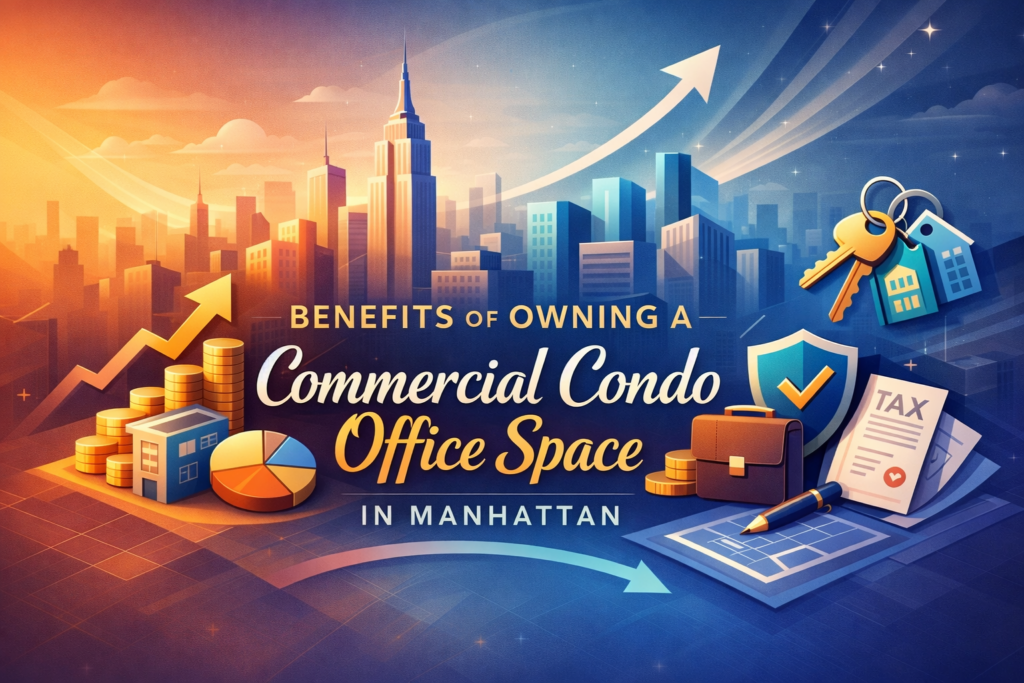
Benefits of Condo Ownership
In Manhattan’s evolving office market, an increasing number of small and midsize organizations are no longer approaching office space purely as a recurring expense. Instead, many are reevaluating their long-term occupancy strategy and choosing to own their office space through commercial condominium purchases rather than leasing. This shift is not driven by speculation, but by practical considerations tied to budget control, operational stability, image, and long-term planning.
As leasing costs remain volatile and build-out investments continue to rise, office condominium ownership has emerged as a strategic alternative for businesses and nonprofit organizations seeking predictability, control, and long-term value. Understanding when ownership makes sense, how it compares to leasing, and who benefits most is critical for tenants navigating today’s Manhattan office market.
What Is a Commercial Condo Office Space?
A commercial office condominium is a fee-simple ownership interest in a specific office unit or floor within a larger building. Unlike leasing, ownership grants the buyer title to the space, while shared building components such as lobbies, elevators, and mechanical systems are collectively maintained through common charges.
Importantly, ownership does not eliminate monthly costs. However, instead of rent escalations dictated by market conditions, owners pay a combination of common charges, real estate taxes where applicable, and mortgage payments when financing is used. Over time, these costs tend to be more stable and more predictable than traditional leasing structures.
Who Benefits Most from Owning an Office Condo in Manhattan?
Ownership is not universal. However, it consistently favors organizations that meet certain criteria:
- Businesses planning to remain in Manhattan for seven years or longer
- Professional firms that require private offices, partner suites, or client-facing layouts
- Organizations making significant investments in furniture, infrastructure, or specialized build-outs
- Nonprofit or mission-driven entities that may qualify for real estate tax exemptions
- Companies seeking to stabilize occupancy costs as part of long-term budgeting
For these users, ownership often aligns more closely with operational realities than leasing.
Why Owning a Commercial Condo Can Be More Cost-Effective Than Leasing
Stabilized Occupancy Costs Over Time
Leasing office space in Manhattan typically includes annual rent escalations, market-driven renewal risk, and unpredictable future pricing. Ownership, by contrast, converts occupancy into a largely fixed long-term cost structure.
While mortgage payments and common charges may adjust modestly over time, they are not subject to sudden market repricing. As a result, owners gain the ability to forecast occupancy costs years in advance, which directly benefits long-term budgeting and financial planning.
Equity Creation Instead of Rent Expense
Lease payments provide no residual value. Once paid, they are permanently gone. Ownership, however, transforms monthly occupancy costs into equity accumulation.
Over time, principal paydown and market appreciation combine to create a tangible asset that can later be sold, refinanced, or leveraged. This shift fundamentally changes how office space functions within a company’s balance sheet.
Tax Advantages of Office Condo Ownership
Depreciation and Interest Deductions
Owners may deduct mortgage interest and depreciate the property over time, which can significantly reduce taxable income. These benefits are unavailable to tenants leasing office space, regardless of lease size or term length.
Real Estate Tax Exemptions for Certain Organizations
In Manhattan, qualifying nonprofit and government-adjacent organizations that own and occupy their office space may be exempt from paying real estate taxes altogether. Tenants leasing office space, even those with exempt status, typically remain responsible for their share of building taxes through rent or additional charges.
This distinction alone can materially alter the long-term cost comparison between owning and leasing.
Control, Customization, and Long-Term Usability
Permanent Build-Outs Without Lease Risk
Leasing often discourages substantial investment in layout, furniture, and infrastructure due to lease expiration risk. Ownership removes this limitation.
Owners can justify higher-quality materials, more ergonomic layouts, private office configurations, and long-term design decisions without concern for lease termination or landlord approval constraints. As a result, the space can be optimized for staff workflow, client interaction, and brand presentation.
Layout Flexibility Based on Business Function
Ownership supports specialized configurations such as:
- Partner offices and conference-heavy layouts for professional services
- Open bullpen or benching environments for collaborative teams
- Hybrid arrangements that balance privacy, density, and acoustics
Unlike leased spaces, these layouts do not need to be reversed at the end of a term, preserving capital investments.
Image, Stability, and Market Perception
Ownership as a Signal of Permanence
Owning office space in Manhattan sends a clear message to clients, staff, and stakeholders. It signals long-term commitment, financial stability, and institutional presence—particularly important for firms operating in competitive or trust-driven industries.
Additionally, ownership reduces the reputational risk associated with frequent relocations, downsizing, or forced moves caused by lease negotiations.
Passive Income and Exit Strategy Advantages
Leasing Excess Space
If staffing needs fluctuate, owners retain the option to lease unused portions of their space. This creates flexibility that is rarely available to tenants locked into fixed lease terms.
Asset Liquidity and Strategic Exit
Unlike a lease, ownership provides multiple exit paths. The asset can be sold outright, refinanced, or exchanged into another property depending on future needs. This optionality allows office space decisions to evolve alongside business growth rather than constrain it.
When Leasing Still Makes Sense
Despite the advantages of ownership, leasing remains appropriate for organizations requiring:
- Short-term flexibility
- Rapid expansion or contraction
- Minimal upfront capital commitment
- Temporary project-based occupancy
Understanding when leasing is strategically superior is just as important as recognizing when ownership creates long-term value.
How to Evaluate Whether Ownership Is Right for Your Business
When comparing owning versus leasing, tenants should evaluate:
- Length of anticipated occupancy
- Total build-out and furniture investment
- Staffing model and space utilization
- Budget tolerance for upfront costs
- Importance of long-term cost stability
- Desire for asset ownership versus flexibility
Viewed through this lens, the decision becomes less about market timing and more about operational alignment.
Final Perspective
In today’s Manhattan office market, commercial condo ownership has evolved from a niche option into a legitimate long-term occupancy strategy for many organizations. When aligned with business duration, layout needs, and financial planning goals, ownership can outperform leasing across cost, control, and stability metrics.
While not universally appropriate, office condominium ownership offers tenants the opportunity to transform office space from a recurring expense into a strategic asset—one that supports budget discipline, operational efficiency, and long-term value creation.
Next Step
For organizations evaluating whether owning a commercial condo office space in Manhattan aligns with their growth, staffing, and financial goals, a tailored analysis can clarify the true cost and opportunity profile of ownership versus leasing based on real market conditions today.
If you are weighing whether leasing or owning office space in Manhattan makes the most sense for your organization, a brief conversation can often clarify the true costs and opportunities. You can call us or complete the form on this page to explore your options at no obligation.
Fill out our 📋 online form or give us a call today 📞 212-967-2061 — let’s find the right options for your business.