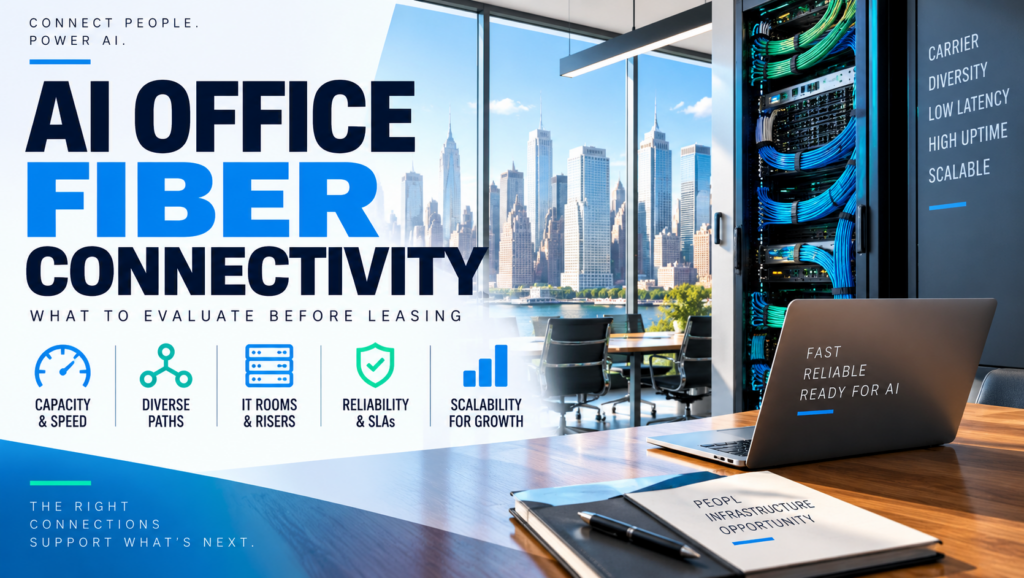
How AI Companies Should Evaluate Fiber Connectivity Before Leasing
For an AI company, office connectivity is operating infrastructure rather than a building amenity.
Teams researching AI office fiber Manhattan options should therefore look beyond an advertised internet speed. A suitable office must connect engineers, cloud environments, colocation facilities, customers, data sources, and remote employees reliably.
The correct requirement depends on what the office actually does. A software team using remote compute has different needs from an office moving petabyte-scale datasets. Likewise, an inference-heavy business may care more about latency and resiliency than raw transfer capacity.
The practical answer: require documented fiber availability, scalable bandwidth, meaningful route diversity, adequate riser capacity, protected network rooms, and workable installation rights. Where outages create serious business risk, add a second connection with genuine physical independence.
A complete review should cover capacity, latency, reliability, scalability, optical condition, route diversity, service models, and implementation timing.
Most importantly, distinguish AI office infrastructure from AI data-center infrastructure.
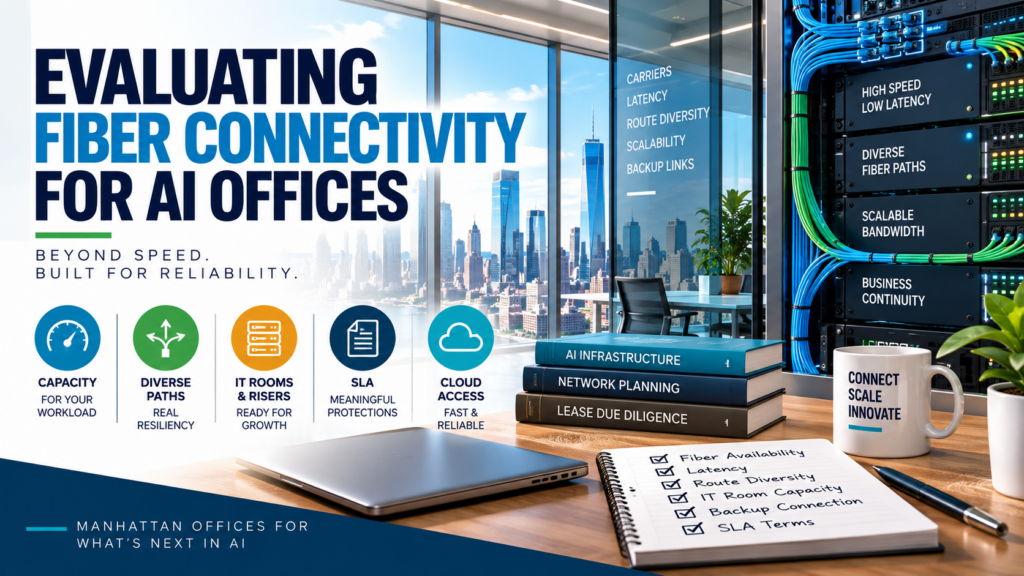
Modern AI data centers may use enormous fiber counts and 800G or 1.6T networking. Current interoperability programs already span 100G through 1.6T for AI-scale environments. However, those figures do not define the correct circuit for a Manhattan office.
An office usually needs excellent access to compute infrastructure. It rarely needs to recreate that infrastructure inside the leasehold.
That distinction can prevent expensive overbuilding.
Start With the AI Workload, Not an Advertised Speed
Bandwidth should follow the workload.
Before comparing buildings, map where data originates, where compute runs, and where results need to travel. Then identify every operationally important endpoint.
An AI company may connect with public cloud regions, private cloud infrastructure, remote GPU capacity, colocation sites, customer environments, and backup locations. Engineers may also depend on code repositories, model registries, observability platforms, and large internal datasets.
Those paths create different requirements.
Training workloads can move enormous datasets before, during, and after a compute job. Large transfers reward high throughput and predictable performance.
Inference workloads often behave differently. Interactive applications can place greater weight on latency, consistency, and rapid failover.
Engineering offices may send comparatively little compute traffic from the actual premises. Nevertheless, hundreds of simultaneous users can create heavy outbound traffic through testing, video, cloud development, model downloads, and data synchronization.
Media-heavy AI teams can add another dimension. Video, imaging, simulation, robotics, and multimodal datasets can turn an ordinary office circuit into a persistent bottleneck.
Translate dataset size into transfer time
“Gigabit internet” sounds substantial until teams move large datasets.
The table below shows idealized transfer times. It excludes protocol overhead, encryption overhead, congestion, storage limits, and application constraints.
| Dataset | 1 Gbps | 10 Gbps | 100 Gbps |
|---|---|---|---|
| 1 TB | 2.2 hours | 13.3 minutes | 1.3 minutes |
| 10 TB | 22.2 hours | 2.2 hours | 13.3 minutes |
| 100 TB | 9.3 days | 22.2 hours | 2.2 hours |
| 1 PB | 92.6 days | 9.3 days | 22.2 hours |
These figures explain why “fast enough for office work” can still prove unsuitable for an AI workflow.
A company regularly transferring 100 TB cannot evaluate connectivity like a conventional professional-services tenant. Conversely, a 25-person AI company using remote compute might not need a 100 Gbps circuit.
Measure the actual workflow before buying capacity.
Start with current peak usage. Next, model expected growth over the lease term. Finally, test unusually demanding events such as migrations, model releases, backups, or bulk ingestion.
Separate bandwidth from latency
Capacity and latency solve different problems.
Bandwidth determines how much data the connection can move during a given period. Latency measures how long information takes to travel between endpoints.
Buying more bandwidth does not automatically reduce latency.
Fiber itself carries signals very quickly. A common planning approximation places propagation near two-thirds of light speed in vacuum. That works out to roughly five microseconds per kilometer in one direction.
Real network latency also includes switches, routers, optical equipment, security appliances, congestion, and routing decisions. Therefore, geographic distance provides only one part of the answer.
For latency-sensitive workloads, test the actual route to the actual endpoint.
A generic speed test against a nearby consumer test server proves very little.
Measure round-trip time to important cloud regions, colocation sites, customer networks, and private infrastructure. Then observe that performance during realistic traffic conditions.
Measure jitter and packet loss too
Average latency can hide operational problems.
Jitter measures variation in packet delivery timing. High variation can affect interactive systems and real-time applications.
Packet loss creates another problem. Retransmissions can reduce useful throughput even when the nominal circuit looks fast.
Therefore, a technical review should define at least four separate measures:
| Measure | What it tells the tenant |
|---|---|
| Committed capacity | How much throughput the circuit should support |
| Latency | How long packets take to reach important endpoints |
| Jitter | How consistently those packets arrive |
| Packet loss | How much traffic fails to arrive cleanly |
Do not replace those measures with a single “internet speed” number.
Does every AI company need fiber?
No law of computing says an AI company must use one specific transmission medium.
However, fiber usually offers the most practical foundation for high-capacity enterprise connectivity. Modern Ethernet development continues toward higher optical speeds because AI and other data-intensive applications keep increasing bandwidth demand.
Smaller teams may initially operate on modest enterprise circuits. Larger organizations can require 10G, 100G, private wavelengths, or dedicated fiber paths.
The right answer comes from workload demand.
Do not buy data-center networking because the company works in AI. Buy enough office connectivity for the company’s real operating model.
Evaluate the Building Before Evaluating the Suite
A beautiful office can hide a poor connectivity environment.
Granite lobbies, new furniture, natural light, and amenity floors say little about network resilience. Even a recently renovated building can create difficulties if it lacks suitable risers or entry diversity.
For that reason, evaluate building infrastructure before spending excessive time on interior finishes.
Count providers, then investigate what that count means
Multiple internet providers create choice.
They can also improve pricing leverage and simplify future capacity changes. Yet provider count alone does not create redundancy.
Two services may enter through the same street conduit. Both could travel through one building entry point.
After entering the property, both connections might share a single riser. One physical incident could then interrupt both services.
Resilient office connectivity therefore requires three separate forms of diversity:
Supplier diversity uses different network operators.
Physical diversity separates entry points, conduits, risers, and other infrastructure.
Logical diversity separates services within the network architecture.
Industry building-connectivity guidance specifically distinguishes these three concepts. It also recommends physically separate fiber entry pathways for stronger resilience.
That distinction matters enormously during a lease search.
Ask where the fiber actually enters
A useful building review should identify every point of entry.
Ideally, critical tenants can access separate pathways from different sides of the building. Those routes should continue independently toward the tenant floor whenever practical.
Ask management to explain:
| Question | Why it matters |
|---|---|
| How many fiber entry points exist? | One entrance can create a physical single point of failure. |
| Where does each entry originate? | Two entrances beside each other may offer limited protection. |
| Which providers use each pathway? | Different providers may still share infrastructure. |
| How many telecom risers reach the floor? | Diverse street entries lose value if circuits converge immediately. |
| Is spare riser capacity available? | Future circuits may require new vertical pathways. |
| Who controls riser access? | Administrative delays can affect installation timing. |
| Where is the building demarcation point? | Distance and access affect installation scope. |
| Can a tenant use two independent paths? | This determines practical redundancy. |
| Does management allow fixed wireless backup? | Wireless can bypass a damaged street fiber route. |
True physical diversity deserves more weight than the number of logos on a building connectivity sheet. Guidance for office buildings likewise emphasizes separate points of entry and separate risers.
Look for spare capacity, not only installed capacity
Tomorrow’s connection may matter more than today’s connection.
Suppose the office launches with a 2 Gbps circuit. Two years later, a major customer contract may require more data movement.
The tenant might then want a second provider, a private line, or a higher-capacity optical service.
That upgrade becomes difficult when the riser is full.
Spare conduit, riser space, telecom-room capacity, and accessible pathways create valuable optionality.
A current Midtown East office with extensive connectivity infrastructure illustrates the difference. The 1,421-square-foot listing identifies eight provider options, additional riser capacity, and multiple points of entry.
Those building-level characteristics deserve scrutiny before a tenant focuses on furniture.
Compare smaller and larger connected-building options
Strong infrastructure does not require a huge footprint.
A Bryant Park-area building with smaller office suites currently offers spaces from roughly 852 square feet upward. The property also reports access to several telecommunications providers.
Companies needing a somewhat larger footprint can examine a Midtown property with multiple fiber providers. Current availability extends from smaller suites into larger opportunities. The building also provides tenant-controlled air conditioning and around-the-clock access.
For larger teams, a 16,515-square-foot Midtown East full-floor opportunity reports several fiber and fixed-wireless connectivity choices. Its current term extends well beyond a short startup bridge.
These examples show why square footage and connectivity should remain separate filters.
A small suite can occupy an exceptionally connected building. Conversely, a large premium floor may still require additional technical work.
Treat connectivity certifications as screening tools
Independent building-connectivity ratings can help narrow a search.
Such systems examine digital infrastructure and can highlight buildings with stronger resilience or technology readiness. Current certification guidance rewards multiple providers and physical infrastructure diversity.
However, a rating should not replace tenant-specific diligence.
The tenant still needs to confirm serviceability for its preferred circuit. Route diversity also needs verification.
Likewise, check the specific floor.
A building may have excellent telecom infrastructure in the basement while the desired floor lacks spare pathways.
Do not rely exclusively on public broadband availability data
Public broadband maps can provide a preliminary signal.
They show reported technologies, providers, and advertised speeds for many locations. Yet large commercial properties often use customized enterprise-grade services rather than ordinary mass-market products.
Commercial buildings can even appear differently because they rely on specialized enterprise connectivity. Therefore, a public availability result cannot substitute for a written enterprise serviceability check.
Ask the proposed network provider to confirm the exact address and suite.
Then request installation assumptions, construction requirements, one-time charges, monthly charges, and expected delivery.
“Fiber near the building” does not equal “your required circuit can reach your office by move-in.”
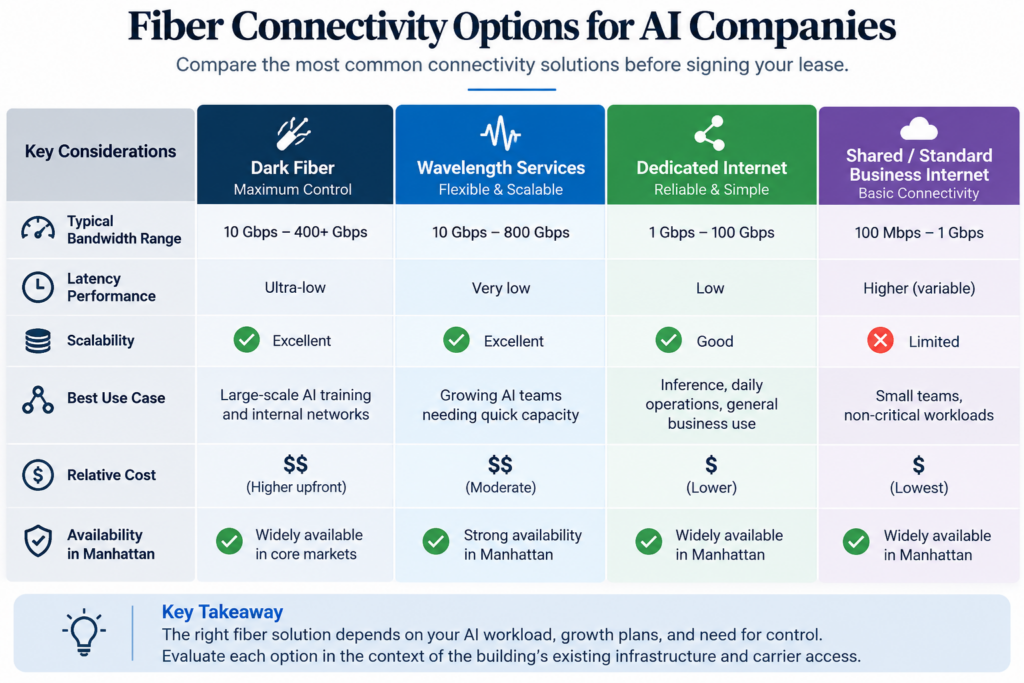
Choose the Right Connectivity Model for the Office
Not every fiber service gives the tenant the same thing.
Some products provide internet access. Others create private connections between two locations.
Dark fiber gives the tenant physical fiber capacity without managed optical transmission. A managed optical service shifts more operational responsibility away from the tenant.
Understanding these distinctions prevents expensive mismatches.
Compare the major office connectivity options
| Connectivity model | Best use | Tenant control | Implementation profile | Key diligence issue |
|---|---|---|---|---|
| Business broadband | Backup or lower-criticality use | Low | Often simpler | Shared characteristics and limited guarantees |
| Dedicated internet access | Primary enterprise internet | Moderate | Common office choice | Committed rate, SLA, delivery date |
| Private Ethernet service | Office-to-office or office-to-colocation | Moderate | Managed connection | Endpoint availability and latency |
| Wavelength service | Very high-capacity site-to-site traffic | High performance with managed optics | More specialized | Optical route and endpoint support |
| Dark fiber | Heavy, stable private traffic | Very high | Greater tenant engineering burden | Optics, maintenance, route, testing |
| Managed optical network | High-capacity private transport | High | Provider manages more layers | SLA and management boundary |
| Fixed wireless | Diverse backup or temporary service | Moderate | Depends on roof access and line-of-sight | Building permission and path |
| Cellular backup | Emergency continuity | Limited | Rapid deployment | Indoor signal and available capacity |
An AI company does not gain anything from choosing the most sophisticated product unnecessarily.
Instead, select the simplest architecture that satisfies performance, security, resilience, and growth requirements.
Dedicated internet access often forms the office baseline
Many AI offices primarily need reliable access to resources outside the building.
In that case, an enterprise internet circuit can form the primary connection.
The proposal should clearly state the committed bandwidth. It should also define restoration targets, performance terms, installation charges, and equipment responsibilities.
Public IP requirements also deserve early discussion.
Teams hosting services from the office may need different addressing than cloud-only operations. Security architecture can create additional requirements.
Private lines can connect the office to compute
Some companies need predictable traffic between the Manhattan office and another facility.
Examples include a colocation environment, private compute cluster, disaster-recovery location, or another corporate office.
A private Ethernet connection may suit that arrangement better than sending everything across public internet paths.
The important question is not whether a private connection sounds more sophisticated.
Ask whether it improves the actual workflow enough to justify its additional cost and complexity.
Wavelength services suit very high-capacity routes
A wavelength can provide substantial capacity across optical infrastructure while keeping operational management with the service provider.
That can appeal to companies moving extremely large datasets between fixed locations.
The model may also work when a tenant needs optical-scale capacity but does not want to operate dark fiber.
However, endpoint availability matters.
A wavelength becomes useful only when the required network can reach both ends.
Dark fiber provides control, not simplicity
Dark fiber means the tenant receives unlit fiber strands.
The tenant then supplies or controls the equipment that turns those strands into a functioning network.
That arrangement can provide exceptional flexibility. Teams can choose optics, upgrade transmission capacity, and control more of the architecture.
Yet dark fiber also creates responsibility.
Someone must specify optical equipment, monitor performance, maintain spares, troubleshoot failures, and coordinate repairs.
An ordinary Manhattan AI office should not assume dark fiber represents an automatic upgrade over managed service.
Use it when the traffic profile, endpoints, engineering capabilities, and economics justify it.
Dark fiber does not automatically make data encrypted
Dedicated physical infrastructure and encryption solve different problems.
Dark fiber can reduce exposure to shared transmission infrastructure. However, it does not cryptographically protect the data by itself.
Sensitive traffic should still follow the company’s security architecture.
That can include encryption, key management, network segmentation, identity controls, logging, and monitoring.
Managed optical service can fill the middle ground
Some companies want dedicated high-capacity transport without running the optical layer themselves.
A managed network can combine dedicated capacity with monitoring, maintenance, and service commitments.
This approach can reduce internal operational burden.
However, define responsibility carefully.
The contract should make clear who manages optics, spares, fault isolation, escalation, and restoration.
Fixed wireless can strengthen path diversity
A backup circuit using another fiber provider may still share underground infrastructure.
Fixed wireless can sometimes create greater physical independence because it avoids the same street-level path. Industry guidance recognizes wireless as a potential method for adding diversity beside a wireline connection.
However, the building needs suitable roof rights, equipment locations, and line-of-sight conditions.
Therefore, investigate backup options before signing the office lease.
Leasing versus owning fiber
Most office tenants should separate leasing a connection from building a telecommunications network.
Building long-haul infrastructure demands rights, construction, capital, maintenance, and operational expertise. That model rarely makes sense for an ordinary Manhattan office tenant.
Leased services usually shorten deployment and shift some responsibility to the network operator.
Dark fiber occupies a middle position.
The tenant can lease existing fiber while still controlling the transmission equipment. That structure provides more control without requiring the company to excavate its own route.
Ownership becomes more plausible when an organization has extraordinary scale, predictable long-term demand, and specialized network staff.
For everyone else, the more useful question is narrower:
What combination of managed service, private transport, dark fiber, and backup connectivity produces the required business outcome?
Inspect Fiber, Telecom Rooms, Power, Cooling, and the Internal Network
Building connectivity only gets the signal to the premises.
The tenant still needs infrastructure inside the office.
A strong due-diligence process therefore continues from the street, through the building, into the telecom room, and across the suite.
Do not apply data-center fiber specifications blindly
AI data centers can use extremely dense optical systems.
The office environment serves another purpose.
A Manhattan office may need one or several high-capacity circuits. It may also need fiber between telecom closets.
However, ordinary office tenants rarely need hyperscale campus strand counts.
Current high-speed Ethernet development reaches 800G and 1.6T for demanding AI environments. Those technologies show where high-performance networking continues to develop. They do not establish a minimum office requirement.
A tenant should scale infrastructure to measured need.
Understand the building demarcation
The demarcation point marks the boundary between network infrastructure and the tenant’s network environment.
Its location matters.
A demarc in the basement can require a long riser path to a high-floor office. The building may impose rules on who can install cable through that pathway.
Ask where the carrier hands service to the tenant.
Then identify every intermediate space.
That route may include the building telecom room, vertical riser, floor telecom closet, tenant IT room, and final network rack.
Decide whether you need single-mode fiber inside the premises
Copper remains useful for many endpoint connections.
However, fiber can make sense for office backbones, long internal runs, high-capacity uplinks, and connections between telecom rooms.
Single-mode optical fiber provides substantial upgrade flexibility.
Bend-insensitive single-mode fiber can also help where pathways contain tight turns. Current international standards specifically define bend-loss-insensitive single-mode cable characteristics.
The cabling designer should match media to distance, topology, optics, and future capacity.
Ask for optical tests when you control the optical path
An ordinary managed internet circuit does not usually require the tenant to audit every fiber characteristic.
Dark fiber creates a different situation.
When a company leases or controls physical strands, obtain relevant test documentation before acceptance.
An Optical Time-Domain Reflectometer, or OTDR, can help identify events along a fiber route. Engineers can use traces to locate splices, reflective events, abnormal loss, bends, or breaks.
Baseline test data also creates a reference for future troubleshooting.
Ask what test wavelength the provider used. Next, confirm the measured route length.
Finally, compare the measured link against the planned optical budget.
Evaluate total optical loss, not a single marketing number
Fiber attenuation matters, but no universal “perfect dB per kilometer” figure describes every installation.
Current standards for bend-insensitive single-mode cable allow maximum attenuation around 0.40 dB/km across broad operating wavelengths. They specify lower maxima within portions of the 1550 nm region.
Connectors and other components add additional loss. Standards for in-premises optical systems explicitly account for those elements when calculating path loss.
Therefore, evaluate the whole optical budget.
The relevant question becomes:
Can the installed route, connectors, splices, optics, and engineering margin support the intended transmission system reliably?
That provides more information than one isolated attenuation figure.
Know when dispersion deserves attention
Chromatic dispersion and polarization-mode dispersion can affect high-speed optical transmission.
Their practical importance depends on fiber type, distance, wavelength, transmission rate, and optical design. Current fiber standards define both attenuation and dispersion characteristics.
A tenant operating a long or very high-capacity dark-fiber route should include these factors in optical engineering.
An office buying a fully managed lit circuit usually delegates that responsibility.
Do not demand exotic optical documentation simply because another AI infrastructure checklist mentions it.
Request the engineering evidence that matches the service you are actually purchasing.
Treat the IT room as critical infrastructure
The network room deserves the same attention as the conference room plan.
It should have enough physical space for racks, switches, firewalls, patch panels, carrier equipment, UPS units, and future additions.
Physical security matters as well.
Limit access to authorized people. Monitor environmental conditions and keep water risks away from critical equipment.
Our guide to office IT and server rooms covers power, backup, security, cooling, network hardware, and expansion considerations.
Existing infrastructure can shorten implementation.
For example, a 4,719-square-foot Downtown office with a dedicated IDF room already reserves space for telecommunications and server equipment.
A larger 18,600-square-foot Times Square office includes an existing server room and UPS infrastructure.
Meanwhile, a SoHo full-floor opportunity with a dedicated IT and server room adds tenant-controlled heating and cooling with 24/7 building access.
Those features can save design time. They still require technical inspection.
Verify UPS and electrical capacity
A redundant fiber connection cannot help when the network rack loses power.
Review the electrical feed serving critical network equipment.
Determine which devices need UPS protection. Then define the desired runtime.
Longer outages may require generator-backed infrastructure.
Confirm whether the building generator supports tenant network loads. Never infer this from the mere presence of a generator.
The tenant’s backup design should match its actual recovery objectives.
Plan cooling around continuous operation
Network equipment creates heat around the clock.
Standard office air conditioning may follow normal business hours. Therefore, a telecom room can overheat even when the office feels comfortable during the day.
Confirm whether the room has dedicated cooling.
If it does not, investigate condenser water, supplemental systems, after-hours HVAC, or another approved solution.
Our Manhattan server-room cooling guide explains why IT environments often need cooling beyond standard office service.
A current Fifth Avenue office with a prewired IT room also provides tenant-controlled HVAC around the clock.
That combination can matter more to a technical tenant than decorative amenities.
Wi-Fi does not replace the fiber review
Excellent wireless networking inside the suite remains important.
Yet Wi-Fi and building fiber answer different questions.
Fiber carries traffic into and through the network infrastructure. Wireless access connects user devices within the workspace.
An AI company needs both layers designed properly.
Do not approve a building because a phone produced an impressive Wi-Fi speed test during the tour.
That test says little about carrier diversity, service guarantees, riser capacity, route independence, or future scalability.
Protect Connectivity Before the Lease Creates a Deadline
Technical due diligence should start before lease execution.
Ideally, identify major connectivity deal-breakers before finalizing business terms.
A signed lease gives the company a legal right to occupy space. It does not guarantee that the office network will work on opening day.
That distinction matters for fast-moving AI companies.
Our current Manhattan AI office timing guide separates transaction timing from operational occupancy. Connectivity can remain an unfinished dependency after lease execution.
Run serviceability checks on finalists
Do not request detailed engineering for every building visited.
Instead, use a funnel.
During initial tours, identify building providers, points of entry, risers, telecom rooms, and known technical limitations.
After narrowing the search, run formal serviceability checks.
Before committing, obtain enough information to understand cost, installation, route, and timing.
A useful provider response should address:
| Required item | What the tenant needs to know |
|---|---|
| Service address | Exact building and suite |
| Product | DIA, Ethernet, wavelength, dark fiber, or another service |
| Bandwidth | Initial committed capacity |
| Upgrade path | Available future capacities |
| Demarcation | Where service reaches the tenant |
| Construction | Whether new fiber or conduit work is necessary |
| Installation charge | One-time implementation cost |
| Recurring charge | Monthly service cost |
| Contract term | Commitment period |
| Delivery estimate | Expected activation window |
| Route information | Available detail on physical path |
| SLA | Performance and restoration commitments |
| Escalation | Fault reporting and emergency contacts |
A sales statement that service “should be available” does not provide enough certainty.
Negotiate carrier access rights
The lease should not accidentally restrict the tenant to one connectivity choice.
Commercial lease counsel should review the exact language.
From a technical standpoint, the tenant should understand whether it can bring in another provider later.
Access can involve the street entrance, telecom room, riser, floor closet, suite, and roof.
The landlord may also require approved contractors or riser-management procedures.
Discover those restrictions before they interfere with a deployment.
Clarify riser and pathway costs
Telecommunications costs do not always stop at the provider invoice.
A building may impose riser charges, access fees, contractor requirements, or after-hours labor costs.
Additional conduit can create construction expenses.
Ask for the building’s telecommunications procedures before signing.
Then incorporate those costs into the connectivity budget.
Preserve a second-path option
A company may launch with one primary circuit.
That should not eliminate the ability to add resilience later.
Where uptime matters, preserve rights for a second provider and another physical path.
Roof rights can also matter when fixed wireless provides the most independent backup.
A resilient design needs more than two invoices.
The backup should avoid as many common failure points as practical.
Address network rooms, cooling, and power in the lease review
Technical infrastructure can affect alterations.
A tenant may need supplemental cooling, dedicated electrical circuits, UPS equipment, rooftop hardware, conduit, or equipment inside shared telecom spaces.
Those items can require landlord consent.
Discuss them while the tenant still has negotiating leverage.
A suitable lease process should examine these practical rights:
| Connectivity issue | Question for the lease team |
|---|---|
| Provider choice | Can the tenant use additional qualified providers? |
| Building entry | Can required cabling enter through approved pathways? |
| Riser access | Can the tenant install and maintain telecom cabling? |
| Telecom-room access | What access procedures apply during outages? |
| Emergency response | Can authorized technicians enter after hours? |
| Supplemental cooling | Can the tenant install necessary equipment? |
| Electrical upgrades | Can additional circuits support network hardware? |
| UPS installation | What approvals apply? |
| Fixed wireless | Can equipment use an approved roof location? |
| Maintenance | Who coordinates work in shared infrastructure? |
| Removal | What equipment must the tenant remove at expiration? |
| Expansion | Can the tenant add circuits during the term? |
Counsel should translate critical business requirements into appropriate lease language.
Technical teams should verify that the negotiated rights match the planned network.
Treat sublease connectivity differently
A furnished sublease may look completely wired.
That does not mean every installed connection transfers automatically.
The existing circuit could belong to the current occupant. Its contract might end before the sublease begins.
Network hardware may also leave with the prior user.
Therefore, separate three questions:
What cabling stays?
What equipment stays?
What service contract stays, transfers, or ends?
Resolve each point independently.
Avoid the “lease signed, circuit later” trap
Carrier installations can involve surveys, building access, riser work, fiber extensions, equipment delivery, testing, and activation.
Any one of those steps can delay opening day.
A tenant with a hard launch date should therefore work backward.
First define the date employees need productive access.
Next set the latest acceptable circuit activation date.
Then create contingency time for problems.
A temporary backup can reduce risk, but it should not become an excuse for weak primary planning.
Compare Buildings With a Technical Scorecard, Cost Model, and Hard-Fail Tests
Good due diligence converts technical information into a leasing decision.
Without a framework, teams can overvalue familiar features.
One building may win because it advertises eight providers. Another may look better because it offers a polished IT room.
Neither fact settles the decision.
The tenant needs to compare complete operating risk.
Use a weighted AI office fiber scorecard
The following framework allocates 100 points.
Adjust the weights for your business model.
| Category | Points | What earns a strong score |
|---|---|---|
| Workload fit | 10 | Capacity supports real workflows and growth |
| Provider choice | 10 | Several viable enterprise options |
| Physical path diversity | 15 | Separate entry and riser choices |
| MDF, IDF, and riser infrastructure | 10 | Accessible pathways with spare capacity |
| Bandwidth scalability | 10 | Practical upgrades without major reconstruction |
| Latency to critical endpoints | 10 | Measured performance meets application needs |
| SLA and restoration | 10 | Clear commitments and escalation procedures |
| Network-room power and cooling | 10 | Reliable 24/7 operating environment |
| Deployment timing | 10 | Credible delivery before operational deadline |
| Lease flexibility and cost transparency | 5 | Rights and fees remain clear |
| Total | 100 |
A high total score should never override a fatal deficiency.
Some conditions deserve a hard stop.
Define hard-fail conditions before touring
A hard-fail standard prevents emotional attachment to a space.
Possible failure conditions include:
| Hard-fail example | Why it can disqualify the office |
|---|---|
| Primary circuit cannot arrive before occupancy | Employees cannot operate normally |
| Required endpoint latency fails testing | Application performance remains unacceptable |
| Building cannot support required riser work | The circuit cannot reach the suite properly |
| Critical backup follows the same physical path | Redundancy exists mainly on paper |
| Network room lacks workable cooling | Equipment reliability suffers |
| Required power cannot reach IT equipment | Network architecture cannot operate safely |
| Landlord will not permit necessary installation | Technical plan lacks legal access |
| No credible expansion path exists | Growth forces an early relocation |
| Required private service cannot reach both endpoints | Network design cannot function |
| Unacceptable security constraint exists | Technical convenience cannot outweigh risk |
A spectacular view should not rescue a failed infrastructure requirement.
Compare cost over the lease period
The cheapest monthly circuit can produce the highest total cost.
Include installation, construction, backup service, equipment, riser charges, cross-connects, power, cooling, and internal cabling.
A useful model looks like this:
Annual connectivity cost = primary service + backup service + equipment + building telecom fees + network-room operating costs.
Add one-time installation expenses separately.
Then compare that total against each building.
For example, a building with existing riser capacity may support a more expensive rent but cheaper deployment.
Another building may offer lower rent while demanding significant infrastructure work.
The occupancy decision should include both categories.
Calculate the value of faster data movement
Bandwidth ROI becomes easier to understand when time has a business value.
Suppose an engineering workflow transfers 50 TB several times each week.
A faster circuit may reduce transfer windows by hours.
That saving can shorten model iteration cycles or accelerate releases.
However, do not assume every saved network minute creates equal financial value.
Estimate how often the network actually blocks useful work.
Then calculate the value of eliminating that constraint.
Calculate outage exposure
Resilience also has an economic value.
Estimate the cost of an office-wide network interruption.
Include lost engineering time, delayed deployments, interrupted customer work, missed meetings, and emergency remediation.
Some companies can tolerate hours of interruption with little harm.
Others may incur substantial losses within minutes.
That difference should determine redundancy spending.
Use an ROI formula that includes avoided risk
A practical model can use:
Incremental annual cost
= upgraded service + backup + equipment + operating expense − current connectivity cost
Estimated annual benefit
= avoided downtime + recovered productivity + reduced transfer delays + avoided emergency upgrades
Then:
ROI = (estimated annual benefit − incremental annual cost) ÷ incremental annual cost
The inputs require judgment.
Nevertheless, the formula forces the team to connect network spending with business outcomes.
Do not choose providers from online reviews alone
General customer reviews can reveal broad service themes.
They do not prove enterprise performance at a particular Manhattan building.
A more useful provider review examines serviceability, escalation, restoration, route options, contractual commitments, and implementation history.
Ask prospective providers how they handle failures.
Then determine who answers outside business hours.
For mission-critical services, request a documented escalation procedure.
Compare current office examples by infrastructure, not prestige
A useful office shortlist can include very different properties.
A 1,421-square-foot Midtown East option currently combines eight provider choices with spare riser capacity and multiple points of entry.
A smaller-suite Bryant Park-area building provides another route for teams that do not need a full floor. Its published building information identifies multiple connectivity providers.
An 8,000-square-foot SoHo full-floor office includes an IT room, server room, tenant-controlled climate systems, and 24/7 access.
A 18,600-square-foot Times Square installation includes a server room and UPS.
These spaces solve different problems.
The best option depends on workload, headcount, timing, resilience, cost, and expansion plans.
What Internet and Fiber Infrastructure Should an AI Company Require?
There is no universal bandwidth number for every AI company.
A strong requirement instead defines measurable outcomes.
The office should support today’s workload while preserving a reasonable path for growth.
For many tenants, that means enterprise-grade primary fiber, another independent recovery path, suitable building pathways, and secure internal networking.
Higher-capacity private services become relevant when workflows justify them.
What are the three most important fiber factors?
If the decision must collapse into three categories, use:
Capacity, latency, and resilience.
Capacity answers whether data can move quickly enough.
Latency answers whether applications respond quickly enough.
Resilience answers whether operations survive failures.
However, serious office diligence should add scalability and implementation feasibility.
A theoretically perfect circuit has little value if it cannot arrive before occupancy.
How much bandwidth does an AI office need?
Start with measured traffic rather than company type.
A small cloud-native AI company may work comfortably with a modest enterprise connection.
A data-intensive team can require multiple 10G circuits or more.
Some specialized offices may justify 100G services, wavelengths, or dark fiber.
Calculate peak demand and large-transfer requirements.
Then apply reasonable growth headroom.
Do not multiply capacity merely because the organization uses AI.
Does an AI company need 100 Gbps internet?
Not automatically.
A 100 Gbps connection can make sense for exceptionally heavy data movement.
Yet many Manhattan AI offices send compute workloads to external infrastructure and need far less.
Use the transfer-time table earlier in this guide.
If a 10 Gbps connection completes required transfers comfortably, 100 Gbps may provide limited current value.
Conversely, frequent 100 TB transfers can change the calculation quickly.
Does an AI company need dark fiber?
Most do not need it simply because they build AI products.
Dark fiber becomes attractive when the company has large, persistent site-to-site traffic and sophisticated networking capabilities.
It can also suit organizations that want direct control over optical capacity.
Managed services often make more sense for ordinary office internet access.
Choose dark fiber because the network architecture requires it, not because it sounds more advanced.
Is fiber becoming obsolete?
No evidence suggests that high-capacity fiber infrastructure is approaching obsolescence.
Current networking development continues to push optical Ethernet toward greater capacity. Recent demonstrations span 400G, 800G, and 1.6T systems for next-generation AI networking.
The more relevant question concerns which fiber service a tenant needs.
Technology can change at the optical endpoints while the underlying fiber remains useful.
That upgrade characteristic helps explain fiber’s long-term value.
What are the current AI fiber trends that matter to office tenants?
The largest bandwidth changes occur inside and between compute facilities.
Office tenants experience those trends indirectly.
Employees increasingly access remote compute, cloud environments, and large datasets. That can increase dependence on fast metro and wide-area connections.
Higher optical speeds also create better upgrade options for demanding tenants. Current Ethernet development already includes 800G and 1.6T products and demonstrations.
For a Manhattan office, however, path diversity and serviceability often matter before terabit-class capacity.
Are long-haul fiber networks important to distributed AI?
Yes, when compute, storage, and users occupy different locations.
Distributed infrastructure needs transport between those endpoints.
However, a Manhattan office tenant usually does not need to engineer the entire long-haul network.
The tenant should instead verify the path to its important destinations.
Ask where compute runs.
Then measure how the proposed office reaches it.
How does latency affect AI performance?
Latency affects any workflow that waits for a remote response.
Interactive inference, development environments, databases, APIs, and remote desktops can all feel latency differently.
High bandwidth cannot eliminate an inefficient route.
Measure application performance against actual endpoints.
Also inspect jitter and packet loss.
The goal is stable response time rather than the lowest possible number on an unrelated test.
What are the benefits of high-capacity fiber for AI?
High-capacity fiber can reduce large-transfer times.
It can also support more simultaneous users and heavier cloud workflows.
Backup and recovery processes may finish sooner.
Large software artifacts, models, video datasets, and checkpoints can move faster.
However, those benefits have value only when bandwidth creates the bottleneck.
Storage, encryption, compute, and remote endpoints can limit performance too.
How many internet providers should an AI office building have?
There is no universal magic number.
More provider choice generally improves flexibility.
However, independence matters more than raw count.
A building with several providers but one shared fiber entrance can still contain a serious failure point.
Building-connectivity guidance emphasizes both supplier diversity and physical diversity.
Ask about providers, entrances, risers, and routes together.
Is two fiber providers enough?
Two providers can create valuable redundancy.
Nevertheless, two contracts do not prove two physical paths.
Verify how each service enters the building.
Then follow each pathway through the riser to the tenant space.
Where practical, investigate upstream route independence as well.
A backup connection should survive the failure scenarios that concern the business.
Should the backup use fiber too?
Sometimes.
Two physically diverse fiber services can provide excellent resilience.
In other buildings, fixed wireless may create stronger path independence.
Cellular service can provide another emergency layer for limited operations.
The best backup depends on bandwidth requirements, building conditions, and failure scenarios.
Can fixed wireless replace office fiber?
It can support some workloads.
It can also serve as an excellent backup.
However, line-of-sight, rooftop access, weather conditions, capacity, and service design deserve review.
High-demand AI offices often benefit from using fiber as the principal connection.
Wireless then provides another failure path.
Should an AI company lease fiber or build its own network?
Most office tenants should lease.
Building metropolitan or long-haul fiber requires substantial infrastructure responsibility.
Leased fiber or managed transport removes much of that burden.
Large organizations with durable traffic demand may justify greater control.
Dark fiber can also provide control without requiring the tenant to construct the physical route.
What alternatives exist to dark fiber?
Several.
Dedicated internet access may cover ordinary internet and cloud usage.
Private Ethernet can connect known sites.
Wavelength services provide high-capacity managed optical transport.
Managed optical networks can support dedicated infrastructure with less tenant operation.
Fixed wireless can add backup diversity.
The correct mix depends on the endpoint map.
Is an on-net building automatically AI-ready?
No.
“On-net” means useful infrastructure reaches the property.
It does not guarantee your preferred service, capacity, price, delivery date, or physical route.
The provider may still need construction inside the building.
Likewise, the desired floor could have pathway constraints.
Confirm the exact service for the exact suite.
What does carrier diversity actually mean?
Carrier diversity means access to separate network suppliers.
That provides commercial choice and some protection from a supplier-level outage.
Yet true resilience also needs physical diversity.
A single damaged conduit can interrupt several carriers simultaneously.
Treat supplier and route diversity as separate checklist items.
What is a point of entry?
A point of entry marks where telecommunications cabling enters the building.
Buildings with genuinely separate entries can reduce physical concentration.
Independent vertical risers can extend that separation toward the office floor.
Industry connectivity guidance uses multiple points of entry and distinct pathways as core resilience concepts.
What is a riser?
A riser provides a vertical pathway for telecommunications cabling through the building.
Fiber often travels from a building telecom room through a riser toward tenant floors.
Limited riser capacity can complicate new installations.
Separate risers can also improve physical redundancy.
Ask both questions during diligence.
What are MDF and IDF rooms?
The main distribution frame generally serves as a central building or network distribution location.
An intermediate distribution frame supports connectivity closer to a particular floor or zone.
Terminology can vary among properties.
What matters is the pathway.
Identify where the service enters, where equipment sits, and how cabling reaches the suite.
What should an AI company ask during an office tour?
Do not turn the first tour into a full engineering study.
However, capture essential facts.
Ask which enterprise fiber services currently operate in the building.
Next, ask about points of entry and riser diversity.
Identify the telecom room.
Then inspect the proposed IT-room location and cooling.
Finally, ask whether management permits another provider, additional conduit, and fixed-wireless backup.
That information quickly separates ordinary buildings from serious candidates.
Should an AI company run a speed test during the tour?
A speed test can provide limited information.
It may measure someone else’s connection rather than the service your company would buy.
Wireless conditions can also distort the result.
A stronger process obtains serviceability confirmation and route information.
Later, test the actual circuit during acceptance.
What documentation should the tenant request?
For a conventional managed circuit, request serviceability, bandwidth, pricing, delivery assumptions, SLA terms, and demarcation details.
For diverse services, add route information.
Dark-fiber users need deeper optical documentation.
That can include OTDR traces, link loss, fiber type, route length, splice information, and optical acceptance criteria.
Match documentation depth to operational responsibility.
When does OTDR testing matter?
OTDR testing matters most when the tenant controls or depends directly on specific fiber strands.
It can establish baseline route characteristics and locate unusual optical events.
A tenant buying ordinary managed internet usually does not need to micromanage this layer.
The service provider remains responsible for delivering the contracted service.
Do not confuse technical thoroughness with unnecessary complexity.
What fiber attenuation should a tenant accept?
Avoid using one universal field threshold.
Fiber standards specify attenuation by fiber category and wavelength.
Current bend-insensitive single-mode standards include maxima around 0.40 dB/km across broad wavelength ranges. Lower limits apply in parts of the 1550 nm region.
Actual link budgets must also include connectors, splices, and engineering margin.
Judge the complete optical path against the selected transmission system.
Does a dedicated fiber connection guarantee security?
No.
Dedicated infrastructure can change the physical risk model.
Encryption solves another layer.
Sensitive AI traffic still needs appropriate cybersecurity controls.
These can include encryption, segmentation, identity management, logging, monitoring, and controlled administration.
Never substitute a private physical path for a complete security architecture.
How should an AI company evaluate a furnished, wired office?
Start by separating cabling, hardware, and network service.
Existing structured cabling can save time.
An IT room can also provide useful infrastructure.
Yet routers, switches, firewalls, UPS units, and carrier contracts may not remain.
Inspect every component and document what transfers.
A “plug-and-play” office can still require substantial network work.
How should an AI company evaluate fiber upgrade ROI?
Measure the bottleneck first.
Estimate how much productivity, transfer time, or outage exposure the improved network can recover.
Next, calculate the full incremental cost.
Include the second circuit, equipment, fees, cooling, and installation.
Then compare the annual benefit with annualized cost.
A technical upgrade deserves approval because it removes a measurable business constraint.
What are the most serious fiber red flags before leasing?
The most serious warning signs involve uncertainty around basic feasibility.
Examples include one undocumented building entry, no spare riser capacity, uncertain provider access, and no network-room cooling.
An unrealistic delivery date deserves attention too.
So does a backup that shares every physical component with the primary circuit.
Another major warning appears when nobody can explain the path from street infrastructure to the proposed suite.
If the team cannot document how connectivity reaches the office, keep investigating before signing.
What should the final approval package contain?
Before lease commitment, the decision team should have a concise connectivity record.
It should identify the primary service, expected capacity, delivery plan, demarcation, installation cost, and recurring cost.
Add the backup architecture where required.
Document the building’s entry points, risers, IT-room condition, cooling, power, and expansion rights.
Finally, record any remaining assumptions.
Unresolved assumptions should never masquerade as confirmed infrastructure.
The tenant-first standard
The best Manhattan office is not necessarily the building with the most fiber.
It is the building whose infrastructure matches the company’s actual operating model.
A cloud-first startup may prioritize fast activation, two independent internet paths, excellent Wi-Fi, and a protected IT room.
A larger AI organization may add 10G or 100G transport, private connections, dedicated optical capacity, and substantial redundancy.
Another company may need direct connectivity between its office and a remote compute environment.
The workload decides.
Start with endpoints. Measure capacity and latency. Verify physical paths. Inspect the network room. Confirm installation. Preserve upgrade rights. Then sign the lease.
Custom Office Report for Fiber
We represent office tenants, not landlords, during Manhattan searches and lease negotiations. We can compare candidate buildings by connectivity, resiliency, occupancy costs, and implementation risk. Compare connected buildings before committing to a lease.
Fill out our 📋 online form or give us a call today 📞 212-967-2061 — let’s find the right options for your business.