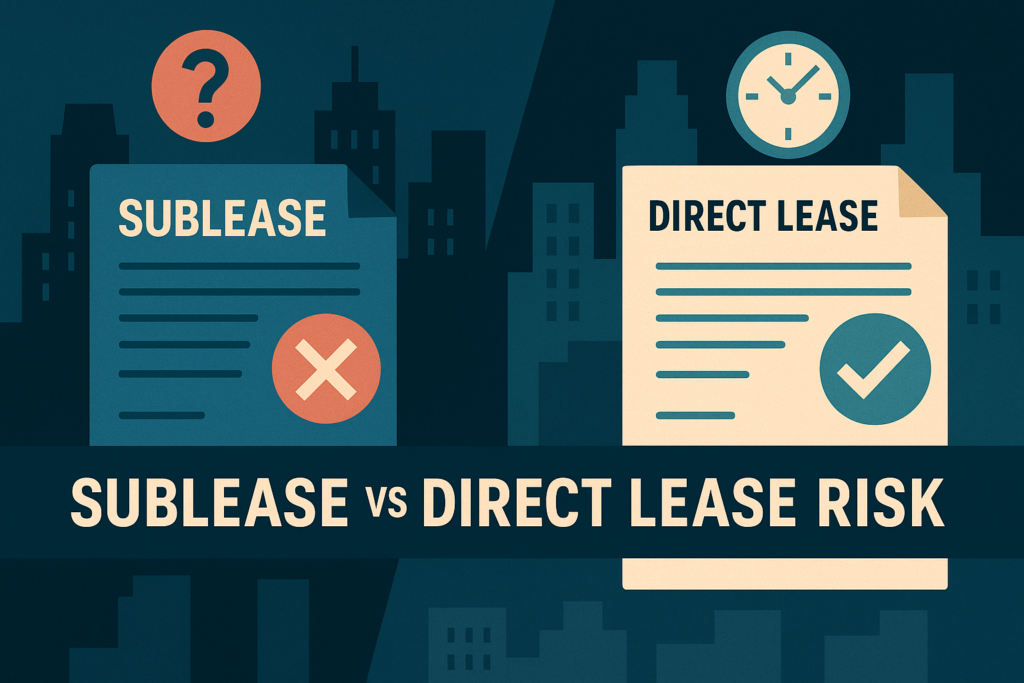
What’s the Risk of Signing a Short-Term Sublease Versus a Direct Lease in Midtown?
Why Subleases Tempt Tenants
In Midtown Manhattan’s 2025 office market, sublease space is abundant and often 20–40% cheaper than direct space. For tenants needing flexibility—startups, nonprofits, project teams—a short-term sublease can seem like the perfect solution.
But subleases carry risks that don’t appear in direct leases: limited rights, restoration surprises, and early termination exposure. Tenants weighing short-term savings need to understand the trade-offs before committing.
How Subleases Work
- Primary lease: Between landlord and the “prime tenant.”
- Sublease: Agreement between prime tenant (sublandlord) and new occupant (subtenant).
- Landlord’s consent: Almost always required.
The subtenant’s rights are entirely derivative of the prime tenant’s lease—meaning if the prime tenant defaults or surrenders, the sublease may be cut short.
Key Risks in Midtown Subleases
1. Early Termination Risk
If the prime tenant negotiates a buyout with the landlord, or defaults on rent, the sublease often ends—even if the subtenant has paid on time.
- Example: A 5,000 RSF subtenant near Grand Central signed a 2-year sublease at $52/SF. Six months later, the sublandlord settled with the landlord and vacated. The subtenant had to relocate with 60 days’ notice.
2. No Renewal Rights
Subleases rarely extend beyond the prime lease’s term. Even if the sublandlord had a renewal option, subtenants typically cannot exercise it.
- For firms wanting to establish a long-term Midtown presence, this creates major continuity risk.
3. Restoration Obligations
Subleases sometimes push restoration obligations down to the subtenant. If the prime lease requires demolition or cabling removal, the subtenant could inherit a $10–$20/SF liability.
4. Concession Gaps
Unlike direct leases, subleases often come as-is—with no tenant improvement (TI) allowance or free rent. Even if rent is cheaper, upfront costs for build-out or furniture can narrow the savings.
5. Landlord Consent Delays
Subleases require landlord approval, which can take 30–60 days. Deals sometimes collapse while waiting for consent.
Midtown Market Realities in 2025
- Discounts: Sublease rents average 25–30% below direct rents in Midtown.
- Terms: Most subleases offer 1–3 years, attractive for firms uncertain about headcount.
- Competition: Many sublandlords are offering plug-and-play furniture to sweeten deals.
Tenant Strategies to Reduce Risk
- Review the Prime Lease: Ensure you understand restoration, assignment, and default clauses.
- Push for Non-Disturbance: Request a “recognition agreement” from the landlord guaranteeing occupancy if the prime tenant defaults (rare, but possible).
- Cap Restoration Costs: Negotiate a maximum liability at lease end.
- Model Total Cost: Factor in furniture, IT cabling, and any restoration obligations to compare against a direct lease.
- Have a Backup Plan: Short subleases work best for firms willing to relocate if needed.
Sublease vs. Direct Lease: Side by Side
| Feature | Sublease | Direct Lease |
|---|---|---|
| Rent | 20–40% cheaper | Market rate |
| Term | 1–3 years typical | 5–10 years standard |
| Renewal Rights | None | Negotiable |
| TI / Free Rent | Rare | Common |
| Restoration Risk | Passed down from prime lease | Directly negotiated |
| Landlord Consent | Required | Not applicable |
Tenant Takeaway
Short-term Midtown subleases in 2025 can be a cost-effective bridge option, especially for firms with uncertain growth plans. But the risks are real:
- No renewal control
- Early termination exposure
- Potential six-figure restoration bills
Tenants should weigh short-term savings against long-term stability and negotiate protections wherever possible.
Where We Fit In
We guide tenants through the fine print of subleases. We’ll:
- Analyze the prime lease for hidden risks
- Benchmark sublease discounts vs. direct deals
- Negotiate caps and carve-outs to protect your business
Contact us to ensure your next Midtown sublease delivers savings without costly surprises.
Fill out our 📋 online form or give us a call today 📞 212-967-2061 — let’s find the right office for your business.