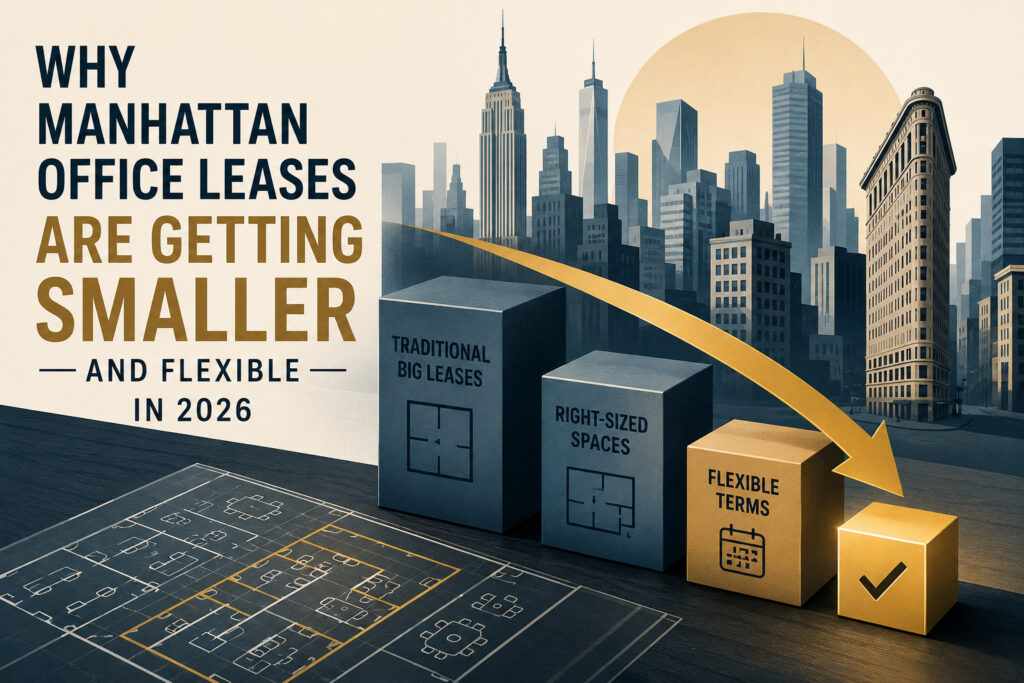
Why Manhattan Office Leases Are Getting Smaller and Flexible in 2026
Manhattan is stronger, so tenants are choosing less space
Manhattan did not loosen in 2026. Leasing accelerated. Vacancy tightened. Asking rents climbed. First-quarter vacancy fell to 13.5%. Average asking rent reached $85.31 per square foot. Direct Class A asking rent reached $95.49. May leasing then hit 3.02 million square feet, which ran 43% above the five-year monthly average.
Premium space also grew harder to replace. Direct availability at 32 trophy towers fell to 1.7 million square feet, or 4.4% of that inventory, down from 6.6 million square feet in early 2024. Sublease supply dropped below 11 million square feet in the second quarter, less than half of its late-2022 peak. Meanwhile, larger tenants kept taking major blocks in Midtown and Downtown, which left less top-tier product for everyone else.
That backdrop explains the core 2026 shift. Many tenants no longer cut space because Manhattan looks weak. They cut space because Manhattan looks selective. Higher rents, tighter premium supply, and faster deal flow now push firms to lease only what they can use well. That is an inference from current market conditions, not a guess.

Smaller no longer means second-best
Back in 2025, smaller leases often signaled caution. In 2026, they signal precision. Companies still want quality. They still want transit. They still want a stronger office experience. They just do not want to pay for empty rows of desks, oversized pantries, or long corridors that no one uses. The market itself now rewards that discipline. Manhattan’s 2026 deal tracker shows that most disclosed deals sit at 50,000 square feet or below, and tenants in the 10,000 to 25,000 square foot range often keep more room to compare layouts and negotiate than trophy users chasing giant blocks.
Hybrid work still shapes that behavior. A 2026 study of post-pandemic office patterns found that office-based work settled far below 2019 levels and now clusters heavily in the middle of the week. Another 2025 report tied New York office demand to stronger return-to-office mandates and renewed interest in top-quality space. Taken together, those trends support a simple planning rule: tenants now size for real attendance, not old peak attendance.
Smaller also no longer means inferior. In today’s Manhattan market, a smaller lease often buys a better building, a faster move, or a more polished layout. That trade has become common because strong demand sits mostly at the high end, while older inventory still competes through price, speed, and flexibility. The result feels less like downsizing and more like footprint editing.
Flexibility now lives in the term, the layout, and the location
In 2026, “flexible” means more than a short lease. It now shows up in three places at once. First, it shows up in the term. Traditional direct leases often run five to fifteen years. Flexible plug-and-play suites often run one to three years. Coworking can start month to month. Second, it shows up in the layout. Tenants want wired, furnished, built suites with meeting rooms, pantry function, and move-in-ready infrastructure. Third, it shows up in the search radius. Firms now compare direct space, sublease space, and landlord-run flexible suites in the same neighborhood instead of locking into one format too early.
That shift matters because speed matters. Good ready-now space can move quickly when layout and location align. In the Flatiron and Union Square band, first-quarter 2026 asking rent hit $87.18 per square foot with 13.9% availability. June 2026 figures for Midtown South showed 17.1% availability, an $86.38 average asking rent, and a $72.39 sublease asking rent. Those numbers tell tenants something useful. Flexible space does not always mean cheap space. It often means faster decision-making and lower upfront friction.
Our own live inventory reflects that new shape of demand. The Union Square plug-and-play page currently highlights ready-now options from roughly 1,750 square feet to 14,005 square feet. Our Midtown East and Downtown building pages also show current options that start around 2,000 to 3,000 square feet and rise into the mid-teens or higher. If you want to compare formats quickly, start with search office listings, then review plug-and-play office space in Union Square and best office buildings in Union Square for small and mid-size teams.
The market has split into scarcity and choice
Manhattan now behaves like two office markets at once. One side feels tight, branded, and expensive. The other side still offers value, optionality, and negotiating room. That divide helps explain why leases get smaller even while leasing stays strong. When premium product tightens, many tenants respond by taking better space in smaller doses. They protect quality, then trim waste.
The high end has real pressure behind it. Financial, legal, and technology demand helped push luxury leasing higher in 2025, including a record number of leases above $100 per square foot. In 2026, some boutique Manhattan deals crossed $200 per square foot, and one reported lease reached $327.50 per square foot. That does not define the whole borough. It does define the ceiling that many tenants now try to avoid by rightsizing their square footage before they compromise on building quality.
At the same time, AI demand tightened the market from another direction. AI firms leased about 1 million square feet in the first quarter of 2026, more than their full-year 2025 total, and they accounted for 56% of Manhattan tech leasing in that quarter. The sublease overhang shrank as those firms, plus financial and legal users, absorbed space faster. That surge did not make every tenant bigger. Instead, it made premium choices scarcer, which pushed many occupiers toward smaller, sharper, and faster deals.
Older inventory still creates room to maneuver, but even that lane has changed. Office-to-residential conversions removed 4.1 million square feet of Manhattan office stock in 2025, the highest level since 2008, and another 8.8 million square feet sat in the proposal pipeline. Those conversions do not eliminate tenant choice. They do thin obsolete supply and raise the importance of comparing what remains with more care. Owners of aging buildings now compete through prebuilt suites, faster occupancy, and more flexible deal structures.
What tenants should do in 2026
Start with how your team actually uses space. Count the busiest normal day, not the rare peak day. Plan for meeting mix, private rooms, and attendance rhythm. Then lease for function, not vanity. That approach matches both the hybrid “midweek mountain” pattern and the current Manhattan cost curve.
Next, compare every format before you tour too far. A direct lease gives you more control. A sublease can give you lower setup cost. A plug-and-play suite can give you the fastest move. In today’s market, those three choices often solve the same need in different ways. If your move must happen this quarter, ready-now space usually deserves first review. If your brand matters most, direct space may still win. If future headcount looks uncertain, a shorter flexible term can protect you from overcommitting.
After that, widen your search before you widen your footprint. Midtown South, Union Square, and Downtown can still offer better value than the tightest trophy corridors. Our own Union Square coverage shows that live pricing can still run well below submarket averages when the layout, building vintage, and lease format line up correctly. That is why many tenants now lease fewer square feet but improve commute convenience, image, and move-in speed at the same time.
Finally, underwrite the office like an operating tool. Use our office space calculator to test your real requirement. Review current deal flow on 2026 Manhattan office leases. Then browse office listings before you lock into one size, one submarket, or one lease structure.
We represent tenants, not landlords. We help you compare direct leases, subleases, and flexible suites across Manhattan without wasting time on the wrong inventory. When you are ready, contact a broker and we will help you secure space that fits how your team actually works.
Fill out our 📋 online form or give us a call today 📞 212-967-2061 — let’s find the right office for your business.