Short-Term Office Space for AI Startups in NYC – A Guide to Flexible Leases
Fast-growing artificial intelligence startups are taking Manhattan by storm – not just in headlines, but in real estate footprints. After securing seed or Series A funding, many AI-driven companies quickly outgrow the garage or coworking desk and need their first real office. However, these companies face a dilemma: they have ambitious growth plans and uncertain headcount, making them hesitant to lock into a traditional 5-10 year lease. The solution is short-term office space – leases ranging from about six months to two years – which provides the flexibility to scale up (or pivot) without long-term commitments. In this guide, we explore who these AI startups are and what they require in an office, why short-term leases have become so popular, where in Manhattan they are setting up shop, and how to find the perfect space on a budget. By understanding the unique needs of burgeoning tech firms and the current NYC office market, a startup founder can make an informed decision that balances agility with professionalism.
Who Needs Short-Term Office Space?
It’s not only bootstrapped entrepreneurs on tight budgets – increasingly, well-funded AI startups and growth-stage tech companies are driving demand for flexible leases. These are companies fresh off significant venture capital injections that are in rapid expansion mode. They often start with small teams of 5–20 employees, then quickly scale to dozens or more within a year. For example, Manhattan brokers report that the majority of new AI office deals are coming from “smaller and midsize firms… mostly under 5,000 sq ft” in size. These firms have the financial backing (sometimes in the tens of millions of dollars of funding) to afford quality office space, yet they remain nimble and cautious about the future. Growth-stage tech companies between funding rounds, project-based teams from larger corporations, and professional services startups all fall into this category of tenants seeking short-term arrangements. They want an office to call their own – a private space for their employees and equipment – but not a decade-long obligation that could turn into a burden if the team quadruples (or if plans change unexpectedly).
What Do AI Startups Look For in an Office?
Above all, these companies need flexibility and agility in their workspace. Practically speaking, that means offices that are move-in ready and adaptable. Most early-stage firms don’t have time or budget to build out a raw space from scratch. They prefer plug-and-play offices – places already furnished or pre-built with open layouts, conference rooms, and good internet infrastructure. Many short-term spaces come “pre-wired and furnished for immediate use”, which is a huge plus for a small tech team that needs to start coding and collaborating on Day 1. AI startups also value a layout that supports their work style: this often means an open bullpen area for engineers alongside a few private rooms for meetings or focus work. They might need space for specialized hardware (like servers or prototyping equipment), though many AI firms primarily need standard desks and breakout areas rather than heavy lab facilities. Quality and image matter as well – even if on a short lease, a startup may host investor meetings or recruitment interviews in the space, so it should reflect a professional image aligned with tech innovation. This is one reason a majority of AI-related leasing in NYC has gravitated toward high-quality buildings: 54% of AI tenants’ leasing activity has been in Class-A buildings, with the remainder in good Class-B offices. The ideal short-term office is therefore modern, well-equipped, and “scalable” – able to accommodate more employees if the team grows in the lease term. Some agreements even build in growth flexibility; brokers note that many AI companies’ leases include expansion clauses to take adjacent space or upgrade to a bigger office if needed.
In summary, AI startups need space that is turn-key yet adaptable, projecting an innovative vibe without locking them into excess space or expense.
Why Are Startups Choosing Short Leases?
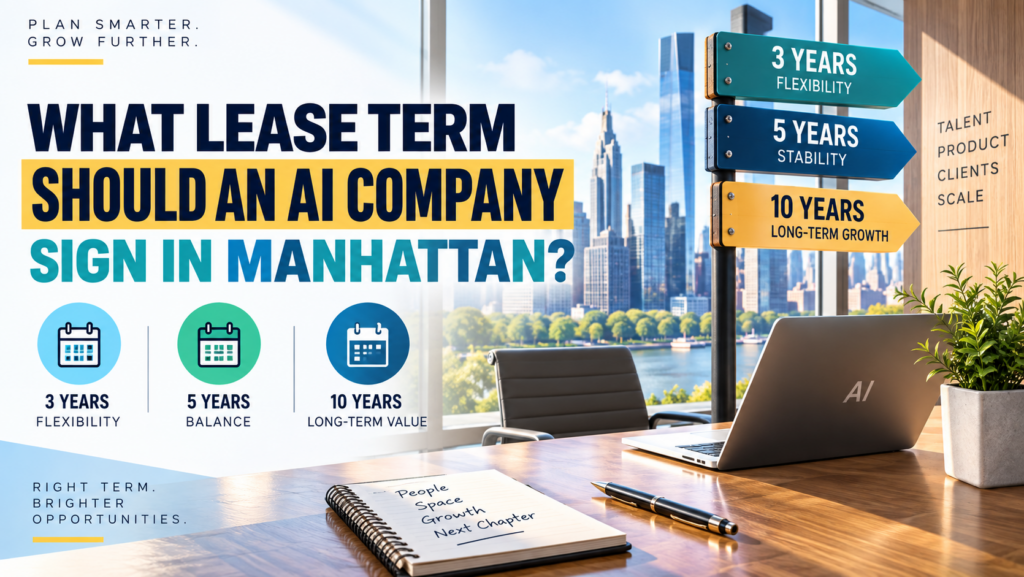
The rise of short-term leases among tech firms is a direct response to the volatility and fast pace of the AI sector. These companies operate on the cutting edge of technology, where a year can bring massive changes in staffing needs. Signing a classic 5-year lease simply doesn’t fit the startup trajectory. Instead, many are opting for two- to three-year deals – or even shorter – to stay flexible.
There are several key reasons behind this trend:
- Uncertain Headcount: A successful AI product launch or new funding round could mean doubling the team in months – but missing a milestone could freeze hiring. A short lease lets the company adjust course sooner. “Unlike traditional long-term leases, many AI companies are opting for 2- to 3-year terms with expansion clauses,” because it appeals to fast-growing startups that remain cautious amid rapidly evolving tech. In other words, they protect against overcommitting to space they might outgrow or no longer need.
- Conserving Capital: Even with significant VC backing, startups must use funds judiciously. Leasing for a shorter term generally reduces the long-term liability on the balance sheet and often requires a smaller security deposit. In fact, New York landlords will sometimes offer cost-saving concessions in exchange for flexibility from the tenant; for example, a landlord might accept a reduced security deposit if a Good Guy Clause is in place. (A Good Guy Clause is a common NYC lease provision that we’ll discuss shortly – it gives the landlord assurance the tenant won’t disappear on obligations, which can make landlords more comfortable with shorter commitments.) By keeping lease obligations lighter, startups preserve cash for core activities like R&D and hiring.
- Market Conditions: The office market in Manhattan has become more amenable to short-term deals in recent years. Post-2020, many larger companies downsized or sublet space, creating opportunities for smaller firms to take over space on a short sublease basis. In Midtown South (a favorite area for tech firms), a growing number of buildings “offer affordable rates, shorter commitments, and available concessions — without sacrificing location or utility”. Essentially, conditions have empowered tenants to negotiate flexibility that might have been unheard of a decade ago. Well-capitalized AI firms are leveraging this to secure prime offices on terms that fit their growth model.
- Risk Mitigation: A short lease paired with protective clauses can act as a safety net if the business doesn’t go as planned. Here’s where the Good Guy Clause comes in. A Good Guy Clause (specific to NYC leases) allows a tenant to exit a lease early without paying for the remaining term—provided they give notice, pay all rent up to exit, and leave the space in good condition. It’s essentially an agreed early-termination policy that limits personal liability for the founders if the company needs to bail out. This clause has become “a staple of responsible leasing” in Manhattan, and it gives startups peace of mind that they won’t be ruined by a lease if they need to shrink or shut down. In short-term leases, a Good Guy Clause is often standard, ensuring flexibility and peace of mind in an ever-changing business landscape. This safety valve is a big reason startups feel comfortable signing even a 2-year lease – they know if they act in good faith, they could potentially exit earlier without long-term rent obligations.
All these factors make short-term leases the pragmatic choice for emerging AI companies. As one real estate CEO observed about these tenants, “These companies are well-funded and nimble… They’re signing shorter leases with room to expand, and they’re fueling a key segment of the leasing market.”
The data backs this up: through Q3 2025, AI-focused firms signed roughly 486,000 sq ft of new leases in Manhattan, nearly double the prior year, with many of those deals being short-term arrangements. Clearly, the strategy is working for them.
Where Are AI Startups Setting Up Shop in Manhattan?
New York City offers a vast array of office locations, but a few key areas have emerged as magnets for startups – particularly those in tech and AI. One hotspot is Midtown South, which includes neighborhoods like Chelsea, Flatiron, NoMad, Union Square, and SoHo. Midtown South has long been known as NYC’s “Silicon Alley” and continues to draw AI firms. Brokers note that AI companies are “snapping up space in turnkey Class-A-minus and B-plus space in Midtown South”, favoring buildings that have a mix of quality and character.
This submarket is attractive for several reasons: excellent transit access (proximity to Penn Station, multiple subway lines, PATH trains), relatively affordable rents compared to Midtown’s corporate towers, and a critical mass of tech companies that creates a community vibe. In fact, many flexible landlords in Midtown South are open to 1-3 year leases for smaller suites, and they actively market these as short-term availabilities for startups or satellite teams.
Our own brokerage has curated lists of such options – e.g., a “4,000 SF creative loft in NoMad — 1 to 3-year term, fully wired, plug-and-play” is a typical example of the kind of space an AI startup might grab for a year or two.
That said, not every AI firm is loft-hunting in Flatiron. Some prefer the prestige and amenities of Midtown Manhattan proper. We’ve seen notable AI players lease space in Class A office towers near Bryant Park and Grand Central. For instance, Salesforce (deeply invested in AI) expanded into 71,000 sq ft at 3 Bryant Park, and OpenAI itself took 90,000 sq ft at the Puck Building in SoHo. Those are large deals, but even smaller AI startups are landing in Class A buildings – about half of AI lease volume has been in Class-A, and about half in Class-B, showing a balance between prestige and value.
Class A buildings in Midtown might offer short-term subleases; for example, a growing AI venture might sublease 5,000 sq ft from a bigger company that had excess space. These sublease deals can be a win-win: the startup gets a built-out, high-quality office for perhaps 1–2 years, and the original tenant offsets their rent. Meanwhile, other startups choose Downtown Manhattan (e.g. the Financial District or Tribeca) for short-term space, where some newer buildings and converted lofts also cater to creative and tech firms.
Overall, Manhattan’s availability of sublet space has given startups plenty of choices. Even as the office market tightens in late 2025, there are still millions of square feet of sublease space out there – often “below-market rents, shorter lease terms, and quality built-outs ready for occupancy“. In summary, AI companies are finding homes in both trendy startup neighborhoods and traditional business districts: the unifying theme is that they go where they can get the right deal on the right terms. That usually means fully built space, flexible duration, and a fair price, whether in a brick-and-beam loft or a modern high-rise.
How Can a Startup Find the Perfect Short-Term Office?
Navigating the Manhattan office market can be daunting for newcomers – but there are strategies and resources to make it easier (and more cost-effective). Here are some steps and tips on securing an ideal short-term lease:
- Leverage Subleases and Flexible Listings: Because direct short leases (especially under one year) are relatively rare, start your search by looking at office subleases. When a company downsizes or relocates, they often list their remaining term for another tenant to take over. These subleases frequently come fully furnished and discounted. As an example, right now you can find offerings like a “plug & play sublet, 3,000 SF loft space, available for an 18-month term” – essentially a turnkey deal where you just move in your team and laptops. Landlords of some Class B/C buildings also proactively list suites specifically for 1-2 year lease options. Focusing on “short-term” or “swing space” categories on listing sites can reveal these opportunities. Keep in mind, the very short (6-month, month-to-month) options will typically be in the form of serviced offices or coworking spaces rather than traditional leases. If you truly only need a space for half a year or on a monthly basis, providers like WeWork, Regus, or a local coworking hub can accommodate that. However, be aware that coworking memberships, while ultra-flexible, often charge a premium per desk and may offer less privacy. Many growing startups use coworking as a stopgap for a few months, then graduate to their own leased office as soon as possible.
- Work with a Tenant Broker (It’s Free for You): Engaging a tenant-representative broker is one of the smartest moves for a small company unfamiliar with NYC real estate. A broker who specializes in tenant interests (like our team at NewYorkOffices) can scan the entire market for suitable short-term fits – including hidden gems not openly advertised. Crucially, a broker can filter for your specific needs (say, 2,000-5,000 sq ft, furnished, 1-year term in Flatiron) and come back with a curated list of options in short order. This saves you countless hours of sifting through listings and chasing leads. Brokers often know of subleases coming up before they hit the market, or landlord willingness to do a shorter deal in certain buildings. And the best part for a tenant: using a broker typically costs nothing out-of-pocket, since the landlord or sublessor pays any brokerage commission. In effect, you gain a professional negotiator and advisor for free. Going it alone may sound independent, but it could mean missing out on ideal spaces or overlooking lease pitfalls. As tenant reps, we also negotiate on your behalf – important in short deals to ensure you get fair prorated rent, sufficient rent concessions (like a free month if available), and protections like that Good Guy Clause. Our fiduciary duty is to you, the tenant, not the landlord, so we aim to secure the best terms for your situation and budget.
- Negotiate Key Lease Terms: Even if the lease term is short, don’t skimp on negotiating terms that can protect you. Standard points to address include:
- Good Guy Clause: As discussed earlier, verify that the lease includes a Good Guy Clause or similar provision allowing early exit if needed. This is common in NYC and greatly reduces risk for a startup. Most landlords will have this in a 1-3 year lease by default, but confirm the notice period and any conditions (e.g. 3 months’ notice and rent paid through that period). It provides peace of mind that you won’t be on the hook for rent after you leave, as long as you’ve been a “good guy.”
- Expansion or Renewal Options: If you suspect you’ll need a bigger space soon, try to get an expansion option or right of first offer on a neighboring space. Alternatively, a short renewal option (say, the right to extend for 1 additional year) can be valuable if your growth is steady but not explosive. Some short-term-focused landlords in Midtown South explicitly offer “flexible renewal options” as part of 1-3 year leases. This way you’re not forced to relocate the moment your lease ends if you’d prefer to stay longer.
- Subleasing/Assignment: If you sign a 2-year direct lease, check that you have the right to sublease or assign the space with landlord’s consent (which should not be unreasonably withheld). This could allow you to transfer the lease to another company or bring in a partner if, for example, your company gets acquired or merges before the term is up.
- Rent and Deposit: Short-term does not always mean cheap monthly rent – in fact, some landlords charge a premium for flexibility. But you can find great value: many short-term offerings in Class B buildings come at **“competitive rents – much lower than Class A buildings”*. Still, negotiate the rent as you would any lease. Use market comps (your broker will provide these) to ensure the rate is fair. Also negotiate the security deposit; with a Good Guy Guaranty in place, some landlords may agree to a lower deposit since they have additional protection. That frees up cash for you.
- Furniture and Restoration: If the space comes furnished (which is a huge convenience), clarify who owns the furniture and what happens at lease end. Most subleases simply let you use the existing furniture. In a direct lease, you might rent furniture or buy it. Ensure the lease doesn’t stick you with unreasonable restoration obligations – you don’t want to be forced to, say, remove all glass walls or undo improvements for a one-year stay unless you negotiated that upfront. Many short deals are “as-is” to avoid these hassles, meaning you accept the space in current condition and just return it broom-clean.
- Good Guy Clause: As discussed earlier, verify that the lease includes a Good Guy Clause or similar provision allowing early exit if needed. This is common in NYC and greatly reduces risk for a startup. Most landlords will have this in a 1-3 year lease by default, but confirm the notice period and any conditions (e.g. 3 months’ notice and rent paid through that period). It provides peace of mind that you won’t be on the hook for rent after you leave, as long as you’ve been a “good guy.”
By being diligent on these points, you can avoid costly surprises and set yourself up to either exit cleanly or expand smoothly when the time comes.
The Advantage of Flexibility
Short-term office leases offer an invaluable runway for AI startups and other young companies in Manhattan. They bridge the crucial period between initial funding and full-scale expansion, providing a professional home base without weighing the company down. With flexible space, a startup can hire aggressively and innovate collaboratively (since, as many founders acknowledge, there’s real creative energy when the team works together in-person – something AI firms cite as key to their success). And when it’s time to grow into a larger, longer-term headquarters, the company can make that move on its own schedule. In the meantime, money saved on excessive rent or unused space can be redirected to product development and talent – a competitive edge in the fast-moving tech landscape.
If you’re a startup founder or office manager reading this, you might be excited by the possibilities of a short-term Manhattan office – but unsure where to begin.
This is where we can help. Our team specializes in representing tenants just like you, and we’ve been at it for over 25 years in NYC. We do not represent landlords, and we don’t push generic coworking packages – instead, we focus on finding your company the perfect private office that meets your needs and saves you money.
Whether you need 2,000 sq ft for six months or 20,000 sq ft for two years, we have the expertise to identify the right opportunity and negotiate a deal that lets you focus on your business, not your real estate headaches.
Contact us for a no-obligation consultation – there’s no fee to you for our service, ever. In the end, our goal is the same as yours: to secure an office solution that empowers your growth without anchoring you down. With the right space and terms, your AI startup can truly take off, knowing that your office will adapt as you do. Here’s to your success in the AI revolution, and to finding the perfect New York office to launch that journey!
Fill out our 📋 online form or give us a call today 📞 212-967-2061 — let’s find the right options for your business.