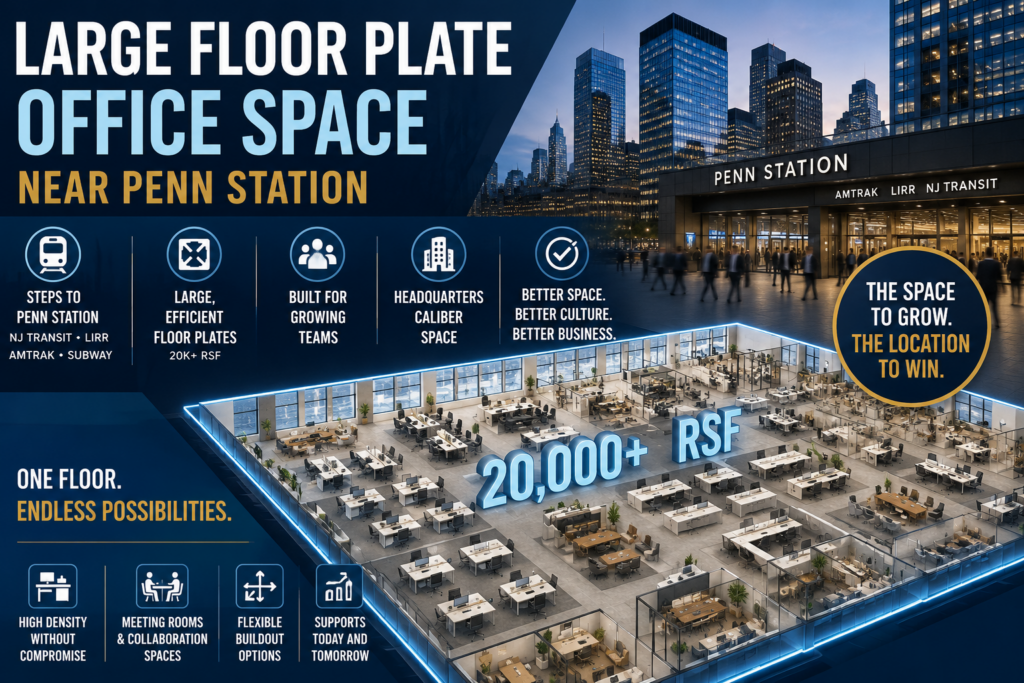
Large Floor Plate Office Space Near Penn Station
Why large floor plates matter near Penn Station
Penn Station solves one of the hardest problems in Manhattan office leasing. It shortens the trip for teams arriving from New Jersey, Long Island, and many city neighborhoods. As a result, a headquarters office near Penn Station often works better than a prettier address with a worse commute.
Scale matters just as much as location. A company with 20,000 RSF, 30,000 RSF, or more does not just need “space near Penn.” It needs a floor plate that supports density, circulation, meeting rooms, private offices, build-out flexibility, and future growth. That is a different problem from renting a prebuilt suite for twenty people.
Large floor plate office space near Penn Station also gives leadership one cleaner operating move. Instead of splitting departments across small floors, a tenant can keep teams together, preserve sight lines, simplify technology planning, and create a stronger day-to-day office culture.
That is why the phrase matters. It signals size, commute logic, and operational efficiency at the same time.
The real question is not whether Penn Station has office space.
The real question is where Penn Station still has true scale.
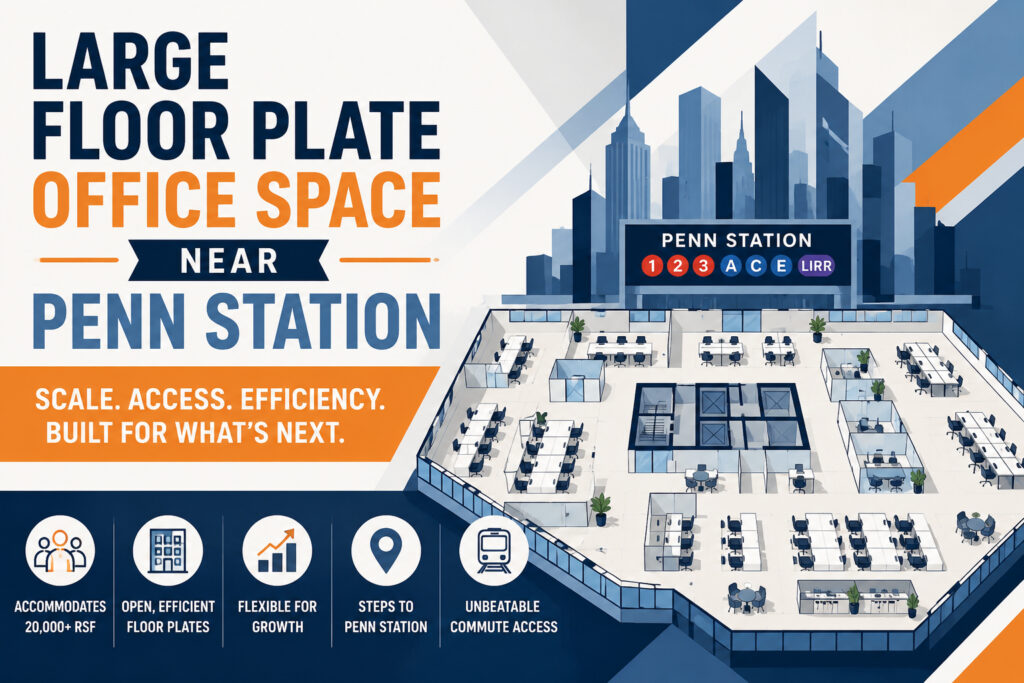
What large floor plate means in this corridor
In this part of Midtown, “large floor plate” should mean more than a broad listing page. It should mean one of three things. First, a full floor around 20,000 to 30,000 RSF. Second, a very large single floor above 30,000 RSF. Third, stacked contiguous blocks that behave like one headquarters move.
Here is the practical breakdown:
| Requirement | What it usually means near Penn Station | Best-fit building type |
|---|---|---|
| 20,000 RSF near Penn Station | One efficient full floor or a large partial with expansion rights | Repositioned Penn Plaza assets and select side-street full floors |
| 30,000 to 60,000 RSF | One major floor or two stacked floors with strong vertical identity | Penn Plaza towers and larger full-block properties |
| 60,000 RSF and up | True institutional block, podium floor, or multi-floor headquarters play | Trophy or campus-style towers |
That distinction matters because the neighborhood mixes several very different products. Some pages in this market focus on small private offices. Others focus on coworking or short-term space. A few market a single building. Only a limited group of buildings truly answer the large floor plate question.
For that reason, a tenant searching “20000 rsf penn station” should ignore most small-suite inventory. Start with buildings that can give you a full floor now and a credible growth path later.
If you want a broader starting point before narrowing to scale, review our current Penn Station offices.
Where true scale exists around Penn Station
The best contiguous blocks near Penn Station cluster in a small set of assets. Some sit directly above the station. Others sit one short walk away. A few offer full-floor opportunities with better economics than the headline towers.
At the very top end, 1 Penn Plaza remains one of the clearest headquarters answers in the corridor. It gives large users a massive tower environment, deep infrastructure, and station-level convenience. When a tenant wants a recognizable address, strong vertical transportation, and institutional-scale floor planning, this is the kind of building that belongs on the shortlist first.
Penn 2 pushes that scale even further. In practical terms, it sits in the rare category where a tenant can secure very large single-floor options instead of stitching several smaller floors together. That matters for firms that want major open work areas, training zones, trading-style density, or large departmental adjacencies. If you are deciding how Penn 2 fits within the broader district, compare our Penn District office space vs. Penn Station office space.
Below that top tier, several nearby buildings still offer real size. 31 Penn Plaza works well for tenants that want 20,000 to 27,000 RSF full floors and the possibility of a larger private block. 7 Penn Plaza fits firms that like efficient full floors in the mid-20,000 RSF range. 5 Penn Plaza adds broad loft-like floors with stronger ceiling heights and a repositioned feel. Meanwhile, 14 Penn Plaza often appeals to users that want full-floor scale without paying top-trophy economics.
Then there is the edge case that traps many tenants. Some side-street and Garment District buildings can look big on paper, yet the layouts feel chopped up, narrow, or hard to program. They may still work. However, they do not solve the same problem as a true headquarters-scale plate.
So, when you compare options, ask one blunt question: Does this floor act like a real operating platform, or just a large collection of rooms?
How to judge a 20,000 RSF requirement the right way
A 20,000 RSF requirement near Penn Station sounds simple. In practice, it is where tenant strategy starts to matter.
Some companies need one clean floor. Others need a visible client-facing office. Many need a recruiting address close to rail. A few need swing space now and expansion later. Those goals all point to different buildings, even when the square footage sounds identical.
Start with layout efficiency. A strong 20,000 RSF floor should let you place the open team area near light, keep executive and meeting rooms on the perimeter where needed, and avoid awkward dead zones around the core. If the plan forces you into long corridors or broken team clusters, the nominal size stops mattering.
Next, test the arrival. A headquarters office near Penn Station should feel coherent from the lobby forward. That does not require a trophy budget. Yet it does require a clean elevator arrival, decent ceiling height, and enough identity for clients and recruits. Full-floor control helps a lot here.
After that, look at future adjacency. Can the building give you the next partial floor, the next full floor, or a short-term bridge if growth hits faster than expected? Large users often win by staying ahead of the second move, not by solving only the first.
Finally, separate direct connection from short walk. Direct access changes the daily commute in bad weather and high-volume office attendance weeks. A one-block walk can still work very well. Still, it is not the same experience. If that distinction matters, compare our guide to office buildings with direct access to Penn Station with our guide to office buildings with direct access to Moynihan Train Hall.
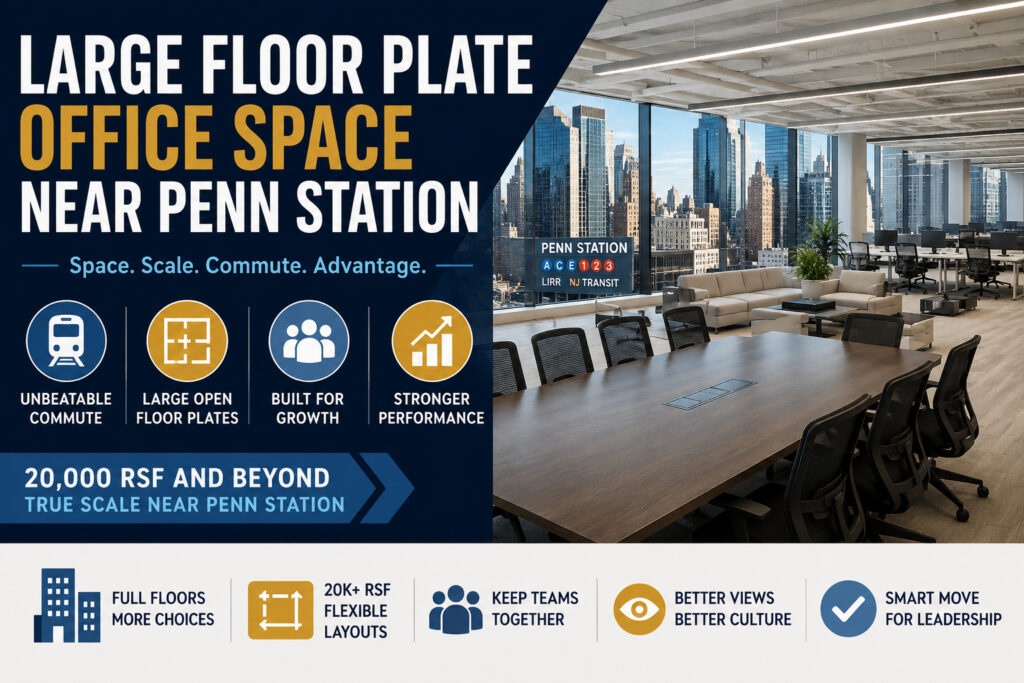
What rent, deal structure, and timing look like today
Penn Station offers more pricing spread than many tenants expect. That is part of its appeal. You can still find very different answers within the same commute zone.
| Product type | Working rent band today | Typical large-block story | Best for |
|---|---|---|---|
| Rebuilt or newly repositioned Class A towers | Roughly $85 to $110+ PSF | Big floors, premium common areas, stronger image | Enterprise users, client-heavy firms, prestige-sensitive groups |
| Repositioned Penn Plaza and nearby Class B assets | Roughly $55 to $75 PSF | Full floors, practical layouts, better value | Growth companies, operating HQs, cost-aware corporate users |
| Older loft or value product near the corridor | Roughly $40 to $55 PSF | Select full floors, creative feel, fewer building amenities | Budget-led teams, design-forward layouts, back-office functions |
Those are working bands, not universal rules. Build-out level, furniture, term, floor height, branding rights, and direct station access all move the number.
Concessions still matter. A built space can shorten your timeline and reduce upfront spend. A raw floor may win on customization, but it usually needs more runway and tighter project management. That is why deal structure matters as much as face rent.
For many large users, the real fork in the road is not tower versus loft. It is direct lease versus sublease. A sublease can compress timing and lower effective cost. A direct lease can deliver longer control and better expansion logic. If your brief could swing either way, compare our guide on Penn Station direct lease vs. sublease office space.
Another point deserves attention. Large blocks do not stay available like small suites do. In stronger markets, the best full floors vanish first. If your requirement sits above 20,000 RSF, start early enough to compare several real contenders, not just whatever remains.
Which nearby options fit different tenant profiles
Not every large user should chase the same building. The right answer depends on brand, density, and commute pattern.
If image leads the brief, start with the largest redeveloped towers in the Penn core. These buildings work best when the office must impress recruits, clients, and leadership at the same time. They also make the strongest case for a headquarters office near Penn Station because they blend scale with a fully modern common-area experience.
If operating efficiency leads, look at properties that give you full-floor control around 23,000 to 30,000 RSF. That band often lands in a sweet spot. You get true scale, better economics, and a simpler build-out story. Many firms find this range more useful than the ultra-large blocks because it is easier to program and cheaper to carry.
If authenticity matters, a repositioned loft-style building near Penn can still win. High ceilings, broad windows, and open plans may fit design, media, product, or engineering teams better than a glossy tower. Yet be careful. Many loft buildings near the station work best below true HQ scale. Once the requirement grows, efficiency can drop.
If your shortlist starts drifting west, do not assume Penn Station and Hudson Yards are interchangeable. They solve different commute and identity problems. Use our Penn Station vs. Hudson Yards office space comparison before you move the search area too far.
Likewise, if your brief is actually smaller, shorter, or already built, this page should not force the wrong fit. Use the more specific guides for short-term office space near Penn Station, small office space near Penn Station, prebuilt office space near Penn Station, and furnished office space near Penn Station.
How to choose the right large floor plate near Penn Station
Start with the commute. Penn wins when regional rail access drives attendance, recruiting, and office culture. If a large part of your staff enters Manhattan through Penn, do not underrate the value of a short last walk.
Then define the floor. Decide whether you need one clean full floor, stacked contiguous blocks, or a major podium-style plate. That single choice rules out a surprising amount of noise.
After that, set your identity threshold. Some firms need a landmark tower feel. Others need a smart, efficient, tenant-forward floor that simply works every day. Pay for the first only if it actually changes your hiring, client work, or long-term brand position.
Next, compare building logic, not just square footage. Ask about ceiling height, core placement, elevator queueing, expansion options, HVAC control, freight access, and whether the floor can support the density you want. One bad answer in those categories can erase the benefit of a great map pin.
Finally, keep the district language straight. Penn Station, Penn Plaza, Penn District, and Moynihan overlap, but they are not identical. That matters for pricing, walk routes, perception, and building type. If you need that distinction clarified before touring, read our Penn District office space vs. Penn Station office space guide first.
Find a Large Office Near Penn Station Today
Large floor plate office space near Penn Station is not one product. It is a narrow group of real options hiding inside a very broad market. The tenants who win here do not tour everything. They identify the handful of buildings that truly deliver scale, compare them against the actual brief, and move before the best contiguous blocks disappear.
Fill out our 📋 online form or give us a call today 📞 212-967-2061 — let’s find the right options for your business.