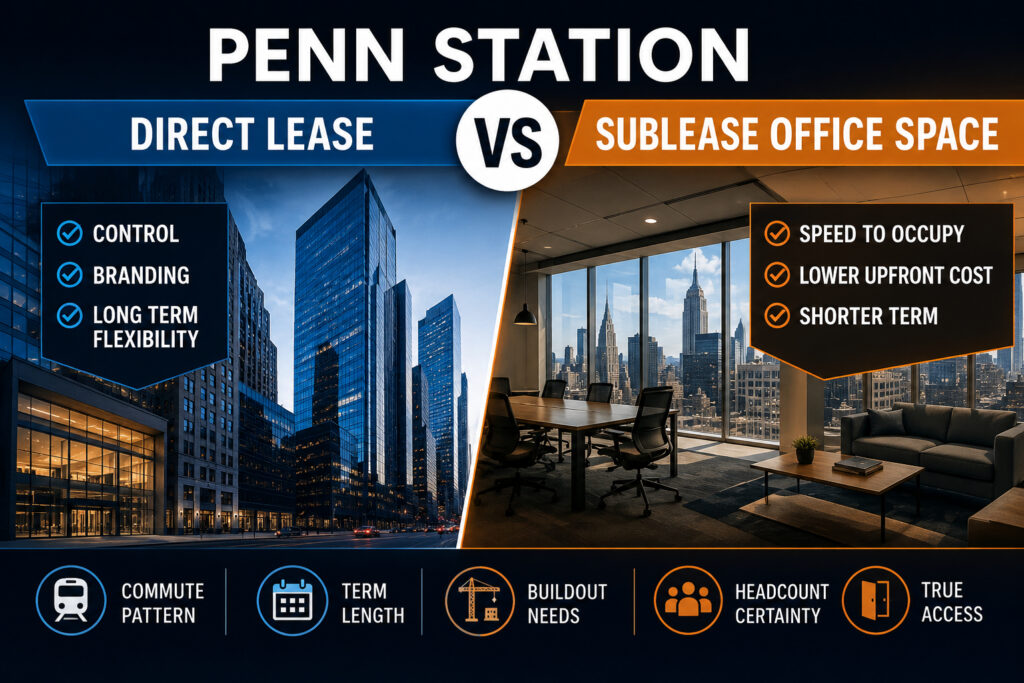
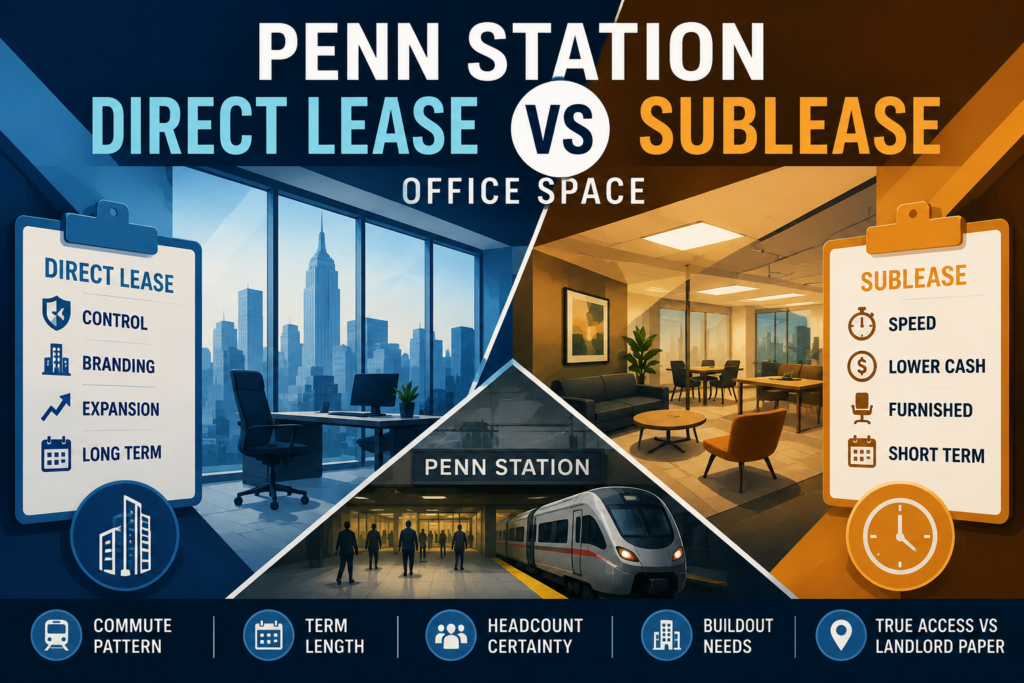
You should not choose Penn Station office space by headline rent alone. We represent tenants, not landlords. Our job is to compare the real tradeoffs before you commit.
Quick answer:A direct lease usually wins when you need control, branding, expansion rights, and a longer runway. A sublease usually wins when you need speed, lower upfront cash, furnished space, and a shorter term. Around Penn Station, the better option depends on five things: commute pattern, term length, buildout needs, headcount certainty, and whether “direct” means landlord paper or true indoor station access.
Why this question gets confusing
Many tenants use the word direct in two different ways. Some mean a direct lease with the owner. Others mean a building with direct indoor access to Penn Station or Moynihan Train Hall.
Those are not the same thing. A direct lease can sit two blocks away. A sublease can sit inside a directly connected tower.
That confusion matters near Penn more than almost anywhere else in Manhattan. The area mixes trophy redevelopments, classic Penn Plaza towers, loft buildings, Herald Square spillover space, and value stock north and south of the station.
You will also see pages blur Penn Station, Penn Plaza, and Penn District into one idea. The commuter draw overlaps. The office product does not.
What a direct lease near Penn Station actually gives you
With a direct lease, you sign with the landlord. That sounds simple because it is.
You control the main business terms. You can push on rent, free rent, tenant improvement money, expansion rights, renewal options, signage, work letters, and buildout scope. You also deal directly with ownership or management from day one.
That control matters most when your layout matters. Law firms need office count and conference ratios. Advisory groups need client-facing reception. Creative teams may want an open plan with phone rooms. Medical-adjacent users may need special plumbing, sound control, or dedicated HVAC hours.
Direct leases also open more inventory. Near Penn Station, you can find raw floors, prebuilt suites, fully refreshed direct space, and some furnished direct offerings. In other words, a direct lease does not always mean construction pain.
Still, direct deals usually ask more from you upfront. You may face a longer term, wider legal paper, a larger deposit, more diligence, and a slower path to occupancy. If the space comes in raw or lightly built, you also carry furniture, wiring, cabling, and move planning risk.
Direct leasing fits best when your business looks stable. It also fits when your office must reflect your brand, your client flow, or your long-term growth plan.
What a sublease near Penn Station actually gives you
A sublease works differently. You take space from an existing tenant rather than directly from the owner.
That structure can save real time. Many Penn-area subleases come already built, wired, and furnished. Some even feel ready on day one.
Speed is the biggest advantage. Cash conservation comes next. A sublease often lets you skip much of the early buildout spend that turns a “good direct rent” into a costly first year.
Subleases also solve timing problems. They work well for swing space, project teams, satellite offices, trial relocations, soft Manhattan entries, and companies that do not trust their headcount forecast yet.
Yet a sublease always comes with limits. Your term cannot outlast the prime lease. Your rights may depend on the master lease. Your alterations may need extra approvals. Your renewal path may disappear. Your repair chain may run through another tenant instead of directly through ownership.
That last point matters more than tenants expect. A cheap sublease loses some of its shine when the term ends just as your team finally settles in.
Subleasing fits best when speed beats perfection. It also fits when you want a strong location without funding a full new office from scratch.
Which is better near Penn Station, and why
For most tenants, neither choice wins on every line item. One wins on control. The other wins on speed.
A direct lease is usually better when you need the office to work exactly your way. That includes custom layout, long-term stability, future growth rights, and a direct relationship with ownership.
By contrast, a sublease is usually better when the office needs to work right now. That includes furnished delivery, shorter horizon planning, lower setup friction, and a faster move.
Penn Station changes the balance because commute utility has real value here. A better route to the building can save your team time every week. An easier rainy-day arrival can improve attendance. A cleaner client arrival can also matter more than a modest rent gap.
That means the “better” choice sometimes flips. A sublease inside a truly connected building can beat a cheaper direct lease several blocks away. On the other hand, a direct lease near the station can beat a flashy sublease if your team needs more control and less expiration risk.
So which is better? Here is the clearest tenant answer:
Choose a direct lease when your company wants control, longer stay certainty, stronger legal footing, and custom buildout value.
Choose a sublease when your company wants speed, cost control, near-term flexibility, and a built office you can use fast.
Choose either one only after you test the actual commute path, not just the address.
What Penn Station does to the decision
Penn Station is not one neat, uniform office market. It is several overlapping lanes.
At the top end, you have rebuilt or highly upgraded product with premium transit appeal. Those buildings pull prestige-driven tenants, larger floor users, and firms that care about direct station integration.
Around that layer, you have solid Class A and repositioned Class B stock. Those buildings often give the best balance of access, image, and cost.
A few blocks out, you still find loft-style, side-street, and value-oriented options. Some are direct. Some are sublets. Many work well for teams that want Penn’s commuter logic without paying station-core pricing.
That is why broad price talk often misleads. One tenant is comparing a premium, directly connected floor. Another is comparing a furnished sublet on a side street. Both say they are “looking near Penn.” They are not shopping the same product.
For live rent context, review How Much Does Office Space Near Penn Station Cost Today?. The short version is simple. The strongest direct product near Penn can run into the low-$100s per foot. Core Penn-adjacent Class A often falls much lower. Repositioned buildings can sit in the mid-range. Value-driven sublets can still show real discounts, especially when a tenant wants speed.
What does “short-term office near Penn Station” usually mean
In practice, a short-term Penn office usually means one of three things.
First, it may mean a true sublease with time left on the prime term. That is the cleanest short-term path.
Second, it may mean a direct lease in a prebuilt suite where the owner will accept a shorter commitment than a raw floor would command. That happens more often than many tenants think, especially in smaller suites.
Third, it may mean furnished space with service layers attached. However, that is a different product category from a conventional office lease, and it should not replace this decision unless you truly want that model.
If your actual goal is twelve to thirty-six months, start by pricing subleases first. Then compare them against prebuilt direct space. Many tenants discover that “cheaper asking rent” and “cheaper first-year occupancy” are not the same thing.
How to compare direct and sublease space without fooling yourself
Ask these questions before you fall in love with a floor.
What is the true end date? A sublease term ends when it ends. Your business does not get to wish for another year.
Who controls extensions? A direct lease can build renewal rights into the deal. A sublease often cannot promise the same certainty.
What comes with the space? Furniture, wiring, server room setup, pantry build, phone booths, and reception millwork all carry value.
Can the layout change? Direct deals usually allow more freedom. Subleases often come as-is.
Who fixes everyday issues? A direct tenant speaks to management. A subtenant sometimes speaks through another tenant.
Is the commute truly better? Near Penn, one block can change the daily experience more than a brochure admits.
Does the building connect indoors, or is it just nearby? That distinction matters in bad weather, for heavy commuter teams, and for client arrivals.
What is the real first-year cost? Do not compare rent alone. Add legal costs, furniture, IT, move costs, electricity, after-hours HVAC, and downtime.
What kinds of tenants usually choose each option
A stable law, finance, or advisory firm often benefits from a direct lease. These groups usually care about control, permanence, layout, and client presentation.
A growing startup, media company, or hybrid team often leans toward sublease first. Fast occupancy and lower setup spend matter more there.
A project office, temporary relocation, or overflow group almost always starts with sublease logic. The goal is speed and useful space, not long-term perfection.
A first Manhattan office can go either way. If the team wants to test the market, a sublease often makes more sense. If the business already knows its headcount and brand standard, a direct lease can create better long-term value.
Real Penn-area examples to compare
If you want live internal examples, start with a direct lease and a sublease that feel close enough to compare honestly.
Do not use those pages as a simple price ladder. Use them as a decision test.
One may save cash. Another may save time. A third may save future disruption.
That is the point.
The biggest mistakes tenants make near Penn Station
The first mistake is mixing up the district names. Penn District, Penn Plaza, Penn Station, Herald Square, and the surrounding side streets do overlap. They still trade differently.
Another mistake is assuming every space near Penn offers the same commute. A direct indoor connection is not the same as a short outdoor walk.
A third mistake involves rent comparison. Quoted rent without fit-out context tells only part of the story. A furnished sublease at a higher number can still beat a cheaper raw direct lease on first-year cash.
Many tenants also ignore expiration risk. That hurts when the sublease works well but ends too soon.
Finally, some groups overbuy image and underbuy functionality. The office should support the commute, the budget, the layout, and the business plan. It should not win on lobby photos alone.
The tenant-side conclusion
If you want the sharpest single answer, here it is.
Direct lease near Penn Station is better for control. Sublease near Penn Station is better for speed.
Now the more important answer. The best choice is the one that matches your term, your commute pattern, your office readiness, and your tolerance for future disruption.
That is why tenants should not ask only, “Which costs less?” They should ask, “Which creates the best result for the next two to seven years?”
Looking for Space Today
We help tenants answer that question from the tenant side. We compare the real options, not just the loudest ones. Then we pressure-test the economics, the layout, and the commute before you sign anything.