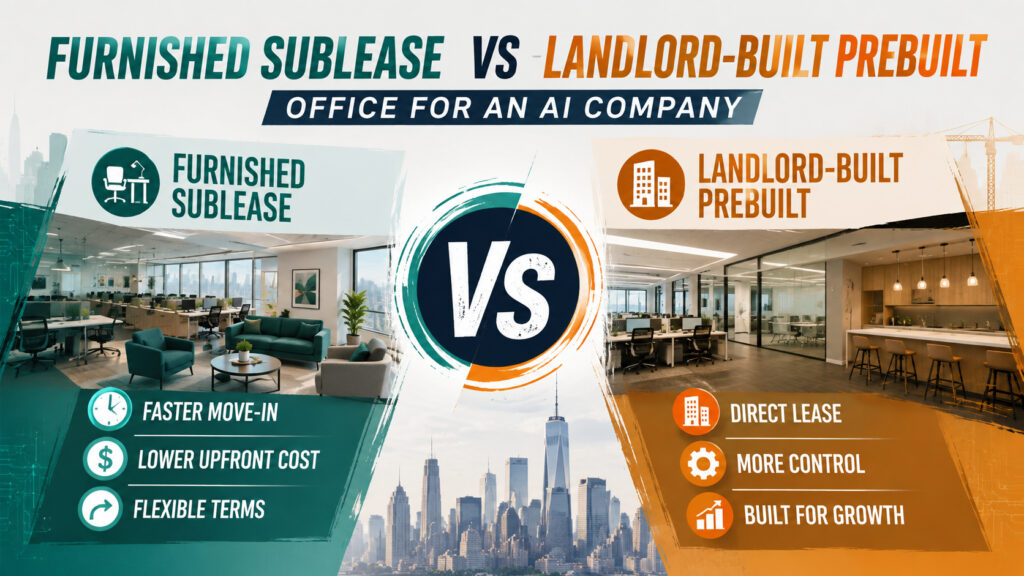
Furnished Sublease vs Landlord-Built Prebuilt Office for an AI Company
The direct answer for an AI company
A furnished sublease usually wins when speed, short commitment, and low initial cash matter most. By contrast, a landlord-built prebuilt often wins when control, continuity, and direct ownership access matter more. Neither product wins automatically, because “move-in ready” can hide meaningful technology and occupancy costs.
For many AI teams, one question should control the comparison. What will this office cost through the intended occupancy period? Asking rent alone cannot answer that question.
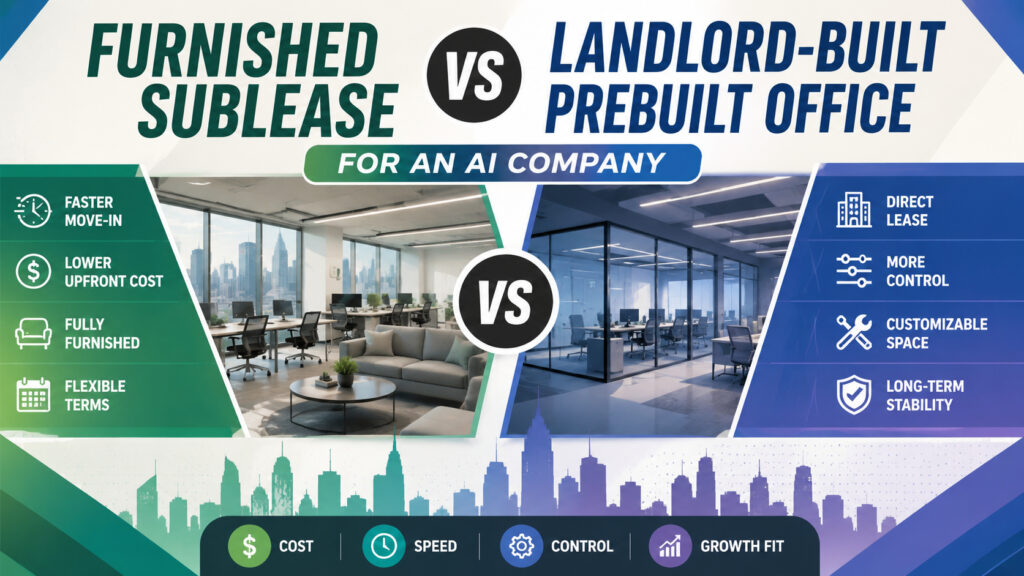
A furnished sublease can include desks, conference rooms, pantry equipment, cabling, and an existing layout. Therefore, the tenant may avoid major furniture and construction spending. However, the tenant accepts another company’s layout and the remaining master-lease term.
A landlord-built prebuilt gives the tenant a direct lease with building ownership. The suite already has walls, lighting, pantry infrastructure, finishes, and mechanical distribution. Yet furniture, live internet, access controls, audiovisual systems, and supplemental cooling may still require work.
| Decision factor | Furnished sublease | Landlord-built prebuilt |
|---|---|---|
| Upfront cash | Usually lower when useful furniture remains | Often higher when furniture and technology remain unfunded |
| Move-in speed | Often fastest when consent and technology are ready | Fast when lease, punch list, and technology align |
| Lease term | Limited by the master lease | Negotiated directly with ownership |
| Layout control | Usually limited | Usually better, though completed construction limits major redesign |
| Furniture | Often included or separately transferred | Sometimes included; never assume |
| Internet | Existing cabling may help | Strong building connectivity still requires tenant service |
| Expansion | Depends on sublandlord and building | Easier to negotiate directly with ownership |
| Renewal | Usually uncertain beyond sublease expiry | Negotiate directly in the lease |
| Counterparty | Existing tenant plus building ownership | Building ownership |
| Best fit | Volatile headcount or short runway | Longer horizon or stronger growth conviction |
The key distinction is contractual, not visual. A beautiful furnished suite can still carry sublease risk. Likewise, a prebuilt suite can feel completely turnkey while lacking operational technology.
Speed favors whichever office needs the fewest unfinished steps. A perfect furnished sublease may beat a new prebuilt by weeks. Conversely, a prebuilt with live connectivity may beat a sublease awaiting ownership consent.
Cost favors the better complete package, not necessarily the lower rent. Furniture, wiring, deposits, concessions, and future relocation can overwhelm a modest rent difference.
Flexibility has two meanings. Short commitment creates financial flexibility. Expansion rights, renewal rights, and direct ownership access create operational flexibility.
That distinction matters for AI companies. Fast hiring may make a short lease dangerous rather than flexible. Slower hiring may make a long direct lease unnecessarily restrictive.
For broader lease structures, review our AI company office space in Manhattan guide. This page focuses only on the furnished-sublease versus landlord-prebuilt decision.
What furnished, prebuilt, turnkey, and plug-and-play actually mean
Furnished describes what sits inside the office. It does not describe who grants your occupancy rights.
A furnished office may come through a sublease or a direct lease. The furniture can belong to several different parties. Therefore, every proposal should identify furniture ownership and removal rights.
That issue sounds minor until a move approaches. The outgoing tenant may remove screens, chairs, televisions, appliances, or networking equipment. A written inventory prevents those surprises.
A furnished sublease places your company under another tenant’s leasehold interest. Your sublease cannot create more term than the underlying lease provides. The master lease also shapes permitted uses, alterations, assignment rights, and other operating rules.
That structure creates a practical dependency. Your team negotiates economics with the sublandlord, while building ownership may retain approval rights. Counsel should review the master lease, consent document, and sublease together before signature.
Commercial lease language can impose specific consent requirements. Consequently, a seemingly simple furnished transaction can involve more documents than a direct lease.
A landlord-built prebuilt is a completed suite that ownership prepared before securing your company. Many market participants also call this a spec suite. The tenant signs a direct lease rather than stepping under another tenant.
Prebuilt does not necessarily mean furnished. It also does not guarantee active internet, configured conference technology, or tenant-specific security. Those items require a written scope.
A landlord might deliver polished floors, glass offices, lighting, pantry millwork, and conference rooms. Meanwhile, the tenant might still need every desk and technology component.
Turnkey should mean the tenant can operate with minimal additional work. In practice, the label varies widely. One suite may include desks and live connectivity, while another only includes completed construction.
For that reason, replace the word “turnkey” with a delivered-condition schedule. Ask what ownership or the sublandlord will leave on possession day.
Plug-and-play implies an even higher level of readiness. Still, treat the phrase as a checklist prompt rather than a contractual promise. Confirm each included item before comparing costs.
At minimum, ask whether the suite includes:
| Readiness item | What to verify |
|---|---|
| Workstations | Quantity, dimensions, condition, and ownership |
| Chairs | Quantity, condition, and ergonomic suitability |
| Conference rooms | Table, chairs, screen, camera, microphone, and cabling |
| Pantry | Appliances, water connection, refrigeration, and equipment ownership |
| Cabling | Cable type, tested ports, patch panels, and termination points |
| Internet | Active service or cabling only |
| Wireless network | Hardware ownership, credentials, coverage, and transfer rights |
| Access control | Cards, readers, administrator rights, and replacement process |
| AV systems | What works and what transfers |
| Server or IDF room | Power, cooling, rack, and security |
| Signage | Existing removal and new installation rights |
| Cleaning | Building service, tenant service, or separate contract |
Our NYC furnished and turnkey office space guide explains these condition labels in greater depth.
The most important takeaway is simple: furniture condition and lease structure are separate variables. That distinction prevents false comparisons.
A direct prebuilt can also arrive furnished. Meanwhile, a sublease may need substantial cabling, security, or furniture replacement. Compare the actual rights and delivered condition, not the marketing label.
Compare total move-in cost instead of asking rent
Manhattan pricing gives useful context, but a market average cannot price a specific suite. During Q2 2026, broad average asking rent measured $80.17 per square foot. Average sublease asking rent measured $59.94 per square foot. The reported sublease availability rate stood at 2.6%.
That broad asking spread equals about 25.2%. However, it does not prove that one matched sublease will beat one matched prebuilt by 25.2%.
Building class can change the answer. So can location, floor, term, condition, concessions, tenant credit, and furniture value.
Use each market number as a benchmark, not a quote. A landlord prebuilt may price above or below a broad average. Likewise, a premium furnished sublease may command stronger economics than ordinary sublet inventory.
For context, a 5,000-square-foot office at $60 per square foot produces $300,000 in annual base rent. The same size at $80 produces $400,000.
Over 24 months, that simple base-rent difference reaches $200,000. Yet the cheaper rent can still lose after adding missing furniture, technology, or another relocation.
Therefore, we model both day-one cash and total occupancy cost.
Day-one cash measures money needed before the company becomes operational.
| Cost category | Furnished sublease | Landlord-built prebuilt |
|---|---|---|
| Security | Sublandlord requirement and transaction terms | Direct landlord requirement |
| First rent | Based on sublease economics | Based on direct lease economics |
| Furniture | Often included, transferred, or licensed | Often a separate purchase or lease |
| Data cabling | Existing system may reduce work | May need tenant-specific installation |
| Internet activation | Verify carrier, circuit, and delivery date | Verify carrier, circuit, and delivery date |
| Security systems | Existing equipment may or may not transfer | Usually requires tenant-specific configuration |
| AV equipment | Existing equipment may remain | Often tenant-provided |
| Moving | Required | Required |
| Minor alterations | Usually more constrained | Often easier to coordinate directly |
| Professional costs | Legal, technical, and project costs vary | Legal, technical, and project costs vary |
Next, calculate total occupancy cost for your planned horizon.
Include rent, escalations, electricity, after-hours HVAC, cleaning, technology, and expected relocation costs. Subtract negotiated free rent and other economic concessions.
A useful internal formula looks like this:
Total occupancy cost = rent + recurring charges + startup costs + technology + move costs + exit costs − concessions.
Then calculate a second measure:
Cost per occupied seat-month = total nonrecoverable occupancy cost ÷ expected occupied seat-months.
That metric helps fast-growing teams avoid a common mistake. A cheap office becomes expensive when half the desks sit empty.
Conversely, a higher rent can work economically when density and expansion rights prevent another move. The calculation should reflect real expected occupancy rather than maximum legal capacity.
Separate refundable cash from nonrecoverable cost. A security deposit affects liquidity even when the tenant expects its return. Therefore, include it in cash-at-signing calculations.
Do not treat the security amount as ordinary rent. The exact requirement depends heavily on credit and transaction structure.
Our office lease proposal and term sheet checklist covers that issue separately. This comparison only needs the deposit as a cash-use line item.
Normalize concessions before comparing rent. One direct lease may include free rent. Another may quote lower face rent with fewer concessions.
Calculate both over the same assumed occupancy period. Otherwise, a three-year prebuilt and an eighteen-month sublease create an apples-to-oranges comparison.
Price the second move. A short sublease can protect against uncertain hiring. However, its expiration may force another brokerage, legal, moving, technology, and downtime cycle.
That future event belongs in today’s decision model. Ignoring it makes short-term space look artificially inexpensive.
Finally, do not assign zero cost to “included” furniture. Inspect its condition, quantity, ownership, and removal terms.
Missing chairs create replacement costs. Broken sit-stand desks create another expense. Incompatible conference systems can erase much of the supposed turnkey advantage.
Speed, lease term, control, and growth separate the two products
Both products can save months compared with a major custom build. Historic transaction research found landlord-built deals reached commencement about 33% faster than tenant-built deals.
The same research found recent effective-rent premiums as high as 18.9% for landlord-built product. Those figures cover 2018 through 2024. Therefore, treat them as trend evidence rather than 2026 pricing.
Current leasing behavior still favors ready product. For offices below 10,000 square feet, one 2026 industry analysis reported an 80% move-in-ready share. It also found those suites leased around 50% faster.
Yet lease signing speed and operational speed are different clocks.
A tenant can sign quickly and still wait for connectivity. Building access, insurance, furniture delivery, security provisioning, and network activation can control the actual start date.
A furnished sublease often compresses the physical preparation timeline. Still, landlord consent can introduce another approval step. A strict twelve-month requirement can also narrow the viable pool sharply.
That issue matters more in today’s tightening sublease market. July 2026 Manhattan availability fell to 12.7%.
Sublet inventory dropped 26.4% year over year. It also reached its lowest level since August 2019.
Therefore, “we only need twelve months” does not automatically make a sublease easy. The remaining terms must line up with your desired start and exit.
Meanwhile, the right layout must appear at the same time. Furniture and technical readiness must also match the company’s needs.
A sublease term comes from somebody else’s lease clock. You cannot create thirty-six months when the master lease has eighteen months remaining.
That constraint can help or hurt. It helps when the remaining term matches your bridge requirement. It hurts when a strong space expires six months too early.
A direct prebuilt creates a new lease clock. Ownership and the tenant negotiate the initial term together.
That usually gives the parties more room to discuss renewal and future growth. However, ownership may seek a longer commitment for that stability.
Headcount volatility should drive the term decision. Model at least a downside, base, and upside hiring case. Then test each space against all three cases.
For example, a 35-person team may expect 70 employees within eighteen months. A short sublease could become a bridge rather than a destination.
That bridge works only when another move will not disrupt recruiting or operations. Otherwise, the apparent flexibility can create avoidable occupancy churn.
Alternatively, a prebuilt may support internal growth without immediate relocation. The value rises when ownership controls nearby suites.
Yet expansion rights have value only when the lease defines them clearly. A verbal expectation of future space should not drive a major commitment.
Control also affects everyday operations. A direct tenant can usually address lease matters with ownership directly. A subtenant often works through another contractual layer.
That difference matters when a team needs alterations, service changes, signage, access adjustments, or growth discussions.
Location also affects growth choices. In H1 2026, AI companies leased 1.50 million square feet across 63 Manhattan transactions.
Midtown South captured 75.1% of all technology leasing activity during that period.
Strong demand can reduce the time available for indecision. Consequently, teams should complete financial, legal, and technical preparation before the right office appears.
Our guide to how fast an AI company can lease Manhattan office space covers the full transaction timeline.
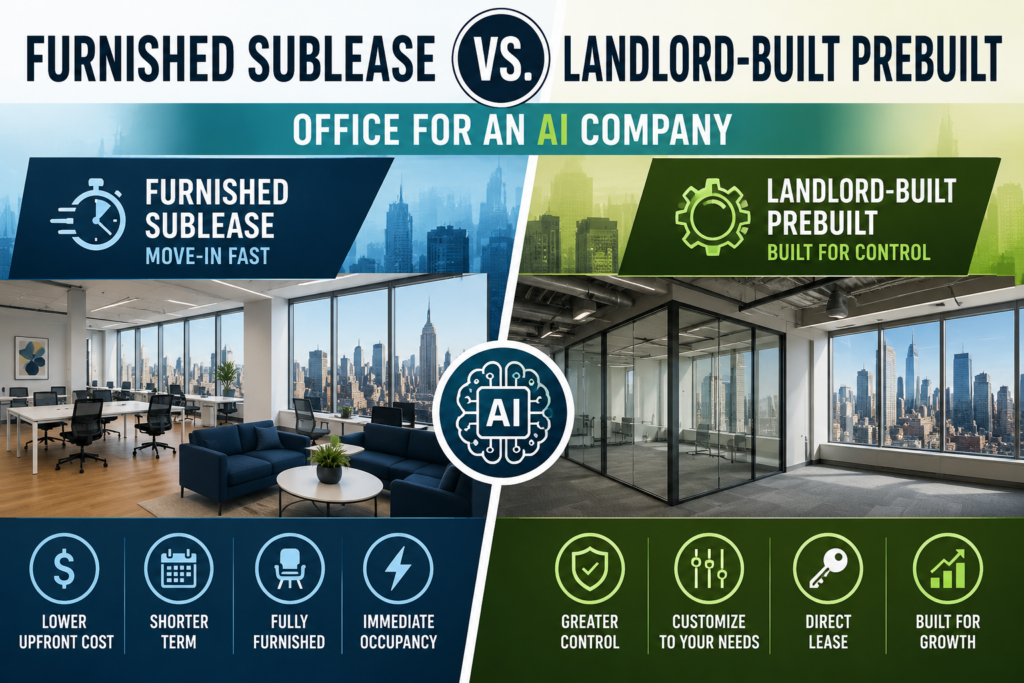
AI companies need to inspect the office behind the furniture
A furnished desk does not make an office AI-ready. An AI company may rely on cloud infrastructure, local hardware, or both. However, every team depends on reliable connectivity and secure access.
The office should support how the company actually develops, meets, tests, hires, and protects information. Therefore, technical diligence should start before lease negotiations finish.
Start with internet delivery, not Wi-Fi branding.
Ask which carriers can serve the suite today. Then confirm circuit type, lead time, demarcation point, riser access, and installation responsibility.
Recent 2026 research found network setup still taking eight to ten weeks in some move-in-ready offices. That work cost tenants about $2 to $4 per square foot in the cited analysis.
Therefore, an office available tomorrow may not support full operations tomorrow. Request a written connectivity plan before signing.
A temporary circuit can help. Still, it should not replace the long-term solution without a deliberate technology decision.
Next, examine provider diversity and resilience.
Modern digital requirements increasingly favor adaptable infrastructure, multiple providers, and strong indoor mobile coverage.
For a furnished sublease, identify which cabling remains after the prior tenant leaves. Test ports rather than trusting labels.
Also confirm ownership of switches, access points, racks, patch panels, and other network equipment. An impressive network closet has little value when everything leaves.
For a prebuilt, inspect the telecom closet and pathway to the building riser. New finishes do not guarantee a complete tenant network.
Ownership may deliver pathways while the tenant supplies electronics and service. Make that division clear before comparing move-in costs.
Power requirements deserve a separate review.
Standard software office requirements can differ dramatically from local compute requirements. Therefore, tell the technical team what hardware will actually operate onsite.
Teams running local GPU servers may need additional power and cooling. Robotics, hardware testing, or laboratory equipment can create different requirements.
Provide equipment loads before committing. Then confirm panel capacity, dedicated circuits, heat output, cooling, and installation feasibility.
Do not assume a premium office can support any hardware load. The engineering review should answer that question.
Cooling matters most in enclosed technical rooms.
Ask whether the IDF or server room has independent cooling. Also ask how after-hours HVAC works for occupied areas.
A beautifully finished suite can become expensive when technical equipment requires supplemental cooling. That cost belongs in the move-in model.
Security should match the company’s work.
Check suite access, visitor control, camera rules, network-room locks, and after-hours entry. Sensitive work may also justify stronger acoustic privacy.
Private conversations need suitable rooms. Investor discussions may need similar separation. Enterprise client calls can create additional confidentiality requirements.
Conference rooms deserve practical testing.
Count rooms by expected simultaneous use, not brochure photographs. Then verify displays, cameras, microphones, power, cabling, and acoustic separation.
A ten-person conference room without working video equipment is not fully operational. Likewise, five small rooms may outperform one large boardroom.
Inspect the working day, not only the floor plan.
Confirm building access, loading procedures, freight access, HVAC charges, cleaning rules, and incident contacts.
Late-working engineering teams can expose service gaps quickly. Weekend access can matter for deployments, customer work, or hardware projects.
Major physical alterations can add permitting and design work. City rules require permits for most construction. Licensed design professionals file many alteration plans.
That makes completed space especially valuable when it already fits. Still, a prebuilt loses its timing advantage if your team immediately redesigns major portions.
Negotiate sublease and prebuilt risks before signing
The cheapest furnished sublease can carry the wrong risk. Likewise, the cleanest prebuilt can create excessive long-term liability. Both products require disciplined diligence.
For a sublease, start with the master lease.
Confirm the remaining term, permitted use, operating rules, and consent requirements. Your counsel should reconcile those provisions with the proposed sublease.
Then review the consent process. Determine who must approve the transaction and what information they require.
Also identify any conditions that could delay possession. Financial statements, insurance requirements, or document revisions can affect timing.
Understand the sublandlord relationship.
Determine who collects rent, handles notices, coordinates services, and communicates with ownership.
The structure adds another contractual layer between your team and the building. That extra layer matters when problems arise.
Ask what happens when the sublandlord needs ownership approval. Likewise, identify the procedure for repairs, access issues, or service complaints.
Furniture needs its own schedule.
List desks, chairs, conference tables, appliances, AV equipment, and accessories. State whether each item transfers, remains licensed, or leaves before possession.
Photographs can support the schedule. However, the written agreement should identify what your company actually receives.
Technology requires similar precision. Identify cabling, racks, wireless hardware, circuits, and conference equipment.
Never assume “wired” means active internet service. Likewise, do not assume the existing carrier contract can transfer.
A sublease also has an expiration problem.
Your occupancy cannot simply outlive the underlying rights. Therefore, model the cost and disruption of another move before accepting a short bridge.
Ask what happens ninety days before expiration. Then identify the likely next-space strategy before the company faces deadline pressure.
For a landlord prebuilt, focus first on delivery condition.
Attach a clear plan and written scope. Include unfinished punch-list items, furniture commitments, technology responsibilities, and completion dates.
A new suite may still have unfinished details. Doors may need adjustment. AV may remain absent. Network service may still need installation.
Examine economics beyond base rent.
Review escalations, operating charges, electricity, after-hours services, and other recurring items.
Compare those expenses on the same time horizon. A lower asking rent can lose after recurring charges increase.
Review growth and exit language.
Renewal, expansion, contraction, assignment, and sublease rights can matter more than small rent differences. Their value increases when headcount remains uncertain.
Alteration rights also matter. A completed prebuilt may restrict changes that affect new finishes or building systems.
Discuss branding, walls, security devices, supplemental cooling, and cabling before signature. Waiting until move-in can create unnecessary delay.
Separate physical possession from operational readiness.
Insurance and access conditions can delay occupancy. Therefore, assign responsibility for certificates, credentials, freight scheduling, and vendor approvals early.
Finally, distinguish lease commencement from rent commencement. These dates can differ.
Your team should understand when it gains access. It should also understand when obligations and rent start.
A useful LOI comparison keeps equivalent issues side by side:
| LOI issue | Furnished sublease question | Landlord-prebuilt question |
|---|---|---|
| Premises | Does the sublease cover the complete intended suite? | Does the lease plan match the delivered suite? |
| Term | Does expiration align with the master lease? | What initial term and renewal structure fit the plan? |
| Possession | Does consent control the handover date? | Does punch-list completion affect access? |
| Rent start | When does payment begin after possession? | How do free rent and commencement interact? |
| Furniture | What stays, who owns it, and who removes it? | What furniture, if any, does ownership provide? |
| Internet | Can existing circuits transfer? | Which carriers and pathways support installation? |
| Alterations | Which changes can the subtenant make? | Which changes will ownership approve before occupancy? |
| Expansion | Can more space enter the same structure? | Can the tenant secure rights to nearby space? |
| Surrender | What must the subtenant remove or restore? | What condition must the tenant deliver at expiration? |
Do not wait for the lease draft to raise operating issues. The LOI should settle major business points first.
That approach reduces avoidable legal rounds and late economic surprises. It also lets technical teams identify deal-breaking issues earlier.
Before signature, create one responsibility matrix. Assign every unfinished item to the tenant, sublandlord, landlord, or vendor.
Add a due date and acceptance standard beside each task. Then use that document through move-in.
The matrix should cover furniture, cabling, internet, access cards, AV, security, cleaning, signage, and minor repairs. It should also identify required building approvals.
After signature, use the same matrix as a move-in tracker. This simple step prevents “turnkey” from becoming a collection of unwritten assumptions.
Finally, this page does not replace legal or technical advice. Commercial lease language varies materially by transaction.
Use qualified counsel and technical professionals for the final documents and infrastructure review.
Which option fits your AI company right now?
Choose the product that matches your operating facts, not your preferred label. Funding stage matters, but headcount certainty often matters more.
A company awaiting a major funding decision faces different risks from an established growth company. Likewise, a hardware-heavy team faces different constraints from a cloud-based software group.
A furnished sublease usually deserves priority when:
You need occupancy quickly. Your preferred horizon remains relatively short.
The existing layout already works. Furniture has real value to your team.
Major technical modifications are unnecessary. Another relocation would remain manageable.
This route can also fit companies preserving cash before another funding milestone. However, budget for the next move from day one.
A cheap bridge loses value when relocation arrives unexpectedly.
Consider a landlord-built prebuilt first when:
You expect a longer Manhattan presence. Direct ownership access matters.
Expansion rights could prevent another move. Client-facing presentation carries material value.
Your team wants a cleaner operational relationship. The company also has greater confidence in future headcount.
This route can fit funded teams with clearer hiring plans. Still, compare the furniture and technology budget carefully.
A polished suite may require meaningful work behind the walls.
The strongest hybrid may be a furnished direct prebuilt.
That product combines a direct landlord relationship with existing furniture. It can reduce the traditional tradeoff between control and startup cost.
Availability remains deal-specific. Therefore, do not assume every prebuilt includes furniture.
Recent listing examples show why labels need careful reading. A 2,530-square-foot furnished Hudson Square office uses a direct lease structure and prebuilt condition.
At a larger scale, an 11,907-square-foot furnished Hudson Yards office is marketed as direct, move-in-ready prebuilt space.
Sublease examples can look equally finished. A 7,000-square-foot furnished SoHo office includes furniture and wiring.
Its listing states a sublease term through August 31, 2027.
The broader Manhattan office sublet inventory recently included options from about 5,000 to 17,500 square feet.
Availability changes quickly. Therefore, verify current status, asking economics, furniture, term, and delivery condition before relying on any listing.
Think about the office as a bridge or a basecamp.
A bridge solves a known short period. It should minimize sunk cost and simplify the eventual exit.
A basecamp should support hiring, meetings, culture, security, and growth for a longer period. It needs more durable rights.
Many bad decisions come from mixing those goals. A company chooses a bridge but expects basecamp stability.
Alternatively, a team signs a basecamp lease while its business plan still requires bridge-level flexibility.
Use this decision test before touring:
| Your priority | Product to test first | Why |
|---|---|---|
| Lowest initial cash | Furnished sublease | Existing furniture and layout can reduce startup spending |
| Hard short-term horizon | Furnished sublease | Remaining term may align with a bridge requirement |
| Direct landlord relationship | Prebuilt | Direct lease removes the sublandlord layer |
| Strong growth probability | Prebuilt | Negotiate expansion and renewal rights directly |
| Immediate physical readiness | Compare both | Actual condition matters more than structure |
| Sensitive technical needs | Compare both after technical review | Infrastructure can override economic advantages |
| Investor or client presentation | Usually prebuilt, but compare quality | Excellent subleases can also present well |
| Maximum short-term flexibility | Usually sublease | A short remaining term can reduce long liability |
| Lowest relocation risk | Usually prebuilt | A longer direct term can support continuity |
The best answer can change after one tour. A sublease with perfect density may beat a cheaper alternative.
Conversely, a furnished prebuilt may erase enough startup work to justify higher rent. The comparison should remain quantitative until the final choice.
Compare turnkey options by total move-in cost
Before choosing a furnished sublease or landlord-built prebuilt, compare both on one worksheet. Use the same square footage, headcount case, occupancy horizon, and move-in date.
Start with five totals. Measure cash at signing, cash before occupancy, monthly run rate, total horizon cost, and cost per seat-month.
Then add a separate risk note for term, growth, technology, and exit.
Do not let free furniture hide a poor term. Similarly, do not let new finishes hide a large technology budget.
The winning office should protect runway while supporting the company’s next operating stage.
What exactly remains in the office?
Create a written furniture and equipment inventory. Test important equipment before assigning it value.
When can the team actually work there?
Use the internet delivery date, not only the legal possession date. Add access, insurance, security, and furniture tasks.
What happens if headcount doubles?
Identify internal expansion, nearby space, or the next relocation path. Price that path before signing.
What happens if hiring slows?
Measure the fixed liability under the signed structure. Do not rely on hoped-for assignment or sublease rights.
Who controls the critical operating relationship?
Map the landlord, sublandlord, building management, and service-provider roles. Know who can approve each important request.
Which option consumes less cash before revenue or funding changes?
Compare deposits, rent, furniture, technology, moving, and professional costs together.
Which option creates the lower two-year or three-year occupancy cost?
Normalize every concession and recurring charge over the same period.
Is a landlord-built prebuilt the same as a build-to-suit office?
No. A prebuilt already exists before your company chooses it.
By comparison, a build-to-suit process creates a more tenant-specific design and usually takes longer.
Is a furnished office automatically a sublease?
No. Furnished direct leases exist.
Always identify the legal lease type separately from the furniture condition.
Is a prebuilt office automatically furnished?
No. Many completed suites include construction but not desks, chairs, AV, or active internet.
Confirm the exact delivery scope.
Which option usually costs less upfront?
A furnished sublease often starts lower when useful furniture and cabling remain.
Yet a direct prebuilt can compete after concessions and startup costs.
Which option usually has lower asking rent?
Broad Manhattan data currently shows lower average sublease asking rents than overall asking rents.
A matched-suite comparison can produce a different result.
Which option gets an AI team working faster?
The answer depends on the slowest critical task.
Consent can slow a sublease, while network delivery can slow either product.
Can we move into a furnished office before permanent internet arrives?
Sometimes. A temporary connectivity solution may bridge the gap.
Confirm performance, security, cost, and installation timing before relying on it.
What if our headcount could double within one year?
Value expansion rights and nearby availability before chasing the lowest rent.
Also model the cost of moving twice.
What if our headcount could shrink after a funding milestone?
A shorter sublease can reduce long fixed liability.
However, verify the term and exit obligations rather than assuming flexibility.
Does an AI company need special electrical capacity?
Not always. Cloud-based software teams may resemble other technology offices.
Local compute, labs, robotics, or hardware can change the requirement materially.
Does Midtown South make sense because it leads recent AI-related technology leasing?
Not automatically. Current activity is strong there, but commute patterns, budget, inventory, clients, and hiring should drive location.
A tighter technology market can also increase competition for suitable ready space. Therefore, neighborhood popularity should not replace property-level analysis.
How should we value furniture in a sublease?
Use condition and replacement value, not the seller’s original purchase price.
Also confirm that the sublandlord owns the items it offers.
Can we customize a prebuilt?
Usually to some degree, subject to ownership approval and lease terms.
Major changes can erase the time advantage of choosing completed space.
Can we customize a furnished sublease?
Sometimes, but the master lease and consent documents can limit changes.
Short remaining terms can also make costly modifications uneconomic.
What does “wired” mean in a listing?
It may only mean cabling exists.
Ask whether circuits remain active and whether equipment transfers with the space.
What does “immediate occupancy” really mean?
It should mean the premises can transfer promptly.
Your operational date may still depend on legal, insurance, technology, and building-access tasks.
How should we compare a one-year sublease with a three-year prebuilt?
Do not compare total lease dollars alone.
Compare the first year on equal terms, then price the renewal or relocation path.
Should coworking enter this comparison?
Only when your company can accept a different operating model.
Shared-service workspace differs from a private sublease or direct lease.
For a company seeking dedicated premises, that distinction matters. This comparison therefore stays focused on private leased or subleased office space.
Why not simply choose the cheapest rent?
Because rent excludes technology, furniture, security funding, moving, service charges, and future relocation.
It also ignores the value of growth rights.
When should we start comparing options?
Start before your current space creates deadline pressure.
Technical diligence and legal preparation work better when the team has multiple viable choices.
For deeper budgeting, review what office space costs for an AI company in Manhattan. Then compare live subleases and direct prebuilts against that same cost model.
Compare turnkey options by total move-in cost. We can screen both structures, normalize their economics, and expose hidden readiness costs. The result should make the lease decision easier before negotiations begin.
Review Options / Setup a Tour
We represent office tenants, not landlords, throughout Manhattan. Our job is to compare structure, readiness, infrastructure, and total cash required before occupancy. We then negotiate the option that best fits your headcount, runway, and operating deadline.
Fill out our 📋 online form or give us a call today 📞 212-967-2061 — let’s find the right options for your business.