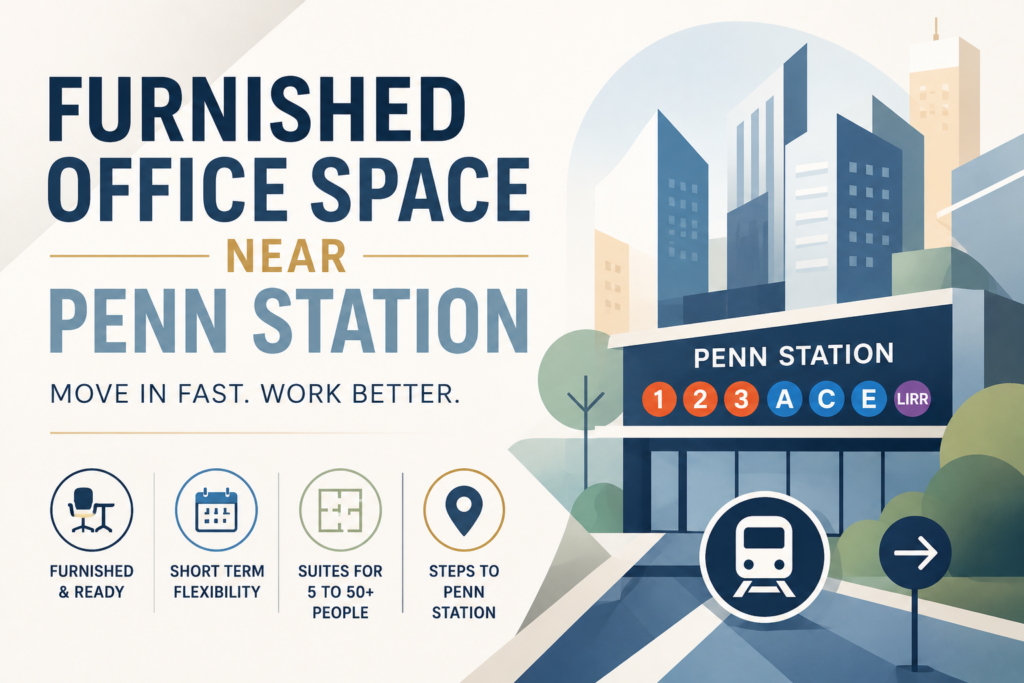
Furnished Office Space Near Penn Station
Why teams target this location
Penn Station wins when speed matters. Teams can shorten the commute, move faster, and avoid a long construction cycle. We represent tenants, so our job is to compare furnished suites, private subleases, and direct lease options from the tenant side.
That matters because this search phrase covers more than one need. Some tenants want a private office for five people next month. Others need a polished plug-and-play suite for 25 people with conference rooms, pantry space, and a real front door. Another group wants a larger furnished sublease that already has furniture, wiring, and meeting rooms in place. Current Penn Station inventory spans flexible offices, serviced suites, furnished subleases, and larger direct lease opportunities, so the right answer depends on your team size, move date, and term.
The location itself also changed. Penn Station no longer serves only as a commute play. Today, the district blends direct rail access, newer amenities, major redevelopments, and a wider mix of furnished choices than most Midtown corridors. Recent market reporting shows the Penn Station submarket has outperformed broader Midtown on asking rents and leasing momentum, which explains why premium product near the station attracts so much attention.
If you want to compare live options while you read, start with our Penn Station Offices page, then review a live Penn Plaza furnished office space example and our guide to prebuilt office space near Penn Station. The point is simple: the best furnished office near Penn Station is not the first space with desks in it. It is the one that shortens setup time and fits the way your team actually works.
What counts as truly furnished
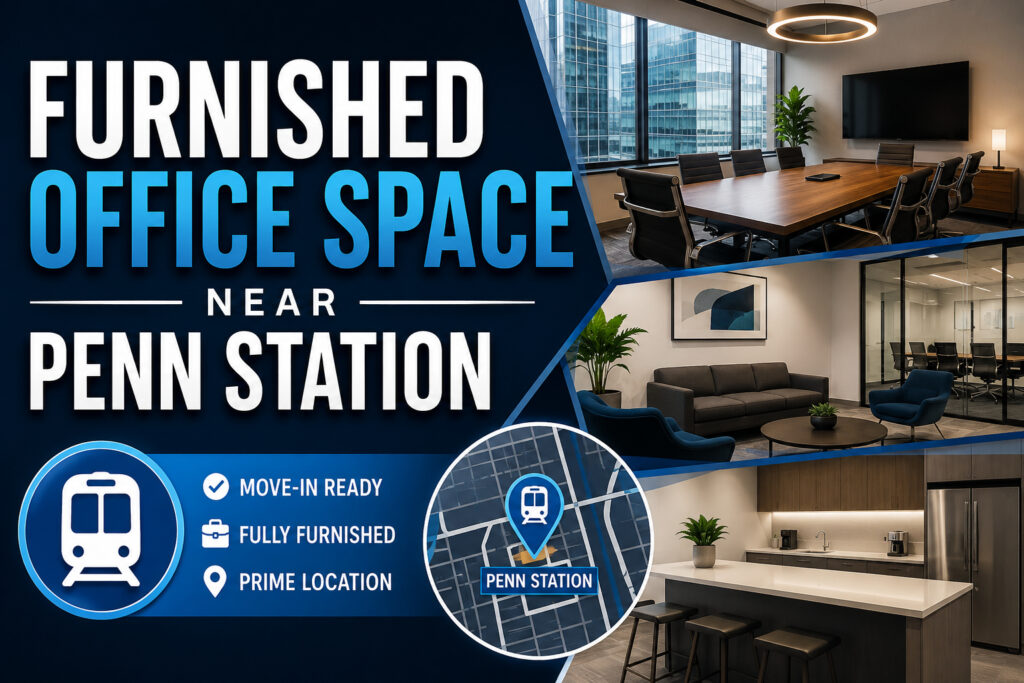
A truly furnished office should let you tour today and operate fast after signing. That means more than a few desks left behind. Real furnished space usually includes workstations, task chairs, conference furniture, reception furniture, pantry basics, a usable wiring plan, and a layout that already makes sense for a working company. Many public listings blur that line. Some offerings are fully serviced and sold per desk. Others are subleases where the existing furniture remains in place. Still others are prebuilt suites that look turnkey but still need furniture, cabling, or IT coordination before move-in.
Here is the clean way to think about it.
Furnished means the furniture stays, or can stay, as part of the deal.
Plug and play means the office already supports fast occupancy. Furniture, wiring, and layout work together.
Move-in ready means the build-out already exists. That does not always mean the furniture comes with it.
Prebuilt usually describes the layout and finishes. Furniture may still sit outside the package.
Serviced office often means shorter terms, shared amenities, and per-desk pricing.
Furnished sublease means another tenant already built the office and now offers its remaining term, often with furniture included on an as-is basis.
That distinction changes cost and risk. A serviced suite may get you in fastest, but it usually gives you less privacy, less branding control, and less flexibility on furniture changes. Meanwhile, a furnished sublease can deliver a real private office with much stronger value, but you need to confirm inventory, condition, and who owns each item. A furnished direct lease can sit in the middle when the owner offers a fully built office and agrees to include furniture.
What should “truly furnished” include before you call it turnkey?
Furniture matters first. Count every bench, desk, guest chair, office chair, training chair, and conference seat.
Infrastructure comes next. Confirm Wi-Fi, hard cabling, IT closet access, printer area, and power at each workstation.
Daily function follows. Test the pantry, refrigerator space, dish storage, water setup, and trash flow.
Usability closes the loop. Check phone rooms, meeting rooms, reception, storage, and whether the current layout fits your headcount.
If one of those pieces fails, the office may look finished but still cost you time and money after signing.
Where near Penn Station really means
“Near Penn Station” covers several different location types, and tenants often lump them together when they should not.
First, there is direct-access or station-edge space. That usually means buildings with unusually fast train-to-desk movement, or addresses directly tied to Penn Station or Penn Plaza. These offices command stronger pricing because the commute friction almost disappears. Some of the strongest product in this group also benefits from upgraded amenity packages, lounges, fitness space, and large conferencing areas.
Next comes the Penn Plaza ring. This is the sweet spot for many tenants. You stay steps from the station, keep excellent employee convenience, and often gain a wider supply of furnished subleases and move-in-ready suites. That is why Penn Plaza appears so often in real tenant searches for furnished offices. Current live examples on our site include furnished Penn Plaza opportunities in the roughly 3,378 to 5,170 square foot range, with layouts that already include offices, conference rooms, kitchen space, and workstation areas.
Then you get the one-block value ring, which usually stretches into the surrounding Penn District and parts of the Garment District. This is where many tenants find the best tradeoff between commute convenience and economics. The walk stays short, yet the pricing can drop meaningfully from the station-edge trophy layer. In this band, you find more loft-style furnished options, more polished concrete and exposed-ceiling suites, and more subleases built by prior occupants.
Finally, there is the broader Penn Station orbit, which can include Herald Square-facing product and blocks that still serve Penn commuters well. These offices remain relevant when your team wants the station nearby but does not need the front-row Penn Plaza address. For many firms, that wider orbit unlocks better floor plates, lower occupancy cost, and more layout variety.
Moynihan changes the map, too. The train hall sits between Eighth and Ninth Avenues, from 31st to 33rd Streets, and gives direct access to Amtrak and Long Island Rail Road, while Penn Station still carries NJ Transit and the full east-side station complex. If your staff arrives from New Jersey, Long Island, or the outer boroughs, the “last block” matters almost as much as the base rent.
Cost, terms, and office formats
Penn Station furnished space does not sit in one price band. It splits into at least two pricing languages.
The first language is per desk. That applies mostly to serviced offices and flexible suites. Around Penn Station, current flexible inventory sits at roughly 275 private offices across about 30 locations, with an average cost near $789 per desk per month. Publicly listed entry points in the immediate area currently show smaller coworking or private-office options from roughly $389 to $535 per month at sampled local centers, depending on privacy level and building. In plain English, the smallest furnished options can look inexpensive at first glance, but the effective cost per enclosed office often rises fast as your team grows.
The second language is rent per square foot. That applies to larger private suites, furnished subleases, and direct leases. In the Penn Station area, current guidance on live stock still breaks into three broad bands. Older loft and value plays often run around $40 to $55 per square foot. Repositioned Class B product often lands around $55 to $75 per square foot. The strongest Penn District product can push into the $85 to $110+ per square foot range. A current furnished example in the Penn/Garment area shows 10,000 square feet at $44 per square foot, which proves that furnished does not always mean premium pricing.
Term length then decides which format fits best.
A serviced suite works best for very small teams, fast starts, or uncertain headcount.
A furnished sublease usually gives the best value when you want privacy, shorter setup time, and a defined remaining term.
A furnished direct lease makes sense when you want more control and the owner already has the right layout in place.
That is why two furnished offices near Penn Station can feel nothing alike even when the photos look similar. One may function like an all-inclusive monthly product. The other may behave like a true private lease with furniture included.
Size also shifts the answer. A two-person team often benefits from high-flex product. A 12-person firm may save money in a small furnished sublease. A 30-person firm usually needs to solve for conference space, pantry capacity, phone rooms, and future seat growth, not just desk count. Bigger teams should care less about the phrase “furnished” and more about how much of the layout already works on day one.
How to compare furnished options intelligently
Start with the walk, not the brochure. Time the route from the exact station entrance your staff will use. A short indoor path often beats a technically shorter outdoor walk. That matters more in bad weather, late evenings, and heavy train periods. Buildings tied closely to Penn Station, Penn Plaza, or the Moynihan side carry different commute benefits, and those differences should influence what you will pay.
After that, test the office as an operating environment.
Look at seat density first. Does the current furniture support your real headcount, or only the staged photos?
Check meeting balance next. Too many desks with too few rooms will create friction in week one.
Review IT readiness carefully. A furnished office loses value fast if your cabling, provider access, and equipment setup still require weeks.
Inspect pantry and storage with equal care. Teams use those spaces every day.
Confirm hours, access, and control before you move forward. Some flexible products feel private until you discover shared rules, limited branding, or restricted after-hours use.
Ask direct lease-style questions even when the suite looks turnkey. Who owns the furniture? What stays? What can leave? Does the inventory attach to the deal, or only to the current occupant’s preference? Will the office deliver wired, cleaned, and emptied of old branding? Which repairs sit with the occupant, and which sit with the building? The more furnished an office looks, the more important the backup documentation becomes.
You should also avoid one common mistake. Many tenants compare furnished product only by speed. Speed matters, but layout fit matters more. A faster move into the wrong office creates six months of operational drag. A slightly slower move into the right office usually wins. Choose the space that fits your meetings, privacy needs, recruiting image, and likely growth over the next 12 to 24 months. That approach saves more money than chasing the first “plug and play” label you see.
Live Penn-adjacent examples and internal paths
If you want to turn the concept into real options, start with live inventory that shows how wide the furnished category can be.
Our current Penn Plaza furnished office space listing at Penn 1 offers 4,776 square feet, a term through July 31, 2027, five private offices, an eight-seat conference room, a larger team room, open seating for about 18 workstations, and direct Penn adjacency. That is a true example of furnished space for a midsize team that needs privacy and speed at the same time.
A second live option, Penn Plaza furnished sublet office, offers 5,170 square feet at 14 Penn Plaza through November 30, 2027, with 12 offices, one conference room, seven existing workstations, room for more, and a full kitchen. That shows how a furnished sublease can feel much more like a conventional private office than a small shared suite.
If your team prefers a direct lease structure with furnished, move-in-ready character, Seventh Avenue furnished office space offers 2,982 square feet with one office, one conference room, and room for roughly 21 workstations. For larger requirements, Furnished Penn Station Office provides 10,537 square feet near Penn Station with capacity for around 70 people, breakout space, and a larger sublease footprint.
For broader coverage, our Penn Station Offices page currently shows active size bands around 1,537, 2,500, 4,600, 5,875, 7,769, 8,724, 9,450, 13,996, and 18,641 square feet. That range matters because the best furnished office near Penn Station depends on where your team sits on the size curve. A five-person law practice, a 15-person client services group, and a 40-person growth company should not shop the same furnished inventory the same way.
The takeaway is simple. Furnished office space near Penn Station should reduce friction, not hide it. The right office gives your team a shorter commute, faster setup, a layout that already works, and a term that matches your next stage. We represent tenants, not buildings, so we evaluate these offices through the lens that matters most: how quickly your team can move, perform, and grow.
Fill out our 📋 online form or give us a call today 📞 212-967-2061 — let’s find the right options for your business.