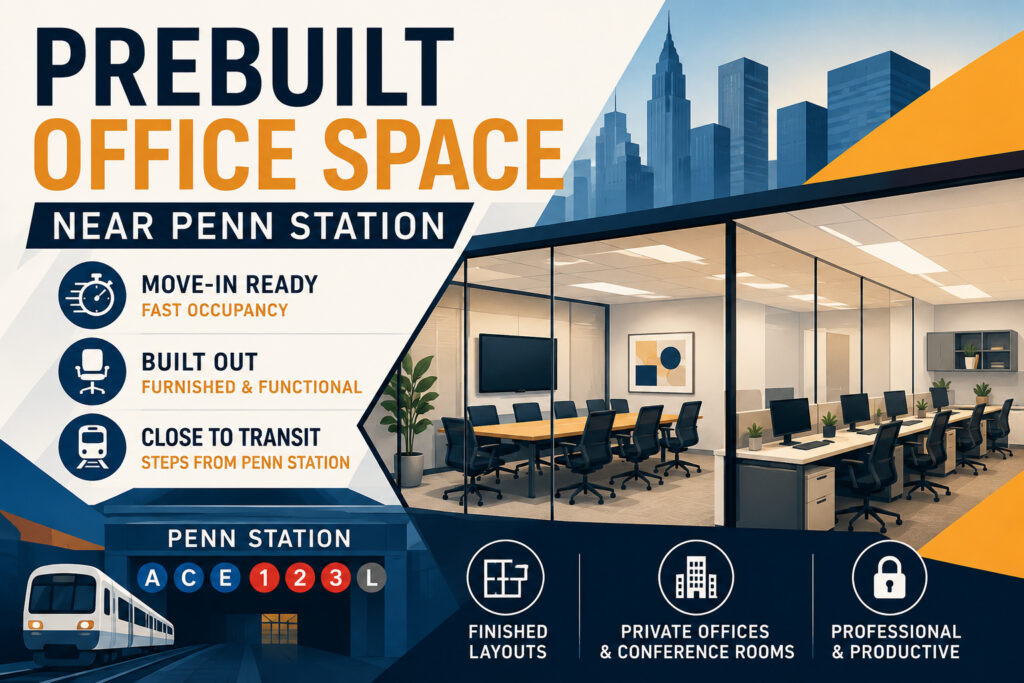
Prebuilt Office Space Near Penn Station
Why this office category matters near Penn Station
Most who search for prebuilt office space near Penn Station want one thing above all else: speed. They need a real office, not a vague future build-out. They also want a shorter route from train to desk, because Penn remains one of Midtown’s key arrival points for regional commuters, while Midtown leasing activity stayed strong through Q2 2026 and availability kept tightening.
That urgency explains why this requirement pulls in several different kinds of options. Some point to true prebuilt suites with walls, conference rooms, pantries, and immediate possession. Others point to furnished subleases, direct leases with landlord-built layouts, flexible private office providers, or broader neighborhood inventories. Those are not the same product, even when they look similar at first glance.
A tenant should sort the lane before touring. If you want a private office for years, a daily office membership will not solve the problem. If you need ten to sixty seats now, a furnished sublease or landlord-built suite may fit far better than raw space. If you want the fastest path to occupancy, start with plug-and-play office space, turn-key office space, and current Penn Station office space for lease.
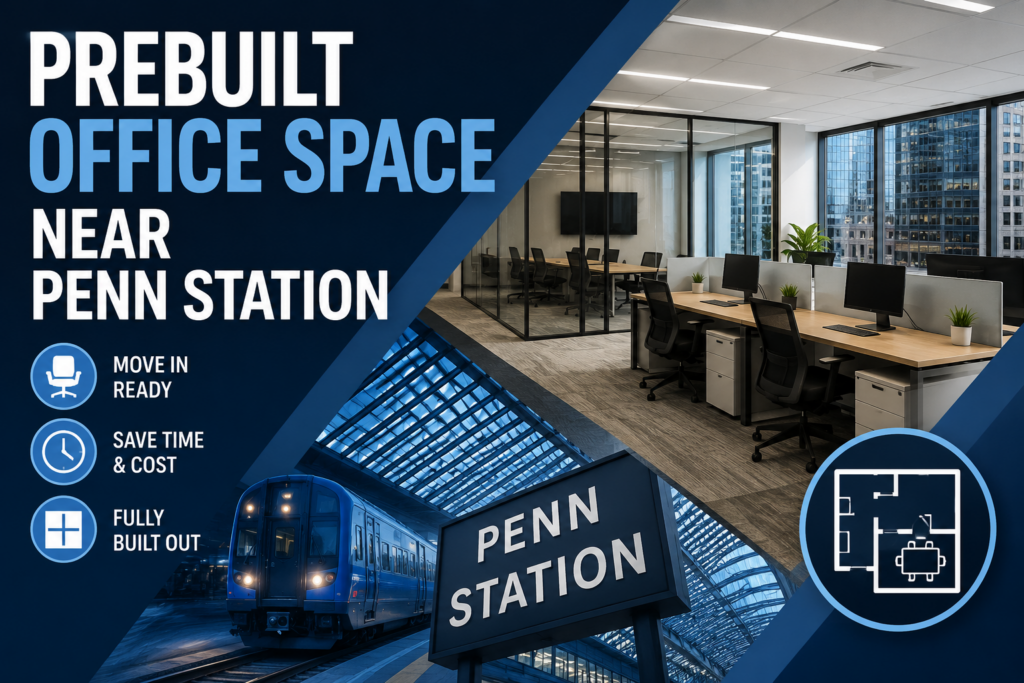
What counts as prebuilt near Penn Station
Prebuilt office space means the suite already has a finished layout. In most cases, that includes enclosed rooms, open work areas, lighting, flooring, HVAC distribution, and a pantry or break area. Many current suites also include furniture, but not all do, so “prebuilt” and “furnished” still mean different things. Plug-and-play usually goes one step further and implies you can move in and work almost immediately.
Distance matters too. “Near Penn Station” can mean a directly connected tower, an address across the street, a Penn Plaza building on the same blocks, or a Garment District building a few minutes north. One directly connected tower sits above Penn Station itself and offers direct access to LIRR, Amtrak, NJ Transit, and the 1, 2, 3, A, C, and E lines. Other modernized buildings market a five- to six-minute walk as the tradeoff for better value or a different building style.
That spread creates a useful tenant hierarchy. Direct access works best for regional teams, heavy client schedules, and firms that care about weather-proof arrivals. Across-the-street or one-block space still delivers speed, often with more varied pricing. Two to six minutes on foot can unlock wider floor plates, loft character, or lower occupancy cost without losing the neighborhood advantage.
The practical question is not whether a suite sits “close.” The real question asks how the final walk feels at 8:45 a.m. on a rainy Tuesday. That is why tenants should compare direct-access options with office buildings that connect to Penn Station, buildings with direct access to Moynihan Train Hall, and the broader Penn District versus Penn Station question before they narrow a shortlist.
What you can expect on size, layout, and pricing
Today’s rent picture breaks into three useful bands. Near Penn Station, many higher-end towers and major redevelopments ask about $85 to $110 per square foot. Repositioned Class B stock often falls around $55 to $75 per square foot. Older loft or value-oriented space can still land around $40 to $55 per square foot. Current concession ranges also remain meaningful, with many deals offering free rent and tenant improvement dollars, especially outside the most premium product.
That range sits inside a market that has become more active, not less. Manhattan logged 8.2 million square feet of leasing in Q2 2026, while overall vacancy fell to 19.3 percent and Class A asking rents rose to $84.79 per square foot. Midtown availability also dropped to 12.7 percent in Q2 2026. In plain terms, quality space still exists, but strong prebuilt suites do not linger forever.
The good news is that Penn-adjacent prebuilt inventory spans more than one size band. One current building-marketing page in the area advertises prebuilt or built-to-suit blocks from 1,400 to 18,500 RSF with flexible layouts and a 24/7 attended lobby. Our own current Penn-area examples also show the breadth of the market: a 4,776-square-foot furnished suite, a 5,755-square-foot direct lease option, a 7,675-square-foot direct lease near Penn Station, and a 9,450-square-foot prebuilt sublease.
Layout quality often matters more than size alone. Many tenants want windowed offices, one or two real conference rooms, a reception point, and enough open seating to support hybrid attendance peaks. Current Penn-area listings show that mix repeatedly, from compact suites with three offices to larger floors with double-digit office counts, lounges, phone rooms, and panoramic light. When the plan works, a prebuilt suite can save months of design and construction time.
How to judge a suite before you tour too many
Speed should never replace fit. A prebuilt office near Penn Station can look great online and still fail in person. Start with seat count, not square footage. Then test whether the layout supports the way your team actually works on busy days, not ideal days. A beautiful pantry will not fix a weak meeting mix. A polished reception will not solve a bad workstation ratio.
Look first at five points. Check the arrival path from station entrance to lobby. Confirm how many enclosed rooms the plan offers. Ask whether furniture stays. Verify the internet handoff, IDF location, and power capacity. Finally, test whether the open area feels productive or cramped. These details decide whether a suite feels turnkey or merely finished.
Client-facing firms usually need a stronger front-end experience. That means a clean lobby, better conference presence, and a calmer route from train to office. Regional teams often care more about direct access, elevator speed, and dependable all-weather commuting. Growth-stage groups usually prioritize flexibility, because a prebuilt suite can reduce downtime now while preserving room to expand later.
Budget-first tenants should ask a harder question. Does a cheaper suite farther from the station still save money after longer walks, weaker retention, extra furniture, and IT work? In many cases, a slightly higher rent for a stronger prebuilt can produce a lower total move-in burden. That is especially true when landlords have already absorbed the build-out and the market still supports concessions.
Furniture deserves special attention. Some suites come truly ready, with workstations, conference tables, soft seating, and kitchen infrastructure in place. Others use “prebuilt” to describe only the construction work. If you need immediate occupancy, cross-check the difference between a finished landlord suite and a furnished sublease. Our current furnished Penn Plaza option and additional Penn furnished options show why that distinction matters.
Lease structure matters just as much. A direct lease may give you term stability and fresh landlord work. A sublease may deliver better economics, furniture, and quicker possession. If that choice sits at the center of your search, the right next read is Penn Station direct lease vs. sublease office space.
The Penn Station advantage for fast-moving tenants
This corridor wins because transit and office inventory overlap in a rare way. Penn Station and Moynihan together give direct rail access to Amtrak and Long Island Rail Road, while Penn handles NJ Transit services and links quickly to major subway lines. Moynihan sits directly across Eighth Avenue, provides direct access to Amtrak and LIRR, and connects to existing Penn Station platforms. That means a tenant can compare several different prebuilt micro-zones without giving up commuter logic.
The best suites also benefit from the area’s amenity arms race. One directly connected Penn tower now markets roughly 160,000 square feet of amenities, including lounges, conference space, flexible workspace, and a large wellness component. Nearby modernized buildings also lean into rooftop lounges, upgraded lobbies, security systems, and hospitality-style common areas. Tenants no longer choose Penn only for transportation. They choose it for speed, image, and daily usability.
That matters for recruitment. It also matters for attendance. Teams usually show up more willingly when the commute feels direct and the office feels finished. Prebuilt space near Penn Station fits that logic better than raw space in many other Midtown pockets, because the move-in timeline shrinks while the last-mile commute often improves. For a company that needs functional space now, that combination creates a real edge.
Still, this page should not replace every narrower question. If you care most about commute geometry, go deeper into direct-access Penn buildings and direct-access Moynihan buildings. If your debate centers on neighborhood identity, compare Penn District office space vs. Penn Station office space and Penn Station vs. Hudson Yards office space. If cost drives the process, start with how much office space near Penn Station costs today.
The questions tenants usually ask before committing
Is prebuilt office space the same as turnkey office space
Not always. Prebuilt means the work exists already. Turnkey usually implies you can occupy the suite with little or no extra effort. Plug-and-play often goes further and assumes furniture, wiring, and immediate usability. Always confirm what stays, what finishes first, and what you still must buy.
Do prebuilt suites near Penn Station only work for large companies
No. Current inventory spans small and midsize teams as well as larger floors. Area marketing pages show blocks starting around 1,400 RSF, while active Penn-area examples on our site include suites in the 3,000- to 10,000-square-foot range and beyond.
Can I move in faster with a prebuilt suite
Usually yes. That is the category’s main value. A finished suite can cut out months of planning, approvals, and construction. Plug-and-play or furnished subleases can reduce the timeline even more.
Does direct access always justify the premium
Not for every tenant. Direct access helps teams with heavy rail commuting, frequent visitors, and strict weather protection needs. Others can save money one to several blocks away and still preserve an easy arrival. The best answer depends on your staff map, your client flow, and how often people actually come in.
What if I need a shorter term, a smaller suite, or a softer commitment
Then narrow the product quickly. Some results in this lane really point to flexible private offices or coworking memberships, while others point to true leasehold space. If your main need is small scale or shorter term, go straight to small office space near Penn Station and short-term office space near Penn Station.
What should I hand over before asking us for options
Send four items. Give us your target headcount. Share your real budget range. Tell us your ideal move date. Add whether you prefer direct lease, sublease, or the fastest possible plug-and-play option. That lets us cut through noise and focus on suites that actually match the brief.
A strong Penn Station search should end with clarity, not clutter. You should know what “prebuilt” means, what “near” really means, what price bands look like today, and which lease type best supports your timeline. Once those pieces line up, the market becomes far easier to navigate.
Find a Prebuilt Office Near Penn Station Today
If you want a tenant-side shortlist, we can build it around speed, commute, budget, and term length. We will compare true prebuilt suites, furnished subleases, and direct-lease options side by side. Then we will help you focus on the Penn-area spaces that fit your team instead of touring everything that happens to sit near the station.
Fill out our 📋 online form or give us a call today 📞 212-967-2061 — let’s find the right options for your business.