What Office Buildings Have Direct Access to Moynihan Train Hall?
Commuters feel the last three minutes of a trip. Clients notice the entry sequence even faster. A west-side office can win or lose on that final approach alone.
The direct answer
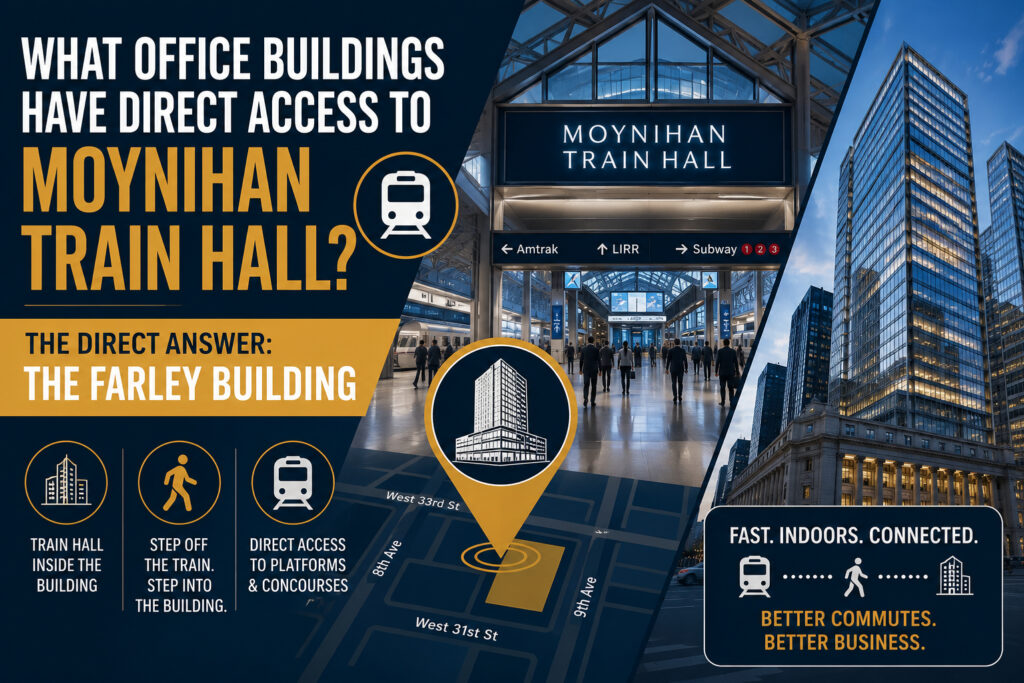
Short answer: If you mean the office building that literally contains Moynihan Train Hall, focus on the Farley Building. The train hall sits inside that property, and the office component rises within the same mixed-use complex. Official train hall and project sources place Moynihan inside the James A. Farley Building, bounded by Eighth and Ninth Avenues and West 31st and 33rd Streets, with four public entry points and direct access to the platforms below.
That said, many tenants use the phrase more loosely. They really mean, “Can my team get from the lobby to Amtrak or LIRR fast, indoors, and without a sloppy street walk?” Under that broader commuter definition, a few Penn-connected towers enter the discussion because Penn Station and Moynihan share platforms, concourses, and transfer paths. Official marketing for PENN 1 even states direct access to Penn Station and Moynihan Train Hall, which is why that building shows up so often in real tenant conversations.
So the cleanest tenant answer works in two layers. Literal, in-building Moynihan access points to the Farley Building. Broader indoor Penn-Moynihan commuter access can extend to select Penn-connected towers. That distinction solves the confusion.
What direct access should mean to a tenant
For practical leasing work, “direct access” should mean one of three things. First, the office building may contain the train hall. Second, the building may offer an indoor or integrated route into the Penn-Moynihan rail system. Third, the building may sit very close to the train hall, yet still require an outdoor walk. Only the first category gives you the most literal answer to this page’s question.
That distinction matters because Moynihan does not operate as a fully separate rail universe. Official guidance says the hall connects directly to the existing platforms beneath Penn Station, gives direct access to Amtrak and Long Island Rail Road, and shares platform access with Penn through tracks 5 through 16. In plain English, a building can feel tightly tied to Moynihan without actually sitting inside the hall itself.
Hours matter too. Moynihan opens daily from 5:00 a.m. to 1:00 a.m., while official guidance says overnight Amtrak and LIRR activity from 1:00 a.m. to 5:00 a.m. shifts back to Penn Station. NJ Transit also remains a Penn Station play, not a Moynihan one. For a daytime Amtrak team, that difference may not matter. For late-night operations, it matters a lot.
The entry pattern adds another layer. The hall has four main public entrances, including two corner entries on Eighth Avenue and two midblock entries on West 31st and West 33rd Streets. Official visitor guidance also recommends the 31st Street midblock entry for Amtrak passengers and the 33rd Street midblock entry for Long Island Rail Road passengers. That alone gives you a useful map rule: a south-leaning office arrival better suits many Amtrak users, while a north-leaning arrival often suits LIRR riders better.
The building that truly sits in Moynihan
If your requirement is strict, the building to understand is the Farley Building. Moynihan Train Hall sits within that landmark structure. Official project, architecture, and property pages describe the office component as roughly 740,000 square feet, along with 120,000 square feet of retail, four major points of entry, and office floors with large plates, slab heights above 17 feet, and multiple office lobbies. The fifth floor also includes nearly 70,000 square feet of landscaped outdoor space plus a 6,000-square-foot glass pavilion.
That profile matters because true direct access here is not a gimmick. It comes wrapped in a very specific office product. You get a horizontal campus feel, unusual floor depth, strong ceiling height, and an arrival experience that starts with one of New York’s clearest rail entries. For headquarters users, client-facing firms, and teams that care about first impression, those details affect more than commute time. They shape how the office reads the moment someone steps off the train.
The office geometry also helps explain why this building dominates the literal answer. Official specifications show floor sizes of about 166,482 square feet on the second floor, 100,358 square feet on the third, 292,692 square feet on the fourth, and 180,068 square feet on the fifth. In other words, the direct-access option is not a tiny boutique oddity. It is a large, serious office platform built above and around the train hall itself.
Another point matters for west-side users. Official design sources say the Ninth Avenue side reshaped the annex into a mixed-use western anchor and aligned the route toward the newer offices west of the station. That means the Farley Building solves two problems at once. It gives the most literal Moynihan answer, and it also acts as the hinge between the station and the broader west-side office district.
Why other office buildings still enter the conversation
Other buildings appear because commuters rarely search like architects. Many people do not care whether the train hall sits inside the same tax lot. They care about how quickly they can reach the office after an Amtrak or LIRR arrival. That broader intent expands the conversation from “Which building contains Moynihan?” to “Which offices let me use Moynihan with minimal friction?”
That is why 1 Penn Plaza enters the picture. Official PENN 1 marketing states direct access to Penn Station and Moynihan Train Hall. Your own 1 Penn Plaza page also frames the building as directly tied to Penn Station and the Long Island Rail Road through its Penn relationship. Put simply, 1 Penn Plaza belongs in the broader commuter-access shortlist, even though it is not the building that contains the train hall itself.
This distinction helps tenants avoid a common mistake. A Penn-connected tower can absolutely work better than Farley for some companies. That is especially true when your workforce uses a mix of NJ Transit, Amtrak, subways, and LIRR, or when you want a taller tower identity rather than a train-hall-integrated address. Yet those goals answer a slightly different question. They answer the Penn-Moynihan commute problem, not the literal “What office building has direct access to Moynihan itself?” question.
Nearby west-side campuses also surface for a reason. Official design sources describe a contiguous pedestrian logic running westward from the train hall, especially from the Ninth Avenue side. That makes several nearby office clusters feel close, intuitive, and weather-manageable on many days. Still, close does not equal direct. If you must step outside, cross a street, or rely on a district path rather than the same building, you have left the literal category.
That is the clean rule for this page. Farley wins the literal test. Penn-connected towers can satisfy the broader indoor-access test. Nearby west-side buildings satisfy the proximity test only. Once you separate those lanes, the topic stops feeling muddy.
Who should prioritize a Moynihan-front office
A direct Moynihan office strategy fits best when your staff or clients arrive first by Amtrak or Long Island Rail Road and then finish the trip on foot. It also fits firms that host frequent regional meetings, recruit from Long Island, or want the cleanest west-side arrival possible. For those users, the shorter the transfer, the stronger the office feels in daily life. Official station guidance supports that logic because Moynihan provides direct Amtrak and LIRR access, while the 31st and 33rd Street entries clearly favor rail-first arrivals.
The case weakens for a heavily NJ Transit office. Official train hall guidance says NJ Transit services remain located in Penn Station, not Moynihan. A mixed commuter pool can still benefit from the district, but a literal Moynihan requirement matters less if New Jersey dominates your headcount. In that scenario, your leasing search should widen from “Moynihan direct” to “best Penn-connected arrival.”
Budget also changes the answer. Because the strict direct-access inventory is so limited, many tenants end up using a broader Penn District strategy instead of chasing the literal Farley option. Current guidance on your site places the Penn District at about $74.27 per square foot with 12.8% availability in Q1 2026, while other site guidance places many Penn-adjacent Class A options around $85 to $110 per square foot, with repositioned Class B around $55 to $75, and older value space around $40 to $55. That spread gives tenants room to buy commute quality without insisting on the single most literal building.
That is often the smartest move. A company does not always need the building that sits in the train hall. Sometimes it needs the best balance of rent, image, and final walk. When that happens, compare the office lobby, the exact rail arrival, the indoor transfer path, and the weather exposure in one test. Do not compare addresses alone.
Tenant takeaway
Here is the clearest answer to publish. The Farley Building is the office building with the most literal direct access to Moynihan Train Hall because Moynihan sits inside it. That remains the headline answer. The office floors, the entrances, and the train hall all live within one integrated property.
If your real goal is a seamless rail-to-office commute, then you should also compare Penn-connected buildings that let staff move easily through the broader Penn-Moynihan system. That is why 1 Penn Plaza belongs in the supporting conversation, even though it does not replace Farley as the literal answer. Official building and station sources support that wider commuter reading.
Find an Office Near Moynihan Hall
We represent tenants, not landlords. That matters here because this question sounds simple, yet the real answer depends on how you define “direct access.” A short walk, a weather-protected path, and a true in-building connection do not mean the same thing when your staff arrives through Moynihan every day.
Fill out our 📋 online form or give us a call today 📞 212-967-2061 — let’s find the right options for your business.