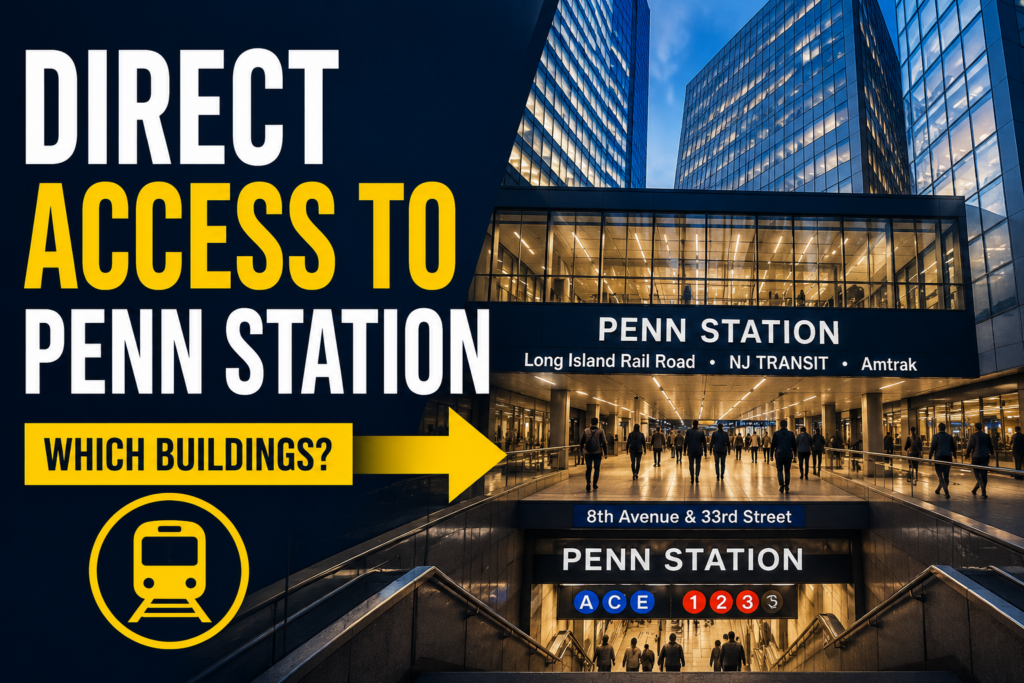
What Office Buildings Have Direct Access to Penn Station
The clear answer
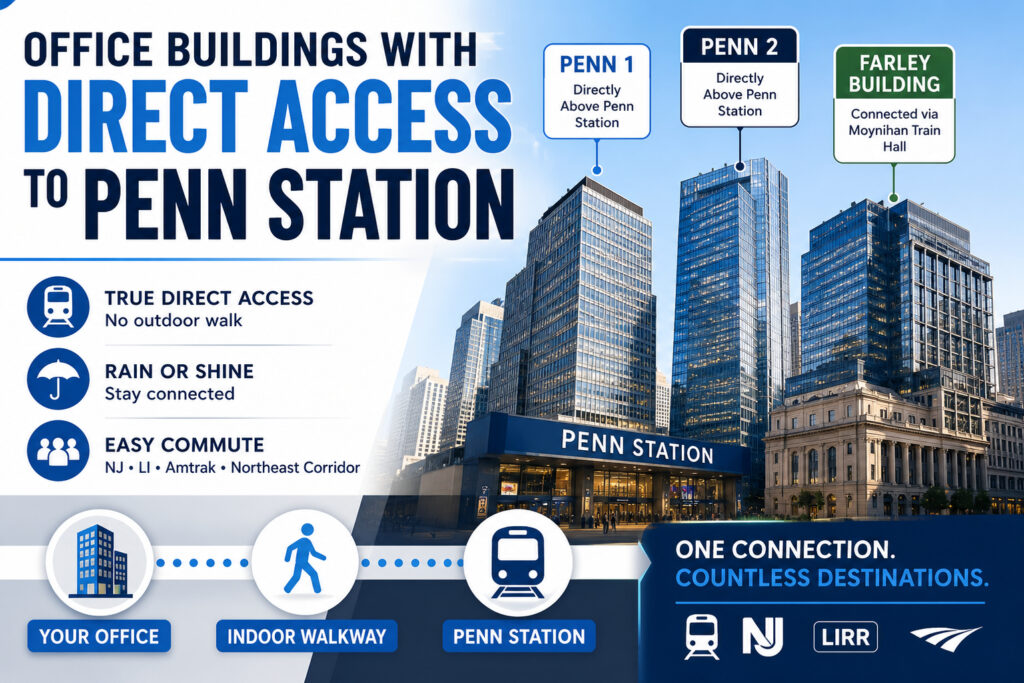
If you need the short answer first, keep it simple. Today, the clearest office buildings with true direct Penn Station access are PENN 1 and PENN 2. If your definition also includes the west-side train hall connection through Moynihan, then The Farley Building belongs on that shortlist too. The uploaded July 2026 search snapshots also point to that same core trio, even though some summaries mix in nearby addresses that do not offer the same kind of indoor connection.
We represent tenants, not landlords. That matters here, because “direct access” gets stretched far too often. Some buildings sit across the street. Some sit beside an entrance. A few sit on top of the station or feed into the station complex itself. Those are very different experiences on a rainy Monday, during winter, or when your team commutes from New Jersey, Long Island, or the Northeast Corridor.
For most tenants, the phrase should mean one thing: you can move from the building into Penn Station or the Moynihan/Penn rail complex without stepping outside for the last block of the trip. By that standard, the list gets much tighter than many casual guides imply.
The direct-access shortlist
PENN 1 stands as the most straightforward answer. The building sits directly above Penn Station, and current owner materials say tenants and guests get direct access to the Long Island Rail Road, Amtrak, NJ TRANSIT, and the 1, 2, 3, A, C, and E subway lines. Those same materials also state that the tower provides direct access to Moynihan Train Hall. For a tenant, that means a true all-weather arrival path, a faster daily commute, and a better experience for staff who come in from several directions. If you want to review tower-specific inventory, start with 1 Penn Plaza.
PENN 1 also matters because it answers more than the transit question. It is a full-scale Class A tower with over 2.5 million square feet, and current portfolio pages show active availabilities ranging from smaller suites to blocks above 60,000 square feet. On our own current Penn Station inventory, live examples tied to PENN 1 range from 4,776 square feet and 9,450 square feet to 18,641 square feet, which gives both midsize and larger users practical options inside a true station-connected address.
PENN 2 is the other clean “yes.” Current owner language describes it as located directly atop Penn Station. That phrasing matters. This is not a building that merely benefits from the neighborhood. It sits over the transit hub itself. PENN 2 also plays a different role in the market from PENN 1, because it targets larger, image-driven users that want major floor plates, upgraded public space, and direct station access in one package.
The space profile reinforces that point. Current PENN 2 materials describe dramatic podium blocks from roughly 61,000 to 105,000 square feet, along with tower floors around 62,000 square feet. Current portfolio pages also show live availabilities from roughly 5,070 to 63,180 square feet. In plain English, PENN 2 is the answer for tenants who want direct access but do not want to compromise on scale, headquarters presence, or floor efficiency.
The Farley Building belongs in the conversation when the searcher really means the broader Penn Station campus, not only the legacy under-street station footprint beneath Seventh Avenue. Current owner materials describe the building as sitting on top of the transportation hub, with Amtrak, LIRR, NJ TRANSIT, and nearly every subway line directly accessible from the building. Amtrak also identifies Moynihan Train Hall as its New York home inside the Farley Building, while engineering coverage of the project explains that the hall directly connects to 17 of Penn Station’s 21 tracks.
That distinction matters for tenants. If your team uses Amtrak often, hosts out-of-town clients, or values the west-side arrival experience as much as the office itself, Farley can be more compelling than a traditional tower over Seventh Avenue. It contains about 740,000 square feet of office space, about 120,000 square feet of retail, and large floor plates with high ceilings and major outdoor space. In other words, Farley does not just connect to the rail system. It turns that connection into part of the workplace identity.
Nearby buildings and how to compare them
This is where the confusion starts. Several nearby buildings appear whenever people ask this question, because they sit so close to Penn Station that many summaries blur together direct access, campus adjacency, and one-minute walking distance. Those are not the same thing, and tenants should not treat them as interchangeable.
5 Penn Plaza is the best example. It is highly relevant to the search because it sits across from Moynihan Train Hall and markets direct access to New York’s largest transportation hub. Yet the same current materials also describe it as across the street from Moynihan and emphasize adjacency to Penn Station. That puts it in the “extremely close” bucket, not the cleanest “internal station connection” bucket. The difference may sound small in marketing language, but it feels large to a commuter who wants to stay indoors from lobby to concourse.
14 Penn Plaza also shows up often because it sits directly across from the station, and our current listings rightly describe it that way. For many tenants, that still works beautifully. You still get a fast walk, strong transit overlap, and easier recruiting. However, “across from Penn Station” is not the same answer as “connected to Penn Station.” If the query asks for direct access, 14 Penn Plaza fits the nearby-shortlist lane, not the true direct-access lane. For a current nearby option outside the station-connected towers, see Penn Station Office Space for Lease.
11 Penn Plaza appears in older writeups and in some historical Penn District discussions. That happens for two reasons. First, it sits extremely close to the station. Second, the broader Penn campus has changed over time, which causes older material to overstate how tightly some addresses connect today. Current owner pages emphasize that 11 Penn sits steps from Penn Station, while older third-party guides sometimes label it as direct access. If you are evaluating 11 Penn, ask one practical question: can your team move from the building lobby into the rail complex without going outside? If the answer is no, treat it as adjacent, not directly connected.
That same tenant logic applies to hotels, smaller Penn Plaza addresses, and Herald Square buildings that appear in loose summaries. Some of them offer a one-minute walk. Some overlap with subway entrances. Some benefit from Penn District foot traffic. All of that helps. None of it should erase the distinction between built-into-the-station access and excellent proximity.
Which option fits your team
If your top priority is the cleanest possible commute, start with PENN 1. It offers the most explicit station language, the broadest regional rail access, and a current range of active suite sizes that works for different team counts. It also gives you a direct route into both Penn Station and Moynihan, which matters if your employees come from Long Island, New Jersey, or intercity Amtrak markets on the same week. If you want to scan the broader neighborhood before narrowing the building list, review Penn Station Offices.
If your company needs very large contiguous space, PENN 2 deserves special attention. The building pairs true station access with oversized floor plates that many Midtown properties simply cannot match. That combination serves headquarters users, trading floors, large back-office functions, and companies that want one floor or several large connected blocks rather than a patchwork of smaller suites.
If your team values arrival quality, west-side identity, and Amtrak-facing access, Farley becomes a different kind of answer. It still solves the commute problem. Yet it also changes the tone of the office search. Instead of “tower over station,” it offers “campus inside a major rail gateway.” That can matter for firms that host clients often, recruit nationally, or care about first impressions the moment someone exits the train hall.
If your budget matters more than a literal indoor connection, the nearby-stock story opens up. On our current Penn Station pricing guide, top Penn District product often lands around $85 to $110 per square foot, repositioned Class B product often falls around $55 to $75, and older loft-style value plays tend to cluster around $40 to $55. That is why nearby addresses remain relevant to the same search. They often let tenants keep the Penn commute while trading down from the premium that true direct-access Class A product commands.
The practical move is simple. First, decide whether you need true indoor station access or just the fastest possible walk. Then, separate the buildings into those two buckets before you tour anything. That one step clears up most of the noise around this topic.
Current research basis
The uploaded PDF captured July 2026 snapshots from Google, Bing, and Yahoo. Those snapshots show a strong top-level consensus around PENN 1, PENN 2, and The Farley Building, but they also show why the query gets muddy: AI summaries and ranking pages regularly blend direct access with adjacency, especially around 5 Penn Plaza, 14 Penn Plaza, and other Penn-adjacent addresses. That input shaped the page’s “true direct access versus nearby access” framing.
Current official building pages support the core answer. PENN 1 states that it sits directly above Penn Station and provides direct access to LIRR, Amtrak, NJ TRANSIT, the 1/2/3 and A/C/E lines, plus Moynihan Train Hall. PENN 2 states that it sits directly atop Penn Station. The Farley Building states that Amtrak, LIRR, NJ TRANSIT, and nearly every NYC subway line are directly accessible from the building.
Amtrak and project sources sharpen the Farley point further. Amtrak identifies Moynihan Train Hall as its New York home inside the Farley Building, and engineering coverage explains that the hall directly connects to 17 of Penn Station’s 21 tracks. That matters because many tenants search for “Penn Station” while really meaning the broader Penn/Moynihan campus.
Find an Office Near Penn Station
Finding the right office near Penn Station starts with understanding which buildings truly provide direct station access and which simply sit nearby. Our tenant-only advisors help companies compare every viable option, negotiate aggressively on their behalf, and identify opportunities that match their budget, operational needs, and long-term growth plans. Whether you need a small office, a full-floor headquarters, or a turnkey sublease, we streamline the search and secure the strongest lease terms available.
Fill out our 📋 online form or give us a call today 📞 212-967-2061 — let’s find the right options for your business.