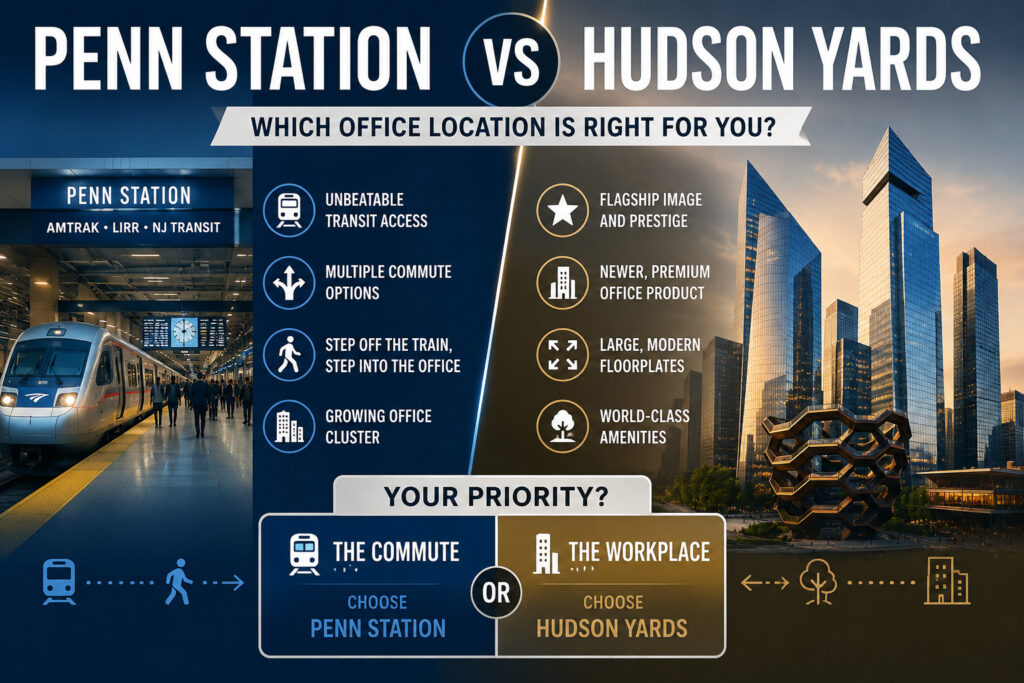
Penn Station usually wins for access, optionality, and commute efficiency.Hudson Yards usually wins for image, newer product, and larger modern floorplates. If your workforce leans hard on NJ Transit, LIRR, Amtrak, or bus commuting, Penn should lead the shortlist. If your brief starts with flagship identity, hospitality-grade amenities, and new-build corporate space, Hudson Yards should move to the top.
That simple answer still needs context. Many tenants use “Penn Station” to mean the station itself, Penn Plaza, the Penn District, or the wider West 30s. Others use “Hudson Yards” to mean the formal campus, nearby towers on Hudson Boulevard, or the broader far West Side. So the right comparison is not one building against one building. It is one office logic against another.
Choose Penn Station if your office plan starts with the daily commute. Choose Hudson Yards if your office plan starts with the workplace itself.
What this comparison really means
Penn Station is no longer just a transit label. Today it also points to a fast-evolving office cluster that wraps around Penn Station, Moynihan Train Hall, Penn Plaza, and nearby Midtown West blocks. Over the past decade, 14 buildings totaling about 23 million square feet were developed or fully renovated in the submarket. From 2023 through 2025, the district captured more than 3.5 million square feet of relocations and nearly one-quarter of Manhattan relocation activity. That tells you something important: tenants now view Penn as a true destination, not just a pass-through.
Hudson Yards means something else. It is a purpose-built, master-planned West Side district tied to the 7 line extension and a long-term expansion of Midtown’s business core. Official city material describes about 3 million square feet of existing office space in the area, while long-range development capacity runs far higher across the broader Hudson Yards plan area. In practical leasing terms, that translates into newer towers, larger floorplates, and a more curated workplace setting.
That distinction explains why this query attracts so many different kinds of pages. Some tenants want a neighborhood answer. Others want a commute answer. Many want a budget answer. A serious tenant, however, needs all four questions answered at once: How do people get there? What kind of space exists there? What does that space cost? Which district fits the company’s actual operating style? This page handles the comparison in that order because that is how the lease decision should work.
Commute and daily friction
Why Penn Station stays so powerful
Penn Station remains the strongest West Side answer for companies with heavy regional commuting. Penn and Moynihan connect directly to NJ Transit, LIRR, and Amtrak. They also connect to the A, C, E and 1, 2, 3 subway lines. Meanwhile, the 33 Street PATH station sits only minutes away on foot. The Midtown Bus Terminal also sits within the broader overlap zone for bus-heavy teams, and Port Authority material still describes it as the world’s busiest bus terminal, with roughly 198,000 average weekday riders across 2025.
That matters more than glossy marketing ever admits. A direct arrival changes attendance patterns. It shortens the last walk. It cuts transfers. It also helps on bad-weather days, late arrivals, and client visits from outside Manhattan. For many tenant rosters, Penn does not just improve commute time. It improves the odds that staff will actually come in more often.
Penn also wins on overlap. A company can serve New Jersey rail riders, Long Island riders, intercity rail visitors, West Side subway riders, and many bus commuters from one district. Very few Manhattan office clusters combine that much transportation depth inside such a compact footprint. That is why commuter-heavy users keep returning to Penn, even when another district looks more polished on paper.
Where Hudson Yards closes the gap
Hudson Yards does not match Penn for direct regional rail access. It does, however, perform far better than many tenants assume. The district anchors itself on the 34 Street–Hudson Yards 7 station. Several core towers also sit within an easy walk of Penn and Moynihan. Current building pages on our site place that walk at roughly five to seven minutes from some towers, and under ten minutes from others. Hudson Yards’ own visitor guidance puts the Penn walk at about fifteen minutes, depending on your path and destination.
That means Hudson Yards works well when your team already wants the far West Side. It also works when your staff commutes mostly by subway, rideshare, or a short transfer after arrival. Once an office day already centers on the West Side, the district’s walkability, 7 train access, and strong internal amenity base start to feel less like a compromise and more like a clean fit.
Still, the final walk stays real. Penn riders headed to the west edge of Hudson Yards will feel that extra distance every morning. By contrast, a Penn-adjacent office can remove that final leg almost entirely. So the best commute question is not “Can staff get to Hudson Yards?” They can. The better question is “How much daily friction do we want to build into the last five to ten minutes?” That is where Penn still holds the cleaner answer for transit-first rosters.
The rule that decides most shortlists
The right district usually comes down to one rule: kill the last transfer and shorten the last walk. If most of your people ride NJ Transit, LIRR, Amtrak, or regional buses, Penn usually wins. If most of your people already live in Manhattan or work patterns center on the far West Side, Hudson Yards becomes much easier to justify. When the roster splits, the smarter move is to test the actual employee origin mix before you fall in love with the prettier lobby.
Space quality, floorplates, and planning
What Penn Station gives tenants
Penn offers the broadest mix. You can find upgraded towers, direct-access assets, older loft-style value plays, repositioned mid-block buildings, and strong sublease inventory within one search geography. That variety matters because it lets tenants compare image, price, term, and commute inside one district. It also means Penn works for both smaller users and larger occupiers. Our current live inventory examples around Penn range from about 1,537 to 18,641 square feet, which is a much wider small-to-mid-size spread than most trophy-only districts offer.
Penn also gives tenants newer top-tier choices than many buyers and occupiers still picture. Current research from Cushman shows a decade-long transformation in the district, driven by redevelopment and amenity upgrades. The area no longer functions as a cheap fallback by default. Instead, it now combines premium product at the top end with genuine budget spread below that tier. In other words, Penn offers range. That range is one of its biggest leasing strengths.
A building like 1 Penn Plaza captures that logic well. It sits directly in the Penn commute ecosystem, contains more than 2.7 million square feet, and connects tightly to the broader station network. If your office brief starts with “make arrival simple,” this kind of Penn address deserves a first look.
What Hudson Yards gives tenants
Hudson Yards gives far less variety, yet much more consistency. The district leans heavily toward newer Class A and trophy stock, large efficient plates, strong mechanical systems, outdoor space, and hospitality-driven amenities. Official market and city sources describe the area as almost entirely premium office inventory. Our current Hudson Yards coverage also reflects a notably larger block profile, with live examples around 7,882, 8,000, 10,680, 14,384, 16,178, 23,324, 29,628, and 45,942 square feet.
That live size pattern tells you a lot. Hudson Yards fits companies that need scale, planning efficiency, and stronger visual identity. It also suits firms that want large contiguous space without starting in an older building and then spending heavily to modernize it. The tradeoff is simple: you get newer product, but you surrender some pricing flexibility and some smaller-suite optionality.
Penn usually serves tenants that want choice. Hudson Yards usually serves tenants that want consistency. Penn helps if you want to compare prebuilt suites, direct leases, subleases, smaller footprints, and direct-access buildings without leaving the same area. Hudson Yards helps if you want cleaner modern systems, larger plates, and a more deliberate headquarters feel from the start. Both districts can support premium users. Only one offers much true price and format diversity.
Cost, leverage, and value
What Penn costs today
Penn’s pricing story needs nuance. Cushman’s Q2 2026 Manhattan report places the Penn Station submarket at about $99.44 per square foot overall and $122.90 per square foot for Class A. Those are not discount numbers. Yet live tenant-facing inventory and recent local market guidance still show a broader working range by product type, with older loft-value space often around $40 to $55, repositioned Class B around $55 to $75, many Class A tours around $85 to $110, and the strongest premium product pushing toward $130.
That spread is exactly why Penn remains so useful. A tenant can start with commuter logic, then sort by budget without abandoning the district. You can pursue efficient mid-range space, fully modernized prebuilt product, or a trophy-level tower inside one submarket. Very few West Side office decisions let you keep that much flexibility.
What Hudson Yards costs today
Hudson Yards commands a premium for a reason. Our current Hudson Yards guidance places the area around $120 per square foot, while public market pages and neighborhood writeups regularly show core direct inventory in the low $120s into the $150s. Some upper-floor or elite commitments have gone much higher, including select deals above $200 per square foot. Formal Hudson Yards inventory also skews almost entirely A+ or trophy, which removes many of the cheaper escape valves tenants can still find near Penn.
That does not mean every Hudson Yards option lives in the same price band. Fringe or near-district space can undercut the core campus. Smaller suites can also blur the line. Even so, if your company wants true Hudson Yards identity in the newer premium inventory, you should plan for a stronger rent burden than most Penn alternatives below the trophy tier.
Which district gives the better value
Penn usually wins on commute-to-cost value. Hudson Yards usually wins on workplace-to-brand value. Penn gives tenant leverage through variety. Hudson Yards charges for new construction, integrated amenities, and image. Neither district is “more expensive” in every single case. Still, across the market, Penn offers the broader mercy band below trophy pricing, while Hudson Yards keeps more of its inventory in premium territory.
One more point matters here. Do not compare coworking rates, desk products, or generic listing feeds against true office floors. That mistake confuses many tenants. A serious comparison should focus on direct leases, real subleases, actual floor quality, and total occupancy cost. Once you clean up the comparison set, the pricing logic gets much clearer.
Best fit and internal next steps
Choose Penn Station if this sounds like your company
Choose Hudson Yards if this sounds like your company
Choose Hudson Yards if you want a flagship workplace, larger plates, newer systems, and a cleaner modern office narrative. Lean there if your team values terraces, river views, hospitality-grade common areas, and a corporate environment built much more recently than classic Midtown stock. Push it to the top if your requirement starts at the workplace experience level rather than the commute level. Begin with Hudson Yards Offices, then move through 10 Hudson Yards, 30 Hudson Yards, 31 Hudson Yards, 35 Hudson Yards, 50 Hudson Yards, and 66 Hudson Boulevard.
Hudson Yards makes the strongest case for larger headquarters users, prestige-sensitive firms, and teams that want newer infrastructure without compromise. It can still work for smaller occupiers, especially in mixed-use or flex-enhanced buildings, yet the district’s natural shape favors larger and more premium requirements. If your company cares deeply about client impression, top-end amenities, and operational scale, Hudson Yards often delivers the cleaner first tour set.
The cleanest tenant conclusion
Penn Station is the better all-around answer for most commuter-heavy companies. Hudson Yards is the better targeted answer for firms that want scale, polish, and newer office product. Put differently, Penn is the smarter default, while Hudson Yards is the stronger statement. The right lease depends on whether your company needs a shorter arrival or a stronger arrival.
FAQ
Is Hudson Yards connected to Penn Station
Yes, but not as a true station substitute. Several Hudson Yards towers sit within a short walk of Penn and Moynihan, and current building pages put that walk at roughly five to ten minutes for some core assets, while district guides sometimes place it closer to fifteen minutes depending on route and destination. That means the connection works. It just does not erase the extra walk.
How far is Hudson Yards from Penn Station
In real leasing terms, the answer depends on the building. Some core towers sit about five to seven minutes away. Others land closer to ten minutes. Broader district guidance often says about fifteen minutes on foot. For a tenant, that difference matters because a five-minute last walk feels very different from a fifteen-minute one over a full year.
Which district works better for New Jersey commuters
Penn usually wins. NJ Transit access sits directly in the Penn ecosystem, the bus terminal sits nearby, and the PATH connection at 33 Street remains a short walk away. Hudson Yards can still work for New Jersey teams, yet it adds another leg unless the office sits in a tower very close to Penn.
Which district has newer office buildings
Hudson Yards wins that category clearly. The district’s office identity rests on newer Class A and trophy stock, while Penn blends major redevelopments with older towers and loft inventory. Penn now competes far better on quality than it once did, but Hudson Yards still offers the more uniformly new workplace environment.
Which district usually costs less
Penn usually costs less once you move below the trophy tier. Q2 2026 submarket data still places Penn Class A in premium territory, yet Penn also offers many more value bands below that level. Hudson Yards remains more concentrated in newer premium space, so its practical entry point usually starts higher.
Is Penn Station office space still old and gritty
That view is outdated. The district still includes older stock, which can help on value. Yet the broader Penn office market now includes major redevelopments, modern amenities, and much stronger demand than many tenants realize. The smarter read is not “old versus new.” The smarter read is “mixed inventory versus premium-pure inventory.”
Can a smaller tenant lease in Hudson Yards
Yes, though the district naturally skews bigger and more premium. Some flex-enhanced or mixed-use buildings support smaller occupiers, but Hudson Yards still fits large users more naturally than Penn does. Smaller tenants who want a Hudson Yards feel should compare carefully against Penn, Manhattan West, and nearby West Side overlap zones before they commit to the premium.
Discuss a Comparison that Works for You
We represent tenants, not landlords. Our job is to compare commute friction, space quality, and lease economics before you commit. That tenant-side lens matters here because both districts sit on the West Side, yet they solve very different problems.
Fill out our 📋online form or give us a call today 📞212-967-2061 — let’s find the right options for your business.