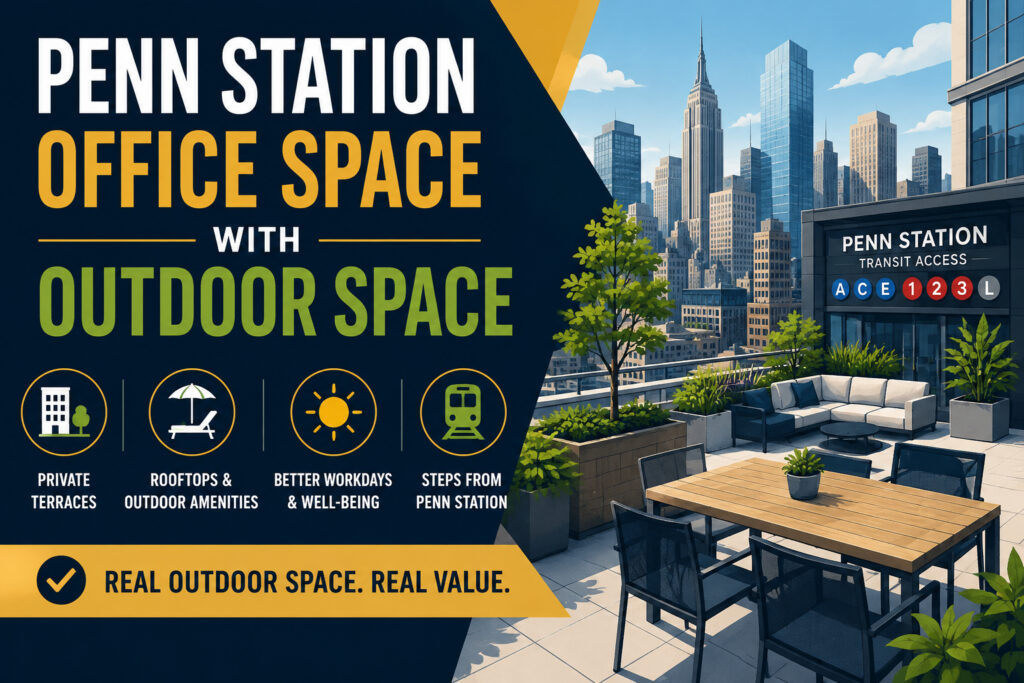
Penn Station Office Space with Outdoor Space
If you are looking for Penn Station office space with outdoor space, start by separating real outdoor inventory from loose marketing language. We represent tenants, not landlords, so we focus on what the outdoor component actually is, who controls it, and whether it improves the workday or just looks good in a brochure. That matters near Penn Station, because one address may offer a private terrace off the suite, while another only gives you access to a shared roof, a public plaza, or a nearby lounge.
Outdoor office options near Penn Station fall into a few clear lanes. One lane gives you a large campus tower with major terrace and rooftop inventory. Another gives you a station-connected tower with shared amenity space and occasional terrace-linked suites. A third gives you a Penn-adjacent loft or penthouse with a private deck. A fourth gives you flexible office access, which solves speed but not always control. For most tenants, the real search begins with leased office space, sublease space, or a prebuilt suite that offers usable outdoor access.
The simple answer sits right in front of the market. The deepest true outdoor inventory clusters in the Penn District core and on the Moynihan side, while smaller private terraces appear in select Penn-adjacent full floors, lofts, and penthouse suites. That is why this topic pulls in everyone from headquarters users to midsize firms to smaller teams that want a single private terrace instead of a full campus amenity stack.
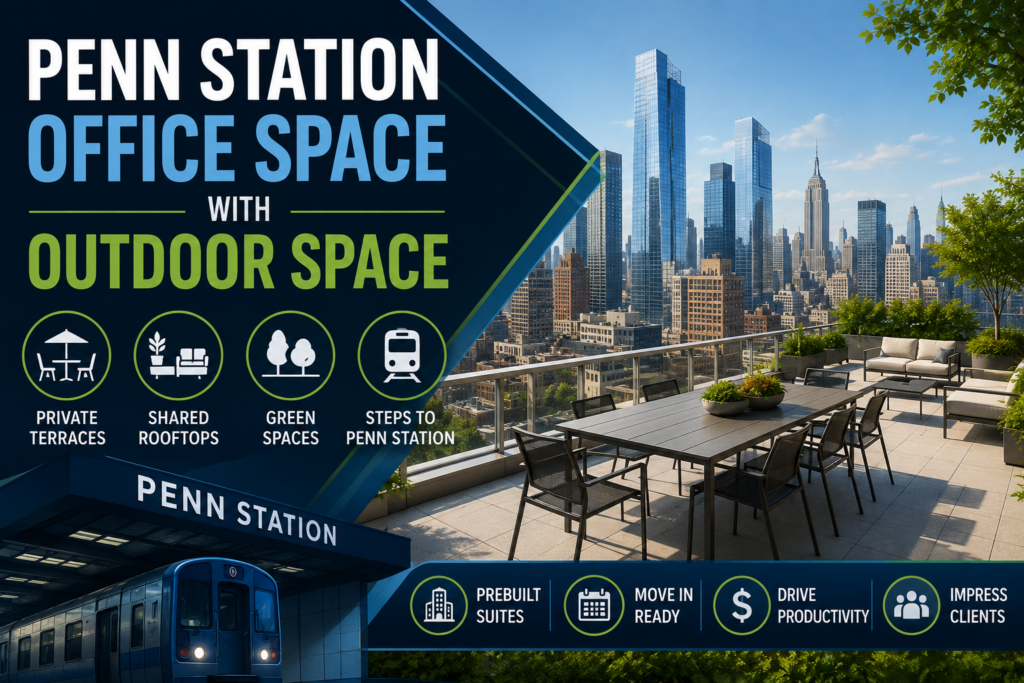
What outdoor space means near Penn Station
Near Penn Station, “outdoor space” can mean five very different things. It can mean a private terrace attached to your suite. It can mean a shared rooftop park. It can mean a building-wide deck or lounge. It can mean a landscaped setback tied to a specific floor. Or it can mean a plaza-centered work environment that gives your office a stronger daily feel without giving you dedicated outdoor square footage. A tenant should never treat those versions as interchangeable.
Private terraces deliver the most control. They support private meetings, quiet phone calls, client hosting, and brand identity. Shared roofs do something else. They improve the employee day, add breakout capacity, and create event space without asking the tenant to lease every outdoor square foot directly. Plaza access helps too, but a public plaza is still not the same thing as stepping straight from your office onto a controlled outdoor area.
The strongest benchmark for true outdoor inventory in the Penn core is PENN 2. Current official materials describe more than 73,000 square feet of outdoor tenant space there, including a 17,000-square-foot rooftop park, 37,000 square feet of private terraces, 16 loggias, and outdoor corners on even tower floors. The Farley Building answers the same need from a different angle, with nearly 70,000 square feet of landscaped outdoor park space and a 6,000-square-foot glass pavilion opening to that green space. PENN 1 sits in the middle, leaning more on a broad amenity stack, adaptable office suites, and communal outdoor value than on a single headline terrace product.
That distinction should shape how you tour. If your staff wants fresh air, lunch breakout space, and informal meeting room overflow, a shared rooftop or outdoor lounge may solve the problem. If your leadership team wants privacy, control, and an outdoor area that feels like part of the suite, you need a terrace-specific floor. If you want the outdoor feel without paying the heaviest premium, plaza-facing buildings and strong communal amenity packages often give a better value than a dedicated terrace that sits empty most of the week.
Where the strongest options sit
At the top of the market, the station-core answer starts with PENN 2. It sits above Penn Station, opens onto Plaza 33, and currently shows availabilities from roughly 5,070 to 63,180 square feet. This is the clearest fit for larger users that want scale, a sharpened arrival sequence, and outdoor space that reads as part of the office identity instead of a side benefit. For teams that want terrace inventory plus major floor plates, this is the benchmark address in the immediate Penn Station zone today.
PENN 1 and 1 Penn Plaza answer a different version of the same search. PENN 1 currently shows marketed availabilities from about 1,361 to 61,346 square feet and centers the experience on lounges, meetings, fitness, adaptable office suites, and shared outdoor value. 1 Penn Plaza gives tenants a classic Penn Plaza location, broad scale, and a public-plaza environment, but most tours there should assume communal or setback-driven opportunity rather than a giant attached terrace on every floor. In other words, these buildings can work very well for the query, but they solve it differently from PENN 2.
The Moynihan side deserves serious attention when arrival quality matters as much as the outdoor feature itself. The Farley Building combines direct rail access, large creative floor plates, tall slabs, and a fifth-floor outdoor park that materially changes the workday. This is the Penn Station answer for firms that value west-side arrival, stronger architectural character, and a greener campus feel tied directly to the office. If your people travel often, that setting can feel calmer and more deliberate from the first minute inside the district.
Smaller private outdoor options do exist, but they appear more selectively. A current Penn Plaza example in the market advertises roughly 3,500 to 5,000 square feet with direct rooftop terrace access. Our own site also features a Seventh Avenue Office for Lease at 7,815 square feet with a private terrace, a Penn Plaza Furnished Office Space listing with communal outdoor areas, and a Madison Square Garden Penthouse Office that offers 2,200 to 4,800 square feet with a large roof deck. Nearby, 7 Penn Plaza has also been repositioning around a building-wide rooftop amenity.
This matters because many tenants do not need a 60,000-square-foot campus floor to win the day. A 4,000-to-8,000-square-foot suite with outdoor access can be the better answer for a private equity group, design firm, advisory team, or lean operating office. The right question is not “which building has the biggest roof.” The right question is “which outdoor option matches the team size, meeting style, and lease strategy we actually need.”
How pricing and availability really break down
Penn Station office space with outdoor space does not trade as one market. It trades as three. Penn District trophy product now lands around the $109 to $125 per square foot range in current market guides, while Colliers put Midtown’s Q1 2026 average asking rent at $84.74 per square foot. That spread makes the core point clear. Near Penn, the outdoor premium usually arrives bundled with newer systems, stronger amenity ecosystems, larger floor plates, and a more polished arrival environment. The terrace matters, but the building quality matters just as much.
The second tier sits in repositioned Penn-adjacent buildings. This is where many tenants find the best balance between image, cost, and usability. You stay close to the station. You keep access to the West 30s, Herald Square, and the wider transit web. You may also gain a shared roof, a private terrace, or a strong prebuilt suite without paying top-campus pricing. In broad terms, that tier often falls in the mid-$50s to mid-$70s, depending on finish, term, and whether the outdoor component belongs to the suite or the building.
The value tier lives north and west of the station core. Think loft floors, smaller full floors, boutique assets, and occasional penthouses. Current guidance still places many Garment District lofts in roughly the $40 to $65 per square foot band, although true terraces and roof-deck suites can price above generic loft stock. This tier works best for creative groups, lean operating teams, private ownership groups, and businesses that would rather control a smaller outdoor area than pay for a trophy address every day of the week.
Availability tells a second story. Our current Penn Station Offices page shows live blocks around 1,537, 2,500, 4,600, 5,875, 7,769, 8,724, 9,450, 13,996, and 18,641 square feet. That does not mean all of them include outdoor space. It does mean the broader Penn market still gives tenants a wide size ladder, with outdoor inventory concentrated in a narrower subset. In practice, the best outdoor fits cluster in four bands: boutique terrace suites, midsize prebuilt offices with shared access, full floors with dedicated decks, and very large campus floors with integrated terrace systems.
The premium only makes sense when the use case is real. If your office runs an active in-person week, outdoor space can improve meetings, employee retention, and event flexibility. If your team comes in once a week, the premium often makes less sense unless the terrace also solves client hosting or brand presentation. That is why tenants should price outdoor space as an operating tool, not as a novelty.
How to choose the right fit
Start with one blunt question: do you need private outdoor space, or do you need reliable access to outdoor space? Private space means the suite opens onto a terrace, deck, or setback area you can control. Reliable access means the building gives your staff a roof, park, deck, or outdoor lounge they can use without leaving the property. Many tenants overpay because they mix up those two goals on day one. When you sort that out first, the shortlist becomes much smaller and much better.
Then match the outdoor type to the team. Headquarters users usually care about privacy, scale, event capacity, and client-facing identity. Hybrid midsize firms care more about shared lounges, meeting capacity, and a strong commute. Smaller teams often win with a full-floor loft or penthouse that gives them a manageable private deck instead of an oversized amenity stack they will never fully use. Penn Station can satisfy all three groups, but not with the same building set.
Before you tour, ask a short list of hard questions.
- Is the outdoor area private to the suite or shared with the building?
- Does it sit on the same floor as the office?
- How many people can use it at once?
- Does the building provide furniture, shade, Wi-Fi, and power?
- Are there restrictions after business hours or during events?
- Do wind, noise, shade, or security conditions limit daily usability?
Those questions sound simple, yet they expose most weak outdoor claims in minutes.
Lease structure matters too. Some of the best terrace options arrive as direct leases with build-out flexibility. Others come as prebuilts, furnished subleases, or short-term swing-space solutions. If you want to widen the search without losing the concept, compare Penn Station Direct Lease vs Sublease Office Space, Prebuilt Office Space Near Penn Station, Furnished Office Space Near Penn Station, Short-Term Office Space Near Penn Station, and Small Office Space Near Penn Station. No two outdoor offices solve the same occupancy problem, even when they sit a few blocks apart.
The cleanest way to search this niche is to tour in layers. Begin with Penn Station Offices. Then compare station-connected options through What Office Buildings Have Direct Access to Penn Station. Sort the west-side campus side with What Office Buildings Have Direct Access to Moynihan Train Hall. Then use Penn District Office Space vs Penn Station Office Space to decide whether you want the polished campus feel or the wider Penn inventory. That sequence cuts wasted tours fast and keeps the search grounded in what the outdoor piece actually means for your team.
Find an Office with Outdoor Space Today
We represent tenants only. That keeps the conversation grounded in fit, leverage, and usable detail. If you want Penn Station office space with outdoor space, the goal is not to chase every roof deck in Midtown. The goal is to identify which outdoor option will actually improve your daily work pattern, then secure it on the right lease terms.
Fill out our 📋 online form or give us a call today 📞 212-967-2061 — let’s find the right options for your business.