Best Manhattan Neighborhoods for AI Companies: A Tenant Comparison
The best Manhattan neighborhoods for AI companies right now
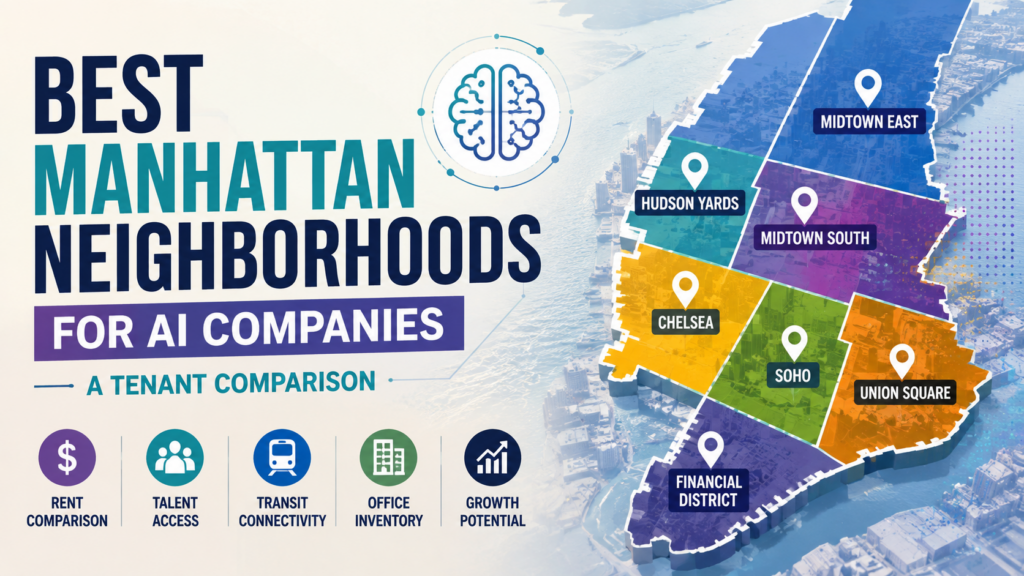
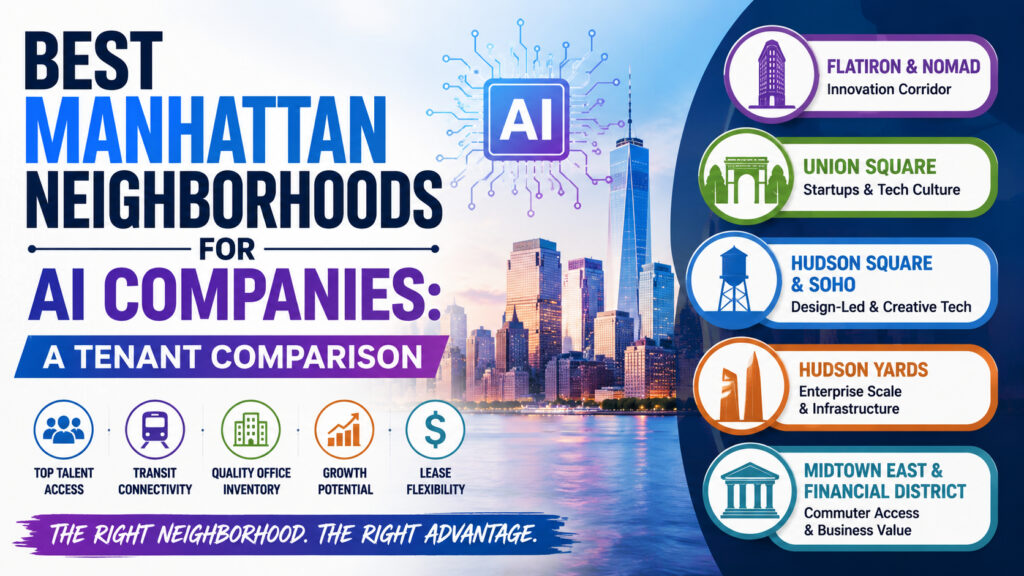
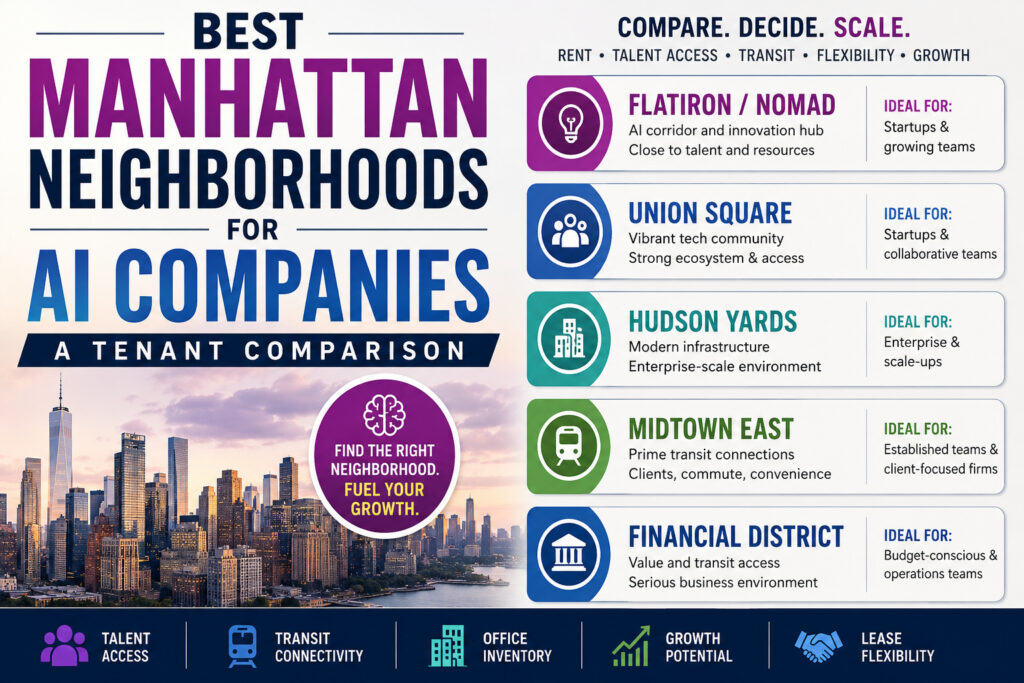
For most funded AI companies, Flatiron, NoMad, and Union Square form Manhattan’s strongest starting corridor. Hudson Square works especially well for larger teams. SoHo and Chelsea favor design-led companies. Hudson Yards supports enterprise-scale requirements. Midtown East and the Financial District deserve serious consideration for commute, clients, and value.
Those choices reflect more than neighborhood reputation. They reflect how AI companies now lease Manhattan offices. Current tenant comparisons consistently emphasize Midtown South, Hudson Square, SoHo, transit, flexibility, infrastructure, and company stage. Competing neighborhood guides cover many of those topics. However, they often blur technology companies, startups, and AI tenants into one category.
AI tenants increasingly need a more precise comparison.
A twenty-person applied-AI startup has different requirements from a 300-person research organization. An enterprise-facing company may value client access above nightlife. A product-led team may rank recruitment above address prestige. Meanwhile, a rapidly funded company may care most about expansion.
That distinction matters because Manhattan’s office market tightened during 2026.
One major market survey placed Manhattan availability at 14.4% during the second quarter of 2026. Average asking rent reached $80.17 per square foot. Sublease availability fell to 2.6%, with sublease asking rents averaging $59.94 per square foot.
Midtown South shows even stronger demand pressure.
Another market study recorded 5.05 million square feet of Midtown South leasing during Q2 2026. That marked its strongest quarter since 2001. Availability fell to 12.7%, while average asking rent reached $79.41 per square foot.
Different research firms calculate vacancy, availability, and rents differently. Therefore, tenants should never treat one market average as a quote.
What has changed for AI tenants
Technology leasing surged across Manhattan during 2025. One sector study counted 6.54 million square feet of technology leasing, across 235 transactions. AI companies accounted for about 790,000 square feet during 2025. They then recorded another 670,000 square feet during Q1 2026 under that study’s methodology.
Another 2026 analysis counted 21 AI transactions totaling 719,200 square feet through the second quarter. Roughly 70% of that activity occurred in Midtown South.
Methodologies differ, but the direction remains clear. AI has become a meaningful office-demand category.
Talent also reinforces Manhattan’s appeal.
A 2026 technology-talent study counted approximately 394,300 technology workers across the New York metropolitan market in 2025. That total increased by more than 30,000 workers from 2022.
For tenants, however, citywide talent statistics only start the discussion.
Your best neighborhood depends on where your people live, how often they meet, and how quickly your headcount may change.
That is why the right decision should compare submarkets before comparing individual buildings.
Manhattan AI neighborhood comparison at a glance
There is no universal “AI neighborhood.” Each Manhattan submarket solves a different operating problem.
The strongest shortlist usually contains three contrasting choices. One might maximize talent access. Another might improve economics. A third could solve future expansion.
| Manhattan neighborhood | Best fit for AI tenants | Current pricing context | Typical office pattern | Biggest advantage | Main tradeoff |
|---|---|---|---|---|---|
| Flatiron / Madison Square | Funded startups, scaling AI, engineering-heavy teams | Midtown South averages roughly high-$70s to low-$80s; premium space runs higher | Loft floors, prebuilts, full floors, Class A options | Deep technology ecosystem and central access | Heavy competition for strong built space |
| NoMad | Growth-stage headquarters, client-facing AI, larger private teams | Often tracks premium Midtown South economics | Boutique full floors, lofts, upgraded Class A | Headquarters quality without losing Midtown South energy | Quality inventory can command a premium |
| Union Square | Distributed teams, hybrid attendance, cross-borough hiring | Prime options often price above broad Midtown South averages | Renovated lofts, prebuilts, full floors | Exceptional subway connectivity | Limited bargains immediately around the square |
| Hudson Square | Scaling engineering teams, larger collaborative offices | Recent submarket benchmarks have exceeded broad Midtown South averages | Large floors, converted industrial stock, modern offices | Space efficiency and growth potential | West-side commute requires team mapping |
| SoHo | Consumer AI, product-led AI, creative technology | Suite-specific premium pricing | Cast-iron lofts, boutique full floors | Strong identity, light, ceiling height | Large contiguous choices remain limited |
| Chelsea / West Chelsea | Product, design, engineering, media-adjacent AI | Wide range because inventory varies greatly | Loft floors, converted industrial buildings, larger floors | Creative character plus west-side scale | Transit quality varies block by block |
| Hudson Yards | Enterprise AI, large headquarters, well-funded growth | Premium product commonly reaches $120+ asking levels | New towers, large plates, modern infrastructure | Scale, amenities, building quality | Higher occupancy cost |
| Midtown East / Grand Central | Enterprise-facing AI, regional commuters, executive teams | Midtown averaged $86.18 per square foot in Q2 2026 | Class A towers, prebuilts, furnished subleases | Regional connectivity and client access | Less concentrated startup identity |
| Financial District | Fintech AI, B2B AI, value-driven scaling teams | Downtown averaged $61.34 per square foot in Q2 2026 | Class A floors, furnished subleases, larger blocks | Cost efficiency and extensive transit | Farther from Midtown South peer density |
Midtown South’s market averages deserve context. One Q2 2026 survey reported an $81.14 overall asking rent there. Class A asking rent reached $104.50 per square foot. The same study placed Midtown’s overall average at $76.98, with Class A at $88.50.
Midtown shows a similar spread under another methodology. Its Q2 2026 average asking rent reached $86.18 per square foot, with 12.7% availability.
Downtown creates a noticeably different economic baseline. Its Q2 average reached $61.34 per square foot. Downtown sublease asking rent averaged just $47.13 per square foot.
Those figures explain why neighborhood selection affects far more than image.
A 10,000-square-foot requirement at $60 per square foot creates $600,000 of annual base rent. At $85, that number rises to $850,000. At $110, annual base rent reaches $1.1 million.
Yet headline rent still tells only part of the story.
Concessions, electricity, escalations, operating expenses, construction, furniture, cabling, and free rent can change the economics. Lease structure can matter just as much.
Our commercial leasing guide explains those cost components before tenants compare proposals.
The practical conclusion: choose a neighborhood for the workforce first. Then choose a building for the operating requirement. Finally, negotiate the space around growth and risk.
Where each Manhattan neighborhood wins — and where it does not
Flatiron and Madison Square: the strongest all-around starting point
Flatiron remains an obvious first tour for many funded AI companies.
The neighborhood combines Midtown South’s technology concentration with strong access from several directions. Teams can reach Penn Station, Union Square, PATH connections, and multiple subway lines without leaving the broader corridor.
Office inventory also provides useful variety.
Smaller companies can pursue built lofts and furnished subleases. Larger teams can target full floors. Mature tenants can compare premium inventory without abandoning the neighborhood’s creative character.
A current 4,125-square-foot furnished Flatiron option illustrates the smaller end. It offers about 30 workstations, meeting rooms, a conference room, and high ceilings.
Growing teams can step into a 5,594-square-foot prebuilt Flatiron office. Its configuration includes several enclosed rooms, conference areas, a kitchen, security, and 24/7 access.
The next size tier becomes especially interesting for scaling AI companies.
An 11,239-square-foot furnished full floor includes 48 installed workstations. Its layout can accommodate substantially more seats. The space also includes boardrooms and huddle rooms. Its current sublease term runs into 2028.
A nearby 11,578-square-foot direct loft provides another path. It supports a larger workforce and offers high ceilings, private rooms, and pantry space.
For larger requirements, an 18,500-square-foot Flatiron full floor offers more than 100 open seats alongside private offices.
Where Flatiron wins: recruiting, peer proximity, Midtown South energy, and inventory diversity.
Where Flatiron loses: bargain hunting.
Strong furnished offices can attract several growing tenants simultaneously. Therefore, a company with rigid timing may need adjacent alternatives.
That is exactly why Flatiron should rarely stand alone on a shortlist.
NoMad: headquarters quality with Midtown South access
NoMad suits companies that want the Midtown South ecosystem without relying on pure loft character.
Many floors offer a more polished headquarters experience. The neighborhood also places teams between major west-side transportation and the east-side business core.
That combination works particularly well for growth-stage AI companies.
Executives can reach client meetings quickly. Engineers retain access to Midtown South. Candidates receive a central destination. Visitors also avoid complicated last-mile journeys.
A current 5,000-square-foot furnished NoMad office demonstrates the smaller headquarters format. It supports more than 35 seats, several offices, conference space, and tenant-controlled cooling. Its advertised sublease term runs through September 2027.
Teams requiring more room can compare an 8,390-square-foot Madison Avenue sublease. The current offering supports roughly 50 people and includes 24/7 access.
NoMad becomes particularly attractive when fundraising changes the office requirement quickly.
A company may enter the market needing 5,000 square feet. Three months later, its hiring plan may require 9,000.
The neighborhood provides enough inventory diversity to handle that change. However, tenants should not assume the next floor will remain available.
Where NoMad wins: polished headquarters, centrality, recruiting, and business access.
Where NoMad loses: tenants seeking the lowest occupancy cost.
A strong NoMad comparison should always include Flatiron, Union Square, or Midtown East. That contrast reveals whether the address premium creates operational value.
Union Square: the commute-first choice
For many AI companies, attendance starts with transportation.
Union Square gives employers unusually broad access across Manhattan and into several outer boroughs. Multiple subway services converge around the neighborhood.
That matters when engineers, product staff, salespeople, and executives live in different directions.
A team spread across Brooklyn, Lower Manhattan, Queens, and Midtown may struggle with a far-west office. Union Square can reduce those conflicts.
Current inventory also spans several meaningful size bands.
A furnished Union Square full floor of roughly 7,700 square feet provides more than 30 workstations. It also contains meeting space and private rooms.
An 8,200-square-foot furnished Union Square office supports approximately 55 people. Its configuration includes breakout areas and a direct lease structure.
Large teams can compare a 30,450-square-foot Union Square opportunity. The offering spans two approximately 15,250-square-foot floors. Dedicated HVAC also gives the tenant greater operating control.
Our Union Square sublease guide explains another route for tenants prioritizing speed and shorter commitments. A separate plug-and-play Union Square guide focuses on move-in-ready choices.
Where Union Square wins: cross-borough commuting and team attendance.
Where Union Square loses: tenants demanding huge contiguous blocks at discount pricing.
For hybrid AI companies, however, a smaller office with better attendance can outperform a larger remote location.
That calculation deserves more attention than rent alone.
Hudson Square: the scale-and-floorplate choice
Hudson Square deserves its own comparison.
It should not disappear inside broader SoHo or Downtown discussions. The building stock, west-side location, and floor sizes create different possibilities.
Large engineering teams often need uninterrupted collaboration areas. Product groups may need several neighborhoods inside one floor. Research teams can require quiet rooms near open work zones.
Broad floor plates make those layouts easier.
A current 2,530-square-foot furnished Hudson Square office shows that smaller teams can still enter the neighborhood. It contains 18 workstations, a conference room, exposed ceilings, and corner light.
Another 3,191-square-foot furnished Hudson Square office supports roughly 40 people under the listing’s planning assumptions.
At the opposite end, a 30,000-square-foot furnished full floor provides nearly 200 installed workstations. It also includes private offices within the larger plan.
That range illustrates Hudson Square’s strongest trait.
A team can pursue neighborhood character without accepting tiny floor plates.
Recent internal market benchmarking placed Hudson Square asking rent around $93.25 per square foot during Q1 2026. Availability stood near 21.1% under that submarket snapshot.
Those numbers do not mean every suite costs $93.25.
Older loft product, new construction, furnished subleases, and direct leases can differ dramatically. Building condition also matters.
Where Hudson Square wins: scaling, open layouts, west-side talent, and larger floor requirements.
Where Hudson Square loses: some commuter patterns.
Before signing there, map employees coming from New Jersey, eastern Queens, and the Upper East Side.
A great office cannot repair a poor commute.
SoHo: the brand-and-product choice
SoHo solves a different problem.
Some AI companies sell infrastructure. Others sell products that consumers, creators, marketers, or design teams touch daily.
For the second group, the office can function as a physical expression of the product.
High ceilings, large windows, exposed structures, and full-floor lofts can create that identity without manufactured startup décor.
A 2,691-square-foot turnkey SoHo office provides an accessible entry point. The current layout includes 20 workstations, private offices, tenant-controlled HVAC, and attended access.
A growing company can compare a 4,000-square-foot SoHo full floor. It combines open work areas with conference rooms and private offices.
Larger options include a 5,550-square-foot full-floor loft with high ceilings and strong natural light.
A 7,184-square-foot prebuilt SoHo office supports a substantially larger team. It includes open areas, private rooms, phone rooms, and a kitchen.
Companies approaching a larger headquarters size can examine a 12,500-square-foot furnished SoHo office. The current listing supports more than 80 people and offers tenant-controlled HVAC.
Where SoHo wins: identity, recruiting appeal, product culture, and loft architecture.
Where SoHo loses: predictable large-block inventory.
A company expecting several rapid expansions should scrutinize building growth paths before committing.
The prettiest 5,000-square-foot floor becomes expensive if you must relocate after twelve months.
Chelsea and West Chelsea: product culture with room to stretch
Chelsea sits between several Manhattan office identities.
Eastern Chelsea connects easily with Midtown South. West Chelsea offers larger industrial-style floors. The broader neighborhood also attracts design, media, creative, and technology teams.
AI companies with product-heavy cultures can find that combination useful.
A 4,722-square-foot furnished Chelsea penthouse office offers a distinctive smaller-team option. The current sublease runs through December 2027. It includes loft features, skylights, and roof access.
Another 5,000-square-foot Chelsea full floor provides furnished space with meeting and private rooms.
Larger West Chelsea buildings can offer far bigger floor plates.
One large West Chelsea office property contains floor plates ranging from roughly 18,000 to 165,000 square feet. The property also includes substantial amenity investment.
Where Chelsea wins: design culture, larger western floor plates, and Midtown South adjacency.
Where Chelsea loses: uniform transportation quality.
Two Chelsea offices can create completely different commutes.
Therefore, tenants should test actual station walks during touring. Do not judge the neighborhood from a map alone.
Hudson Yards: the enterprise-scale choice
Hudson Yards works best when scale outranks neighborhood intimacy.
Modern towers can provide large floor plates, stronger building systems, premium amenity packages, and polished visitor experiences.
That makes the neighborhood especially relevant to well-capitalized AI organizations.
A current 11,907-square-foot furnished Hudson Yards office offers a modern Class A environment and large, efficient floor planning.
A 20,222-square-foot furnished Hudson Yards sublease offers a longer runway. Its published term extends to May 2032. The floor supports more than 130 people under current planning.
Much larger organizations can evaluate a 45,942-square-foot Hudson Yards headquarters opportunity. It spans two floors and includes substantial amenity areas.
Our current Hudson Yards office guide places premium asking economics around $120 per square foot in current guidance. Individual proposals can move well above or below that level.
Where Hudson Yards wins: scale, presentation, amenities, modern systems, and regional rail access.
Where Hudson Yards loses: cost and last-mile convenience for some employees.
A company should not pay for trophy infrastructure unless its operation, recruitment, or customer experience benefits.
Midtown East and Grand Central: the enterprise-access choice
AI companies do not need a startup-branded neighborhood to recruit strong teams.
Midtown East deserves more attention when clients, executives, and regional commuters matter.
Grand Central access can materially improve travel for employees coming from northern suburbs. The district also works well for enterprise sales teams.
Current availability ranges from modest furnished subleases to full-floor offices.
A 4,451-square-foot prebuilt Third Avenue office provides immediate direct-lease inventory with glass-fronted rooms.
A 6,678-square-foot furnished Third Avenue sublease currently offers an 18-to-36-month structure. Its layout includes private offices, conference rooms, and approximately 30 workstations.
Budget-sensitive tenants should notice the spread inside one neighborhood.
A 7,367-square-foot furnished Midtown East office currently advertises $45 per square foot. It includes wiring, workstations, private offices, and conference space.
A 10,500-square-foot Grand Central full floor currently advertises $51 per square foot. The listing supports roughly 70 people.
Those examples sit below Midtown’s broad Q2 average.
They demonstrate why live inventory matters more than generalized neighborhood pricing.
Where Midtown East wins: enterprise clients, commuter access, built space, and relative value opportunities.
Where Midtown East loses: concentrated startup atmosphere.
For many B2B AI companies, that supposed weakness barely matters.
Financial District: the Manhattan value choice
The Financial District creates the strongest pricing contrast in this comparison.
Downtown’s Q2 2026 average asking rent reached $61.34 per square foot. Midtown averaged substantially more. Midtown South also carried a clear premium.
That difference can fund additional hires, better furniture, or a larger office.
The neighborhood also offers extensive subway coverage and PATH access. Those connections strengthen its case for New Jersey commuters.
A 2,573-square-foot furnished Financial District office offers a smaller private option. Its current sublease term runs through February 2028.
A 5,606-square-foot furnished Downtown office can expand to approximately 15,752 square feet. Its published sublease term extends through September 2029.
Companies seeking a direct lease can compare a 10,115-square-foot furnished full floor. Its plan combines perimeter rooms with open work areas.
Another 3,138-square-foot furnished Downtown sublease offers a longer term through December 2030.
Where the Financial District wins: economics, transit breadth, New Jersey access, and enterprise-facing business activity.
Where it loses: distance from Midtown South’s densest AI leasing corridor.
That tradeoff can become attractive at larger sizes.
Saving $20 per square foot on 20,000 square feet equals $400,000 annually in base rent. That difference deserves a serious comparison.
Match the neighborhood to your stage, headcount, commute, and lease model
Funding stage alone should never determine location.
Two companies with equal funding can need completely different offices. One may operate remotely with occasional collaboration days. Another may require five-day attendance.
Still, company stage helps organize the search.
Our AI startup office-space roadmap uses approximately 2,000 to 3,500 square feet for teams of eight to fifteen people as an early-stage planning range.
From there, requirements can change quickly.
| Team profile | Useful planning range | Neighborhoods worth testing first | Lease formats to compare |
|---|---|---|---|
| 8–15 people | 2,000–3,500 SF | Flatiron, NoMad, SoHo, Chelsea, Midtown East | Furnished sublease, prebuilt direct, private flexible suite |
| 15–40 people | 3,500–8,000 SF | Flatiron, Union Square, SoHo, Hudson Square, Midtown East | Furnished sublease, turnkey direct, prebuilt |
| 40–100 people | 7,500–15,000 SF | NoMad, Flatiron, Union Square, Hudson Square, Chelsea, Grand Central | Full-floor direct, long sublease, spec suite |
| 100–200 people | 15,000–30,000 SF | Hudson Square, Hudson Yards, Union Square, West Chelsea | Large full floor, multi-floor direct, long sublease |
| 200+ people | 30,000 SF and above | Hudson Yards, Hudson Square, West Chelsea, larger Midtown options | Headquarters lease, contiguous floors, phased occupancy |
These are planning bands, not formulas.
An office with many enclosed rooms fits fewer engineers than an open loft. Large meeting suites also consume meaningful area. Kitchens, labs, production rooms, and internal event space change density again.
Seat count should follow work patterns.
A company with 70 employees may only need 45 assigned desks. Yet it could need significant collaboration space for weekly gatherings.
Another 70-person company may require nearly every person onsite daily.
Those firms should not tour the same inventory.
Commute geography can overturn the neighborhood ranking
Before searching buildings, plot the team.
Record each employee’s nearest subway or commuter station. Add expected senior hires. Include the next twelve to eighteen months of recruitment.
Then compare three proposed neighborhoods.
A Brooklyn-heavy workforce may favor Union Square, Flatiron, or SoHo. New Jersey commuters can strengthen the case for Flatiron, NoMad, Penn-area locations, or Downtown.
Northern suburban commuters may benefit from Grand Central access.
Our PATH commuter neighborhood guide compares these tradeoffs directly.
Do not assume employees will tolerate an inconvenient neighborhood because the office looks impressive.
Attendance behavior often reveals the real cost of a poor location.
Choose the lease model after defining growth risk
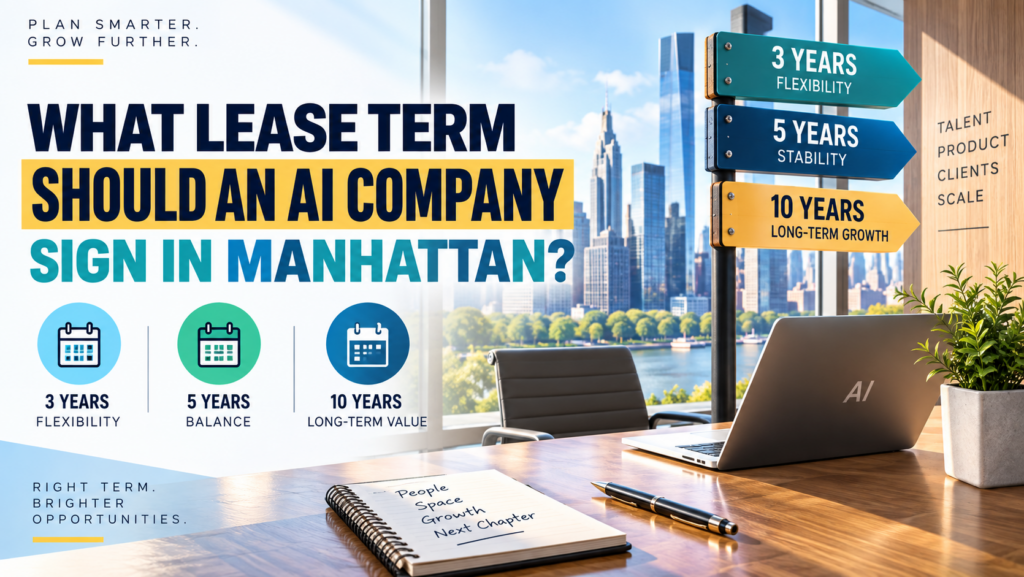
AI companies often receive conflicting advice about lease length.
Some teams need short commitments because headcount remains uncertain. Others now sign long leases because they expect sustained Manhattan growth.
Current leasing behavior supports both scenarios.
The correct question is not, “Should AI companies sign short leases?”
Ask instead: How expensive would it become if our headcount misses the forecast in either direction?
A short-term AI office guide explains bridge options for uncertain teams. For Midtown requirements, our flexible AI office guide covers another lane.
A furnished sublease can reduce setup time.
A direct lease can provide stronger expansion planning.
A prebuilt suite can split the difference.
Shared workspace can serve temporary teams. However, it should not dominate the neighborhood decision.
This page focuses on private office solutions with meaningful tenant control.
Expansion deserves its own negotiation
Rapid growth changes real estate economics.
Suppose a 50-person AI company expects 100 employees within eighteen months. Taking only today’s requirement could force an early move.
Taking twice today’s requirement creates immediate carrying cost.
Neither approach automatically works.
Instead, examine adjacent availability, future floors, assignment rights, sublease rights, and expansion protections.
A well-structured 10,000-square-foot lease may outperform a poorly structured 15,000-square-foot lease.
Optionality has a price, but forced relocation has one too.
AI-ready means building-ready, not just neighborhood-ready
No Manhattan neighborhood can guarantee an “AI-ready” office.
That label should describe a building and suite after technical review. It should never rely on a neighborhood stereotype.
Our guide to AI-optimized Manhattan office space covers technical screening in greater depth.
For neighborhood selection, tenants should focus on seven operating questions.
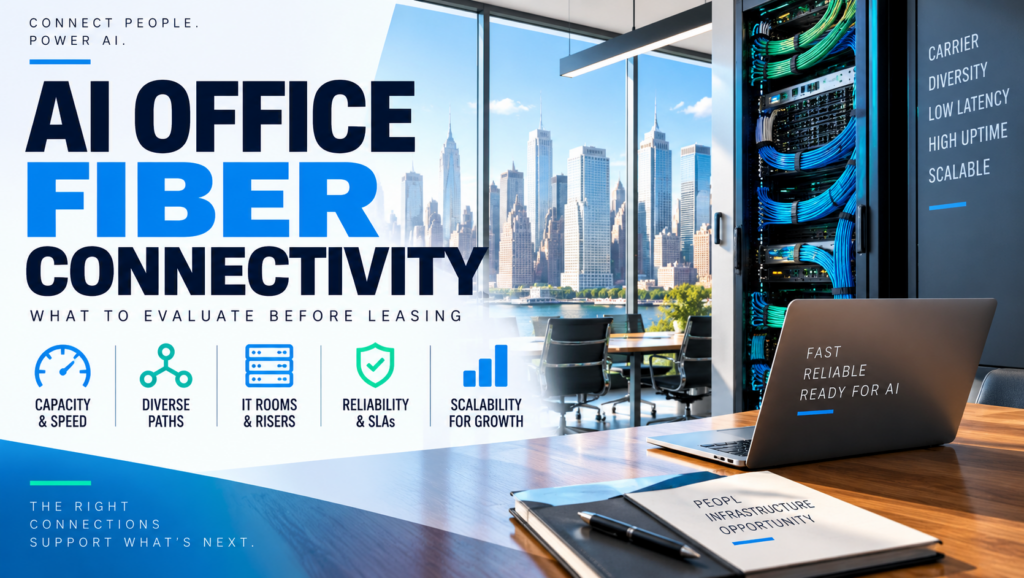
Connectivity comes first. Confirm available fiber providers, service paths, installation timing, and redundancy requirements. Do not assume a famous building has the exact service your team needs.
Power requires actual engineering review. Cloud-first AI teams may use ordinary office loads. Teams operating substantial local equipment can require much more.
That distinction matters.
A software company running workloads elsewhere does not need a miniature data center inside its office.
A research group with substantial onsite equipment may need upgraded electrical capacity, cooling, and ventilation.
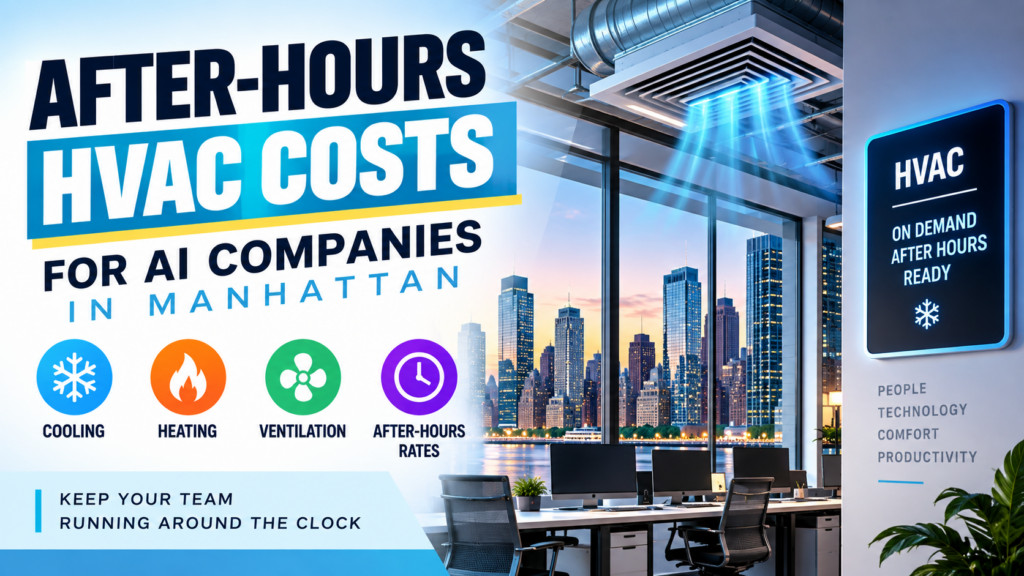
Cooling must match operating hours. Many offices provide central HVAC only during defined building hours. After-hours service can carry additional charges.
Tenant-controlled systems create more flexibility.
Several current listings already emphasize that feature. The 5,000-square-foot NoMad office includes tenant-controlled cooling. So does the 2,691-square-foot SoHo office.
Access matters when teams work irregular schedules. Ask about 24/7 entry, visitor procedures, freight access, elevator policies, and after-hours building services.
The 5,594-square-foot Flatiron prebuilt currently advertises 24/7 access and building security.
Acoustics matter more than open-plan aesthetics. AI teams often combine engineering, product, recruiting, sales, and executive functions.
Those groups create different sound patterns.
An effective office needs open collaboration areas, quiet work zones, call rooms, and private conference rooms.
A giant loft without acoustic planning can underperform a conventional floor.
Privacy needs building-level review. Confidential meetings, unreleased products, customer information, and recruitment discussions all require controlled space.
Private suites can simplify access management.
Companies with heightened security requirements should also inspect elevator access, reception protocols, cameras, key systems, and visitor handling.
Expansion must extend beyond the suite. Ask what else exists inside the building.
Check adjacent floors. Review upcoming expirations. Understand whether the landlord controls nearby inventory.
That information can matter more than an extra conference room today.
Building class does not determine AI suitability
A Class A label does not automatically create the best AI office.
Some upgraded loft buildings provide excellent fiber, tenant-controlled cooling, high ceilings, and efficient layouts.
Meanwhile, an expensive tower can still have the wrong floor size.
The ideal building combines the right systems with the right economics.
Evaluate the exact suite, not the category.
That approach also prevents unnecessary spending.
Companies frequently pay for amenities they rarely use. Others underinvest in infrastructure that affects daily work.
A disciplined tour separates useful features from presentation.
Furnished space can buy valuable time
Speed has become an important AI leasing variable.
Funding, recruiting, and product milestones do not always align with construction schedules.
Move-in-ready inventory can reduce that mismatch.
Our Flatiron furnished and plug-and-play guide covers that option in depth.
The current listings show several sizes already.
A 4,125-square-foot furnished Flatiron office can serve a smaller scaling team. An 11,239-square-foot full floor can serve a much larger one.
However, furniture should never distract from lease quality.
A free desk has little value inside the wrong commitment.
What AI office space costs across Manhattan in 2026
Manhattan does not have one office rent.
It has thousands of individual negotiations inside overlapping submarkets.
During Q2 2026, one major survey placed Manhattan’s average asking rent at $80.17 per square foot. Midtown averaged $86.18. Downtown averaged $61.34.
Another survey placed Midtown South overall at $81.14 per square foot. Its Class A category reached $104.50.
A separate Midtown South survey recorded $79.41 per square foot.
None of those figures conflict in a practical tenant comparison.
Each firm tracks a somewhat different dataset and methodology.
The spread reinforces a more important lesson.
Do not budget from one published average.
Translate rent into annual exposure
Office rent usually appears as annual dollars per rentable square foot.
The arithmetic remains straightforward.
| Requirement | Asking rent | Annual base rent | Approximate monthly base rent |
|---|---|---|---|
| 5,000 SF | $60/SF | $300,000 | $25,000 |
| 5,000 SF | $85/SF | $425,000 | $35,417 |
| 5,000 SF | $110/SF | $550,000 | $45,833 |
| 10,000 SF | $60/SF | $600,000 | $50,000 |
| 10,000 SF | $85/SF | $850,000 | $70,833 |
| 10,000 SF | $110/SF | $1,100,000 | $91,667 |
| 20,000 SF | $60/SF | $1,200,000 | $100,000 |
| 20,000 SF | $85/SF | $1,700,000 | $141,667 |
| 20,000 SF | $110/SF | $2,200,000 | $183,333 |
Those numbers exclude other occupancy expenses.
Electricity can add cost. Operating expenses may apply. Tax escalations can matter. Construction can dwarf several months of rent.
Furniture, cabling, security, moving, legal work, and restoration obligations also belong in the analysis.
Therefore, compare total occupancy cost, not asking rent.
Current inventory shows how wide the spread can become
Broad market statistics can hide specific opportunities.
The current 7,367-square-foot furnished Midtown East office advertises $45 per square foot.
A 10,500-square-foot Grand Central office advertises $51 per square foot.
Another 11,500-square-foot Midtown full floor currently advertises $64 per square foot.
Those spaces sit inside a Midtown market averaging much more.
Why?
Building, floor, lease term, condition, sublease structure, ownership objectives, and timing can all create discounts.
The opposite happens too.
A premium furnished office can exceed its submarket average because it eliminates construction and delivers immediate occupancy.
Free rent can change the comparison
Suppose one landlord asks $85 per square foot.
Another asks $90.
The second landlord might offer more free rent and a stronger improvement allowance.
That proposal could produce the lower effective occupancy cost.
Therefore, tenants should normalize every serious proposal.
Compare the same lease length. Include free rent. Include escalations. Add improvement obligations. Account for electricity.
Then estimate construction and moving costs.
Finally, assign a value to flexibility.
That final step becomes especially important for AI companies.
A cheaper ten-year obligation may create more financial risk than a higher-priced flexible structure.
Buildout can erase an apparent neighborhood bargain
Raw space can look inexpensive.
Construction changes that quickly.
Technology-heavy offices often need upgraded meeting rooms, acoustic work, security, supplemental cooling, structured cabling, and specialty infrastructure.
Even ordinary offices can require substantial construction.
Our office buildout budgeting guide explains those expenses before tenants compare raw and finished space.
That is why a furnished sublease at $75 can outperform raw direct space at $60.
The cheaper rent may require months of work and substantial capital.
Conversely, a long-term direct lease can become superior when the landlord funds meaningful improvements.
Rent answers one question. Total occupancy cost answers the decision.
How to build a three-submarket shortlist before touring
The best first tour should not include twelve neighborhoods.
That approach creates noise.
A stronger process chooses three submarkets that represent different strategic outcomes.
| Your priority | First submarket | Compare against | Why the comparison works |
|---|---|---|---|
| Recruiting and peer density | Flatiron | NoMad and Union Square | Tests ecosystem against headquarters quality and commute |
| Cross-borough attendance | Union Square | Flatiron and SoHo | Tests transit against inventory and brand character |
| Fast scaling | Hudson Square | West Chelsea and Hudson Yards | Tests large floors against price and building quality |
| Consumer-facing brand | SoHo | Flatiron and Chelsea | Tests identity against transit and growth capacity |
| Enterprise clients | Midtown East | NoMad and Hudson Yards | Tests accessibility against innovation corridor and prestige |
| New Jersey commuters | Financial District | NoMad and Penn-adjacent Midtown South | Tests PATH access against central Manhattan |
| Lowest practical occupancy cost | Financial District | Midtown East and selected Midtown South subleases | Tests base-rent savings against commute and culture |
| Large headquarters | Hudson Yards | Hudson Square and West Chelsea | Tests premium towers against larger creative inventory |
That table turns neighborhood selection into an operating decision.
Start with people, not buildings
Map every current employee.
Next, map the people you expect to hire.
Then identify investors, clients, universities, advisers, or partners your team meets frequently.
A Manhattan headquarters sits inside all those travel patterns.
The best location minimizes collective friction.
That does not always mean choosing the geographic center.
A company with concentrated Brooklyn talent may prefer Union Square. A firm with many New Jersey employees might favor Downtown or western Midtown.
An enterprise sales organization can gain more from Midtown East than Flatiron.
Neighborhood fit depends on your actual network.
Add one deliberately different submarket
Three nearly identical locations produce a weak comparison.
Flatiron, NoMad, and Madison Square may all work. Yet they can share similar economic pressures.
Instead, introduce a contrasting market.
Compare Flatiron with Midtown East.
Test SoHo against the Financial District.
Put Hudson Square beside Hudson Yards.
The contrast reveals what the tenant values.
Teams frequently discover that an expensive assumption does not survive a real tour.
Others discover that paying more creates better attendance or expansion capacity.
Both outcomes provide useful information.
Tour comparable spaces, not random inventory
Each neighborhood should receive a similar test.
For example, compare one furnished option around 7,500 square feet in each market.
Do not compare a trophy 12,000-square-foot tower against an obsolete 5,000-square-foot loft.
That exercise only compares buildings.
A controlled shortlist compares neighborhoods first.
Once the preferred submarket becomes clear, widen the building search.
Our inventory covers more than 1,400 building listings, with building and space information updated continually.
Tenants can also use the Flatiron office guide or Midtown Manhattan inventory guide to expand a selected submarket.
Score each tour against the same questions
After every visit, rate the office on commute, layout, privacy, connectivity, expansion, economics, and occupancy speed.
Avoid vague reactions like “cool” or “corporate.”
Those labels rarely survive negotiation.
A beautiful loft may create poor sound control.
An ordinary tower floor may provide a superb commute, strong systems, and favorable economics.
Likewise, an expensive new building may justify its cost through efficiency.
Use the office after mentally removing the furniture and view.
Ask how the team would work there on a crowded Tuesday.
That test reveals far more.
Why Brooklyn appears in broader AI comparisons
DUMBO and Williamsburg frequently appear beside Manhattan technology neighborhoods. Current comparison material reflects that broader New York framing.
They can make sense for Brooklyn-heavy teams.
However, they answer a different geographic question.
This comparison focuses Manhattan.
A Brooklyn office should enter the shortlist only when commute data, economics, or workforce geography support that move.
Do not add Brooklyn merely because another technology company chose it.
The same rule applies to Long Island City.
Your office should follow your operating model, not somebody else’s address.
Questions AI tenants should answer before choosing a Manhattan neighborhood
Which Manhattan neighborhood works best for most AI startups?
Flatiron provides the strongest default starting point for many funded AI startups. It combines technology density, transit, multiple office formats, and strong recruiting appeal. NoMad and Union Square should usually accompany it during the first comparison. Current AI leasing also remains heavily concentrated in Midtown South.
Is Flatiron better than NoMad for an AI company?
Neither wins universally.
Flatiron offers especially strong technology identity and varied loft inventory. NoMad often provides a more polished headquarters environment.
A company should compare similar-size spaces in both neighborhoods.
Commute, economics, growth rights, and building infrastructure should decide the winner.
Is Union Square the best location for hybrid AI teams?
It can be.
Union Square’s transportation network reduces commute friction for many geographically distributed teams.
However, no transit hub fits every employee base.
Map actual home locations before giving Union Square an automatic advantage.
Should an AI startup choose SoHo or Flatiron?
Choose SoHo when brand, product identity, loft character, and creative recruitment carry unusual weight.
Choose Flatiron when peer density, central transit, and inventory depth matter more.
Growing teams should also compare future expansion options.
A small SoHo floor may become restrictive faster.
Is Hudson Square better than Hudson Yards for AI companies?
Hudson Square often offers more creative inventory and a less formal environment.
Hudson Yards offers newer infrastructure, larger modern towers, and premium amenities.
Large enterprise tenants may prefer Hudson Yards.
Scaling engineering-led companies can find Hudson Square especially compelling.
What Manhattan neighborhood gives AI companies the best value?
The Financial District provides the clearest broad-market value case.
Downtown’s Q2 2026 average asking rent stood at $61.34 per square foot. Midtown’s comparable average reached $86.18.
Specific Midtown subleases can still undercut Downtown averages.
Therefore, live inventory should always test the general market assumption.
Can Midtown East work for an AI startup?
Yes.
A company does not need a loft district to operate like a technology business.
Midtown East offers strong regional transportation, enterprise access, built inventory, and occasional sublease value.
That combination can suit B2B AI particularly well.
What neighborhood works best for an AI company hiring heavily from Brooklyn?
Union Square deserves the first test.
Flatiron and SoHo can also perform well.
Actual subway lines matter more than borough labels.
A Williamsburg employee and a Park Slope employee can face very different commutes.
What neighborhood works best for New Jersey employees?
The answer depends on the rail line.
PATH-heavy teams should compare the Financial District, Flatiron, NoMad, and nearby western Midtown South.
Penn Station commuters may prefer NoMad, Chelsea, Flatiron, or Hudson Yards.
Our PATH commuter comparison goes deeper into that decision.
Do AI companies need special office power?
Not necessarily.
Cloud-first teams may have normal office requirements.
Companies running substantial local compute equipment need more detailed electrical and cooling review.
The building should confirm actual capacity before lease execution.
Does an AI company need redundant fiber?
Many technology companies value connection redundancy.
The importance depends on operational risk.
Tenants should verify providers, pathways, installation timing, and failover requirements building by building.
A neighborhood name cannot guarantee redundancy.
Should an AI company insist on 24/7 HVAC?
Only when the team needs it.
Some companies operate mostly during standard business hours.
Others run late engineering schedules or substantial onsite equipment.
Ask how the building charges for after-hours cooling before comparing proposals.
Should a seed-stage AI startup sign a long Manhattan lease?
Not automatically.
A long term can unlock stronger landlord economics and construction contributions.
However, uncertain headcount creates risk.
Short subleases, prebuilt direct space, and flexible private offices deserve comparison.
Our short-term AI office guide focuses on that decision.
When should an AI company choose a direct lease instead of a sublease?
A direct lease becomes attractive when the company values control, branding, longer occupancy, and future expansion.
Subleases often win on speed, furniture, and shorter remaining terms.
Neither structure always costs less.
Compare the full economics.
How much office space should an AI company take per employee?
There is no reliable universal ratio.
Hybrid attendance, enclosed rooms, collaboration areas, labs, kitchens, and event spaces all change the requirement.
Start with the operating model.
Then create a test fit before negotiating.
Can a furnished office save an AI company money?
Often, but not always.
Furniture, wiring, and existing construction can reduce upfront spending and occupancy time.
A furnished office with an unfavorable lease can still cost more overall.
Compare total economics.
How early should an AI company start looking for Manhattan office space?
The answer depends on condition and size.
A furnished sublease can move quickly.
A custom direct lease requires more time for negotiation, design, permits, construction, furniture, and technology installation.
Larger requirements also need more search time.
Starting early creates negotiating leverage.
What happens when the team doubles after signing?
Expansion becomes much easier when the lease anticipated it.
Look for adjacent availability, future floors, assignment rights, subleasing flexibility, and negotiated expansion provisions.
Do not rely on the landlord “probably” having more space later.
Should investors or clients influence neighborhood selection?
Yes, when those meetings happen frequently.
Enterprise-facing companies may gain meaningful efficiency from Midtown East or Midtown.
Investor-heavy companies may prefer Midtown South.
Occasional meetings should not outweigh daily employee commuting.
Does office prestige help AI recruiting?
Workspace quality can influence recruiting, especially for competitive senior hires.
Yet prestige means different things to different candidates.
Some value a premium tower.
Others value natural light, commute time, privacy, or neighborhood energy.
Ask current employees before assuming.
Does a more expensive neighborhood necessarily attract better AI talent?
No.
Location can improve recruiting when it reduces commuting or supports the desired workplace culture.
Higher rent alone provides no recruiting benefit.
A badly located premium office can hurt attendance.
Should AI companies compare Class A and Class B space?
Yes.
Building class should act as a filter, not the final decision.
A renovated Class B loft may offer excellent infrastructure and better layout economics.
A Class A tower may deliver stronger systems, amenities, security, and expansion.
Tour both when the requirement allows.
What should tenants ask about security?
Ask about lobby control, visitor registration, elevator access, cameras, suite entry, freight policies, and after-hours access.
Then define the company’s internal requirements.
Teams handling confidential information may need additional suite-level controls.
Which neighborhood offers the best large floor plates?
Hudson Yards, Hudson Square, and West Chelsea deserve early attention.
Certain Midtown buildings can also provide large contiguous blocks.
Exact availability changes constantly.
Large tenants should search by floor plate before narrowing too aggressively by neighborhood.
Which neighborhood works best for an AI headquarters above 20,000 square feet?
Hudson Square, Hudson Yards, West Chelsea, Union Square, and selected Midtown buildings deserve comparison.
The final answer depends on contiguous availability.
A 25,000-square-foot requirement behaves very differently from a 5,000-square-foot search.
Should we choose the neighborhood before the building?
Usually, but not rigidly.
Define two or three acceptable neighborhoods first.
Then let exceptional building opportunities challenge the initial ranking.
That keeps the search disciplined without becoming inflexible.
What is the most common location mistake AI companies make?
They optimize one variable.
Some chase rent.
Others chase prestige.
Another group follows peers without checking commute patterns.
The better decision balances people, economics, technical fit, timing, and expansion.
How do we know which three Manhattan submarkets belong on our shortlist?
Start with headcount, eighteen-month hiring, employee geography, move date, budget, and client patterns.
Add technical requirements and preferred lease length.
Those inputs usually reduce Manhattan to three serious alternatives.
Then live inventory reveals which one wins.
Get a three-submarket shortlist before you commit to a building
The strongest AI office search does not begin with a tower.
It begins with a business problem.
Perhaps recruiting feels difficult. Maybe the current office cannot absorb new hires. The team might need a better commute.
A relocation can also follow a funding event.
Each trigger changes the neighborhood ranking.
For example, a 35-person company seeking speed could start with furnished Flatiron, Union Square, and Midtown East options.
A 120-person organization might compare Hudson Square, West Chelsea, and Hudson Yards instead.
An enterprise-facing AI company could test NoMad, Midtown East, and the Financial District.
That structure creates meaningful contrast.
Current inventory supports those comparisons across many sizes.
A smaller team can compare the 2,691-square-foot SoHo turnkey office, 2,530-square-foot Hudson Square office, and 2,573-square-foot Financial District office.
A mid-size team can compare the 7,687-square-foot Union Square full floor, 7,184-square-foot SoHo office, and 7,367-square-foot Midtown East office.
Larger companies can compare an 18,500-square-foot Flatiron full floor, 20,222-square-foot Hudson Yards office, and 30,000-square-foot Hudson Square floor.
Availability changes constantly.
That makes the method more durable than any single listing.
First, choose three Manhattan submarkets that solve different versions of your requirement.
Next, compare equivalent spaces inside each.
Then normalize the economics.
After that, verify technical conditions and expansion.
Finally, negotiate the winning building against credible alternatives.
That process turns a neighborhood preference into a defensible real estate decision.
Customized List of Space Options
We represent office tenants, not landlords, and we compare neighborhoods before we compare buildings. Share your headcount, target size, commute priorities, budget, and move date; we will return three Manhattan submarkets with relevant live options. Get a 3-submarket shortlist for your team, then compare direct leases, subleases, and move-in-ready offices on equal terms.
Fill out our 📋 online form or give us a call today 📞 212-967-2061 — let’s find the right options for your business.