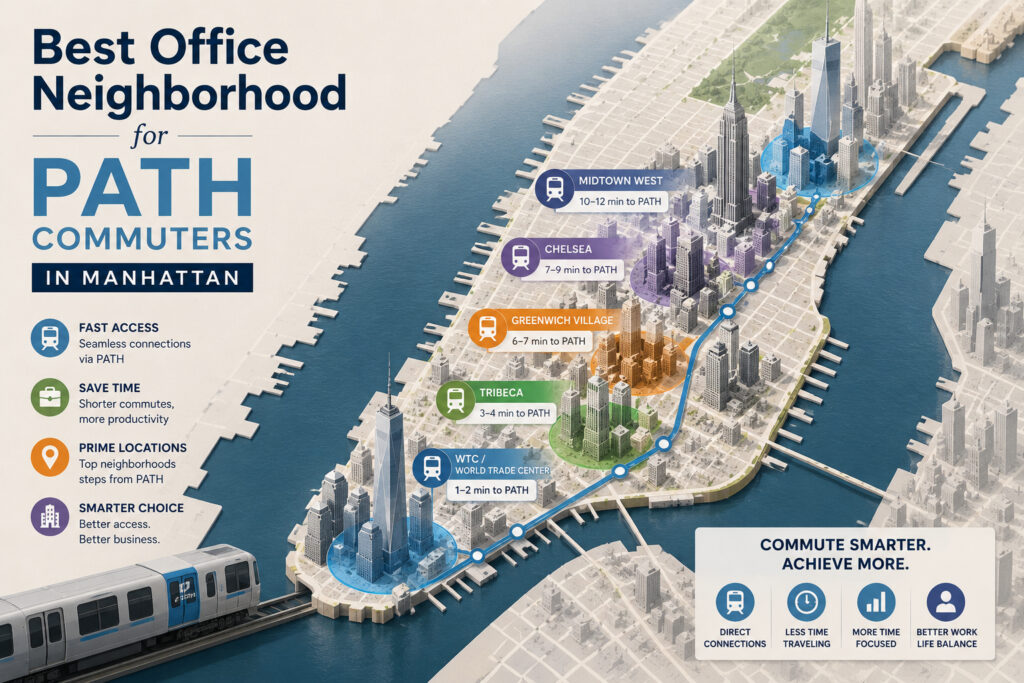
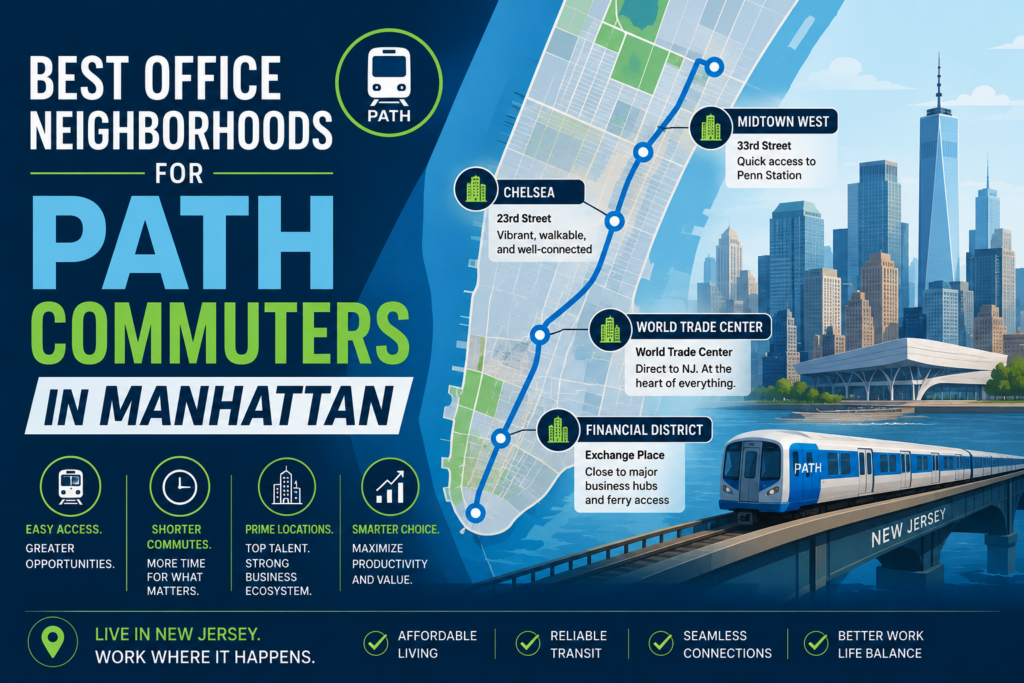
For most PATH-heavy teams, the best office neighborhood in Manhattan is the World Trade Center and Financial District area. That answer flows from route geography, transfer simplicity, and rent math. The Manhattan PATH network has six stations, and the riders who land at World Trade Center often avoid the extra subway leg that drains time twice each day.
Still, one answer does not fit every roster. If most employees arrive on the 33 Street branch, then Penn Station and nearby Chelsea can move into first place. Official station pages show 33 Street sits minutes from Penn and connects to major subway lines, while Penn links PATH with regional and intercity rail plus nearby subway complexes.
Tenant takeaway: The right office does not chase a famous address first. It kills the last transfer and shortens the last walk.
Why World Trade Center and the Financial District lead
World Trade Center wins because it gives many New Jersey riders a true Manhattan finish point. Official station information shows World Trade Center serves the Newark ↔ World Trade Center and Hoboken ↔ World Trade Center services. The campus also offers direct, weather-protected access to a deep transit web, including 12 subway lines, 2 PATH lines, and 17 ferry routes.
That reach matters after the train ride ends. Official station details list direct connections from the World Trade Center PATH stop to the A, C, E, J, R, W, Z, 1, 2, 3, 4, and 5 lines. Nearby, the Lower Manhattan transfer hub integrates five subway stations serving nine lines and handles up to 300,000 daily customers. As a result, a Downtown office can still work for mixed teams once the PATH rider arrives.
The rent picture strengthens the same answer. Major Q1 2026 brokerage reports placed Downtown asking rents in the low $60s overall, with Downtown West around $70.16 per square foot. Those same reports placed Midtown South around $80.27 to $88.32, and Midtown around $81.43 to $84.74. In plain terms, Downtown often lets a tenant buy a better commute at a lower average rent.
Availability also supports a tenant-first search in Lower Manhattan. One Q1 2026 report put Downtown availability at 19.0%, with Downtown West at 16.5%. Another placed Lower Manhattan availability at 16.8%. That combination gives tenants real choice without forcing them into Midtown pricing.
Current site inventory shows the district has real depth, not just theory. The World Trade Center pages currently display options from about 4,719 square feet to 21,246 square feet, including a 17,531 RSF furnished high-floor option. That range works for firms that need either a polished prebuilt or a larger contiguous block near the PATH terminal. Start with Downtown Manhattan office space, Financial District office space listings, and furnished World Trade Center office space.
When Penn Station and Chelsea move into first place
Penn Station becomes the best answer when your PATH users mainly finish on the 33 Street line. Official station information shows 33 Street connects to the B, D, F, N, Q, R, and W lines and sits minutes from Penn. Official Penn Station information also shows direct ties to regional rail, intercity rail, PATH, and multiple subway stations. That makes the corridor especially strong for split workforces that combine New Jersey riders with Long Island or city riders.
The numbers here still work, even if they do not match Downtown’s pricing edge. A major Q1 2026 brokerage report put the Penn District at 12.8% availability and $74.27 per square foot. That rate sits above Downtown, yet below Midtown South and below many premium Midtown corridors. So Penn often lands in the sweet spot between commute efficiency and cost control.
Live inventory in the district looks practical for real tenants. The current Penn Station neighborhood pages show listings from about 1,537 square feet to 18,641 square feet. A current turnkey sublet in Penn Plaza shows 4,776 square feet, five private offices, strong natural light, and a term through 7/31/27. Use Penn Station office space and Penn Plaza furnished office space when you want a west-side shortlist.
Chelsea joins the shortlist when your team wants a Midtown South feel without drifting too far from PATH. Official station pages show the 14 Street PATH stop connects to the F, M, L, 1, 2, and 3 lines. That connection pattern gives Chelsea and the lower West Side real value for teams that need both PATH access and broad subway reach. A current West 14th Street listing on your site adds a live example at 3,212 square feet near the Union Square and West Village edge.
Where Union Square, Flatiron, and Hudson Square fit
Union Square and Flatiron work best for tenants who want Midtown South energy and who can live with higher rent. They fit teams that care about culture, food, brand feel, and subway reach after the PATH ride ends. Official station pages show 14 Street, 23 Street, 9 Street, and Christopher Street all connect PATH riders into the core Midtown South grid.
That geography helps, but it costs more. A major Q1 2026 market report put Flatiron/Union Square at $87.18 per square foot with 13.9% availability. The same report placed Hudson Square at $93.25 per square foot with 21.1% availability. So these neighborhoods can outperform on vibe and recruiting appeal, yet they usually lose on simple commute value versus World Trade Center or Penn.
Union Square still deserves a serious look if your team wants PATH plus broad subway choice. Current site inventory shows Union Square options from about 1,750 square feet to 14,005 square feet, including a 6,500-square-foot furnished option and an 8,200-square-foot furnished option. Review Union Square offices and Union Square furnished office space for live Midtown South comparisons.
Hudson Square makes sense for firms that prefer a west-of-Broadway creative feel and can pay for it. The current neighborhood pages show active options from about 1,211 square feet to 17,500 square feet. That gives the district real flexibility, especially for teams that want loft character, prebuilt space, or a polished west-side identity near the Christopher Street and 14 Street PATH approach. Start with Hudson Square offices.
One extra detail separates strong commute planning from shallow listicles. Official PATH information says the 9 Street and 23 Street stations close nightly from 12 AM to 5 AM for maintenance. That matters if your firm runs late, staffs support teams after hours, or expects frequent evening client dinners. In those cases, World Trade Center, 14 Street, Christopher Street, or 33 Street usually offer safer commute logic.
Compare budgets, rents, and live inventory
Best overall value for PATH riders: World Trade Center and the Financial District. Downtown pricing sat in the low $60s overall in Q1 2026, while Downtown West reached about $70.16. Current World Trade Center inventory on your site spans roughly 4,719 to 21,246 square feet, which gives both smaller and larger tenants real choice near the terminal.
Best balance for mixed regional commuters: Penn Station and nearby Chelsea. The Penn District averaged $74.27 per square foot with 12.8% availability in Q1 2026. Current site inventory ranges from 1,537 to 18,641 square feet, and a turnkey 4,776-square-foot Penn Plaza sublet adds a move-fast option for teams that do not want a long construction timeline.
Best premium Midtown South play: Union Square, Flatiron, and Hudson Square. Flatiron/Union Square sat at $87.18 per square foot, while Hudson Square reached $93.25. Union Square currently shows options from 1,750 to 14,005 square feet, and Hudson Square ranges from 1,211 to 17,500 square feet on your site. Those neighborhoods can win on experience, but they usually demand a rent premium for it.
What is the best office neighborhood for PATH commuters in Manhattan? For most PATH-heavy rosters, the winner is World Trade Center and the Financial District. That area gives direct access to the World Trade Center terminal, broad downstream subway reach, weather-protected movement, and lower average rent than Midtown South. Penn Station and nearby Chelsea can beat it only when the 33 Street branch dominates your employee map.
Which neighborhood works best for Newark, Harrison, Grove Street, and Exchange Place riders? World Trade Center usually wins. Official station pages show the Newark ↔ World Trade Center service runs through that rider pattern, and Grove Street also connects to both the Newark ↔ World Trade Center and 33 Street branches. Put differently, a Downtown office protects the most one-seat rides for those riders.
What about Hoboken and Newport riders? Those riders need a split answer. Official station pages show Newport and Hoboken feed both the 33 Street side and the World Trade Center side. Therefore, the deciding factor becomes the final Manhattan walk, not just the train map. World Trade Center wins if you want the simplest Downtown arrival. Penn, Chelsea, or Midtown South can win if your users already favor the 33 Street branch.
Is Downtown cheaper than Midtown South right now? Yes. Major Q1 2026 market reports put Downtown overall asking rents around the low $60s, while Midtown South landed around the high $80s. Downtown West also remained below Hudson Square and close to or below many Penn-adjacent choices. That spread creates real leverage for tenants who value both cost control and PATH access.
Do late-night teams need to think differently? Absolutely. Official PATH information says 9 Street and 23 Street close nightly from 12 AM to 5 AM. So if your team often leaves late, do not rely on those stops alone. World Trade Center, 14 Street, Christopher Street, and 33 Street create stronger late-day logic. Official accessibility information also lists both 33 Street and World Trade Center among the elevator-accessible stations.
Can smaller tenants still target PATH-first neighborhoods? Yes. Current site inventory shows small and mid-size options across every serious contender. Penn Station currently starts around 1,537 square feet, Union Square around 1,750 square feet, Hudson Square around 1,211 square feet, and World Trade Center around 4,719 square feet on the pages surfaced here. Good commute logic is not only for large headquarters users.