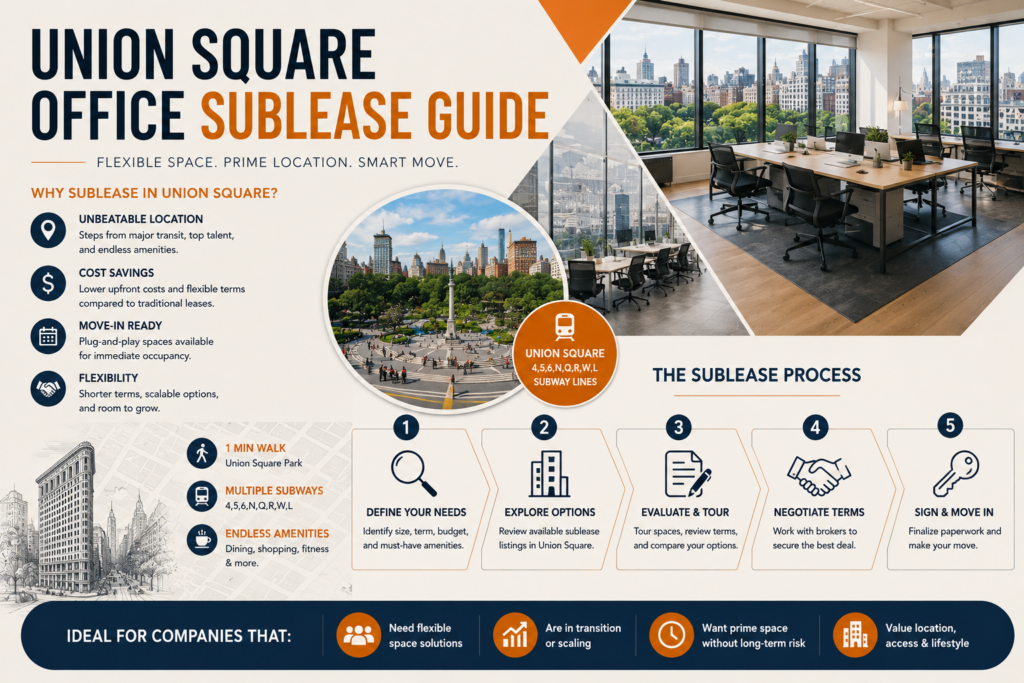
Union Square subleases attract tenants who need speed, flexibility, and a stronger commute story. Right now, Newmark tracks Flatiron/Union Square at 13.9% availability, with $88.34 per square foot in direct asking rent and $69.00 per square foot in sublet asking rent. That gap puts local sublease pricing about 21.9% below direct asking rent before you even value furniture, wiring, or built rooms.
Plenty of tenants care less about a long lease and more about momentum. They want a space that opens fast, feels finished, and sits on top of a major transit hub. Union Square fits that brief because the station serves the 4, 5, 6, L, N, Q, R, and W trains, and the local district organization calls it one of the city’s biggest transit nodes, with more than 35 million annual travelers.
Speed matters even more in a tighter Midtown South market. Newmark reported 16.9% availability for Midtown South in the first quarter of 2026, while CBRE put the broader submarket at 17.1% in June 2026 and pegged sublease availability at 2.3%. That means good turnkey subleases still exist, but clean, well-built floors do not linger forever.
Fast take:If your team needs a move-in-ready office, a shorter commitment, and lower entry cost, Union Square deserves a hard look. If you need a long term, heavy build-out rights, or a guaranteed renewal path, compare a direct lease before you commit.
Why tenants focus on Union Square subleases
Location drives this search, but practicality closes the deal. Union Square gives tenants fast access to Midtown South, Downtown, Brooklyn, the East Side, and the West Side from one address. That reach helps recruiting, eases client travel, and raises the odds that a hybrid team will actually show up.
The neighborhood also feels active throughout the day. Local district reporting showed 91% storefront occupancy in the BID boundary for the fourth quarter of 2025, 55,000-plus average daily visitors on the Broadway Plaza, and 28% more riders at the Union Square station than a year earlier. Those signals matter for office tenants because lunch options, after-work energy, and visible street life all shape how a space feels to staff and clients.
Another draw sits in the product itself. Union Square subleases often come built, furnished, and wired. Public listings in the area currently range from very small private office arrangements near the park to larger plug-and-play floors around 6,500 square feet and beyond. That range lets a team choose between a short runway, a medium-size prebuilt, or a larger full-floor move without starting from raw space.
Subleases also solve a timing problem. A direct lease often pulls you into legal review, design, bidding, permits, and construction planning. By contrast, many current Union Square options already contain conference rooms, glass offices, pantries, desks, or lounge space. When a team wants to move fast, that built value can matter as much as face rent.
What the Union Square sublease market looks like now
At the submarket level, the math looks favorable for tenants who value flexibility. Newmark’s first-quarter 2026 table shows Flatiron/Union Square direct asking rent at $88.34 per square foot and sublet asking rent at $69.00 per square foot. On paper, that creates a spread of $19.34 per square foot between direct and sublet space in the same local market.
Zoom out one level and the same pattern holds. For Midtown South overall, Newmark shows $90.23 per square foot on direct asks and $74.04 per square foot on sublet asks in the first quarter of 2026. CBRE then reported $86.38 per square foot average asking rent in June 2026, with $72.39 per square foot for sublease asking rent. Union Square therefore sits inside a broader submarket where flexible, secondary supply still prices below direct inventory.
Our current Union Square inventory also shows real size diversity today. The live neighborhood page lists Union Square options from 1,750 square feet up to 14,005 square feet, including a smaller office, multiple furnished midsize layouts, a sublet, and a full-floor opportunity. That matters because many competing pages talk about Union Square in vague terms, while tenants actually need to know whether the local market can fit a 10-person, 30-person, or 70-person plan.
Those examples show a clear pattern. Small users can still chase boutique layouts with private rooms and pantry space. Mid-size teams can step into furnished floors with meeting rooms and benching already in place. Larger occupiers can secure full floors that support branding, denser planning, and cleaner circulation.
Who should choose a Union Square sublease
A Union Square sublease works best for teams that need speed. If you want to shorten the distance between search and move-in, the local market offers fully built options with desks, rooms, and kitchen infrastructure already installed. That saves time, lowers disruption, and cuts the number of decisions you must make before opening the door.
Growth-stage companies also benefit here. A shorter remaining term lets you avoid locking today’s headcount into a long lease. You can capture the neighborhood, the transit, and the build-out value now, then reassess later when your staffing picture sharpens. Meanwhile, New York City’s own commercial lease guide reminds tenants that landlords do not have to renew a commercial lease unless the document says so, so term planning matters from day one.
Hybrid teams often like Union Square because the commute feels fair from more directions. A central hub reduces friction for in-office days and helps client-facing groups plan meetings without forcing every attendee through a single corridor. That advantage becomes more valuable when attendance fluctuates and convenience shapes culture.
Subleases also fit project offices, swing space, and temporary expansion. If you just won a major account, need an interim floor during a relocation, or want a Manhattan address before a longer commitment, a furnished Union Square suite can bridge that gap. In those cases, furniture value and timing often beat the perfect long-term layout.
On the other hand, not every tenant should force a sublease. If you need prominent signage rights, heavy construction, a long amortization window, or a guaranteed control path beyond the current term, a direct lease may serve you better. The right question is not “Is sublease cheaper?” The better question asks, “Does this sublease match my timing, layout, risk tolerance, and exit plan?”
How to judge cost, value, and savings
Start with the headline spread, but do not stop there. In Flatiron/Union Square, the first-quarter 2026 gap between direct and sublet asking rent was $19.34 per square foot. On a 4,000 square foot requirement, that spread equals about $6,447 per month before you price the value of furniture, wiring, existing rooms, and avoided downtime.
Move up to a larger floor and the savings can scale quickly. A 6,500 square foot deal priced at that same submarket spread implies roughly $10,476 per month less than direct asking rent. A 7,687 square foot requirement implies about $12,389 per month on the same math. Those figures do not guarantee your final deal, but they show why many tenants start with sublease inventory before they tour direct product.
Next, price the built value. Current Union Square examples on our site include layouts with conference rooms, meeting rooms, glass offices, private bathrooms, eat-in pantries, sit-stand desks, benching, and lounge-ready open areas. If you had to build that package from scratch under a direct lease, you would spend more cash and wait longer. JLL’s 2025 fit-out guide pegged average U.S. office fit-out cost at $280 per square foot, which shows how expensive construction can become once you leave raw space.
Then review what the monthly number hides. A cheaper sublease can still lose if the remaining term is too short, the furniture should go, the internet setup needs replacement, or the prime lease shifts ugly costs onto the subtenant. The real comparison should include face rent, remaining months, furniture condition, electricity, cleaning, HVAC rules, restoration risk, and whether you can extend after the term ends.
Finally, separate asking rent from occupancy cost. Market reports publish asking rent, not your final net deal. You still need to negotiate deposits, free rent, work letters, assignment rights, move timing, and exit language. That is why smart tenants compare subleases against at least one direct lease option, even when the sublease looks better at first glance.
What to review before you sign
The floor sells the tour, but the documents decide the risk. New York City’s commercial leasing guide states that most landlords allow assignment or subletting only with prior written consent. That same guide also warns that the original tenant usually stays liable if the new tenant or subtenant fails to pay. In other words, you must read the prime lease, not just the marketing flyer.
Focus on the points below before you commit:
Consent rights. Make sure the sublease clearly states whether the landlord approved the deal, or what the approval path requires.
Remaining term. Check the exact expiration date, any notice deadlines, and whether you can extend, renew, or convert into a direct lease.
Use language. Confirm that your business fits the permitted use in the prime lease.
Services. Review HVAC hours, cleaning rules, internet readiness, elevator access, and security procedures.
Alterations. Ask what you may change without approval and what you must remove later.
Restoration. Determine who pays to remove furniture, branding, partitions, cabling, or special installations.
Default risk. Learn what happens if the prime tenant defaults under its direct lease.
Renewal risk deserves extra attention. New York City’s SBS guide states that landlords do not have to renew a commercial lease unless the lease says so. Therefore, a Union Square sublease without an extension path can solve today’s problem while creating tomorrow’s move. Ask for early renewal discussions, a direct-deal option, or at least enough notice to plan your next step.
Utilities and building operations also shape the real experience. The same city guide notes that landlords only owe the utilities and services written into the lease, and they often charge overtime HVAC outside stated hours. If your team works late, hosts weekend sessions, or runs sensitive equipment, lock those operating rules down before you sign.
This is also where tenant representation matters most. We pressure-test consent language, remaining term, furniture value, assignment rights, and restoration exposure before emotion takes over. A beautiful prebuilt means little if the paper blocks your business plan.
How to search, tour, and negotiate
Begin with the business plan, not the photo gallery. Define target headcount, in-office attendance, meeting room needs, brand goals, and move date. Once you know those variables, you can sort real options instead of reacting to finishes.
Next, tour with a simple scorecard. Grade each option on layout efficiency, natural light, meeting mix, pantry quality, furniture value, internet readiness, visitor arrival, and term fit. Then compare those notes against the economics, because the cheapest space often loses on usability.
Most importantly, negotiate the end before you celebrate the beginning. Ask who owns the furniture, whether you can keep the wiring, how deposit terms work, when consent must arrive, and what happens if the prime tenant fails under the direct lease. Those questions rarely appear on glossy listing pages, yet they often decide whether a Union Square sublease becomes a smart move or an expensive detour.
Frequently asked questions
Is a Union Square sublease cheaper than a direct lease
Often, yes. Newmark tracked Flatiron/Union Square at $69.00 per square foot for sublet asking rent versus $88.34 per square foot for direct asking rent in the first quarter of 2026. That spread does not include the value of existing furniture or built rooms, which can widen the practical savings.
How long does a Union Square sublease usually last
The remaining term depends on the prime lease. Public Union Square-area listings currently advertise both small shared arrangements and plug-and-play subleases around two to three years, while other options simply market immediate occupancy without stating term on the public page. Always verify the exact remaining term in writing.
Can I renew after a sublease ends
Only if the documents give you a path. New York City’s commercial lease guide states that landlords do not have to renew a commercial lease unless the lease says so. Therefore, seek a renewal option, a direct-deal path, or a firm notice period.
Who approves the sublease
In most cases, the landlord must approve it under the prime lease. The city’s commercial leasing guide says most landlords permit assignment or subletting only with prior written consent, though tenants can negotiate for a reasonableness standard.
Does the original tenant stay liable
Usually, yes. The same city guide states that the original tenant typically remains liable under the lease even after an assignment or sublease if the new occupant fails to pay. That risk makes document review essential.
Are Union Square subleases usually furnished
Many are. Current local listings on our site include turnkey layouts with desks, conference rooms, meeting rooms, pantries, private offices, and wired workstations. Still, you should confirm exactly what stays after signer and landlord approvals.
What size range can I find in Union Square now
Today, our live Union Square inventory spans 1,750 square feet to 14,005 square feet on the neighborhood page, with several furnished midsize options in between. Public listings elsewhere in the area also show smaller shared-office sublets for teams that need only a few desks or offices.
When should I choose direct lease instead
Choose direct lease when you need a longer commitment, major construction, cleaner control rights, or a stronger renewal path. Choose sublease when you value speed, built value, and lower entry cost more than maximum control. The answer depends on your timeline and risk profile, not just the ask.
Work with tenant brokers who protect the deal
We represent tenants, not landlords. We source active Union Square subleases, pressure-test remaining term, furniture value, consent language, and assignment risk, and then compare them against direct lease alternatives. Share your size, budget, timing, and layout needs, and we will narrow the search to Union Square options that protect both leverage and flexibility.
Fill out our 📋online form or give us a call today 📞212-967-2061 — let’s find the right office for your business.