Flatiron Office Space NYC
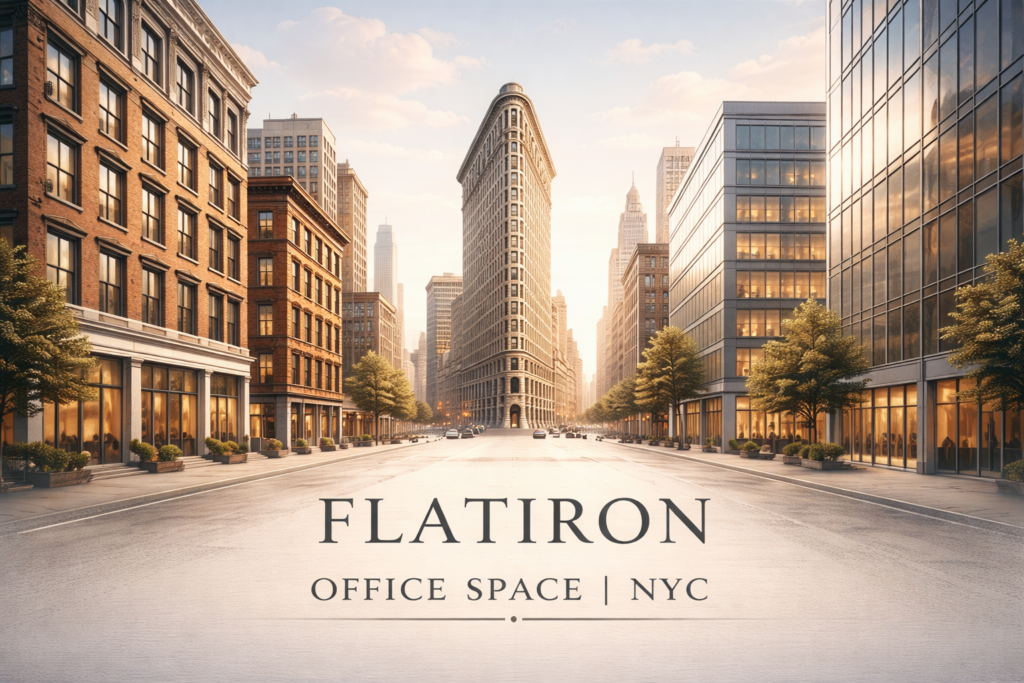
Flatiron Office Space NYC represents one of Manhattan’s most concentrated entrepreneurial corridors. Unlike Midtown’s institutional headquarters environment or Downtown’s cost-leverage market, the Flatiron district functions as a growth-stage ecosystem where venture capital, technology firms, and scaling companies cluster within a relatively compact geographic footprint.
However, the strategic value of Flatiron is not simply its location on the map. Instead, the district operates as a network-driven environment where proximity to talent, investors, and peer companies influences leasing decisions.
This page defines how Flatiron functions as a startup and venture-centered office market, explains how building inventory supports high-growth tenants, and clarifies when the premium associated with the district makes operational sense.
Geographic Boundaries
Flatiron Office Space NYC generally refers to the area surrounding Madison Square Park, typically spanning:
- 14th Street to 23rd Street
- Park Avenue South to Sixth Avenue
Notably, the district overlaps with portions of Midtown South while maintaining its own distinct identity tied to venture-backed companies, media technology firms, and emerging software businesses.
Because of its compact footprint, Flatiron operates less like a broad submarket and more like a concentrated node within Manhattan’s broader office ecosystem.
In practice, a few blocks often determine whether a building participates fully in the district’s startup-driven network.
Explicit Pricing Context
Flatiron Office Space NYC typically trades within Midtown South pricing bands but often commands a modest premium due to ecosystem demand.
Current broad ranges include:
Renovated Loft and Tech-Oriented Class B Buildings
Approximately $70 to $95 per rentable square foot
Newer or Repositioned Boutique Class A Buildings
Typically $90 to $120+ per rentable square foot
Older Value-Oriented Buildings
Often $60 to $75 per rentable square foot
Consequently, pricing in Flatiron frequently aligns with or slightly exceeds Midtown South averages.
However, tenants are rarely paying solely for building quality. Instead, a portion of the rent reflects participation in the district’s venture and technology ecosystem.
For growth-stage companies, the network effect often justifies the premium.
Floor Plate Characteristics
Flatiron buildings tend to feature smaller, boutique floor plates compared to Midtown towers.
Typical sizes range between 4,000 and 12,000 rentable square feet per floor.
As a result, tenants often occupy partial floors, boutique full floors, or multi-floor vertical stacks rather than large contiguous blocks.
These dimensions align well with technology companies scaling between early-stage startup operations and mid-size institutional footprints.
However, companies requiring large single-floor plates above 25,000 square feet may find inventory limited within the district.
Flatiron supports growth, but not unlimited expansion.
Architectural Character
Much of Flatiron’s office inventory consists of early twentieth-century commercial loft buildings that have undergone modernization and repositioning.
These structures typically feature:
High ceilings
Large industrial windows
Column grids supporting open layouts
Exposed brick and structural elements
Consequently, many buildings naturally accommodate collaborative work environments favored by technology and creative teams.
At the same time, renovated mechanical systems and upgraded lobbies increasingly bring these historic structures closer to modern operational standards.
Flatiron blends character with functionality.
Venture and Startup Density
The defining feature of Flatiron Office Space NYC is its concentration of venture-backed companies, startup accelerators, and technology investors.
Over the past two decades, the district has attracted:
Software companies
Media platforms
Venture capital firms
Product development teams
Growth-stage startups
This clustering effect produces a reinforcing cycle.
Startups locate near venture investors.
Investors locate near startups.
Service providers follow both.
Consequently, Flatiron operates as a feedback loop rather than simply a real estate location.
Tenants choosing the district often seek proximity to opportunity rather than simply square footage.
Talent and Recruitment Advantages
Flatiron’s environment also supports recruitment strategies focused on younger professional talent and technology-oriented labor pools.
The district offers:
Direct access to multiple subway lines
Walkability between office buildings
Proximity to Madison Square Park
A dense network of restaurants, cafes, and meeting locations
As a result, companies frequently cite talent attraction as a factor when evaluating the district.
Office location becomes part of the employment proposition.
When Flatiron Makes Strategic Sense
Flatiron Office Space NYC aligns best with companies that:
Operate in technology or venture-backed sectors
Require collaborative layouts rather than private office grids
Benefit from proximity to investors or startup networks
Maintain headcounts that fit within boutique floor plates
Value ecosystem positioning over institutional formality
For these organizations, location strengthens operational momentum.
Flatiron functions as a business accelerator.
When Flatiron Becomes Limiting
Despite its advantages, Flatiron does not suit every organization.
Companies may encounter limitations when:
Headcount growth exceeds available floor plate sizes
Institutional clients require more formal office environments
Large contiguous space blocks become necessary
Budget constraints favor Downtown or outer Midtown alternatives
In those cases, companies often graduate from Flatiron into Midtown or Midtown South towers while maintaining operational presence in the district.
Flatiron frequently represents a stage within a company’s lifecycle rather than its final headquarters location.
Relationship to Neighboring Submarkets
Flatiron occupies a unique position within Manhattan’s office geography.
Midtown offers institutional scale and prestige.
Midtown South provides creative flexibility across larger districts.
Chelsea offers inventory variance with block-by-block pricing swings.
Meanwhile, Flatiron operates as a concentrated entrepreneurial node between these markets.
It acts less like a traditional submarket and more like a business ecosystem.
Summary
Flatiron Office Space NYC represents Manhattan’s most concentrated startup and venture corridor. However, its value extends beyond architecture or rent levels.
Companies choosing Flatiron often prioritize proximity to investors, talent, and peer companies within a compact entrepreneurial network.
The district rewards growth-stage firms that benefit from ecosystem density.
However, organizations requiring large floor plates, institutional formality, or strict cost discipline may eventually outgrow the environment.
Flatiron is not simply a location.
It is an operating ecosystem within Manhattan’s office landscape.
Fill out our 📋 online form or give us a call today 📞 212-967-2061 — let’s find the right office for your business.
Flatiron Office Space Availability and Leasing Activity
Search queries around Flatiron Office Space NYC frequently indicate active leasing exploration rather than general market research. Prospective tenants commonly search variations such as:
- Flatiron office space for rent
- Office space Flatiron District NYC
- Flatiron NYC office for lease
- Commercial office space Flatiron Manhattan
These searches generally come from companies already evaluating Midtown South locations but seeking a more concentrated entrepreneurial environment.
Availability in the Flatiron District tends to be limited by the neighborhood’s small geographic footprint. Many buildings consist of historic loft structures with floor plates that rarely exceed boutique scale. Because of this, vacancy cycles are often influenced by the relocation of only a few tenants.
Consequently, available inventory can fluctuate quickly when technology firms, venture-backed startups, or media companies shift space requirements.
Flatiron leasing activity tends to move in short bursts rather than broad cycles.
Typical Office Sizes Found in Flatiron
The majority of available spaces in Flatiron fall within the boutique office category.
Common configurations include:
- 2,000 to 5,000 square feet in smaller loft floors
- 5,000 to 10,000 square feet in mid-rise commercial buildings
- 10,000 to 15,000 square feet in select repositioned assets
Large blocks exceeding twenty thousand square feet appear infrequently.
When they do occur, they are typically the result of a company relocating to a larger Midtown South building or consolidating operations elsewhere in Manhattan.
Because of this pattern, Flatiron frequently attracts firms that value location density over large contiguous square footage.
Coworking and Flexible Office Space in Flatiron
Search engine results for Flatiron office space often highlight coworking providers and flexible office operators. This reflects the neighborhood’s long-standing role as a startup hub.
Flexible workspace providers frequently offer:
- Private furnished offices
- Short-term membership suites
- Shared work environments for small teams
- Meeting rooms and collaboration spaces
For early-stage companies, these environments allow immediate proximity to the Flatiron technology ecosystem without long-term lease commitments.
However, as companies grow beyond approximately twenty employees, direct office leases in the district often provide stronger cost efficiency than long-term coworking memberships.
Flexibility provides access to the ecosystem, but it carries pricing tradeoffs.
Pricing Questions Tenants Often Ask About Flatiron
Search behavior frequently includes pricing-related queries such as:
- Flatiron office space cost
- Flatiron office space NYC price
- Average rent in the Flatiron District
Flatiron pricing is influenced less by building height or institutional infrastructure and more by the district’s technology and venture capital ecosystem.
Compared to neighboring markets:
- Pricing often tracks slightly above average Midtown South loft inventory
- It can remain below prime Midtown tower rents
- It frequently aligns with high-demand startup corridors
Because supply remains constrained, premium buildings within the district can maintain stable pricing even during broader market fluctuations.
In short, Flatiron rents reflect ecosystem demand more than pure building economics.
Startups and Technology Firms in the Flatiron District
Flatiron’s reputation as a startup corridor continues to influence tenant demand.
Search results frequently highlight the neighborhood’s role as a technology cluster. Companies in the district often operate within sectors such as:
- Software development
- Digital media platforms
- Venture-backed startups
- Product development teams
- Artificial intelligence and data companies
The concentration of these industries produces a network effect.
Investors locate near companies.
Companies locate near investors.
Service providers cluster around both.
This environment makes proximity itself a strategic advantage.
For many tenants, the Flatiron District functions less like a traditional office market and more like a professional ecosystem.
Leasing Versus Ownership in the Flatiron District
Some searches also reference office space for sale in Flatiron. While the district contains a few commercial condominium units, ownership opportunities remain relatively rare.
Most buildings operate under traditional lease structures rather than condominium ownership.
Companies evaluating long-term presence in Flatiron typically prioritize flexibility over ownership due to the fast-changing nature of the technology sector.
As a result, leasing continues to dominate the district’s occupancy model.
Ownership remains a niche strategy.
Transportation Access in the Flatiron District
Flatiron’s location around Madison Square Park provides strong connectivity to several major subway lines.
Nearby transit options typically include:
- N, R, and W trains along Broadway
- F and M lines along Sixth Avenue
- The 4, 5, and 6 lines along Park Avenue South
- PATH access within short walking distance
This transit density allows employees commuting from multiple boroughs and New Jersey to reach the district efficiently.
Equally important, the neighborhood’s compact layout allows workers to walk between buildings, restaurants, and meeting locations within minutes.
For companies relying on collaboration across startups, investors, and partners, this walkability reinforces the district’s network-driven identity.
Common Questions About Flatiron Office Space
Is Flatiron good for startups?
Yes. The district’s venture capital presence and technology concentration continue to attract early-stage and growth-stage companies.
Is Flatiron cheaper than Midtown?
In many cases, yes. However, high-demand buildings may approach Midtown South pricing levels.
Does Flatiron offer large office blocks?
Rarely. The district primarily offers boutique floor plates rather than large institutional spaces.
Is coworking common in Flatiron?
Yes. Flexible workspace providers play a major role in the neighborhood’s startup ecosystem.
Is Flatiron primarily technology-focused?
While not exclusively, the district remains strongly associated with technology and venture-backed firms.
Strategic Perspective on the Flatiron District
Flatiron Office Space NYC operates as a specialized node within Manhattan’s office geography.
It combines:
- Midtown South loft architecture
- Venture capital density
- Startup culture
- Boutique building inventory
For companies prioritizing network proximity and entrepreneurial energy, the district provides significant strategic value.
However, organizations requiring large floor plates, institutional infrastructure, or highly scalable footprints may eventually transition toward Midtown or larger Midtown South corridors.
Flatiron excels at concentration.
It does not prioritize expansion.