FinTech Office Space in Flatiron and NoMad
FinTech companies need more from an office than a fashionable Manhattan address. They need infrastructure, recruiting reach, privacy, flexibility, and workable lease economics.
Flatiron and NoMad meet those requirements through very different types of buildings. Together, they form one of Midtown South’s strongest technology and financial-business corridors.
The broader district contains about 36 million square feet of commercial space and supports more than 100,000 daily workers. Its business base includes high concentrations of technology, finance, insurance, marketing, hospitality, and related industries.
Meanwhile, Midtown South continues attracting technology companies at extraordinary levels. The market captured 75.1% of Manhattan technology leasing during the first half of 2026.
That demand makes office selection more important for a growing FinTech company. A strong requirement can still uncover value, especially across direct leases, subleases, and existing installations.
The central question is not simply whether Flatiron or NoMad works. A tenant must determine which building, floor, lease structure, and location fit its next stage.
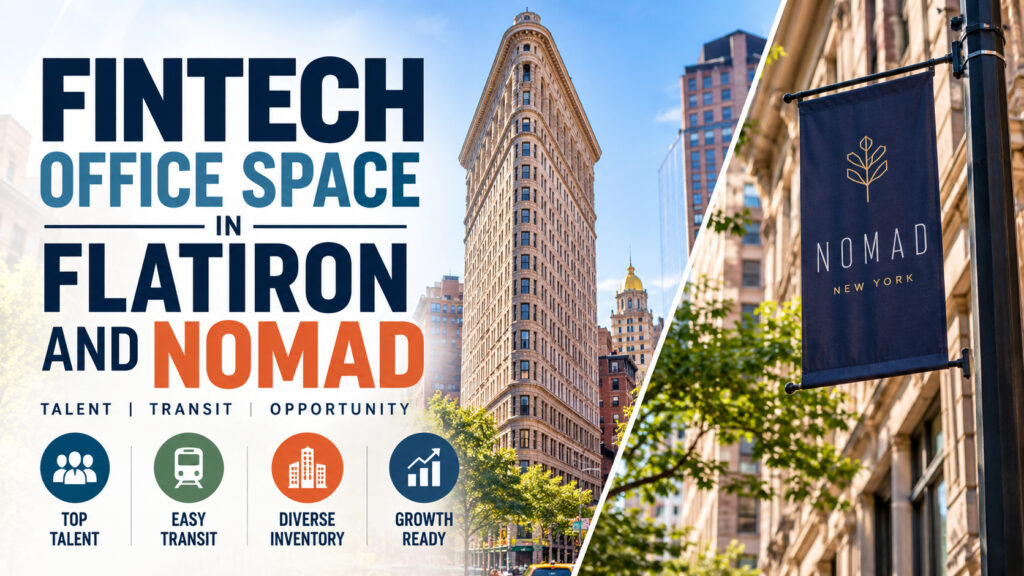
Why FinTech Companies Lease Offices in Flatiron and NoMad
Why do FinTech companies lease offices in Flatiron and NoMad?
The neighborhoods combine technology talent, financial-business access, central commuting, varied office inventory, and a strong Midtown South identity.
That combination matters because FinTech businesses often sit between two professional ecosystems. One side resembles traditional finance, investment, banking, insurance, or payments. Another side resembles software, data, engineering, product development, and other technology businesses.
Flatiron and NoMad let a company occupy both worlds without choosing a conventional financial district. They also avoid the corporate character associated with many traditional tower corridors.
Midtown South’s current leasing activity supports that positioning. Technology companies leased 4.15 million square feet across Manhattan during the first half of 2026. That represented 18.2% of total Manhattan leasing during the period.
A central location for recruiting
A FinTech office in Flatiron can draw employees from several parts of Manhattan. Brooklyn commuters also gain multiple approaches through Lower Manhattan and Midtown South.
NoMad adds stronger access toward major regional transportation hubs. That advantage matters for teams drawing employees from New Jersey, Long Island, and elsewhere.
Neither neighborhood wins every commute.
Instead, employee ZIP codes should help determine the preferred blocks before tours begin.
A workplace that can support technology culture
Classic loft buildings offer exposed structure, large windows, open layouts, and smaller full floors. Modernized buildings provide stronger mechanical systems, amenities, security, and polished common areas.
Consequently, founders can choose an office identity rather than accept one standard product.
A product-led company may prefer an informal loft. Conversely, a client-facing financial platform may want a more polished building.
Proximity without conventional corporate formality
Many FinTech companies need credible client-facing space without resembling a traditional financial institution.
Flatiron often delivers that balance through Fifth Avenue, Broadway, and Park Avenue South inventory. NoMad provides another version through Broadway, Fifth Avenue, Madison Avenue, and nearby side streets.
Tenant takeaway: Location can support recruiting and branding. However, the specific building determines whether the office actually supports operations.
Flatiron and NoMad Are Adjacent, but They Are Not Interchangeable
Flatiron and NoMad blend around Madison Square, so tenants sometimes treat them as one office market.
That approach can hide meaningful differences.
Flatiron generally feels more established as a technology and creative-business address. NoMad often feels more connected to Midtown transportation and northward business districts.
A FinTech startup office in Midtown South could work equally well in either area. The better choice depends on employees, clients, floor requirements, and lease economics.
For a deeper neighborhood comparison, review our Flatiron versus NoMad office leasing guide.
| Decision factor | Flatiron | NoMad | What a FinTech tenant should consider |
|---|---|---|---|
| Workplace character | Established tech, creative, loft, and premium office mix | Loft, prebuilt, boutique, and polished Midtown South mix | Match the building to your recruiting and client image |
| Typical office experience | Creative lofts through premium institutional space | Boutique floors through larger modernized buildings | Do not judge either neighborhood by one building |
| Employee access | Strong downtown, east-side, west-side, and Brooklyn connections | Strong Manhattan access plus regional commuting options | Map actual employee commutes before choosing blocks |
| Client access | Central for downtown and Midtown meetings | Strong connection toward Midtown and regional hubs | Measure where clients actually originate |
| Small-team options | Numerous lofts, subleases, and smaller floors | Numerous prebuilt, furnished, and boutique floors | Existing installation can reduce upfront spending |
| Growth options | Larger blocks exist around major corridors | Larger footprints appear across several avenue corridors | Verify future expansion before committing |
| Brand impression | Technology, design, creativity, established Midtown South | Growth, technology, hospitality, contemporary Midtown South | Choose the image that supports your business |
| Cost pattern | Premium buildings can command premium pricing | Pricing varies sharply by building and block | Compare actual proposals, not neighborhood stereotypes |
The border matters less than the building
A company should not reject an otherwise excellent floor because it sits several blocks north.
Likewise, a NoMad label does not automatically make a building more convenient.
One Fifth Avenue address can provide a very different workplace from another nearby property. Building systems, floor geometry, windows, elevators, security, and HVAC can change dramatically within several blocks.
The practical solution involves creating a building-level comparison rather than a neighborhood beauty contest.
Madison Square creates the shared hinge
The area surrounding Madison Square creates a natural bridge between both office markets. Tenants can reach dining, hotels, retail, transportation, and client destinations from either side.
The broader district also records substantial daily pedestrian activity. More than 17 million pedestrians crossed its primary public plazas during 2025.
Therefore, companies considering both neighborhoods should tour them together. Walking between competing buildings reveals differences that maps often hide.
Tenant takeaway: Pick the office first and the neighborhood label second.
What FinTech Office Space Costs in Flatiron and NoMad in 2026
Office pricing requires context because one neighborhood average cannot price every building.
Current published benchmarks show a tightening Midtown South market. However, building quality, floor condition, term, size, and lease structure still create large pricing differences.
As of September 2026, current data provides the following reference points.
| Market benchmark | Current published figure | What it means |
|---|---|---|
| Flatiron / Union Square direct asking rent | $88.34/SF | Useful directional benchmark for direct space |
| Flatiron / Union Square sublet asking rent | $69.00/SF | Shows the potential discount within existing sublet inventory |
| Flatiron / Union Square availability | 13.9% | Indicates a considerably tighter market than the post-pandemic peak |
| Midtown South average asking rent | $79.41–$81.14/SF | Major market reports differ slightly by methodology |
| Midtown South Class A asking rent | $104.50/SF | Shows the premium attached to stronger top-tier inventory |
| Midtown South availability | 12.7% in Q2 2026 | Supply tightened during a strong leasing quarter |
| Midtown South availability, July 2026 | 12.2% | The tightening continued after quarter-end |
Midtown South recorded 5.05 million square feet of leasing during the second quarter of 2026. That marked its strongest quarterly demand since late 2001.
July then pushed Midtown South availability down to 12.2%. Sublease supply also continued shrinking across Manhattan.
Why published rent averages differ
One market report placed Midtown South’s second-quarter average at $79.41 per square foot. Another reported $81.14 during the same period.
Neither figure makes the other wrong.
Research groups use different building inventories, classifications, boundaries, and measurement dates. Therefore, published averages should guide a search rather than price a specific office.
NoMad creates another complication. Major research reports often include it inside wider Midtown South categories.
Consequently, tenants should compare live NoMad proposals building by building.
What does $88.34 per square foot mean for a tenant?
Consider a hypothetical 5,000-rentable-square-foot office.
At $88.34 per square foot, initial annual base rent equals about $441,700. Monthly base rent equals roughly $36,808.
A 5,000-square-foot sublet at $69 per square foot equals about $28,750 monthly.
Those calculations only compare starting face rent.
They exclude annual increases, electricity, taxes, operating expenses, HVAC, cleaning, construction, furniture, technology, and other costs.
That distinction can change the winner.
Review our current Flatiron renewal and relocation guide for a fuller occupancy-cost comparison.
Tenant takeaway: Never choose an office by asking rent alone. Compare total cash exposure across the entire commitment.
Direct Lease, Sublease, or Flexible FinTech Office Space
A FinTech office search usually crosses several product categories.
Those categories solve different problems.
A direct lease offers control and longer-term stability. A sublease can provide existing infrastructure and a shorter commitment.
Flexible private space removes even more setup work. However, that convenience usually reduces control over economics, identity, and future rights.
| Office structure | Typical advantage | Primary limitation | Best tenant situation |
|---|---|---|---|
| Direct lease | Control, branding, longer runway | Greater commitment and possible buildout | Established or well-capitalized growth company |
| Prebuilt direct lease | Faster occupancy with direct landlord relationship | Existing design may constrain layout | Scaling company that wants speed and stability |
| Furnished sublease | Furniture, wiring, rooms, and shorter remaining term | Limited control over extension or modifications | Funded startup with uncertain long-term headcount |
| Full-floor sublease | Privacy plus existing infrastructure | Term follows another tenant’s lease | FinTech team needing a private headquarters quickly |
| Managed private office | Low setup burden and shorter commitment | Higher bundled economics and less control | Early-stage company prioritizing flexibility |
| Shared coworking membership | Minimal commitment | Privacy, identity, acoustics, and control vary | Very small team with limited infrastructure needs |
Coworking and FinTech office space are not the same thing
Flexible workspace appears frequently when tenants explore Flatiron and NoMad.
However, coworking represents a lease structure, not a FinTech office specification.
A private managed suite might fit a ten-person payments startup perfectly. An open membership environment might fit the same company poorly.
Privacy requirements can also change as a company grows.
Board meetings, investor calls, customer conversations, hiring interviews, and sensitive financial discussions create additional room requirements.
Therefore, compare flexible offices based on actual operating conditions.
When a sublease becomes especially attractive
A furnished sublease can reduce three major burdens: construction, furniture procurement, and setup time.
Current Midtown South sublet supply has tightened, though. Manhattan sublease availability fell again during July 2026 and reached its lowest level since August 2019.
That trend does not eliminate sublease opportunities.
Instead, it means strong furnished spaces deserve quicker evaluation once they satisfy the requirement.
When a direct lease makes more sense
Direct leases become more attractive when a FinTech company expects meaningful growth or specialized improvements.
Longer occupancy also lets a tenant amortize furniture, technology, architectural work, and construction across more years.
Additionally, direct negotiations can address expansion, contraction, assignment, renewal, and signage rights.
A strong process should compare multiple structures before narrowing the field.
Tenant takeaway: Start with business risk and growth expectations. Then choose the lease structure.
What FinTech Companies Need From an Office
Not every FinTech company needs a trading floor, server room, or unusual power capacity.
A software-led payments company may resemble another technology business operationally. Conversely, market-data or trading operations can require much stronger infrastructure.
Therefore, define technical requirements before touring buildings.
| Requirement | Question to ask | Why it matters |
|---|---|---|
| Internet connectivity | Which carriers currently serve the floor? | Existing service can shorten setup time |
| Network redundancy | Can a second connection use a separate pathway? | Route diversity can reduce a single point of failure |
| Power capacity | Does the floor support the planned equipment load? | Dense technology can exceed a standard office requirement |
| HVAC | Can employees control cooling during working hours? | Technology and dense occupancy generate heat |
| After-hours cooling | What does overtime HVAC cost? | Late work can create substantial operating costs |
| Equipment cooling | Can an IT room receive dedicated cooling? | Small enclosed rooms can overheat quickly |
| Private rooms | How many calls and meetings occur simultaneously? | Open seating alone rarely supports a growing team |
| Acoustics | Can rooms contain confidential conversations? | Financial and customer discussions need practical privacy |
| Access control | How do employees and guests enter the floor? | Security procedures affect daily operations |
| 24-hour access | Can authorized staff enter outside normal hours? | Global teams may operate beyond standard business hours |
| Generator capability | Does the building offer backup capability where needed? | Certain operations may need stronger continuity planning |
| Expansion | Can the tenant add nearby space later? | Growth can arrive before lease expiration |
Power, cooling, connectivity, and specialized layout requirements become especially important for higher-intensity financial technology operations.
Start with internet, not exposed brick
A beautiful loft becomes a poor technology office when connectivity creates operational risk.
Ask which providers already reach the building. Next, determine whether they reach the actual premises.
Afterward, investigate installation timing and pathway diversity.
A second carrier provides limited redundancy when both connections travel through the same physical route.
Separate ordinary FinTech from infrastructure-heavy FinTech
Most product, software, lending, payments, and financial-platform teams do not resemble data centers.
They still need reliable connectivity, meeting privacy, sensible cooling, and secure access.
Latency-sensitive or equipment-heavy operations require deeper investigation.
Those tenants should test power capacity, supplemental cooling, equipment placement, and telecommunications pathways before pursuing economics.
Meeting rooms matter more than workstation counts
A floor may technically seat 50 employees while functioning poorly for 30.
Customer calls, engineering meetings, investor conversations, interviews, and video conferences all consume rooms.
Consequently, test fits should model simultaneous room demand, not only desk capacity.
Tenant takeaway: The right FinTech office combines technology infrastructure with human infrastructure.
How Much Flatiron or NoMad Office Space a FinTech Company Needs
Headcount gives a tenant a starting point, but it cannot determine square footage alone.
Attendance policy, meeting demand, room sizes, growth, and floor efficiency can materially change the answer.
Use the following ranges as early planning estimates rather than fixed rules.
| Planned team | Initial planning range | Typical issue to test |
|---|---|---|
| 8–15 people | 1,500–3,000 RSF | Avoid paying for unnecessary reception and circulation |
| 15–30 people | 2,500–5,000 RSF | Balance open seating with enough meeting rooms |
| 30–50 people | 4,500–8,000 RSF | Build room capacity for managers, clients, and interviews |
| 50–100 people | 8,000–15,000 RSF | Plan departments and future seating carefully |
| 100–200 people | 15,000–30,000+ RSF | Evaluate full floors, contiguous floors, and expansion rights |
| 200+ people | Program-specific | Building selection becomes a major strategic decision |
Size the office around peak attendance
Hybrid work makes average attendance a dangerous metric.
Suppose 60 employees average three office days weekly. That does not necessarily mean only 36 desks matter.
Teams often choose the same Tuesday through Thursday pattern.
Instead, calculate expected peak attendance and add reasonable growth.
Meeting rooms, circulation, pantries, phone rooms, IT space, storage, and collaboration areas require additional square footage.
Plan for the company you expect to become
A startup should model at least several headcount cases.
One case should assume slower hiring. Another should reflect the expected plan.
A third should test faster growth.
Then compare each scenario against the lease term.
An oversized long-term lease wastes capital when hiring slows. Yet an undersized office can force an expensive second move.
Expansion rights, contiguous floors, short-term overflow space, and sublease rights can reduce that tension.
Current inventory shows useful size variety
Live inventory changes constantly, but current examples illustrate the available formats.
A 2,600 RSF move-in-ready loft sublet provides a small-team benchmark. Its existing layout includes meeting space, work areas, a pantry, and tenant-controlled cooling.
A 6,800 RSF full-floor direct lease provides a NoMad growth-stage example. The current installation includes open workspace, private rooms, huddle areas, and tenant-controlled HVAC.
Larger furnished Flatiron inventory can extend beyond 10,000 square feet. Recent live examples have included an 18,500-square-foot furnished full floor.
Meanwhile, current Fifth Avenue NoMad inventory spans several thousand square feet through larger full-floor options.
Availability can change before a tenant tours. Reconfirm every floor, price, term, and installation before making a decision.
How to Compare Buildings, Lease Terms, and Total Occupancy Cost
The lowest asking rent does not necessarily produce the lowest office cost.
A FinTech tenant should model each serious option using the same assumptions.
Otherwise, a furnished sublease and an unfinished direct lease can look artificially similar.
Compare rentable efficiency first
Rentable square footage does not measure workplace usefulness.
One 7,000-square-foot floor may provide better capacity than another 8,000-square-foot floor.
Columns, elevator cores, corridors, unusual geometry, mechanical rooms, and internal walls all affect efficiency.
Therefore, ask an architect to test serious finalists.
A better layout can support more employees while reducing total rentable area.
Compare every economic component
| Cost or right | Why it matters |
|---|---|
| Starting base rent | Creates the headline occupancy cost |
| Annual escalation | Compounds throughout the lease |
| Free rent | Reduces early cash requirements |
| Improvement allowance | Offsets eligible construction spending |
| Existing furniture | Can reduce immediate capital spending |
| Existing cabling | Can lower technology setup costs |
| Operating expenses | Add recurring occupancy cost |
| Real-estate-tax escalation | Can increase future expense |
| Electricity | Pricing structure varies by building |
| Overtime HVAC | Matters for late-working teams |
| Cleaning | May sit inside or outside quoted economics |
| Security deposit | Can tie up cash or credit capacity |
| Moving expenses | Increase relocation cost |
| Restoration obligations | Can create a future exit liability |
| Assignment rights | Matter after an acquisition or restructuring |
| Sublease rights | Help manage excess future space |
| Expansion rights | Reduce relocation risk during growth |
| Renewal rights | Protect a successful location |
For a detailed negotiation framework, use our NYC office lease proposal and term-sheet checklist.
Treat concessions as economics, not gifts
Free rent and improvement money can change the effective cost materially.
However, concessions do not carry identical value.
Ten months of free rent helps cash flow differently from an improvement allowance. The allowance may also contain detailed reimbursement rules.
Likewise, a turnkey landlord buildout can shift execution risk away from the tenant.
A cash allowance gives the tenant greater control but creates more responsibility.
Compare each structure using real cash flows and actual construction assumptions.
Start early enough to create alternatives
Larger, technical, or multi-floor requirements deserve substantial lead time.
Existing Flatiron tenants should often start renewal-versus-relocation analysis 12 to 18 months before expiration. More complex assignments can require 18 to 24 months.
Smaller furnished requirements can move much faster.
Still, speed should not eliminate technical review, financial comparison, or lease review.
A practical process moves through requirements, tours, test fits, proposals, business terms, legal documents, technology planning, and occupancy.
Tenant takeaway: Negotiating leverage comes from credible alternatives, not from asking a landlord for a better deal.
FinTech Office Flatiron and NoMad Questions Tenants Ask
Why do FinTech companies choose Flatiron and NoMad?
They gain a central Midtown South location with technology talent, financial-business proximity, diverse buildings, and strong commuting options. Midtown South also remains Manhattan’s leading technology leasing market during 2026.
Is Flatiron better than NoMad for a FinTech company?
Neither neighborhood wins universally. Flatiron can offer stronger technology and creative-office identity, while NoMad can improve regional commuting.
The building usually matters more than the label.
Is NoMad cheaper than Flatiron?
Sometimes, but not reliably.
Older loft inventory can create value in both areas. Premium NoMad buildings can also compete directly with high-end Flatiron pricing.
Compare actual asking rents, concessions, buildouts, and rentable efficiency.
How much does FinTech office space cost in Flatiron?
Current Flatiron/Union Square benchmarks place direct asking rent around $88.34 per square foot. Sublet asking rent sits around $69 per square foot.
Individual spaces can price well above or below those figures.
What does a premium Midtown South office cost?
Midtown South Class A asking rents averaged $104.50 per square foot during Q2 2026. The overall submarket average measured $81.14 under the same methodology.
Those figures provide context rather than a quote for any specific building.
Can FinTech startups find small offices here?
Yes.
Current area inventory includes spaces around 2,300 to 3,500 square feet, plus many larger options.
Small tenants should compare boutique direct leases, furnished subleases, and private flexible suites.
Can a growing FinTech company find 10,000 square feet or more?
Yes, although quality and availability vary.
Live Midtown South inventory currently spans small suites through headquarters-scale floors. Our database contains more than 1,400 commercial building listings across Manhattan and updates inventory daily.
Should a FinTech company use coworking?
It depends on stage and operating needs.
Coworking can reduce initial commitment for a small team. However, a private suite or dedicated floor may provide better privacy and identity.
Growing companies should compare the all-in monthly cost against subleases and prebuilt direct space.
What should a FinTech tenant inspect before signing?
Start with connectivity, HVAC, power, security, access, acoustics, meeting capacity, lease flexibility, and expansion potential.
Next, test the floor plan against realistic peak attendance.
Finally, model total occupancy cost across the entire term.
Does every FinTech company need unusual power and cooling?
No.
Software-oriented financial technology teams usually have conventional technology-office requirements.
Trading, market-data, equipment-heavy, or latency-sensitive operations may need deeper technical investigation. Those teams should inspect power, cooling, telecom pathways, and continuity planning early.
Are there offices inside the famous triangular Flatiron landmark?
Not for a new commercial office tenant.
The landmark has moved from its historic office use into a residential conversion. Surrounding Flatiron blocks still contain extensive commercial office inventory.
Therefore, a tenant seeking “Flatiron Building office space” should usually interpret the phrase as office space in the Flatiron District.
What does “FinTech” mean in this context?
Here, FinTech means a financial-technology company seeking commercial office space.
The term does not describe technology used for apartment payments, tenant screening, multifamily leasing, or property management.
That distinction matters because those subjects address real-estate technology rather than a FinTech company’s workplace.
Should a funded FinTech startup lease extra space for future hiring?
Some growth capacity makes sense, but unlimited speculative space does not.
Model several hiring outcomes before committing.
Then examine expansion rights, adjacent floors, sublease flexibility, and shorter-term alternatives.
How should a FinTech tenant choose between Flatiron and NoMad?
Start with employee commute data and client travel patterns.
Next, define the required square footage, budget, term, infrastructure, and move date.
Afterward, compare suitable buildings across both neighborhoods under identical financial assumptions.
Do not select the neighborhood first and force the requirement into it.
What is the most important mistake to avoid?
Do not confuse a visually impressive office with a strategically suitable office.
A strong workplace must support employees, infrastructure, budget, privacy, recruiting, clients, and future growth simultaneously.
The lease also needs enough flexibility for an industry where headcount and capital plans can change quickly.
Where should a FinTech company start its Flatiron or NoMad office search?
Begin with a written requirement covering present headcount, projected growth, peak attendance, rooms, infrastructure, budget, lease term, and move date.
Then compare direct leases, subleases, existing installations, and private managed options together.
Our tenant representation process can organize those variables before tours begin.
Flatiron and or NoMad Options
We represent office tenants, not landlords. We compare direct leases, subleases, prebuilt suites, furnished floors, and other suitable options across both neighborhoods. Get Flatiron/NoMad options based on your headcount, budget, timing, infrastructure, and growth plan.
Fill out our 📋 online form or give us a call today 📞 212-967-2061 — let’s find the right options for your business.