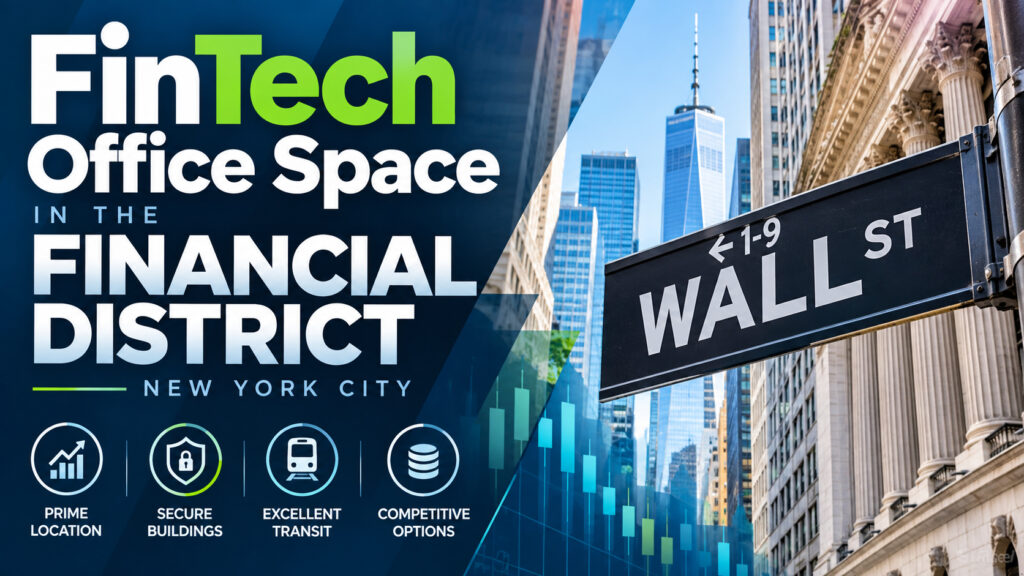
FinTech Office Space in the Financial District
FinTech office space in the Financial District does not describe one specific type of office. The phrase can cover direct leases, subleases, private offices, furnished suites, and office ownership. It can also describe an ordinary office redesigned around financial-technology operations.
For a tenant, that distinction matters.
A five-person payments startup needs something different from a 200-person trading platform. A regulated financial business also evaluates space differently from a general software company. Security, telecom, client privacy, uptime, growth, and lease flexibility can matter as much as the address.
The Financial District can support all those requirements within one compact Downtown market. Current inventory ranges from small furnished suites to large floors and corporate blocks. Office condominium ownership also remains an option for companies with stable, long-term requirements.
We represent office tenants, not landlords. Our job is to compare suitable spaces and identify the strongest tenant-side economics. We also help tenants negotiate the lease, buildout, flexibility, and protections around their business plan.
Is the Financial District a Good Location for a FinTech Company?
For many FinTech companies, yes.
FiDi combines financial-industry proximity with a deep and varied office inventory. It also gives teams access to Lower Manhattan’s broad transportation network. That combination can work for startups, mature technology companies, trading businesses, and regulated financial firms.
The value proposition has changed considerably during the current office cycle.
As of August 2026, Downtown Manhattan recorded an average asking rent of $62.01 per square foot. The same report placed Downtown availability at 16.1%. Average Downtown sublease asking rent stood at $47.59 per square foot.
Those figures cover the broader Downtown market. They do not represent every Financial District building or individual suite.
Still, they provide an important benchmark.
Manhattan’s overall asking average reached $80.05 per square foot during the same month. Midtown averaged $85.55, while Midtown South averaged $86.26.
That put the Downtown average about 27.5% below Midtown. It also sat roughly 28.1% below Midtown South.
A FinTech company can therefore compare several building tiers without leaving Lower Manhattan.
That does not mean every FiDi office represents a bargain.
Premium Downtown towers can command much higher rents. Recent FinTech leasing illustrates that spread clearly.
Reported Lower Manhattan FinTech deals have included a 35,454-square-foot sublease near $40 per square foot. Another large lease carried an asking rent around $60 per square foot. A newer 12,000-square-foot office carried an $80 asking rent. Premium tower space reached $115 per square foot in another 2026 transaction.
Those numbers do not create a FinTech rent average. Instead, they show how building quality and lease structure change the economics.
A FinTech office on Wall Street might emphasize clients, investors, and financial-industry identity. Another company may prefer Water Street for larger floors and stronger value. A growing technology platform may pay more for premium infrastructure near the western edge.
FiDi also sits inside a much larger technology economy.
New York City counted more than 25,000 tech-enabled startups and 1,200 active venture firms in a late-2025 city assessment. The city’s technology sector employed more than 360,000 people.
That matters because FinTech sits between finance and technology.
Companies need developers, product specialists, compliance professionals, analysts, sales teams, and financial specialists. Manhattan gives employers access to those overlapping labor markets.
The neighborhood also supports companies at different stages.
An early-stage firm may want a furnished sublease with very little upfront construction. A scaling company may need a prebuilt direct lease with expansion possibilities. Mature operations may require dedicated infrastructure and a long-term lease.
Recent published FiDi inventory illustrates that breadth. Current examples include small furnished subleases, midsize prebuilt direct offices, full-floor subleases, and office condominiums.
That range makes the Financial District unusual.
A company can start small, grow, and potentially remain inside the same submarket.
What FinTech Office Space in FiDi Actually Means
FinTech office space is not an official building classification.
No zoning designation turns an ordinary commercial office into a FinTech office. The tenant’s operating requirements create that distinction.
A suitable office supports the company’s employees, technology, privacy, clients, compliance obligations, and future growth.
That definition prevents a common mistake.
A beautiful technology-style office may still fail a financial company. Likewise, an older office can work extremely well after thoughtful upgrades.
Four occupancy structures account for most FinTech requirements.
| Occupancy route | Best fit | Main advantage | Main limitation |
|---|---|---|---|
| Direct lease | Established or scaling companies | Control over premises and longer-term planning | Greater commitment and possible construction |
| Sublease | Growing teams needing speed | Existing improvements can reduce upfront work | Limited remaining term and renewal control |
| Private managed office | New teams or temporary requirements | Quick occupancy and simple operating structure | Higher unit costs and less control |
| Office condominium | Stable long-term users | Ownership and asset control | Capital commitment reduces mobility |
The first decision should therefore concern occupancy strategy, not furniture style.
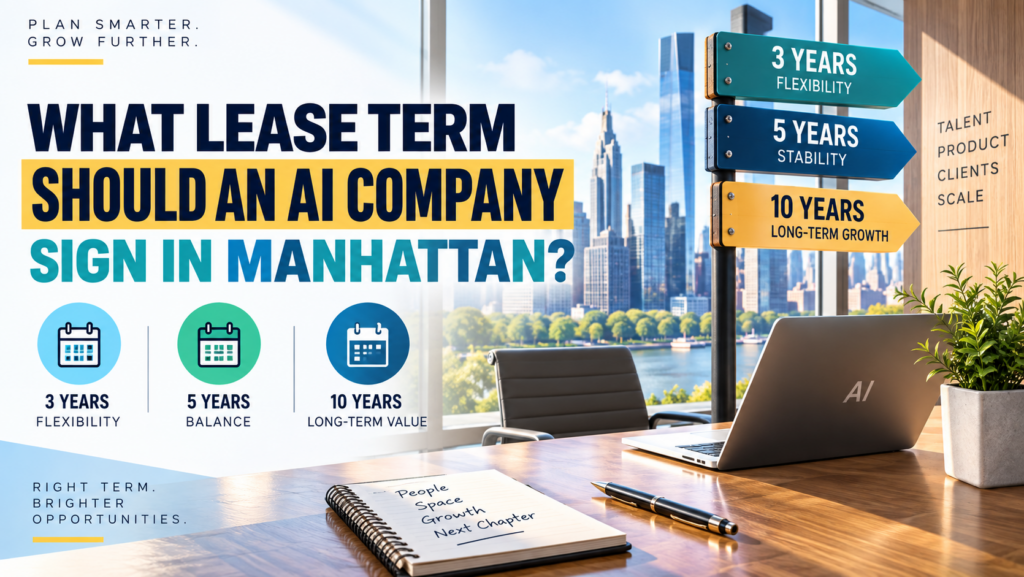
A company expecting rapid headcount changes should value flexibility differently. Another company may know its ten-year requirement with confidence. Neither business should approach the same FiDi office identically.
Direct leases offer the most control.
A direct tenant negotiates with the building owner. That structure can provide renewal rights, expansion options, construction allowances, signage rights, and long-term operational certainty.
However, direct leases require more diligence.
The tenant must understand rentable area, operating expenses, tax escalations, electricity, construction responsibility, security, insurance, assignment rights, and restoration obligations.
Our commercial leasing guide explains those issues in greater detail. A major direct lease search can reasonably begin six to twelve months before occupancy. Larger or specialized projects can require even more lead time.
Subleases solve a different problem.
A sublease can give a FinTech company an already built office without paying for a complete installation. Furniture, meeting rooms, workstations, cabling, and pantry infrastructure may already exist.
That speed can protect capital during a growth phase.
However, a subtenant inherits important limitations. The original lease controls many rights. The building owner may also need to approve the transaction.
A subtenant should understand the remaining term before investing heavily in improvements.
Managed private offices work best as a bridge.
They can make sense for a market-entry team, project group, incubating company, or temporary requirement. The tenant can avoid a long construction cycle.
Yet convenience carries a cost.
Shared infrastructure can also limit privacy, branding, visitor control, network architecture, and future expansion.
For those reasons, flexible space should represent one tool rather than the default FinTech solution.
Office ownership answers the “for sale” version of the requirement.
Buying can suit an established company with predictable long-term occupancy. Ownership may also appeal to businesses seeking control over improvements and long-duration occupancy costs.
Growth uncertainty creates the opposite case.
A fast-scaling FinTech company can outgrow a condominium. Capital tied to real estate may also compete with product, hiring, acquisitions, or technology investments.
Financial District ownership opportunities do exist. Our current office condos for sale include Downtown inventory.
The better question is not “Which office type is best?”
Ask which structure protects the company through its next business stage.
What FinTech Office Space Costs in the Financial District
Office rent creates only one component of occupancy cost.
A tenant should model base rent, escalations, electricity, cleaning, taxes, furniture, technology, construction, legal costs, and moving expenses. A low face rent can become expensive after those items.
Conversely, a higher-priced prebuilt office can sometimes reduce total occupancy costs.
Start with the current Downtown benchmark.
As of August 2026, the broader Downtown market averaged $62.01 per square foot. Downtown sublease asking rents averaged $47.59 per square foot. Availability stood at 16.1%.
Market reports can use different building sets and measurement methods. Tenants should therefore treat any single market average as a reference point.
Individual FiDi offices can trade far below or above that number.
Here is what the current Downtown average means mathematically.
| Rentable size | Annual base rent at $62.01/SF | Monthly equivalent |
|---|---|---|
| 5,000 SF | $310,050 | $25,837.50 |
| 10,000 SF | $620,100 | $51,675 |
| 20,000 SF | $1,240,200 | $103,350 |
These calculations show base asking rent only. They do not include additional rent or concessions.
That difference matters.
A landlord may quote one face rent while offering free rent or a construction allowance. Another landlord may quote less but provide little capital.
The net effective economics can reverse the apparent winner.
FinTech transactions show how wide FiDi pricing can become.
Recent reported Lower Manhattan transactions provide useful boundaries. They should not replace a current building-by-building comparison.
A large built sublease reached the market around $40 per square foot. A separate large FinTech lease carried an asking rent around $60. Newer space reached $80, while a premium tower transaction reached $115.
Lease type explains part of that range.
A sublease can price below direct space because another tenant wants to shed a commitment. A premium direct lease can cost much more because the tenant gains building quality and longer control.
Floor height, views, condition, term, landlord capital, and timing also affect pricing.
Class A versus Class B creates another major divide.
Recent Downtown research found that 73% of leasing since 2020 concentrated in Class A buildings. The reported Class A rent premium over Class B reached 25.5% during early 2026.
That pattern reflects a broader flight toward quality.
FinTech tenants should still avoid treating “Class A” as a checklist.
A Class B office with strong elevators, good telecom, new HVAC, and excellent light might outperform another space operationally. A premium lobby cannot compensate for weak infrastructure.
Current FiDi inventory also shows the gap between market averages and individual opportunities.
As of September 2026, our published listings include a 2,573-square-foot furnished FiDi sublet asking $39 per square foot.
A 5,300-square-foot direct Downtown office carries a published $38-per-square-foot asking rent.
Another 8,755-square-foot prebuilt direct office currently shows negotiable pricing. Its layout includes private offices, workstations, conference rooms, meeting rooms, and a pantry.
A 10,120-square-foot full-floor sublet currently lists at $39 per square foot.
Inventory changes constantly. Always confirm availability, term, pricing, and landlord approval before relying on a listing.
Commercial Rent Tax also deserves attention.
Many Manhattan commercial tenants can face New York City’s Commercial Rent Tax. The tax generally concerns qualifying premises south of 96th Street with sufficient annual rent.
Current rules start the general threshold at $250,000 of annual or annualized gross rent. Credits and exemptions can materially change liability.
The nominal tax rate equals 6% of base rent. A standard 35% reduction lowers the effective rate to 3.9% before applicable credits.
Certain tenants can qualify for additional credits.
A designated Downtown area also receives a specific exemption under current city rules. Boundaries and qualification require careful review.
Do not assume a quoted office budget already reflects this tax.
Your attorney and tax adviser should confirm the treatment before lease execution.
Finally, compare FiDi with the office market you would otherwise choose.
A company debating Midtown and Downtown should compare equivalent quality levels.
The August 2026 Downtown average sat about 28% below Midtown and Midtown South.
That spread can support a better buildout, more private rooms, or additional expansion space.
However, the lowest rent should never become the objective by itself.
The objective is the lowest risk-adjusted occupancy cost for the right office.
How to Size and Configure a FinTech Office
Headcount alone does not tell you how much space to lease.
A 60-person company could need fewer than 60 permanent desks. Another 60-person operation could require much more space.
The difference comes from attendance, privacy, client activity, hardware, trading functions, and meeting patterns.
Start with peak attendance rather than total payroll.
Suppose a company employs 80 people.
Forty employees might use the office on a typical day. Peak attendance could still reach 60 during team meetings or executive visits.
Leasing around the 40-person average would create a problem.
Planning around the credible peak creates a more resilient workplace.
A useful programming exercise separates five numbers:
| Planning input | Question |
|---|---|
| Total headcount | How many people belong to the company? |
| Peak daily attendance | How many may arrive simultaneously? |
| Fixed-seat population | Who genuinely needs a permanent station? |
| Growth reserve | What headcount could arrive during the lease term? |
| Visitor load | How many clients, candidates, vendors, or investors visit? |
Those numbers matter more than a fashionable desk ratio.
Different FinTech functions also consume space differently.
Engineering teams may favor open project areas and smaller collaboration rooms. Compliance teams may need acoustic privacy and controlled document handling.
Sales staff often need call rooms.
Executives may need confidential meeting space. Trading operations can require dense technology, resilient power, stronger cooling, and uninterrupted connectivity.
The office should reflect those differences.
Secure zones deserve deliberate planning.
A FinTech workplace often needs a clear boundary between visitors and employee-only areas.
Reception should not open directly into sensitive operating areas. Conference rooms near the entrance can contain outside meetings.
Internal zones can then hold staff workstations, IT infrastructure, finance functions, and confidential discussions.
This approach creates both practical privacy and better circulation.
Do not confuse cybersecurity compliance with building prestige.
A premium address does not make a financial company secure.
New York’s cybersecurity regulation applies to covered financial-services entities operating under relevant state financial laws. Covered entities must maintain risk-informed cybersecurity programs and policies.
Federal privacy rules can also impose incident-response requirements on covered financial institutions.
The lease itself cannot satisfy those obligations.
However, the physical office can support the company’s program.
A tenant should evaluate access control, visitor procedures, telecom, equipment rooms, backup-power options, and physical privacy. Teams should also understand who can access risers, closets, and sensitive infrastructure.
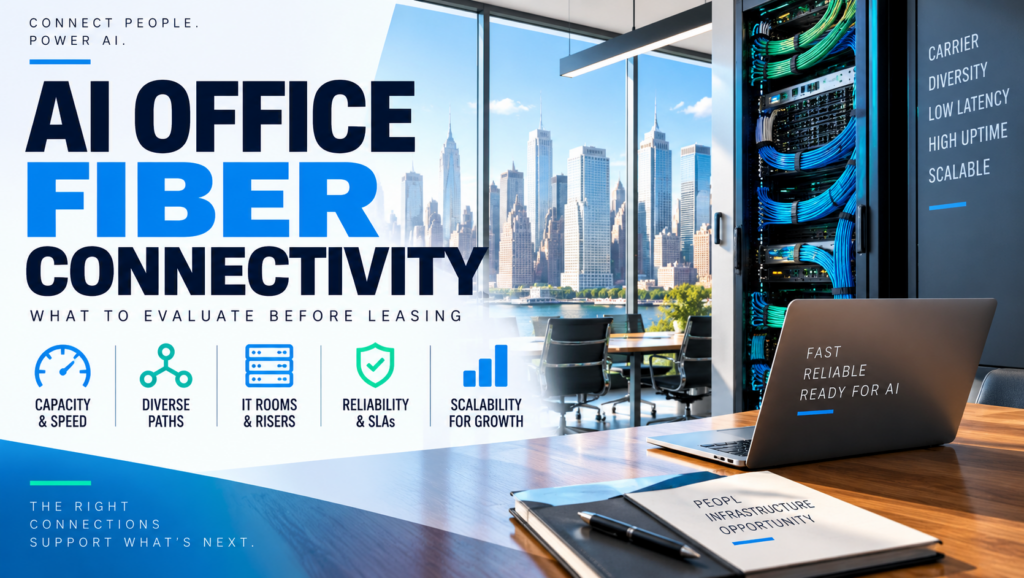
Telecom deserves more attention than most tours provide.
Ask which carriers actually serve the premises.
Confirm whether two carriers enter through genuinely independent pathways. Determine where the building hands service to the tenant.
Next, inspect the riser arrangement.
A marketing statement about “high-speed internet” provides little operational detail. A FinTech company should understand how its actual network will reach the floor.
Power questions should become equally specific.
How much electrical capacity reaches the premises?
Does the building provide emergency power? Which tenant systems can use it?
Can the tenant install dedicated backup equipment where needed? What happens during utility interruption?
Those answers can matter greatly for trading, payment, digital-asset, and real-time financial operations.
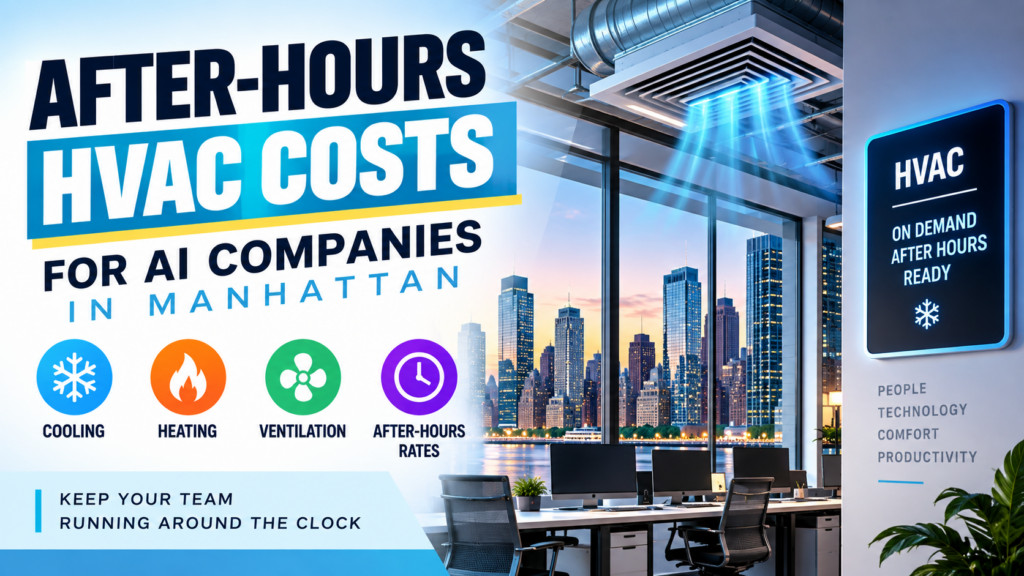
HVAC can become another hidden issue.
A standard office may provide cooling only during defined business hours.
That can create problems for servers, network equipment, late shifts, or globally oriented teams. After-hours HVAC charges may also alter operating costs.
Ask about schedule, capacity, controls, and supplemental cooling before signing.
Acoustics matter in finance more than exposed ceilings suggest.
Open ceilings look attractive.
However, confidential calls require speech privacy. Compliance discussions, investor conversations, compensation meetings, and customer issues can expose sensitive information.
Private rooms need suitable partitions and acoustic treatment.
Phone booths can help, but they do not replace actual confidential rooms.
A FinTech office should also separate concentration from collaboration.
Large open rooms create visibility and density. They can also create distraction.
Smaller rooms should support calls, pair work, interviews, and short meetings. Larger rooms should handle board meetings, investor presentations, and team sessions.
Quiet areas help developers and analysts focus.
The strongest design gives employees several choices without wasting large amounts of space.
Growth planning needs physical and contractual solutions.
A company should not simply lease extra space because growth might happen.
Instead, examine several possibilities.
The landlord may offer adjacent space later. A right of first offer could preserve access to that space.
The lease might also permit assignment or subletting.
A building with several suite sizes can create another path. Growing within one property may cost less than moving the entire operation.
Repurposing an existing office can work particularly well for a FinTech startup.
A traditional office-heavy layout may already contain valuable privacy.
Instead of demolishing everything, convert selected perimeter rooms into conference rooms, call rooms, secure offices, or project spaces. Open only the areas that need team seating.
Retain usable cabling and furniture where practical.
Then invest capital where technology or employee experience requires it.
That approach can save both time and money.
Where Should a FinTech Company Look Inside the Financial District?
FiDi covers a compact area, yet individual streets create very different office experiences.
A five-minute walk can change the building stock, floorplate size, transit pattern, views, pricing, and atmosphere.
For that reason, “Financial District” should represent the start of your location analysis.
Wall Street and the traditional financial core
A FinTech office on Wall Street creates the neighborhood’s strongest financial identity.
This area can work well for client-facing platforms, trading businesses, investment technology, market-data companies, lending businesses, and financial infrastructure firms.
The office stock mixes older towers with extensively improved buildings.
Some floors contain traditional private-office layouts. Others offer modern prebuilts with glass offices, open seating, and conference rooms.
Transit also surrounds the core.
For teams that meet frequently with financial clients, a few blocks of proximity can save meaningful time.
Broadway and the western core
Broadway gives tenants strong north-south connectivity across Lower Manhattan.
The corridor also offers a wide range of building vintages and office sizes.
FinTech companies can find smaller prebuilt suites, midsize floors, and larger institutional space. Building quality can vary dramatically within a short distance.
That variation creates opportunities.
A tenant that cares more about efficient space than trophy finishes can sometimes find strong value here.
Water Street and the Seaport edge
Water Street deserves particular attention from growing FinTech companies.
Large towers can provide sizable floorplates and high-floor views. The area also offers access to the East River waterfront.
Recent leasing shows that financial-technology tenants will consider substantial blocks here. One 2025 FinTech lease covered more than 73,000 square feet. A separate 2026 FinTech sublease exceeded 35,000 square feet.
Those transactions demonstrate an important point.
FinTech demand in FiDi does not stop at Wall Street.
The Seaport side can accommodate companies that prioritize floor efficiency, scale, and economics.
Current inventory reinforces the range. Our Financial District pages include direct and sublease opportunities from small suites through much larger blocks.
Fulton and the northern edge
The Fulton area offers one of the neighborhood’s strongest transit positions.
That advantage matters for companies drawing employees from several boroughs.
A business with a dispersed workforce should compare actual employee commutes rather than judging a location by neighborhood name.
The northern edge can also create easier access toward City Hall, Tribeca, and Brooklyn connections.
Battery and Bowling Green
The southern edge gives teams a different office environment.
Harbor views, ferry access, and older institutional buildings shape the area.
The Staten Island Ferry runs year-round between Lower Manhattan and Staten Island. City ferry routes also connect Wall Street/Pier 11 with several waterfront communities.
That can make this area useful for teams with employees outside traditional subway commuting patterns.
The western premium district
The western edge includes some of Downtown’s newest and highest-priced office product.
These buildings can offer large modern floors, strong transit integration, newer systems, and extensive tenant amenities.
They can also carry significant rent premiums.
Recent FinTech leasing reached a reported $115 per square foot in this premium segment.
A tenant should therefore ask what that premium actually buys.
Better infrastructure can justify more rent. So can recruiting value, client presentation, efficiency, or commute improvement.
Prestige alone may not.
Transportation makes the entire district more flexible.
FiDi offers subway access across multiple north-south corridors. PATH service connects Lower Manhattan with New Jersey.
Ferries add another commuting network.
Current regional plans have also expanded PATH service, including improved weekend connections during 2026.
For a hybrid FinTech company, commuting quality matters even more.
Employees may come into the office fewer days. However, those office days often concentrate around shared schedules.
A difficult commute can reduce participation precisely when collaboration matters most.
Neighborhood change also affects long-term office supply.
Lower Manhattan leads the city’s current office-conversion wave.
A city fiscal analysis counted 14 Lower Manhattan rental conversion projects representing 7.8 million gross square feet. Those projects could create 9,297 housing units within the studied pipeline.
Conversions remove older office inventory from the market.
That can improve the neighborhood’s residential base while reducing obsolete office stock.
For tenants, the implication remains straightforward.
Do not assume today’s deepest-value building inventory will remain unchanged throughout the next lease cycle.
How to Evaluate, Negotiate, and Secure the Right FinTech Office
The best FinTech office rarely reveals itself through asking rent alone.
A tenant needs a disciplined comparison.
That comparison should cover the physical space, building infrastructure, lease economics, operational risk, and future flexibility.
Begin with a written requirement before touring.
Define headcount, peak attendance, target occupancy date, preferred term, and budget.
Next, identify non-negotiable operational requirements.
Those could include 24-hour access, supplemental cooling, private meeting rooms, loading access, telecom redundancy, or high electrical capacity.
Separate necessities from preferences.
That distinction prevents a beautiful office from overriding an operational problem.
Compare usable value, not just rentable square footage.
Two 10,000-square-foot offices can perform very differently.
One might contain deep interior space, oversized corridors, columns, and unusable corners. Another may offer an efficient rectangle with strong window exposure.
Count actual seats and functional rooms.
Then evaluate circulation.
A more efficient 9,000-square-foot floor could outperform an inefficient 11,000-square-foot alternative.
Inspect the existing installation carefully.
A prebuilt office has value only when your team can use it.
Count conference rooms, offices, workstations, phone rooms, and collaborative areas.
Check furniture condition.
Review cabling and power locations. Inspect the pantry, bathrooms, ceiling condition, and lighting.
Then determine what must change before occupancy.
A $40-per-square-foot sublease can become less compelling after a major reconstruction.
Ask infrastructure questions during the first tour.
Do not wait until lease negotiations.
Request information about telecom carriers, electrical service, HVAC hours, supplemental cooling, access controls, freight procedures, loading, generator service, and building management.
A FinTech company should also understand after-hours procedures.
Who can access the building at 2:00 a.m.? How does a visitor enter?
What happens during an outage?
Operational questions reveal the difference between an office that looks good and one that works.
Model every candidate on the same financial basis.
Create a lease comparison that includes:
| Cost category | What to compare |
|---|---|
| Base rent | Face rent and annual increases |
| Free rent | Timing and conditions |
| Construction | Landlord work, allowance, and tenant contribution |
| Electricity | Included, submetered, or separately contracted |
| Cleaning | Included or tenant expense |
| Taxes | Base year, escalations, and applicable city rent tax |
| Operating expenses | Base year and pass-through structure |
| Furniture | Existing, landlord-provided, purchased, or leased |
| Technology | Cabling, carriers, equipment, cooling, backup systems |
| Legal and design | Attorney, architect, engineer, and permits |
| Exit costs | Restoration, removal, and surrender obligations |
Only then can the tenant compare effective economics.
The cheapest face rent can lose that comparison.
Suppose one suite requires substantial demolition and cabling.
Another office might cost several dollars more per square foot. Yet it already contains suitable conference rooms, workstations, power, and wiring.
The second space could require less cash and permit faster occupancy.
Time also has a cost.
A growing FinTech company may value three saved months differently from a mature business.
Negotiate flexibility while the landlord still wants the deal.
Growth rights deserve attention before lease signing.
Expansion options can matter.
So can assignment rights, sublease rights, renewal options, contraction possibilities, and early termination provisions.
Not every landlord will agree to every request.
However, tenants lose negotiating power after execution.
Build future scenarios into the original discussion.
Security deposits also deserve scrutiny.
Early-stage businesses may lack a long operating history.
Landlords can respond with larger security demands or financial guarantees.
Strong financial reporting may help the negotiation.
A larger company could offer different credit support.
The objective should match landlord protection with tenant risk.
Avoid accepting unnecessary long-duration collateral simply to finish negotiations quickly.
Construction language can carry more financial impact than face rent.
Define the work carefully.
Who prepares plans?
Who files permits?
Which party pays for changes?
When does rent start if construction runs late?
What condition must the landlord deliver?
Ambiguous construction language can create expensive disputes.
Our commercial leasing guide covers the wider lease process and alteration issues.
FinTech tenants should also review compliance-sensitive physical conditions before commitment.
Financial regulators increasingly focus on cybersecurity and customer-data protection. Covered New York financial companies face specific cybersecurity program requirements.
A building cannot make the company compliant.
Still, poor physical controls can make compliance harder.
Review secure access, confidential meeting space, IT-room protection, vendor entry, network architecture, and business-continuity needs with the appropriate specialists.
Do not overlook business continuity.
Ask what happened during previous power, water, telecom, or weather disruptions.
Understand the building’s procedures.
Determine whether key technology can remain operational during an interruption.
Also review alternative workplace arrangements for critical staff.
A company handling time-sensitive financial transactions may need more resilience than an ordinary office user.
Finally, tour competing building tiers on the same day whenever possible.
Memory changes quickly.
A tenant can compare a premium office, strong Class B alternative, and furnished sublease within hours.
That contrast reveals where the rent premium creates actual value.
It also exposes features that looked important before the tour but matter less afterward.
The goal is not to find the fanciest FinTech office in Downtown NYC.
The goal is to find the office that best supports the business.
Frequently Asked Questions About FinTech Office Space in FiDi
Is the Financial District a good location for a FinTech company?
Yes, it can offer an unusually strong combination of financial-industry proximity, transit, inventory depth, and relative value.
Downtown’s August 2026 asking average reached $62.01 per square foot. Manhattan overall averaged $80.05 during the same period.
The neighborhood also accommodates very different company sizes.
Recent FinTech deals have ranged from approximately 12,000 square feet to more than 73,000 square feet.
Suitability still depends on your team.
A company should compare employee commutes, clients, infrastructure, lease flexibility, and total occupancy costs.
What does “FinTech office space” actually mean?
It means commercial office space that supports a financial-technology company’s particular operating needs.
No formal real estate class defines it.
The office may involve a direct lease, sublease, furnished suite, private managed office, or owned condominium.
What matters is the configuration.
A suitable FinTech office can support secure access, private meetings, reliable connectivity, technology infrastructure, collaboration, and headcount growth.
How much does FinTech office space cost in the Financial District?
There is no single FinTech rental rate.
The broader Downtown market averaged $62.01 per square foot in August 2026. Downtown sublease asking rent averaged $47.59.
Individual offices can fall well outside those averages.
Recent disclosed FinTech transactions ranged from around $40 per square foot for a large sublease to $115 for premium space.
Current individual FiDi listings can also ask below those market-wide benchmarks.
Is FiDi cheaper than Midtown for office space?
On current broad-market asking averages, yes.
Downtown averaged $62.01 per square foot in August 2026. Midtown averaged $85.55 during the same month.
That represents a difference of roughly 27.5%.
However, compare similar building classes.
Premium Downtown offices can exceed ordinary Midtown pricing. Lower-cost FiDi buildings can sit far below both submarket averages.
Are FinTech offices in FiDi only for large companies?
No.
Current Financial District inventory includes offices below 3,000 square feet. Other opportunities can exceed entire floors or much larger blocks.
Small companies often prioritize furnished space and shorter commitments.
Growing firms can use midsize prebuilt suites.
Larger companies may need contiguous floors, infrastructure capacity, expansion rights, and longer lease control.
Should a FinTech startup lease directly or take a sublease?
The answer depends on growth certainty and timing.
A sublease can reduce startup costs when furniture and improvements already match the requirement.
Direct leases provide greater long-term control.
A startup expecting major growth should examine the remaining sublease term carefully.
The cheapest short-term solution can create an expensive second move.
What should a FinTech company inspect before leasing an office?
Start with telecom, power, HVAC, security, layout, and expansion.
Then review the economics.
Check conference-room privacy, visitor circulation, IT-space security, after-hours access, supplemental cooling, and carrier availability.
A technology specialist should review critical infrastructure when the business depends heavily on uptime.
Does a FinTech company need redundant internet service?
Not every company needs the same redundancy.
However, businesses that depend on continuous transaction processing should examine carrier diversity carefully.
Two service providers do not always mean two independent building pathways.
Ask where carriers enter the property.
Then confirm how each service reaches your floor.
Should the office have backup power?
That depends on the company’s operations.
A team can tolerate a different outage profile than a time-sensitive trading or payments operation.
Determine which building systems receive emergency power.
Next, establish whether tenant equipment can connect to available backup systems.
Specialized operations should involve qualified technology and engineering advisers.
Does building security make a FinTech company compliant?
No.
Cybersecurity compliance depends on the company’s legal obligations, risk program, technology, controls, and procedures.
Certain New York regulated financial companies must maintain risk-informed cybersecurity programs.
Physical office security can support that program.
It cannot replace it.
Is a Wall Street address necessary for a FinTech company?
No.
A Wall Street location can support client proximity and financial-sector identity.
Water Street, Broadway, Fulton, Battery, and other FiDi areas may offer better economics or layouts.
Recent FinTech leasing confirms that companies choose several parts of Lower Manhattan.
The right block depends on the tenant’s priorities.
Is Water Street good for FinTech offices?
It can work especially well for teams seeking midsize or large floorplates.
Recent major FinTech activity has occurred on the eastern side of the district.
Current inventory also includes smaller prebuilt spaces.
For example, our 8,755-square-foot direct office offers an already configured midsize layout.
Can a hybrid FinTech company use a smaller office?
Yes, but avoid planning around average attendance alone.
Measure peak attendance.
Then account for meetings, visitors, company events, and hiring.
A hybrid office often needs more meeting space per occupied desk because employees concentrate collaboration into office days.
Flexible seating can reduce dedicated desk count.
However, inadequate meeting rooms can quickly erase those gains.
How should a growing FinTech company plan for expansion?
Start with a realistic headcount range.
Then evaluate adjacent space, expansion rights, assignment rights, and sublease flexibility.
Do not automatically lease years of unused space.
Contractual flexibility can provide a better growth solution.
A building with multiple suitable suite sizes may also create internal relocation options.
Can a FinTech company buy office space in the Financial District?
Yes.
Commercial condominiums provide an ownership route.
Current Downtown inventory includes office space offered for sale.
Ownership usually suits companies with stable requirements and available capital.
Fast-growing firms should consider the opportunity cost of tying capital to real estate.
Future expansion can also become harder when the company owns a fixed unit.
What is the difference between asking rent and effective rent?
Asking rent represents the quoted face rate.
Effective rent considers negotiated economics across the lease term.
Free rent can lower effective cost.
A tenant improvement allowance can also create substantial value.
Escalations, taxes, and operating expenses push costs in the other direction.
Always compare the complete cash flow rather than one dollar-per-square-foot figure.
Does Commercial Rent Tax apply to a Financial District office?
It can.
Current city rules generally bring qualifying Manhattan premises into the tax framework at $250,000 or more in annualized gross rent. Credits and exemptions can alter the result.
A specific Downtown geographic exemption also exists.
Ask your tax adviser to calculate liability for the exact premises.
Do not assume the landlord’s rent proposal includes every tenant-side tax obligation.
When should a FinTech company start looking for FiDi office space?
Start earlier when the requirement involves construction or significant infrastructure.
A major conventional lease can justify a six-to-twelve-month planning horizon. Complex projects can require longer.
A furnished sublease may move much faster.
Starting early preserves options.
It also gives the tenant time to compare buildings before an approaching deadline weakens leverage.
Are office conversions reducing Financial District inventory?
Yes, particularly among older Lower Manhattan buildings.
A recent city analysis tracked 7.8 million gross square feet across 14 Lower Manhattan rental-conversion projects.
That trend removes some obsolete offices while adding residential activity.
Over time, fewer low-quality buildings could reduce the deepest-value office inventory.
The effect will vary block by block.
What kind of FiDi office is usually best for an early-stage FinTech company?
A furnished sublease or efficient prebuilt direct suite often deserves the first look.
Both can reduce construction requirements.
The decision should depend on term, cash requirements, growth, and infrastructure.
A short sublease becomes less attractive when the company expects rapid expansion.
A long direct lease becomes risky when headcount remains uncertain.
What kind of office suits an established FinTech company?
Established businesses can place more emphasis on control.
That may mean a direct lease with dedicated infrastructure, expansion rights, and a longer planning horizon.
Client-facing companies may value presentation and location more heavily.
Regulated operations may prioritize secure circulation and resilient systems.
Large employers should also model employee commutes before selecting a block.
What makes a FinTech office tenant-ready?
Tenant-ready means more than installed desks.
A functional office should align with your workplace program.
It should also support technology, privacy, meetings, access, and occupancy timing.
For one company, that could mean a furnished 3,000-square-foot suite.
Another may need a 30,000-square-foot floor with substantial technology modifications.
How do we compare available FinTech office space in the Financial District?
Start with five facts: required size, occupancy date, budget, term, and peak attendance.
Add any non-negotiable infrastructure requirements.
We can then compare direct leases, subleases, furnished offices, and ownership opportunities against the same tenant criteria.
That approach avoids wasting tours on spaces that never matched the business.
Compare available FiDi spaces to review current Financial District office inventory across multiple sizes and lease structures. Current published options span small startup suites, midsize offices, larger floors, subleases, direct leases, and sale opportunities.
Find FinTech Office Space
We represent office tenants throughout this process. We compare alternatives around your business rather than one landlord’s vacancy. Our focus stays on the space, economics, flexibility, infrastructure, and lease terms that protect your company.