NYC Tenant Broker Services for Office Tenants
Finding office space in New York City starts with a business decision, not a property tour. Your space must support people, budget, growth, clients, technology, and timing. A tenant broker turns those priorities into a structured office strategy.
We are tenant brokers representing office tenants throughout New York City. Our job is to protect your business interests from planning through occupancy. We do not negotiate for the landlord on your assignment.
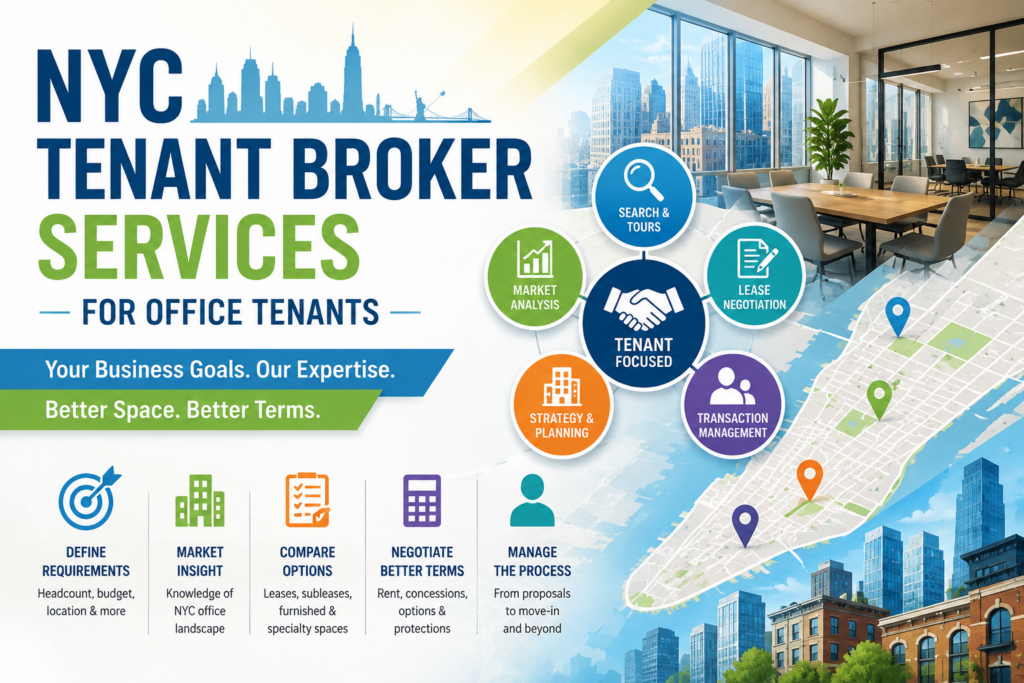
What NYC tenant broker services actually cover
Tenant representation starts before anyone schedules a tour. First, we define your requirement around headcount, square footage, location, budget, lease term, and move date. We also examine growth plans, hybrid work, client access, security, branding, and infrastructure.
Next, we build a market survey across direct leases, subleases, furnished offices, and other suitable options. A useful survey compares more than asking rent. It should flag layout efficiency, building quality, landlord posture, term flexibility, and likely construction needs.
Tours then test the survey against physical reality. We compare natural light, elevator service, HVAC, ceiling height, noise, access, bathrooms, pantries, and existing improvements. We also study how each floor supports your actual work patterns.
After tours, the work becomes more financial and strategic. We request proposals, compare economics, and negotiate business terms. Those terms can include rent, free rent, improvement money, security, escalations, options, and flexibility rights.
A strong tenant broker also coordinates the transaction around your attorney, architect, project manager, and internal decision-makers. The broker does not replace legal counsel. Instead, the broker helps define the business deal that counsel documents.
For a deeper service checklist, review what a tenant broker should actually do. Our commercial leasing guide explains the broader leasing process.
Tenant representation can cover the entire office lifecycle: new leases, renewals, relocations, expansions, contractions, and sublease strategy. The purpose remains consistent throughout. Your real estate decision should serve your business rather than dictate it.
Who a tenant broker represents and why that matters
The landlord usually enters every serious lease discussion with professional representation. That representative protects the owner’s pricing, risk, timing, and building strategy. An office tenant needs its own negotiating perspective.
A tenant broker works from the tenant’s requirements. The assignment should focus on your budget, operating needs, flexibility, and long-term business plan. That focus matters when several spaces look similar but carry different risks.
Some commercial brokers handle both landlord and tenant assignments. That structure does not automatically create a problem. However, you should understand every relationship before relying on advice.
Ask who represents the building and who represents your company. Next, determine whether another relationship could influence recommendations. Clear answers help you evaluate the advice you receive.
Compensation deserves the same clarity. In many standard New York City office leases, the landlord side pays the brokerage commission. The tenant broker then receives the agreed tenant-side share. Separate consulting arrangements, unusual subleases, or other structures can work differently.
Therefore, review the engagement terms before tours begin. Confirm who owes any fee and when a fee becomes due. Also determine what happens if the transaction changes.
Do not rely on a casual promise about “free service.” Ask for an explanation of the compensation structure instead. That approach removes uncertainty before negotiations become serious.
The best relationship gives you one accountable advisory channel. It also creates a consistent record of tours, proposals, financial comparisons, and negotiations. That continuity becomes valuable when several buildings compete for the same requirement.
Our office broker guide explains the basic roles. The tenant broker question checklist helps you test experience and fit.
How tenant representation works from requirements to signed lease
A disciplined office search follows a sequence. Skipping steps usually creates confusion later, especially when timing becomes tight. Public-sector tenant-representation scopes follow a similar structure of planning, market analysis, site search, and negotiation.
Requirement definition. We start with headcount, growth, preferred neighborhoods, budget, timing, and operational needs. Then we convert those needs into a realistic rentable-square-foot range.
Market coverage. We review direct listings, subleases, prebuilt suites, furnished spaces, and less visible opportunities. We also compare buildings that may satisfy the requirement differently.
Tours and shortlisting. Each tour should answer practical questions. Can the floor support your people, meetings, technology, privacy, and daily circulation?
Proposal stage. We ask selected landlords or sublandlords for complete business terms. A serious proposal should address much more than first-year rent.
Financial comparison. We normalize proposals over the full term. That process exposes differences in free rent, escalations, improvement money, electricity, and other occupancy costs.
Term-sheet negotiation. We negotiate the main economic and operational points before lease drafting. A developed term sheet gives counsel a stronger starting point.
Lease and due diligence. Your attorney handles legal drafting and legal risk. Meanwhile, technical professionals can review construction, systems, permits, and physical conditions.
Move planning. After signing, the work can include design, approvals, construction, furniture, cabling, insurance, movers, and building coordination.
For many traditional Manhattan requirements, starting six to twelve months early protects leverage. Larger or customized occupancies can require longer planning. Smaller turnkey deals may move much faster.
The office search timetable provides a fuller scheduling framework. It also helps teams plan internal approvals before deadlines control the deal.
A tour is not the beginning of the strategy.
By the first tour, your budget, timing, priorities, and decision process should already make sense.
How brokers compare office economics and negotiate lease terms
Asking rent never tells the whole story. Two offices can show the same face rent and produce very different occupancy costs. A tenant broker should model the full economic package.
Start with rentable square feet and annual base rent. A 5,000-square-foot office at $80 per square foot equals $400,000 annually. That equals about $33,333 monthly before additional costs.
Then add every recurring charge that applies. Those costs may include electricity, operating increases, real estate tax increases, cleaning, and overtime HVAC. Lease structures vary, so never assume every building calculates charges alike.
Next, account for concessions and capital. Free rent lowers effective cost, while improvement money can reduce upfront construction spending. A larger allowance does not always create a better deal.
For example, expensive construction can consume a generous allowance quickly. Likewise, a long free-rent period may hide higher future escalations. The broker should compare the entire term, not one headline number.
A proper proposal comparison should answer several questions at once:
| Economic question | What the tenant needs to understand |
|---|---|
| Base rent | Annual and monthly contractual rent |
| Escalations | How rent increases during the term |
| Free rent | When it applies and when payments begin |
| Improvement allowance | How much capital supports construction |
| Additional rent | Taxes, operating charges, utilities, and services |
| Security | Cash or other security the landlord requires |
| Effective cost | The economic result across the full term |
Negotiation should also cover operational rights. Important points can include renewal options, expansion rights, assignment, subletting, signage, access, and after-hours HVAC. Restoration obligations can also create major end-of-term costs.
Security deposits and guaranties deserve separate attention. They affect capital exposure even when the face rent looks attractive.
A letter of intent usually establishes business terms before lease drafting. However, the signed lease ultimately governs the relationship. Your attorney should review legal language and protect legal rights.
Our guide to tenant improvement allowances explains how build-out money works. The renewal option guide covers future extension rights.
Renew, relocate, expand, contract, or sublease
Tenant broker services do not begin only when you need a new address. Many assignments start because an existing lease approaches a decision point. That decision can involve staying, moving, growing, shrinking, or disposing of excess space.
A renewal should compete against real alternatives. Without a market test, the tenant cannot easily judge the landlord’s proposal. Touring credible alternatives can create leverage even when staying remains the preferred outcome.
Relocation requires a broader comparison. Rent matters, but moving costs, construction, downtime, furniture, technology, and employee disruption also matter. A cheaper lease can become expensive after transition costs.
Expansion creates another set of questions. Can you grow inside the current building? Does the lease provide expansion rights, first-offer rights, or access to adjacent space?
Future flexibility can carry significant value. A well-structured right may help a growing company avoid another premature relocation. Our guide to office expansion rights explains common structures.
Contraction requires different planning. You may need a smaller direct lease, a shorter commitment, or a partial disposition strategy. Existing lease rights often determine what options remain available.
Sublease advisory helps tenants with surplus space. The broker can assess pricing, remaining term, furniture, condition, and landlord consent requirements. A realistic marketing position improves the chance of reducing carrying costs.
Short-term needs can also favor furnished or plug-and-play offices. Those spaces may reduce capital spending and accelerate occupancy. However, shorter terms often provide less control over future costs.
Review plug-and-play office space before comparing turnkey options. For expiring leases, our end-of-lease guide covers renewal, move-out, and restoration planning.
Renewal versus relocation is not simply a rent comparison. It is a total business comparison involving economics, disruption, flexibility, and future control.
What today’s NYC office market means for tenants
New York City’s office market has tightened from its post-pandemic extremes. However, conditions still vary sharply by building quality, location, size, and condition. Premium space can behave differently from average inventory.
Current Q2 2026 research places Manhattan’s average asking rent near $78 to $80 per square foot. Reported availability sits around 13% to 14.4%, depending on methodology. Those figures describe the market, not every suitable office.
One Q2 benchmark placed Midtown’s average asking rent at $86.18 per square foot. Availability there measured 12.7% under the same methodology.
Downtown showed a different value profile. Average asking rent measured $61.34 per square foot, while availability reached 16.6% in that dataset.
Manhattan sublease asking rent averaged $59.94 per square foot in the same borough-wide survey. Sublease availability measured 2.6%.
Those numbers explain why neighborhood selection can materially change a tenant’s budget. Yet building class can create an equally large difference.
Highly improved, well-located space can attract competition even when broader availability looks comfortable. Separate research also shows tightening conditions across many high-quality assets.
Therefore, tenants should not treat a Manhattan average as a negotiation target. A broker should compare relevant buildings, similar floors, recent deals, and active alternatives.
The current market also rewards preparation. Strong leasing activity has reduced some high-quality choices. Tenants with clear requirements can move faster when the right floor appears.
At the same time, value remains available in older buildings, subleases, and Downtown inventory. The correct choice depends on people, budget, image, term, and construction tolerance.
Use our NYC office space for lease guide to understand the principal leasing structures. Then compare individual opportunities against total occupancy cost.
Current market takeaway: Manhattan still offers choices, but desirable office space no longer behaves like distressed inventory.
Strong tenants should prepare early, compare carefully, and negotiate from current evidence.
When to hire a tenant broker and how to choose one
Hire a tenant broker before you start serious tours. Early representation helps preserve negotiating consistency and reduces conflicting communication. It also gives the broker time to build a complete market set.
For many office searches, six to twelve months provides a useful planning window. Complex headquarters, custom construction, or specialized uses may need more time. Fast prebuilt transactions can require much less.
Experience should match your assignment. A broker handling huge headquarters may not specialize in a 4,000-square-foot requirement. Likewise, a small-space specialist may lack complex multi-floor experience.
Ask for recent tenant-side work within your size range and target neighborhoods. Then ask how the broker compares direct leases, subleases, and furnished options.
You should also understand who handles tours, analysis, proposals, and negotiations. A senior name on a presentation matters less than actual assignment involvement.
Market knowledge should go beyond a listing database. A useful advisor understands ownership, management, operating costs, recent leasing, and physical limitations. That context can expose problems behind an apparent bargain.
Financial analysis matters equally. Ask to see how the broker compares effective rent and total occupancy cost. A simple asking-rent spreadsheet does not provide enough information.
Communication style also matters. Your broker should challenge unrealistic assumptions while respecting business priorities. Good advice sometimes means rejecting an attractive-looking office.
Questions worth asking before the first tour include:
- Who exactly do you represent on my assignment?
- What recent tenant transactions match my size and neighborhoods?
- How will you compare direct, sublease, and move-in-ready options?
- What costs will you model beyond base rent?
- How do you receive compensation?
- Can you represent us during a renewal instead?
- What happens if we later need to expand or sublease?
Those questions closely track the issues tenants should resolve before selecting representation.
Finally, confirm compensation and representation in writing. Clear terms reduce confusion later.
Use the questions to ask a tenant rep broker before selecting representation.
Common questions office tenants ask before hiring a tenant broker
Do I need a tenant broker to lease NYC office space?
You can tour and lease office space without your own broker. However, the landlord’s representative does not represent your business interests.
Does a tenant broker cost the office tenant money?
Many standard office deals use landlord-paid brokerage commissions. Still, compensation can vary by transaction. Confirm the structure in writing before starting.
Can a tenant broker show listings from many landlords?
Yes. A tenant-focused market search should compare suitable opportunities across many ownership groups. Your requirement should drive the shortlist.
Can a tenant broker find opportunities that I have not seen online?
Market coverage can include publicly marketed space and less visible opportunities. Current public tenant-representation scopes also include both on-market and off-market property identification.
Can I use a tenant broker for a renewal?
Yes. A renewal benefits from financial benchmarking and credible outside alternatives. That market test helps clarify whether staying creates the strongest outcome.
Will the broker negotiate the lease?
The broker negotiates business terms and helps frame the transaction. Your attorney negotiates legal language and provides legal advice.
Should my attorney join before or after the term sheet?
Bring legal counsel into the process early enough to flag important risks. Commercial lease legal support can cover new leases, amendments, renewals, and terminations.
Can a broker help with a sublease?
Yes. Tenant representation can include acquiring sublease space or disposing of surplus space. Each side requires different pricing, consent, and timing work.
What should I prepare before the first call?
Bring headcount, move date, preferred locations, and budget. Add current lease dates and major operating requirements.
How much office space should I request?
Start with people and work patterns rather than a fixed square-foot assumption. Meeting rooms, private offices, circulation, storage, and growth all change the answer.
Should I choose the cheapest office?
Not automatically. Low face rent can lose its advantage through construction, inefficient layout, extra charges, or operational problems.
Should I consider a sublease instead of a direct lease?
Possibly. A sublease can offer existing improvements, furnishings, shorter commitments, or lower asking costs. However, the remaining term can limit long-term control.
What about furnished or turnkey space?
Turnkey offices can work well when speed and lower upfront capital matter. Verify furniture, cabling, internet readiness, condition, and actual possession timing before committing.
When should I start?
Begin early enough to keep credible alternatives. Many traditional searches benefit from six to twelve months. Larger requirements can require more time.
What should a good tenant broker ultimately accomplish?
The broker should make each real estate decision clearer. More listings alone do not accomplish that goal.
Contact Us Today, Tour Tomorrow
We help tenants define requirements, search the market, evaluate offices, analyze proposals, and negotiate business terms. Our work also covers renewals, relocations, expansions, contractions, and sublease planning.
Most importantly, your office decision should support the company after the lease gets signed. It should not merely solve today’s property search.
Contact us when you are ready to define your requirement and compare the available paths.
Fill out our 📋 online form or give us a call today 📞 212-967-2061 — let’s find the right options for your business.