Best Manhattan Neighborhoods for FinTech Companies
Where Should a FinTech Company Lease Office Space in Manhattan?
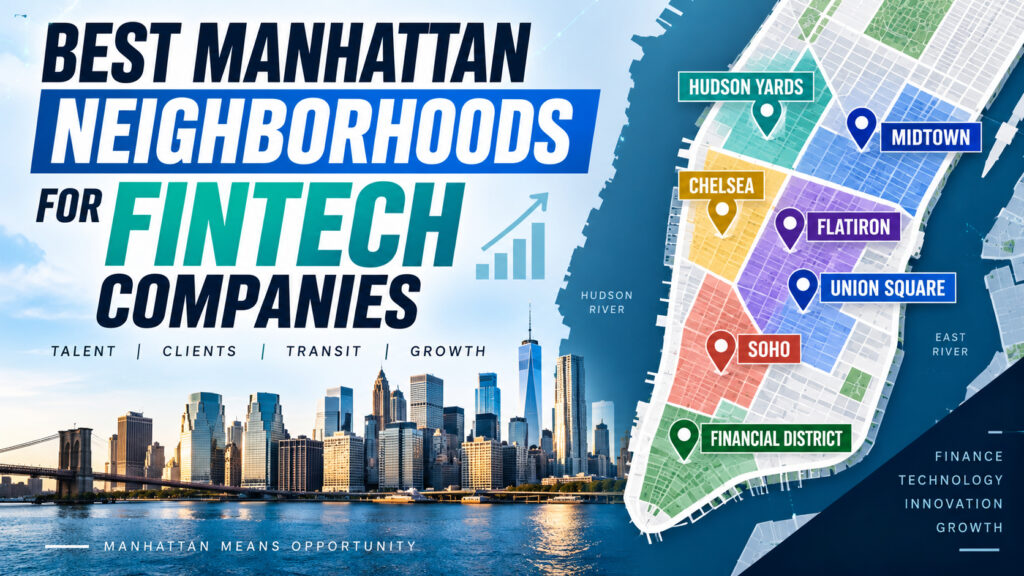
For most growth-stage FinTech companies, Flatiron and Union Square provide the strongest overall balance. They combine technology talent, finance access, transit, flexible office stock, and Midtown South positioning.
However, the best answer changes with the business model.
Institutional FinTech companies often gain more from the Financial District or Midtown East. Consumer-facing FinTech brands may prefer Flatiron, SoHo, Hudson Square, or Chelsea. Larger late-stage companies can benefit from Hudson Yards, Penn Station, or newer Midtown towers.
Current Manhattan comparisons repeatedly identify Flatiron, Union Square, SoHo, the Financial District, Midtown, and Hudson Yards as leading choices.
That pattern makes sense because FinTech sits between two office ecosystems.
One side revolves around technology, engineering, product development, design, and venture-backed growth. The other revolves around banking, capital markets, insurance, investment management, compliance, and enterprise sales.
Your location should reflect which side matters more.
The simplest decision rule: choose Flatiron or Union Square for the strongest technology-finance balance. Choose Downtown for institutional access and value. Choose Midtown for corporate access. Choose Hudson Yards for scale and premium infrastructure.
What “FinTech” means for office location
FinTech covers very different businesses.
A payments platform does not need the same Manhattan location as a trading technology company. An insurance technology company may prioritize different clients than a consumer finance application.
The category can include payments, lending, banking software, wealth technology, capital-markets software, insurance technology, compliance technology, digital assets, financial data, and accounting platforms.
Consequently, there is no universal “FinTech district.”
The better question asks which neighborhood supports your particular revenue model, workforce, and operating pattern.
A business selling technology into institutional finance should examine Downtown and Midtown East closely. Teams competing for engineers may favor Midtown South instead.
Companies serving both groups usually gain the most from Flatiron, Union Square, NoMad, or Penn Station.
Why Manhattan still works especially well for FinTech
FinTech companies gain from Manhattan because customers, investors, financial professionals, engineers, attorneys, advisers, and specialized vendors share a compact geography.
That density changes the usefulness of an office.
A Manhattan headquarters can support recruiting in the morning and client meetings later that afternoon. Executives can also meet investors without allocating half a day for travel.
The office market strengthened substantially during 2026. Manhattan’s availability tightened while leasing volume stayed above recent historical averages. July availability reached 12.7% under one major market methodology.
That tightening matters for FinTech tenants.
Quality space now disappears faster than secondary inventory. Therefore, a company should screen buildings before negotiating aggressively on headline rent.
The cheapest floor rarely delivers the lowest business cost.
Manhattan FinTech Neighborhood Comparison
A FinTech office decision should start with business function rather than neighborhood reputation.
The table below summarizes the strongest Manhattan choices.
| Neighborhood | Best FinTech Fit | Primary Advantage | Typical Office Product | Main Trade-Off |
|---|---|---|---|---|
| Flatiron / Union Square | Growth-stage FinTech, B2B platforms, payments, software | Best technology-finance balance | Lofts, prebuilts, boutique Class A, full floors | Strong demand and tighter quality supply |
| NoMad / Park Avenue South | Series B+, enterprise FinTech, headquarters teams | Central positioning and polished offices | Full floors, lofts, newer Class A | Premium pricing for top product |
| Financial District | Institutional FinTech, trading, regtech, banking infrastructure | Finance access, value, regional transit | Large Class A floors, prebuilts, subleases | Less direct access to some Midtown clients |
| SoHo / Hudson Square / Tribeca | Consumer FinTech, product-led firms, design-focused teams | Brand, recruiting, creative workplace character | Lofts, renovated buildings, large Hudson Square floors | Uneven transit and limited small-floor supply |
| Chelsea / Penn Station | Hybrid tech-finance teams, engineering-heavy FinTech | Regional transit and flexible inventory | Furnished subleases, lofts, upgraded Class A | Quality changes quickly by block |
| Hudson Yards | Late-stage FinTech, enterprise headquarters | New infrastructure and expansion scale | Trophy towers, large floorplates, premium prebuilts | Highest occupancy costs |
| Midtown East / Grand Central | Institutional sales, wealthtech, capital-markets FinTech | Corporate access and executive commute | Class A towers, private-office layouts | Less startup-style neighborhood character |
The neighborhood shortlist aligns closely with current FinTech, finance, technology, and startup location comparisons.
However, market conditions have changed faster than many neighborhood guides suggest.
During July 2026, Midtown South averaged $86.34 per square foot in asking rent under one consistent reporting methodology. Availability measured 16.8%.
Downtown averaged $61.91 per square foot and carried 16.3% availability.
Midtown averaged $85.77 per square foot while availability tightened to 12.3%.
Those figures represent large submarkets rather than individual buildings.
A renovated loft, commodity office, trophy tower, and furnished sublease can carry completely different economics.
Therefore, use neighborhood averages as orientation, not pricing promises.
How to read the comparison
Start with your company’s strongest location dependency.
A bank-facing platform should value proximity to financial decision-makers differently than a consumer application.
Next, map employee commutes.
Then compare the actual inventory inside each neighborhood.
Finally, calculate effective occupancy costs rather than asking rent alone.
That sequence prevents one attractive office from deciding the entire location strategy.
The Best Manhattan Neighborhoods for FinTech Companies
Flatiron and Union Square — best overall for growth-stage FinTech
Flatiron remains the most balanced choice for many FinTech companies.
The district combines Midtown South’s technology culture with convenient access to Midtown and Downtown finance. Union Square adds one of Manhattan’s strongest subway intersections.
That combination helps firms recruit from several boroughs without abandoning client accessibility.
Teams can compare current Flatiron office space across smaller lofts, mid-sized floors, and larger headquarters options.
Current Flatiron inventory spans several useful sizes. Examples include spaces around 3,000 square feet, 5,500 square feet, 11,000 square feet, and substantially larger full floors.
That range suits companies moving beyond their first small office.
A growth-stage team can lease a compact headquarters without committing immediately to a trophy tower.
For example, a currently marketed 11,239-square-foot Flatiron full floor includes furniture and substantial seating capacity. Its published sublease term runs through May 2028.
Larger FinTech teams can examine a 30,450-square-foot Union Square option across two full floors.
Where Flatiron wins: recruiting, transit, startup culture, client access, and office character.
Where Flatiron loses: large blocks can prove harder to assemble than Downtown or Hudson Yards.
Best fit: Series A through later growth, B2B FinTech, payments, enterprise software, regtech, and financial infrastructure.
Gramercy can also work along the eastern edge. However, the office inventory becomes less concentrated there.
NoMad and Park Avenue South — best for a polished growth-stage headquarters
NoMad provides much of Flatiron’s accessibility with a somewhat more headquarters-oriented identity.
The neighborhood works particularly well for companies that have outgrown an informal startup office.
Many buildings offer full floors, strong natural light, private meeting rooms, and substantial branding opportunities.
NoMad also sits between Penn Station and the East Side business corridors. That geometry helps companies serving both technology and finance.
A 5,000-square-foot furnished NoMad office currently offers seating for more than 35 people. It also includes six windowed offices and conference space.
Its published sublease term runs through September 2027.
That type of opportunity illustrates NoMad’s core strength.
A FinTech company can obtain headquarters character without taking an enormous floor.
Park Avenue South becomes especially relevant for enterprise-facing companies.
The corridor provides straightforward access toward Midtown East while preserving Midtown South’s technology identity.
Where NoMad wins: headquarters image, central geography, commuting, investor meetings, and full-floor options.
Where NoMad loses: the best renovated product can command substantial premiums.
Best fit: funded FinTech companies, enterprise platforms, insurtech, corporate financial software, and companies entering rapid hiring phases.
Financial District — best for institutional FinTech and value
The Financial District offers the clearest connection between FinTech and traditional finance.
That positioning can matter for platforms selling into banks, trading firms, investment managers, insurers, or capital-markets businesses.
Downtown also provides a powerful cost comparison.
July 2026 average asking rent measured $61.91 per square foot under the same methodology that placed Midtown South at $86.34.
Availability remained greater Downtown, although it tightened significantly during the preceding year.
That spread can change a growth company’s economics.
A 10,000-square-foot requirement creates a substantial annual difference before concessions.
Downtown also offers larger floorplates than many Midtown South loft buildings.
That matters for FinTech teams building trading areas, customer operations, compliance groups, or larger engineering organizations.
Review the broader Financial District office market before comparing individual buildings.
Current inventory includes everything from smaller suites to blocks exceeding 20,000 square feet.
A 3,138-square-foot furnished Downtown sublease currently offers a smaller move-in-ready option. Its published term runs through December 2030.
A larger team can compare an 8,755-square-foot direct Financial District office. That current plan includes open seating, offices, meeting rooms, and conference rooms.
Where Downtown wins: institutional access, pricing, large floorplates, PATH access, and broad Class A inventory.
Where Downtown loses: some employees or Midtown-focused sales teams may face longer journeys.
Best fit: capital-markets technology, banking infrastructure, payments, compliance, digital assets, trading technology, and institutional FinTech.
SoHo, Hudson Square, and Tribeca — best for brand-led FinTech
These neighborhoods work differently from Flatiron.
They place more emphasis on brand identity, product culture, architectural character, and West Side talent access.
Consumer-facing FinTech businesses can benefit from that environment.
So can product teams that compete directly for designers, engineers, and creative leaders.
SoHo offers distinctive loft inventory. However, building quality varies significantly.
Hudson Square provides another profile.
Its larger buildings can support substantially bigger teams while preserving a downtown creative identity.
Tribeca gives some FinTech firms a useful bridge between Hudson Square, SoHo, and the Financial District.
The strongest fit often comes from a company that wants financial credibility without feeling conventionally corporate.
Where this corridor wins: recruiting, design identity, leadership appeal, client entertainment, and creative office product.
Where it loses: subway convenience changes substantially between individual blocks.
Best fit: consumer finance, wealth technology, product-led applications, brand-sensitive businesses, and design-heavy FinTech.
A company should never select this area from a neighborhood map alone.
Walk the exact route from the office to the trains during commuting hours.
Two buildings separated by several avenues can create completely different employee experiences.
Chelsea and Penn Station — best for regional transit and flexible growth
Chelsea can solve a difficult FinTech problem.
It keeps companies near Midtown South’s technology ecosystem while improving access to Penn Station.
Eastern Chelsea provides easier access to Flatiron and Union Square.
Western Chelsea offers larger loft-style buildings and dramatic headquarters spaces.
Yet transit quality varies sharply as teams move west.
A 4,722-square-foot furnished Chelsea office currently provides a turnkey smaller-team option. Its published term extends through December 2027.
Penn Station addresses a different requirement.
Teams with employees arriving from New Jersey or Long Island may gain enormous value from regional rail access.
A 4,776-square-foot furnished Penn Plaza office currently offers a move-in-ready sublease through July 2027.
Another 5,170-square-foot furnished Penn Plaza sublet runs through November 2027.
Those options illustrate why Penn appeals to fast-growing companies.
Existing installations can reduce both construction time and upfront capital.
Where Chelsea and Penn win: commuter reach, furnished inventory, Midtown South access, and flexible size options.
Where they lose: neighborhood character and pricing change block by block.
Best fit: hybrid FinTech teams, engineering groups, distributed regional workforces, and companies prioritizing speed.
Hudson Yards — best for late-stage scale
Hudson Yards offers a very different office proposition.
The district emphasizes new construction, large floorplates, premium amenities, sophisticated building systems, and headquarters visibility.
Late-stage FinTech companies can use those characteristics to support rapid expansion.
The neighborhood also provides access to the 7 train and nearby Penn Station.
Current direct pricing across premium Hudson Yards inventory can fall around $80 to $150-plus per square foot. Individual trophy situations can exceed that band.
That price makes disciplined sizing essential.
A company should not pay premium rent for desks that sit empty throughout the week.
Our Hudson Yards office guide explains the district’s size, building, and infrastructure differences.
A 10,680-square-foot Hudson Yards prebuilt suite currently provides a private-office-heavy direct option.
Larger current opportunities extend far beyond that size. Several buildings support 20,000-square-foot, 30,000-square-foot, and multi-floor requirements.
Where Hudson Yards wins: infrastructure, building quality, expansion, amenities, regional access, and executive image.
Where Hudson Yards loses: cost, minimum practical suite sizes, and premium occupancy economics.
Best fit: late-stage FinTech, large financial technology platforms, enterprise headquarters, and well-capitalized expansion offices.
Midtown East and Grand Central — best for institutional client access
Midtown East deserves more attention from FinTech companies than generic startup guides usually give it.
FinTech firms selling into traditional finance may spend more time with clients than venture-backed peers.
For those companies, proximity to Grand Central, Park Avenue, Lexington Avenue, and major corporate offices can outweigh startup density.
Current Midtown East planning ranges vary enormously.
Older or secondary space can appear much lower. Mainstream Class A product near Grand Central often moves into roughly the $85-to-$110 range.
Trophy product can move considerably higher.
Explore Midtown East office space by corridor rather than treating the neighborhood as one market.
Park Avenue, Lexington Avenue, and Third Avenue provide different price-to-image ratios.
A 4,090-square-foot furnished Third Avenue office currently demonstrates the smaller move-in-ready side of this market.
Where Midtown East wins: institutional meetings, executive commuting, corporate image, Class A inventory, and private-office layouts.
Where it loses: some buildings feel less aligned with engineering-led startup culture.
Best fit: wealthtech, institutional software, financial data, capital-markets platforms, enterprise sales teams, and mature FinTech businesses.
Match the Neighborhood to Your FinTech Business Model
The label “FinTech” alone does not tell you where to lease.
Your customers usually provide the better answer.
B2B financial infrastructure
Companies selling software to finance teams need both technical talent and enterprise access.
Flatiron, Union Square, NoMad, and Park Avenue South usually provide the strongest balance.
Those districts shorten travel between product teams and client meetings.
Institutional finance technology
Capital-markets platforms, trading technology, financial data providers, and institutional compliance companies should examine Downtown and Midtown East carefully.
Client proximity can carry direct operating value.
A founder may value a fashionable neighborhood.
A sales organization values twenty fewer minutes between important meetings.
Consumer FinTech
Consumer finance businesses depend more heavily on product, brand, design, marketing, and recruiting.
Flatiron, SoHo, Hudson Square, Chelsea, and Union Square often fit that profile better.
Those districts also provide more loft-style inventory.
Payments and banking technology
Payments companies occupy a middle position.
Many need enterprise bank relationships alongside strong engineering teams.
Flatiron, NoMad, Union Square, and the Financial District deserve early consideration.
Wealth technology
Wealth platforms can split into consumer and institutional models.
Consumer-focused businesses may lean toward Midtown South.
Advisor-facing or institution-facing businesses may prefer Midtown East.
Insurance technology
Insurance technology often benefits from Midtown access because the business relies heavily on enterprise relationships.
NoMad, Midtown East, and Flatiron can each work.
The correct choice depends on whether product talent or carrier relationships drive the business.
Digital assets and blockchain infrastructure
These companies often need strong compliance capabilities alongside engineering talent.
Downtown provides institutional positioning and comparatively favorable office economics.
Flatiron can better support recruiting and venture-backed culture.
Therefore, many companies should compare both before deciding.
Match office location to funding stage
Seed and early stage: flexibility usually matters more than prestige.
A furnished sublease, short direct term, or compact full floor can protect capital.
Avoid designing for hypothetical headcount that lacks approved funding.
Series A and Series B: recruiting, culture, and growth options become more important.
Flatiron, Union Square, NoMad, Chelsea, and Downtown can provide useful choices.
At this stage, expansion rights deserve serious attention.
Later growth: operational continuity becomes more valuable.
Companies often need stronger building systems, larger conference facilities, better security, and more sophisticated visitor experiences.
Hudson Yards, Penn Station, Midtown East, and larger Midtown South buildings become stronger contenders.
Mature or public-company scale: business continuity can outweigh neighborhood personality.
Large blocks, redundancy, transportation, building management, executive access, and long-term expansion matter more.
Do not confuse employee lifestyle with business location
Restaurants and after-work amenities matter.
However, they should not control the decision.
Employee commute time usually has greater influence on office attendance.
Current employee addresses provide better evidence than neighborhood reputation.
Map your workforce before touring.
Include likely future hiring pools as well.
A company that expects major New Jersey hiring should weight PATH and Penn Station heavily.
Teams concentrated in Brooklyn may value Union Square, Lower Manhattan, or East Side subway connections differently.
Westchester and Connecticut commuters can change the case for Grand Central.
The office should serve the workforce you plan to have, not only today’s founders.
What FinTech Companies Should Require From an Office Building
FinTech office requirements extend beyond desks and conference rooms.
A visually impressive floor can still fail operationally.
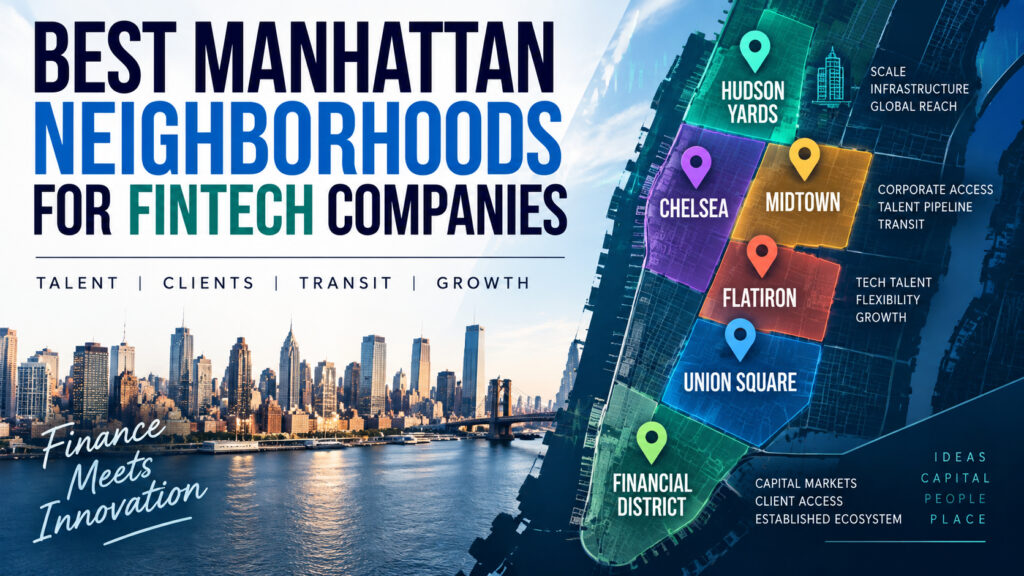
Connectivity comes first.
Confirm the building’s fiber options before signing.
Ask which carriers actually enter the property.
Then determine how service reaches your floor.
A second provider can support redundancy.
However, two contracts do not always create true route diversity.
Your technical team should verify the network path.
Check power requirements early.
Most modern FinTech offices do not need data-center power density.
Nevertheless, trading, engineering, monitoring, lab, and operations teams can need more power than conventional office users.
Server rooms also create heat.
Therefore, ask about electrical capacity and cooling before lease negotiations reach final documents.
After-hours HVAC can materially change costs.
Many FinTech teams operate beyond standard Manhattan office hours.
Engineering releases, global markets, security monitoring, and overseas operations can extend the workday.
Ask how the building charges after-hours air conditioning.
Some properties charge by zone.
Others use different minimum periods or hourly rates.
Those rules can make two apparently similar leases behave very differently.
Physical security matters.
Building security should support the company’s own controls.
Look for reliable access management, visitor procedures, secure elevator access, and predictable after-hours entry.
The office itself may require controlled rooms for finance, compliance, executive, or technology personnel.
A building does not make a company compliant.
However, poor physical controls can complicate internal security policies.
Acoustic privacy deserves attention.
FinTech teams regularly discuss customers, transactions, products, strategy, hiring, financing, and regulated matters.
Glass conference rooms can look excellent while providing poor acoustic separation.
Test them.
Stand outside the room while someone speaks normally inside.
That simple exercise can reveal problems before a lease creates an expensive one.
Conference-room capacity often matters more than desk density.
Hybrid teams reduce daily attendance but increase meeting demand.
FinTech companies also host customers, investors, auditors, advisers, job candidates, and vendors.
Consequently, an undersized meeting program can make a large office feel too small.
Plan conference rooms around peak meeting activity.
Private offices should follow function.
Executives do not automatically need private offices.
However, legal, finance, human resources, security, and certain customer teams may require enclosed rooms.
Build the plan around confidentiality and workflow.
Do not copy another company’s layout.
Test cellular service.
Walk the entire premises while using several devices.
High floors, deep floorplates, special glass, and interior rooms can create weak areas.
Strong Wi-Fi helps employees.
It does not eliminate every cellular requirement.
Review emergency power realistically.
A building generator does not automatically power every tenant outlet.
Ask exactly which systems receive emergency power.
Then identify what your company actually needs during an outage.
Critical applications may operate from cloud infrastructure rather than the office.
Your continuity plan should reflect that distinction.
Examine loading, deliveries, and hardware logistics.
Technology teams sometimes move monitors, networking equipment, security devices, and substantial furniture.
A difficult freight process can slow installations.
Check freight elevator hours, certificates, building approvals, and scheduling procedures.
Look beyond the lobby.
A beautiful reception area does not compensate for poor elevators, weak HVAC, inadequate bathrooms, unreliable connectivity, or difficult management.
Tour operational areas whenever possible.
Ask how existing tenants access freight.
Inspect common corridors.
Check mechanical noise.
Test doors and meeting-room privacy.
Those details determine everyday office quality.
FinTech Office Costs, Space Planning, and Availability
Manhattan’s 2026 office market requires a more precise budget than a simple rent comparison.
Overall leasing demand strengthened while high-quality inventory tightened. During July, Midtown South availability reached 16.8% under one methodology. Downtown reached 16.3%, while Midtown tightened to 12.3%.
Another market methodology placed Manhattan-wide availability at 12.7% during July. It also recorded the lowest total available supply since 2020.
Methodologies differ.
The practical conclusion remains consistent.
Good space competes differently from average space.
An outdated interior in a secondary building may remain available for months.
A furnished floor near major transit can attract several serious tenants quickly.
How much office space does a FinTech company need?
Start with peak attendance rather than total payroll.
A balanced office often falls around 125 to 175 square feet per regularly present person during initial planning.
Dense open layouts can run lower.
Private-office-heavy plans require more.
Our office space planning guide breaks the ranges down further.
A 25-person team might begin around 3,125 to 4,375 usable square feet under a balanced planning model.
The rentable area will exceed usable area after the building applies its loss factor.
Therefore, do not compare a 4,000-square-foot requirement across buildings without checking measurement.
FinTech sizing by operating style
| Operating Pattern | Starting Planning Range | Typical Need |
|---|---|---|
| Dense engineering team | 100–125 SF per peak attendee | Desks, huddles, limited private offices |
| Balanced hybrid FinTech | 125–175 SF | Desks, conference rooms, collaboration |
| Client-facing FinTech | 150–200+ SF | Reception, meetings, executive rooms |
| Office-heavy institutional team | 175–250+ SF | Perimeter offices, boardroom, confidentiality |
| Trading or operations-heavy team | Case-specific | Dense seating, power, screens, technical support |
These ranges provide a starting point rather than an architectural program.
What a 5,000-square-foot rent comparison looks like
Consider a hypothetical 5,000-rentable-square-foot office.
At Midtown South’s July 2026 average asking rent of $86.34, annual base rent reaches about $431,700.
That equals approximately $35,975 monthly before separate occupancy expenses.
At Downtown’s $61.91 average, the same 5,000 rentable square feet equals roughly $309,550 annually.
Monthly base rent reaches approximately $25,796.
The difference exceeds $122,000 annually.
However, that does not prove Downtown creates the better deal.
A Midtown South space may arrive furnished.
The Downtown alternative may need construction.
One building may offer stronger concessions.
Another may charge more for after-hours air.
The correct comparison requires total occupancy cost.
Headline rent is not the lease cost
A FinTech budget should model:
Base rent + electricity + cleaning + internet + additional rent + construction + furniture + cabling + moving + legal costs + operating charges.
Then subtract negotiated concessions.
Free rent can materially change early-year cash flow.
A landlord contribution can reduce construction expense.
Existing furniture can preserve capital.
A shorter sublease can reduce long-term risk.
Conversely, a cheap raw office can require substantial upfront investment.
That difference becomes especially important for venture-backed companies.
Capital spent on construction cannot fund hiring or product development.
When furnished space has unusual value
Furnished offices can create strong economics for companies that need speed.
Current Manhattan inventory includes furnished choices across Chelsea, Flatiron, NoMad, Penn Station, Midtown East, Downtown, and Hudson Yards.
Review the broader furnished and turnkey office guide before assuming a custom buildout provides the only serious option.
Furniture alone does not make a space turnkey.
Confirm cabling, conference technology, internet timing, power, HVAC, security, and occupancy approvals.
Sublease or direct lease?
A sublease often works well when speed and flexibility matter.
An existing installation can eliminate months of construction.
However, the remaining lease term can constrain growth.
The subtenant also depends upon the underlying lease structure.
A direct lease provides greater long-term control.
It may also support landlord-funded construction and expansion rights.
Our commercial leasing guide explains these distinctions in broader detail.
For FinTech companies, the decision should track funding visibility.
A rapidly changing startup may value a shorter commitment.
A mature firm may pay more for long-term certainty.
How FinTech Companies Should Negotiate the Lease
Choosing the neighborhood solves only the first problem.
The lease determines whether the office can support growth.
Expansion rights deserve early attention.
Fast-growing companies frequently underestimate this issue.
Your perfect 8,000-square-foot office can become a problem when headcount doubles.
Ask whether adjacent floors could become available.
Explore rights of first offer where appropriate.
Also examine opportunities elsewhere in the landlord’s portfolio.
No provision guarantees expansion.
Still, negotiated rights can improve your options.
Assignment language matters for FinTech companies.
Funding rounds, restructurings, acquisitions, subsidiaries, and corporate reorganizations can change company ownership.
A lease should not create unnecessary friction around ordinary business events.
Commercial transfer language can restrict assignments, subleases, or shared occupancy.
Therefore, legal counsel should review those provisions carefully.
Sublease rights protect downside flexibility.
A company might grow more slowly than expected.
Hybrid attendance can reduce space needs.
An acquisition could also change office strategy.
Reasonable sublease language gives the tenant another tool.
However, commercial subleases usually require attention to landlord consent and the prime lease.
Construction responsibilities need precision.
The lease should clearly describe who performs the work.
Identify the approved plan.
Specify delivery conditions.
Clarify electrical, HVAC, pantry, cabling, and supplemental cooling responsibilities.
Set realistic completion procedures.
Then separate landlord work from tenant work.
A vague construction schedule creates risk.
Building access should match FinTech hours.
Twenty-four-hour entry does not necessarily mean twenty-four-hour services.
Employees may enter the building while HVAC remains unavailable.
Freight access can also operate under limited schedules.
Confirm each service separately.
After-hours HVAC needs a budget.
Ask for the exact charge structure before signing.
Determine whether the building bills per hour, zone, floor, or equipment unit.
Estimate actual usage.
A global FinTech team can consume much more after-hours service than a conventional office tenant.
Review generator and emergency systems.
Do not rely on marketing language.
Ask what the generator supports.
Identify elevator coverage, life-safety coverage, base-building systems, and tenant power availability.
Then let technical advisers determine whether the arrangement meets company needs.
Check signage and branding rights.
Some companies want discreet offices.
Others want strong headquarters visibility.
Building directories, lobby identification, elevator signage, and entrance branding can each carry separate rules.
Address those expectations during negotiations.
Protect confidentiality during the search.
A significant office move can reveal hiring plans or financial expectations.
Limit unnecessary distribution of sensitive requirements.
Do not circulate detailed headcount forecasts more widely than necessary.
A broker can often describe a requirement without revealing strategic information immediately.
Negotiate around your actual risk profile.
An early-stage company and mature enterprise should not accept identical economics.
Lease term, security structure, construction exposure, expansion flexibility, and termination risk all interact.
The lowest face rent does not always produce the best risk-adjusted deal.
A better FinTech site-selection process
Begin with a business brief.
Define peak headcount, target move date, budget, required term, preferred neighborhoods, and technical needs.
Next, map employee locations.
Identify customer and executive travel patterns.
Then create a broad inventory set.
Tour several neighborhoods before narrowing the list.
Compare direct leases against subleases.
Evaluate furnished choices against construction opportunities.
Finally, negotiate several credible alternatives whenever possible.
Tenant leverage improves when the landlord knows another option can actually work.
That approach also keeps a company from emotionally committing to one attractive office.
Frequently Asked Questions About FinTech Office Locations in Manhattan
What is the best Manhattan neighborhood for a FinTech startup?
Flatiron and Union Square provide the best overall balance for many FinTech startups.
They combine technology recruiting, finance access, transit, restaurants, and varied office inventory.
Early-stage companies should still compare NoMad, Chelsea, and Downtown.
The right answer depends heavily on budget and commuting.
Where do FinTech companies lease office space in NYC?
FinTech activity spreads across several Manhattan corridors rather than one isolated district.
Flatiron, Union Square, NoMad, the Financial District, Midtown, Chelsea, Hudson Square, and Hudson Yards all attract relevant users.
Current neighborhood comparisons repeatedly highlight those areas.
Is Flatiron still a technology neighborhood?
Yes.
Flatiron remains a major Midtown South office destination for technology, growth companies, and adjacent professional firms.
Current inventory also supports smaller loft users and larger headquarters requirements.
However, technology companies no longer occupy one exclusive Manhattan cluster.
The broader ecosystem now stretches through NoMad, Chelsea, Hudson Square, SoHo, and the West Side.
Is the Financial District good for FinTech companies?
Yes, particularly for institution-facing businesses.
Downtown combines proximity to traditional finance with lower broad-market asking rents than Midtown South.
July 2026 average asking rent reached $61.91 per square foot under one major methodology.
Large floorplates also support growing operations teams.
Is Hudson Yards worth the premium for FinTech?
Sometimes.
Hudson Yards works best when the company values building quality, scale, infrastructure, employee amenities, and regional transit.
Premium direct space often carries materially higher rents than Downtown.
A smaller company may gain little from paying that premium.
Late-stage firms can value it much more.
Should a FinTech company choose Midtown South or Downtown?
Choose Midtown South when recruiting, product culture, and technology access dominate.
Choose Downtown when finance relationships, large floorplates, regional transportation, or occupancy economics dominate.
Hybrid companies should compare both markets with the same space program.
Do not change requirements between neighborhoods.
That practice makes the economic comparison meaningless.
What is the best Manhattan location for an institutional FinTech company?
The Financial District and Midtown East should usually make the first shortlist.
Downtown provides direct financial-market positioning and comparatively lower broad-market rents.
Midtown East provides executive access, Grand Central connectivity, and a dense corporate environment.
Flatiron can still win when engineering recruitment carries equal importance.
What is the best location for a consumer FinTech company?
Flatiron, Union Square, SoHo, Chelsea, and Hudson Square deserve close examination.
Consumer FinTech businesses often compete aggressively for design, engineering, product, and marketing talent.
Those neighborhoods support a less conventional corporate identity.
Should FinTech companies lease near their clients or employees?
Neither group automatically wins.
Measure both.
A company with frequent institutional meetings may tolerate a modestly weaker employee commute.
An engineering-heavy business may make the opposite decision.
Calculate weekly travel hours for the entire organization.
That analysis often reveals more than neighborhood reputation.
How important is PATH access for a FinTech company?
PATH can become highly important when significant staff live in New Jersey.
Flatiron’s western edge, Chelsea, NoMad, and Lower Manhattan provide useful access patterns.
Downtown also benefits from major regional connections.
Map actual home locations before assigning weight to any station.
Should a startup take extra office space for future growth?
Usually only within a disciplined range.
Paying premium Manhattan rent for empty desks can destroy the value of “planning ahead.”
Instead, combine sensible excess capacity with expansion rights where possible.
A furnished short-term solution can also bridge uncertain growth.
How much space should a 50-person FinTech team consider?
A balanced preliminary model might start around 6,250 to 8,750 usable square feet.
Private-office, meeting-heavy, or institutional layouts can require more.
Dense engineering teams can sometimes use less.
Our NYC headcount planning guide provides a more detailed sizing framework.
Does every FinTech company need Class A office space?
No.
Building class should follow business requirements.
A well-renovated loft can outperform an expensive tower for an engineering-led startup.
Conversely, institutional clients may respond better to a polished corporate environment.
Infrastructure, management, security, elevators, HVAC, and connectivity matter more than a label alone.
Are subleases good for FinTech startups?
They can work extremely well.
A furnished sublease can lower capital requirements and shorten occupancy time.
However, term length and legal dependency require careful review.
Direct leases become stronger when companies need control, construction, branding, or long-term expansion.
What should FinTech companies inspect during office tours?
Inspect natural light, HVAC, power, fiber, cellular service, acoustics, security, elevators, bathrooms, meeting capacity, and employee arrival.
Test the actual conference rooms.
Walk from the train.
Ask about after-hours costs.
Check freight access.
Examine the floorplan against real headcount.
Do not judge a building from the lobby.
How early should a FinTech company begin searching for Manhattan office space?
The answer depends on size and construction.
Move-in-ready subleases can support shorter schedules.
Custom direct leases require more time for negotiation, documents, design, permits, construction, cabling, and move coordination.
Current quality supply has also tightened across Manhattan.
Start before the existing office becomes an emergency.
Which neighborhood provides the best value for a scaling FinTech company?
The Financial District often presents the strongest broad-market cost comparison.
Downtown’s July average asking rent remained materially below Midtown and Midtown South.
However, a furnished Flatiron sublease can outperform a raw Downtown lease.
Compare effective cost for the exact spaces.
Which neighborhood offers the best employee commute?
No neighborhood wins for every workforce.
Union Square performs strongly for multi-borough subway access.
Penn Station can dominate for New Jersey and Long Island commuters.
Grand Central works especially well for northern suburban commuters.
Downtown provides strong regional and subway connectivity.
Your employee map should decide the weighting.
Is office prestige important for a FinTech company?
Sometimes.
Institutional sales organizations can benefit from a polished client experience.
Early-stage engineering companies may gain more from culture, commute, and flexibility.
Prestige should serve the business.
It should not become an objective by itself.
What is the biggest mistake FinTech companies make when choosing a Manhattan neighborhood?
They choose the neighborhood before defining the requirement.
That sequence reverses the decision.
Start with people, clients, operating hours, infrastructure, growth, budget, and lease term.
Then compare neighborhoods.
The best Manhattan neighborhood for a FinTech company is ultimately the one that lowers friction across the entire business.
For many growth companies, that answer will start with Flatiron and Union Square.
Institutional FinTech firms should challenge that assumption with Downtown and Midtown East.
Late-stage companies should test Hudson Yards and Penn Station.
Brand-led teams should explore SoHo, Hudson Square, Chelsea, and Tribeca.
The final decision should come from real inventory rather than a neighborhood stereotype.
Get a shortlist of FinTech office spaces matched to your team size, commute patterns, growth plan, budget, technical requirements, and preferred Manhattan neighborhoods.
Ready to Review Custom Options
Fill out our 📋 online form or give us a call today 📞 212-967-2061 — let’s find the right options for your business.