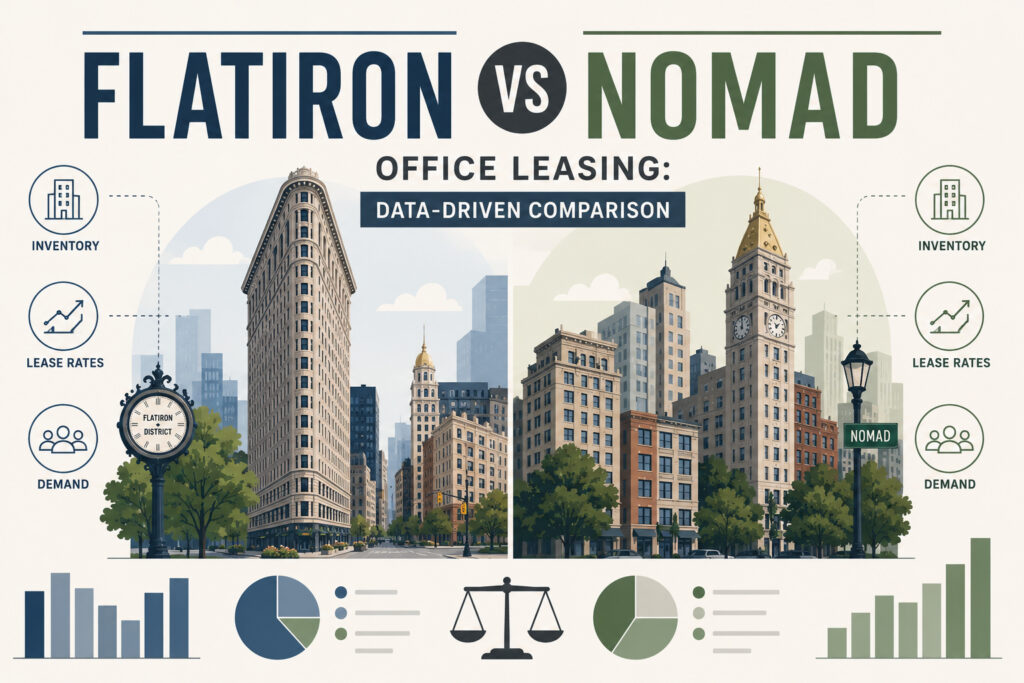
Flatiron vs NoMad Office Leasing: Data-Driven Comparison
Flatiron and NoMad are adjacent Midtown South submarkets with overlapping appeal, but they differ in inventory, pricing, and tenant mix. Flatiron (around 23rd–26th Streets) is anchored by historic loft buildings and is famous as Silicon Alley’s core. NoMad (“North of Madison Square Park,” roughly 26th–31st Streets) has a growing mix of boutique offices and new trophy conversions. Both areas have seen tightening vacancy and surging leases in 2025. In fact, Flatiron/NoMad Class A/B availability fell from ~30% in early 2024 to about 15–18% by Q3 2025, as tenants signed 822,000 SF of new space in Q3 2025 (a 50% YoY increase).
Submarket Definitions and Inventory
- Flatiron District: Spans roughly 20th–26th Streets between Sixth and Park Avenues. Total office inventory is on the order of 25–30 million SF, mostly in prewar lofts and a few Class A buildings (e.g. 1250 Broadway, 41 Madison). The iconic Flatiron Building (175 Fifth Ave) anchors the southern part. Flatiron offers a dense retail/restaurant scene around Madison Square Park.
- NoMad: Extends north from about 26th to 31st Streets (Fifth to Sixth Avenues). Contains older loft-style buildings and newer redevelopments (e.g. One Madison Avenue, 28th Street). Inventory is somewhat smaller (roughly 15–20 million SF) but growing. NoMad’s development includes major adaptive-reuse offices with large floorplates, and it lies just north of Flatiron.
Vacancy and Leasing Trends
According to Flatiron NoMad Partnership data, office vacancies in both districts have tightened dramatically. Class A availability is down to ~18% and Class B to ~15% as of Q3 2025. Overall, only about 15% of space remains vacant – among the lowest in Manhattan. Leasing activity has accelerated: in Q3 2025 tenants took 822K SF of Class A/B space, up 50% year-over-year. Several “blockbuster” leases were signed (Sigma Computing took 64K SF at One Madison, others topped 40K SF). These trends show that Flatiron/NoMad demand is strong – vacancy is falling and rental inquiries are growing.
Rental Rates and Lease Terms
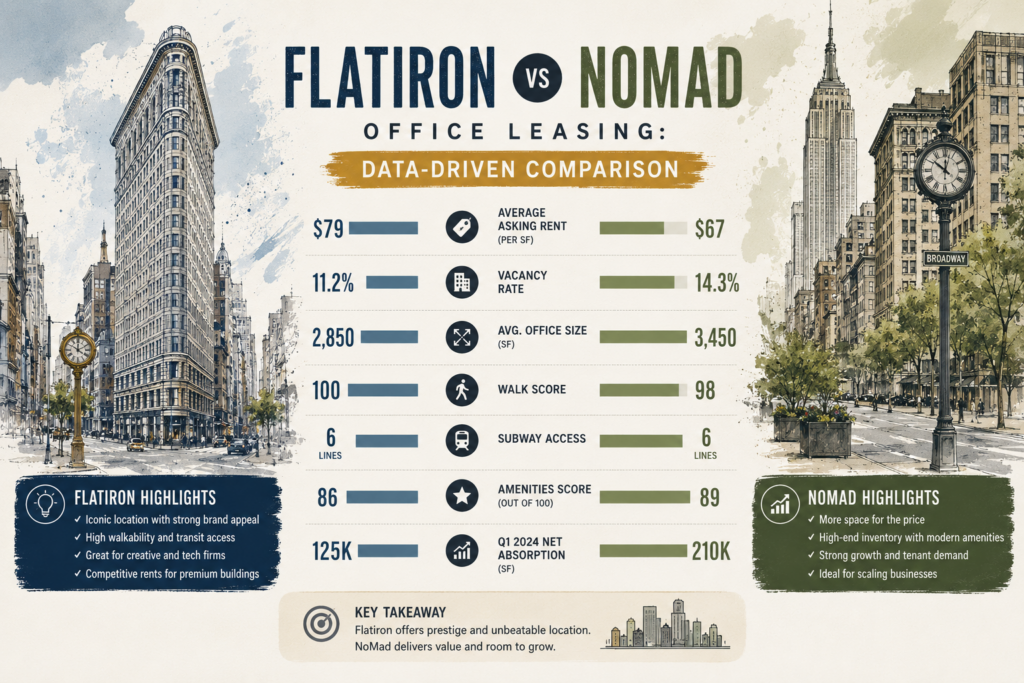
Rents in Flatiron tend to be higher on average than in NoMad, reflecting its loft appeal and density of amenities. In Flatiron, loft buildings typically rent in the $60–$75 per SF range, while modern Class A offices go for roughly $85–$100/SF. By contrast, NoMad’s average asking rent was about $51/SF in mid-2025, reflecting a 30–40% discount to higher-end neighborhoods. (For context, creative lofts on the fringe of NoMad/Flatiron still trade around $55–$65/SF.) Landlords in both areas are offering generous concessions: typically 8–10 months free rent on a 5–7-year lease plus sizable tenant-improvement allowances. In summary, Flatiron commands a premium – its Class A rents match or exceed Midtown averages – whereas NoMad often provides similar quality at somewhat lower rates.
Building Types and Tenant Profiles
- Flatiron: Mix of authentic loft offices and boutique Class A buildings. Historic lofts (with brick walls, high ceilings) attract tech startups, fashion/design showrooms, and media/marketing agencies. Modern additions (e.g. 1250 Broadway, One Madison’s creative spaces) house larger tech and financial firms. For example, 920 Broadway (loft space) and 860 Broadway (efficient floorplates) are popular with startups and creative firms. The iconic Flatiron Building and plazas give a strong “Midtown South” identity that appeals to tenants needing a prestigious brand.
- NoMad: Blends old and new. Class B lofts and mid-rises (often built in the 20s–30s) still host design companies and growing tech teams. Recently, new Class A stock has emerged: One Madison Avenue (SL Green) houses tenants like IBM and Sigma Computing, while 28–30 West 25th (MLB Properties) offers high-end fit-outs. NoMad is now seen as a balanced innovation hub – a recent report calls it “Manhattan’s most balanced commercial submarket” and “a hub for innovation and design”. Tenants in NoMad range from venture-backed startups to marketing firms, drawn by new office fit-outs and the neighborhood’s amenity-rich blocks.
Location, Transit and Amenities
Both districts enjoy excellent access. Key subway lines (N/Q/R/W, 4/5/6, F/M/L via Union Square/23rd St) serve Flatiron/NoMad, and 28th–34th Streets connect to Penn Station (1/2/3, A/C/E) and Herald Square (B/D/F/M). The Flatiron area offers dense restaurants (Eataly, Shake Shack), Madison Square Park access, and pedestrian plazas. NoMad has developed its own “piazza” on Broadway (between 25th–31st) and hosts upscale hotels/restaurants (e.g. Eleven Madison Park nearby). Both neighborhoods rank high on walkability. Recent analyses note NoMad’s “exceptional blend of accessibility and lifestyle,” with abundant dining and cultural venues within walking distance. In short, commuting is convenient in either district, but the vibe differs: Flatiron feels more historic/European-cast-iron, NoMad feels modern and vibrant.
Choosing Between Flatiron and NoMad
Ultimately, the better choice depends on your priorities. Flatiron is ideal for firms that value a creative, high-profile address and are willing to pay a premium. Its loft spaces project authenticity – attracting fashion, media, and startup tenants – while its few Class A towers offer corporate polish. NoMad suits companies seeking similarly well-connected space at a relative discount. It offers comparable amenities and has become a new tech/design corridor (so lease terms may be slightly more tenant-friendly). For example, a growing startup might take an affordable loft in NoMad or Flatiron, while a finance firm might lease a Class A floor in One Madison (NoMad) versus 1250 Broadway (Flatiron) depending on space needs. In either case, leasing experts recommend touring comparable spaces: a Flatiron loft vs. a NoMad loft, or Flatiron Class A vs. NoMad Class A, to judge which match your culture and budget.
Sources: Flatiron NoMad Partnership market reports and industry analyses provide the above data. These figures reflect the latest leasing volumes, availabilities, and rents in Flatiron and NoMad, enabling a side-by-side comparison of the two districts.
Fill out our 📋 online form or give us a call today 📞 212-967-2061 — let’s find the right office for your business.