Tuesday August 18, 2026

NYC Office Lease Proposal and Term Sheet Checklist

Commercial Real Estate | August 11, 2026

An NYC office lease proposal should explain much more than rent and lease length. It should define the economics, delivery, construction, operations, security, flexibility, and timing of the deal. A strong term sheet then carries those negotiated business points into lease drafting.

That distinction matters because the formal lease contains far more detail. Your proposal creates the business framework before attorneys turn those points into contract language. Therefore, unresolved terms can become expensive problems after you select a space.

Use this checklist before accepting an office proposal, signing an LOI, or approving a term sheet. It also works when comparing several landlord offers side by side.

For the broader transaction sequence, start with our Commercial Leasing Guide for NYC.

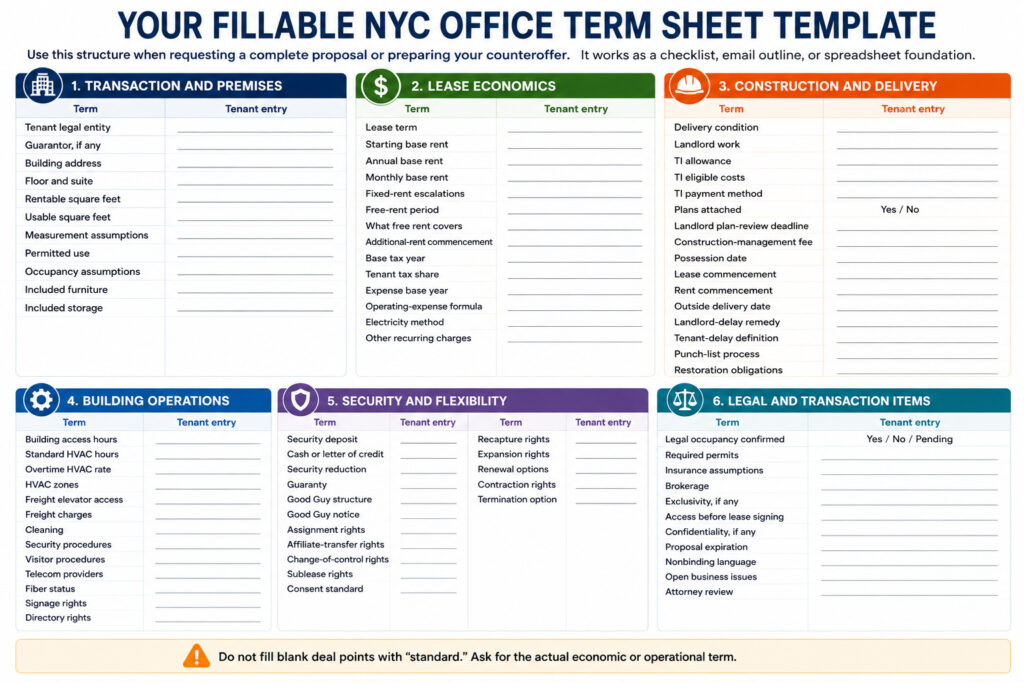
Download a form-fillable PDF NYC Office Lease Proposal Checklist

The central rule: Compare the whole office deal, not the quoted rent.

NYC Office Lease Proposal and Term Sheet Checklist

From Office Proposal to Term Sheet to Lease

Office leasing uses several documents before the lease arrives. Their names often overlap, which creates unnecessary confusion.

RFP, proposal, offer, LOI, and term sheet are different stages

DocumentWhat it doesWhat the tenant should expect
Request for Proposal, or RFPAsks landlords to quote the same requirementConsistent answers on rent, term, work, concessions, security, and timing
Landlord proposalPresents the landlord’s initial business offerEconomic terms, construction assumptions, delivery, and major conditions
Tenant proposal or counterofferStates the terms the tenant wantsRevised economics, concessions, risk protections, and open items
Letter of Intent, or LOIRecords negotiated business points before lease draftingA concise outline of the intended transaction
Term sheetPerforms much the same function as an LOIA deal-point summary, often presented as a table
LeaseCreates the detailed contractual relationshipFinal rights, duties, remedies, deadlines, costs, and restrictions

In NYC commercial leasing, proposals commonly address lease length, base rent, additional rent, utilities, and security. An LOI or term sheet usually follows after the parties narrow those business points.

Is an LOI the same as a term sheet?

Usually, the practical difference is formatting rather than purpose.

An LOI often looks like a letter between the parties. A term sheet often looks like a list or table of deal points.

Both documents aim to settle important business terms before the lease draft arrives.

However, never assume that every provision lacks legal effect. Counsel should review the wording before anyone signs.

NYC commercial leasing guidance describes the LOI as generally non-contractual. It also warns tenants to address important terms at this stage. Owners may resist reopening those issues during lease negotiations.

What does “office lease proposal” actually mean?

The phrase can describe two different packages.

The first is the deal proposal. It states what you will pay and what the landlord will provide.

The second is the tenant proposal package. That package helps the landlord evaluate your company and financial strength.

A complete submission may contain both.

Your deal proposal addresses rent, concessions, delivery, and lease protections. Meanwhile, your tenant package supports the offer with company and financial information.

Prepare underwriting documents before negotiations become urgent. Our Documents Needed to Lease Office Space NYC guide covers that package in detail.

Do not treat a proposal like the final lease

A proposal can look complete while leaving major legal issues unresolved.

The lease adds default remedies, indemnities, insurance requirements, casualty provisions, restoration duties, and many other clauses. It can also change how earlier business points operate.

Therefore, every negotiated concession must survive into the final documents.

Free rent mentioned in an email is not enough.
A promised buildout needs written delivery standards.
A renewal discussion needs actual option language.
A verbal flexibility promise needs lease language.

NYC commercial leasing guidance emphasizes that the written lease controls the landlord-tenant relationship. It also cautions tenants against relying on oral promises.

The Complete NYC Office Lease Proposal Checklist

Start your comparison before the first landlord response arrives.

Create one requirements sheet for every building. Then require each proposal to answer the same questions.

That approach exposes missing information immediately.

Identify the tenant and premises precisely

Your proposal should identify the actual transaction.

Checklist itemWhat the proposal should state
□ TenantFull legal name of the proposed leasing entity
□ GuarantorIndividual or entity, if any
□ BuildingStreet address
□ PremisesFloor, suite, and included areas
□ Rentable areaStated rentable square footage
□ Usable areaVerified or estimated usable square footage
□ PlansReferenced floor plan or test fit
□ UseIntended business activities
□ OccupancyExpected employee and visitor levels
□ TermProposed lease duration
□ Target possessionWhen you can enter the space
□ Target commencementWhen the lease term starts
□ Rent commencementWhen rent actually starts

Do not allow “approximately” to hide material differences between competing spaces.

Rent normally applies to rentable square footage. However, your employees operate within the usable layout.

A more efficient suite can outperform a larger quoted suite. Compare the actual workplace you receive, not just advertised square footage.

Define the permitted use before negotiating price

The use clause deserves attention at the proposal stage.

A general office tenant may need more than the phrase “general office use.”

Consider whether your business also needs:

Client meetings · training · product demonstrations · light testing · podcasting · content production · events · storage · showroom functions

A narrow permitted use can create problems later.

Your proposal should also identify any unusual visitor volume. The building may have security, elevator, access, or occupancy concerns.

For regulated uses, confirm required licenses and approvals before making an unconditional commitment.

Confirm legal occupancy before falling in love with the deal

The physical space must support your intended use.

Check the building’s legal occupancy records. Confirm that your intended use fits the approved conditions.

A Certificate of Occupancy states a property’s legal use and occupancy. A Temporary Certificate can address approved occupancy during certain unfinished conditions. Older buildings can involve different documentation.

Your architect and attorney should investigate unusual conditions before lease execution.

A cheap proposal cannot fix a space your business cannot lawfully occupy.

Make delivery dates unambiguous

Several dates can appear within one office transaction.

Possession may let you enter for measurements or construction.

Lease commencement may begin the contractual term.

Rent commencement determines when fixed rent starts.

Those dates should not blur together.

Ask what happens when the landlord misses its delivery deadline. The proposal should also identify an outside date for serious delays.

If timing matters, negotiate the remedy now.

Possible remedies include additional abatement, delayed commencement, or termination after an outside date. Counsel should structure the final language.

Rent, Concessions, and the Real Cost of the Proposal

Headline rent offers only the starting point.

Two landlords can quote identical rent and deliver dramatically different economics.

Therefore, normalize every proposal before ranking it.

For a deeper side-by-side process, use our Compare Office Proposals NYC guide.

Base rent needs more than a dollar figure

A useful proposal states:

Quoted rent per rentable square foot
Rentable square footage
Annual fixed rent
Monthly fixed rent
Scheduled rent increases
Dates for each increase

The basic calculation is straightforward:

Annual Base Rent = Rentable Square Feet × Annual Rent Per Square Foot

Then divide annual rent by twelve for the starting monthly amount.

However, never stop there.

If the rent increases each year, model every lease year separately.

Escalations change the full-term number

The proposal must identify exactly how fixed rent grows.

Possible structures include:

  • fixed percentage increases;
  • stated dollar increases;
  • predetermined rent schedules;
  • index-based adjustments; or
  • larger stepped increases during longer terms.

Do not write “standard escalations.”

Write the actual formula.

An apparently small annual increase compounds across a long lease. Accordingly, compare total scheduled rent rather than Year One rent.

Our Most Common Office Lease Terms in Manhattan guide explains how these terms work together.

Free rent needs five answers

“Six months free” does not fully describe a concession.

Ask:

When does the abatement begin?
Does it cover fixed rent only?
Does additional rent continue?
Does free rent run consecutively?
Can the landlord recapture it after a default?

Construction periods also complicate the comparison.

One landlord may offer free rent during construction. Another may delay rent commencement until delivery.

Those structures can create different results.

Review the wider concession picture in Cost-Saving Concessions in Office Leasing.

Additional rent belongs in the proposal

Never accept “additional rent per lease” as a complete answer.

You need enough information to model the obligation.

The proposal should address:

Cost itemQuestions to settle
Real estate taxesWhat base year applies? What share does the tenant pay?
Operating expensesIs there a base year? Which expenses qualify?
Expense escalationHow does the landlord calculate increases?
Proportionate shareWhat percentage applies to the premises?
ElectricityDirect meter, submeter, fixed charge, or included?
HVACWhat hours come with rent? What does overtime cost?
CleaningIncluded, separately contracted, or charged back?
Water or sprinklerIncluded or separately billed?
FreightAre move-in or after-hours fees applicable?
Building servicesWhich items generate extra charges?

Ask for current estimates when available.

The estimate does not replace lease language. However, it helps expose a proposal with artificially low headline rent.

Compare effective economics, not marketing economics

Use a cash comparison for every serious option.

Full-Term Net Occupancy Cost
= Scheduled Base Rent

  • Additional Rent
  • Utilities and Service Charges
  • Tenant-Funded Improvements
  • Required Technology and Move Costs
  • Tenant-Level Occupancy Taxes, when applicable
    − Rent Abatements
    − Landlord Reimbursements

Then calculate:

Average Annual Net Occupancy Cost
= Full-Term Net Occupancy Cost ÷ Lease Years

For layout-sensitive comparisons, take another step:

Annual Cost Per Usable Square Foot
= Average Annual Net Occupancy Cost ÷ Usable Square Feet

This model does not replace accounting advice. Instead, it gives decision-makers one consistent cash comparison.

Do not confuse face rent with effective rent

Face rent means the stated contractual rental rate.

Effective rent adjusts the economics for concessions.

Yet tenants should look beyond even effective rent.

A low effective rate can hide an expensive deposit, weak delivery package, or major construction exposure.

That is why your spreadsheet needs separate economic, timing, and risk sections.

Buildout, Tenant Improvements, and Office Delivery

Construction terms can move more money than a modest rent reduction.

Treat buildout as a primary negotiation category.

Do not save it for lease drafting.

First decide who performs the work

Most proposals fall somewhere among three structures.

Landlord turnkey work: The owner completes an agreed plan.

Tenant improvement allowance: The landlord contributes money toward tenant work.

As-is delivery: The tenant accepts the existing space, subject to negotiated conditions.

Each structure shifts cost and schedule risk differently.

A turnkey deal needs detailed specifications.

A TI deal needs reimbursement mechanics.

An as-is deal needs more physical due diligence.

A TI allowance needs its own checklist

A dollar allowance alone tells you very little.

Ask:

TI questionWhy it matters
□ AmountEstablishes the landlord contribution
□ Measurement basisConfirms whether allowance uses rentable square footage
□ Eligible costsDetermines what the allowance can fund
□ ArchitectureConfirms whether design fees qualify
□ EngineeringClarifies MEP and structural costs
□ FurnitureStates whether furniture qualifies
□ Cabling and ITIdentifies technology eligibility
□ PermitsClarifies filing and permit expenses
□ Management feesIdentifies landlord or construction charges
□ Payment timingDetermines tenant cash exposure
□ Requisition processExplains required invoices and lien waivers
□ Unused allowanceStates whether unused funds disappear
□ DeadlineEstablishes when reimbursement requests expire

Read What Are Tenant Improvement Allowances? before comparing allowance numbers.

A work letter should answer “who does what”

The work letter converts a construction promise into defined responsibilities.

It should identify the scope, plans, materials, approval process, contractors, and timing.

For landlord work, insist on a written scope.

“Landlord will build standard offices” creates too much uncertainty.

How many offices?

What fronts?

Which doors?

What ceiling?

Which lighting?

What pantry?

What flooring?

What electrical capacity?

What HVAC changes?

What data pathways?

What finishes?

Ambiguity during proposal negotiations usually becomes a budget argument later.

Tie construction to rent commencement carefully

The proposal should define what must happen before rent begins.

Possible milestones include substantial completion, possession, permit signoff, or another negotiated delivery standard.

Also separate landlord delay from tenant delay.

Your own late plan revisions should not carry the same consequences as delayed landlord construction.

Meanwhile, landlord review periods should have specific deadlines.

NYC leasing guidance encourages tenants to address extensive alteration terms during term-sheet negotiations. It also emphasizes plans, permits, approvals, responsibilities, and construction timing.

Verify building systems before accepting the construction package

A beautiful test fit cannot fix inadequate infrastructure.

Check:

Electrical capacity
HVAC capacity and zones
Supplemental cooling rights
Plumbing requirements
Sprinkler conditions
Telecom carrier access
Fiber availability
Equipment-room conditions
Emergency power, when required
Freight access
Structural capacity for unusual equipment

The proposal should flag required upgrades and identify who pays.

Address restoration before installing improvements

The lease may require removal of certain alterations at expiration.

That risk belongs on the term-sheet checklist.

Try to establish restoration expectations when the landlord approves the work.

Do not wait until move-out.

A reasonable surrender standard can save substantial demolition costs later.

Security, Guarantees, Flexibility, and Exit Rights

The cheapest proposal can create the greatest balance-sheet risk.

Security, personal exposure, and exit flexibility deserve the same attention as rent.

Security deposit terms should never stay open

State the security requirement during proposal negotiations.

The structure may involve:

Cash security
A letter of credit
A guaranty
A combination of these

The amount depends heavily on the tenant’s credit profile and the transaction.

Therefore, avoid universal rules such as “every tenant posts three months.”

Instead, negotiate the actual requirement.

Also ask whether security can decrease after specific milestones.

Possible triggers include time, stronger financial results, or a clean payment history.

Our Security Deposits and Letter of Credit Requirements guide covers those structures in greater depth.

A Good Guy Guaranty is not the same as lease cancellation

This distinction matters.

A Good Guy Guaranty can limit a guarantor’s future personal exposure after proper surrender.

It does not automatically terminate the tenant entity’s lease obligations.

Conditions usually matter.

Those conditions can include notice, payment status, surrender, vacant possession, and return of keys.

The detailed guaranty language can also contain unexpected liabilities.

Therefore, negotiate the business concept first. Then have lease counsel review every release condition.

Our Good Guy Clause guide explains the distinction.

NYC commercial leasing guidance also warns tenants about overbroad guaranty language. A limited guaranty can lose much of its value through accelerated rent or concession clawbacks.

Assignment and subletting protect future flexibility

Companies change faster than office leases.

Your proposal should address what happens when you:

sell the company;
merge with another business;
create an affiliate;
reorganize internally;
need less space;
need another location;
want to sublease; or
transfer the lease with a business sale.

Ask whether landlord consent applies.

Then address the consent standard.

“Landlord consent required” creates less protection than a reasonable consent standard.

Also review recapture rights.

A recapture provision may allow the landlord to take back space after you request a sublease.

That can undermine your exit plan.

Change-of-control language deserves separate attention

Do not assume a corporate transaction qualifies as a permitted transfer.

The lease may define certain ownership changes as assignments.

That creates risk for growing companies, partnerships, investment firms, and acquisition targets.

Address this issue in the term sheet when future ownership changes are foreseeable.

Renewal rights need a complete formula

A renewal “option” means little without mechanics.

Define:

Renewal issueTerm-sheet question
NoticeWhen must the tenant exercise?
Renewal termHow many additional years?
RentFixed schedule or market formula?
Market processWho determines market rent?
DisputesWhat happens if the parties disagree?
ConditionMust the tenant satisfy specific requirements?
ConcessionsDoes renewal include any?
ImprovementsIs additional TI available?
GuarantyDoes the existing guaranty continue?

Commercial landlords do not automatically owe tenants another term after expiration. A negotiated renewal right can therefore carry real value.

Expansion rights should match the growth plan

Do not lease extra space today merely because you might need it later.

Instead, explore expansion rights.

A Right of First Offer can give you an early opportunity on future space.

A Right of First Refusal can create matching rights under defined conditions.

An option on specific space can provide stronger certainty.

The best structure depends on building inventory and your growth plan.

Early termination deserves realistic economics

Some tenants need an early termination option.

Landlords may demand repayment of unamortized transaction costs.

Those costs can include construction, concessions, and other deal expenses.

Therefore, do not describe the option merely as “tenant may cancel.”

Define:

Earliest termination date
Notice period
Termination payment
Concession repayment
TI repayment
Required surrender condition

Then compare that right against your sublease alternative.

Holdover can become a large exit cost

A holdover occurs when a tenant remains after lease expiration.

Commercial leases often impose a substantial rent premium during that period.

Your proposal does not need every holdover detail.

However, tenants with tight relocation schedules should flag the issue early.

A delayed new office can otherwise create simultaneous construction and holdover pressure.


Download a form-fillable PDF Term Sheet Template HERE

How to Compare Several NYC Office Proposals

A spreadsheet should do more than place three rents beside each other.

Build separate columns for economics, space efficiency, construction, timing, operations, security, and flexibility.

Use the same assumptions for every proposal

Suppose one landlord quotes electricity separately.

Another includes electricity.

A third provides no information.

Those numbers are not ready for comparison.

Research the missing item or create a clearly labeled estimate.

Apply the same rule to additional rent, HVAC, buildout, and usable area.

Otherwise, the model rewards whichever proposal discloses the least.

Keep face terms and normalized terms separate

Your spreadsheet should contain two values where necessary.

Proposal value: What the landlord actually offered.

Normalized value: The amount you use for comparison.

That distinction prevents assumptions from becoming deal terms.

For example:

ItemLandlord ALandlord BNormalized question
Starting rent$___$___What is full-term rent?
Free rent___ months___ monthsWhat cash does each concession save?
TI$___$___What tenant construction remains?
Security$___$___How much cash becomes restricted?
Usable area___ SF___ SFWhat is the real cost per usable foot?
Delivery______Which date carries less schedule risk?
Additional rent$___$___What does each tenant actually pay?

Compare concessions together

Never negotiate free rent in isolation.

Free rent, TI, landlord work, delivery timing, and rent commencement interact.

A landlord can improve one term while weakening another.

For example, additional free rent may come with less construction funding.

A higher TI package may require a longer term.

Turnkey work can reduce capital needs while creating schedule dependence.

Therefore, measure the package as one transaction.

Compare security as money and risk

A larger deposit creates real opportunity cost.

A broader guaranty creates personal exposure.

A letter of credit can involve bank requirements and fees.

Those terms do not appear within face rent.

Yet they can influence the better business decision.

Give them their own comparison columns.

Compare speed separately from cost

A slower office can become very expensive.

Your current lease may expire.

Temporary space may become necessary.

Furniture storage can cost money.

Employees may work through disruption.

Therefore, assign delivery certainty its own decision category.

The lowest rent should not automatically outrank the cleanest path to occupancy.

Compare flexibility before selecting a finalist

Ask how each proposal handles your company three years from now.

Could you grow?

Could you shrink?

Could you sell the business?

Could you sublease?

Could you renew?

Could you leave early?

A proposal that answers those questions can carry more value than a small rent discount.

Create an “open items” column

Every incomplete answer belongs here.

Examples include:

Security: TBD
TI payment method: TBD
Tax base: TBD
HVAC charges: TBD
Landlord work: subject to plan
Renewal rent: market
Delivery: estimated

A proposal with many open items carries execution risk.

Do not let a low rent number distract from that uncertainty.

Negotiate the business points before the lease arrives

Once you choose a preferred building, resolve the major open items.

Then move those terms into the LOI or term sheet.

The goal is not to create a fifty-page miniature lease.

Instead, settle every business issue that could change the transaction materially.

Your attorney can then focus on converting the deal into protective lease language.

Keep a proposal-to-lease audit

Create one final column called “Lease confirmed.”

Check every negotiated item against the lease draft.

Look for:

□ Base rent
□ Escalations
□ Free rent
□ TI
□ Landlord work
□ Delivery condition
□ Rent commencement
□ Security
□ Guaranty
□ Additional rent
□ Utilities
□ HVAC
□ Assignment
□ Subletting
□ Renewal
□ Expansion
□ Use
□ Signage
□ Surrender

This simple audit catches a common problem.

The lease draft can describe a negotiated term differently from the proposal.

For a broader pre-signing review, read All Office Leasing Pitfalls Before Signing Lease.

NYC Office Lease Proposal and Term Sheet Questions

What is a term sheet for an office lease?

A term sheet summarizes the principal business points for a proposed lease.

It commonly covers premises, rent, term, concessions, security, construction, delivery, and major flexibility rights.

The parties often use it before the landlord’s attorney prepares the lease.

Is an NYC office term sheet legally binding?

Many office term sheets state that the proposed lease terms are nonbinding.

However, wording and circumstances matter.

Specific provisions can receive different treatment.

Therefore, have your attorney review any LOI or term sheet before signing.

What is the difference between an LOI and a term sheet?

They often perform the same business function.

An LOI usually uses letter format.

A term sheet usually presents terms in a table or outline.

Focus on the substance and legal wording rather than the title.

What should an NYC office lease proposal include?

At minimum, address the premises, term, rent, additional rent, utilities, security, concessions, construction, and delivery.

A complete proposal should also address flexibility and operational requirements.

Those items include assignment, subletting, renewal, HVAC, access, and permitted use.

How do you write a business proposal for an office lease?

Start with the legal tenant name and exact premises.

Next, state the requested term, rent, concessions, work, delivery, security, and flexibility.

Attach the financial and business information needed for landlord underwriting.

Keep uncertain items visible rather than hiding them.

Who usually prepares the first office proposal?

The process varies.

A tenant broker may issue an RFP or opening offer.

The landlord may then provide its proposal or counterproposal.

Several rounds can follow before the parties agree on a term sheet.

Should every landlord receive the same RFP?

Yes, when practical.

Using consistent requirements makes competing offers easier to compare.

It also prevents one landlord from looking cheaper because important items remain unanswered.

What is a tenant proposal package?

A tenant proposal package supports your offer with information about the proposed occupant.

It can include company details, financial records, business use information, references, and related underwriting materials.

The landlord uses that information when evaluating credit and security.

What is a standard commercial lease agreement in New York?

There is no single office lease form that protects every commercial tenant.

Landlords often begin with their own form.

The lease can contain many provisions beyond the agreed proposal.

Consequently, your attorney should review the entire document and its riders.

NYC guidance stresses that commercial tenants rely heavily on their written lease rights.

How long does an NYC office lease last?

Office lease length depends on the premises, construction package, tenant strength, and business plan.

Many direct leases use multi-year terms.

Smaller prebuilt suites, subleases, and special situations can support shorter commitments.

Choose a term that fits your operating forecast rather than chasing a supposed universal standard.

What are the biggest office proposal red flags?

Watch for missing information.

Major warning signs include vague additional rent, undefined construction, unclear delivery, and unresolved security.

Also question narrow use clauses, weak sublease rights, and uncertain renewal formulas.

A proposal should become clearer with each negotiation round.

Is “additional rent per lease” acceptable in a proposal?

It is not enough for meaningful comparison.

Ask what additional rent actually includes.

Identify taxes, operating expenses, utilities, HVAC, cleaning, building charges, and other pass-throughs.

Then obtain reasonable estimates where possible.

Should the proposal state the base tax year?

Yes, when real estate tax escalation uses a base-year structure.

The proposal should also identify the tenant’s share.

Otherwise, you cannot model future exposure accurately.

Should the term sheet include free rent?

Yes.

State the amount, timing, and scope of any rent abatement.

Also determine whether additional rent continues during the free period.

The lease should later reflect those same economics.

Should TI allowance appear in the LOI?

Yes, when the landlord contributes toward construction.

State the allowance amount and eligible costs.

Also address reimbursement procedures, deadlines, and unused funds when those points matter.

What is better, a TI allowance or landlord turnkey work?

Neither structure always wins.

TI can give the tenant more construction control.

Turnkey work can reduce upfront capital and administrative responsibility.

Compare scope, timing, control, and cost exposure before choosing.

Should rent start when the lease gets signed?

Not necessarily.

Lease execution, possession, commencement, and rent commencement can occur on different dates.

The term sheet should define each applicable milestone.

That clarity becomes especially important when construction remains unfinished.

What happens after both sides agree to the term sheet?

The landlord usually moves toward lease drafting.

The tenant’s attorney then reviews the lease and related documents.

Architectural, insurance, construction, and technical work can also continue.

Do not assume the transaction has finished merely because business terms look settled.

Can the landlord change a term after the LOI?

The parties can continue negotiating until they create binding obligations.

That is why detailed business terms matter before lease drafting.

A tenant should flag any lease language that conflicts with the negotiated deal.

Should I pay a deposit when signing the term sheet?

Do not assume the term sheet itself requires payment.

NYC commercial leasing guidance advises tenants against making payments or starting alterations before lease execution.

Your attorney should review any requested pre-lease payment or access arrangement.

What office lease red flags should an attorney review?

Important areas include guaranties, default remedies, indemnity, assignment, subletting, casualty, and restoration.

Counsel should also review insurance, compliance obligations, renewal rights, and lease termination provisions.

Business negotiations and legal review should reinforce each other.

Should a startup use the same term sheet checklist?

Yes, but security deserves extra attention.

A newer company may face different underwriting requirements.

That can affect deposits, letters of credit, guaranties, and landlord construction exposure.

Prepare financial support early and negotiate security with the rest of the economics.

What if two proposals have the same rent?

Then compare what the rent does not show.

Review usable efficiency, free rent, TI, additional rent, security, delivery, HVAC, and flexibility.

Those items usually separate apparently identical offers.

What should I negotiate first?

Start with the terms capable of changing the entire transaction.

Those usually include rent, term, concessions, delivery, buildout, security, and flexibility.

Next, resolve operational requirements that could affect occupancy.

Finally, make sure the lease reflects every agreed business point.

What should never remain vague before lease drafting?

Do not leave major money terms undefined.

Avoid uncertainty around rent increases, free rent, TI, delivery, and security.

Likewise, resolve any mission-critical use or operational requirement.

Unknown legal details can enter attorney negotiations, but material business assumptions should not remain hidden.

What is the single most important proposal comparison rule?

Do not select the office with the lowest quoted rent. Select the transaction with the best complete fit.

That means comparing cash cost, usable space, delivery certainty, construction exposure, operating conditions, and future flexibility.

A strong term sheet makes those tradeoffs visible before commitment.

Review the Market in Detail

We represent office tenants, not landlords. We organize proposal rounds, normalize competing terms, and protect your leverage throughout negotiations. Our goal is to help you understand the whole office deal before you commit.

Fill out our 📋 online form or give us a call today 📞 212-967-2061 — let’s find the right options for your business.
NYC Office Lease Proposal and Term Sheet Checklist

Resources

NYC MyCity Business

NYC Office Lease Proposal Checklist

NYC Office Term Sheet Review