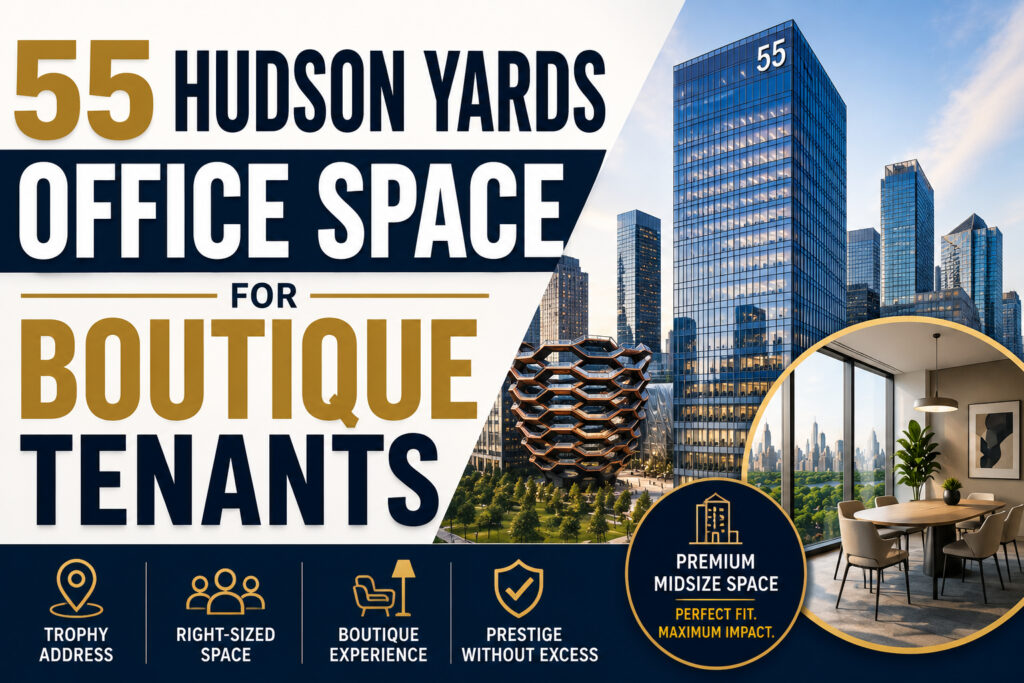
55 Hudson Yards Office Space for Boutique Tenants
Boutique Trophy Space Without the Oversized Tower Feel
55 Hudson Yards works for a very specific kind of tenant. It suits firms that want a trophy address, but do not want to vanish inside a mega-floor, a supertall lobby procession, or a campus built around giant headcounts. In plain English, this is the premium midsize answer inside Hudson Yards.
That distinction matters. Some towers in the district feel engineered for massive global occupiers first. Those buildings deliver scale, prestige, and huge blocks. However, they can feel too broad for a 40-person, 60-person, or 90-person company that wants identity, privacy, and a more polished client experience. By contrast, 55 Hudson Yards often feels more composed, more tailored, and more natural for boutique users.
The building itself reinforces that impression. It rises 51 stories, stands about 780 feet tall, and contains roughly 1.3 million square feet. The tower faces the park, sits by the High Line edge, and stands just across from the No. 7 line. Floor plates stay efficient, ceilings run high, glass coverage stays generous, and tower floors avoid interior columns. That combination gives boutique tenants a clean planning canvas rather than a compromised one.
The aesthetic also helps. Instead of chasing a pure glass-object look, the building blends a more grounded exterior profile with large windows and modern interior efficiency. For many boutique firms, that tone lands better. It reads as premium, serious, and established. At the same time, it still feels current.
That is why this address attracts firms that care about impression without excess. They want clients to feel the quality. They want staff to enjoy the light, the views, and the commute. Yet they do not need a building that performs like a global billboard.
This is also one of the few office buildings in New York that opens directly to green space. That matters more than most tenants expect. The park frontage softens the arrival. The High Line adjacency improves the neighborhood feel. The western light helps the workday. Even the walk to and from meetings feels better here.
Inside, the technical package stays strong. The tower offers high finished ceilings, deep vision glass, high-speed destination dispatch elevators, and a modern HVAC system designed to support indoor air quality. Better systems do not just sound good in a brochure. They make day-to-day office life easier, especially for firms that host clients, run long hours, or depend on a higher ratio of private offices.
For a tenant that wants Hudson Yards prestige with a more boutique corporate mood, 55 Hudson Yards stands near the top of the shortlist.
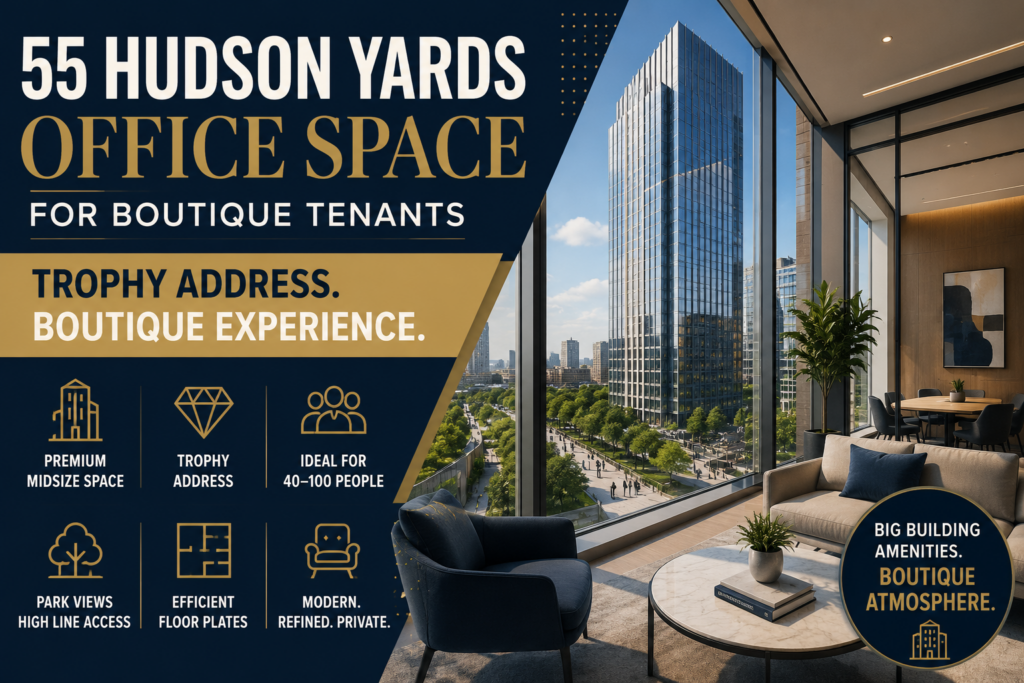
What Boutique Tenants Actually Mean When They Search This Building
Most firms using this phrase are not asking one simple question. They usually want several answers at once, even if they do not phrase them that way.
First, they want to know whether 55 Hudson Yards truly fits boutique tenants, or whether the building only works for giant occupiers. Second, they want to know what size range actually appears here in real life. Third, they want to understand the cost. Fourth, they want to know whether move-in-ready options exist. Finally, they want to compare this tower with other Hudson Yards choices without wasting weeks on tours that never made sense.
That is why the phrase pulls in many page types. You will often see an official property page. That page helps with location, architecture, and core facts. You will also see broad office marketplaces. Those pages help with surface-level inventory, but they often mix true boutique suites with generic flexible office options or stale examples. Next, you will find broker marketing pages. Those pages can show useful size bands, though they often focus more on inquiry capture than on clean tenant education. You may also see transaction-data pages. Those pages help you understand the tenant profile, but they rarely solve the live leasing question.
Sometimes flexible office or serviced office pages appear as well. That happens because the broader market lumps many “small office” searches together. Still, that is not the real center of gravity here. 55 Hudson Yards is not mainly a coworking story. It is a direct lease and sublease story inside a trophy building.
Likewise, some nearby West Side buildings often appear in the same conversation. That does not mean they equal 55 Hudson Yards. It means tenants use the district label loosely. They may compare a pure campus tower, a Hudson Boulevard building, and a Penn-adjacent option in the same afternoon. The commute pattern overlaps. The trophy standards overlap. The pricing often overlaps, too. Yet the personality of each building can differ sharply.
If your team values terraces, a design-forward profile, or direct Penn access, another nearby tower may deserve a look. If your team wants a more classic corporate feel, better privacy, and a strong office-heavy layout bias, 55 usually moves back in front.
The biggest misconception centers on the word boutique. In this part of Manhattan, boutique rarely means 1,500 square feet. It usually means something more like premium midsize occupancy. Think roughly 7,000 to 15,000 square feet in a high-end suite, often with a meaningful office count, polished reception, better finishes, and faster move-in timing. Below about 5,000 square feet, choices become far less common. Above that threshold, the field opens.
That reality shapes expectations. If your team wants a trophy image, but only needs a few thousand square feet, you should widen the map before committing to this address. If you need around 10,000 square feet and care about quality, this tower starts to make much more sense.
For firms sorting the broader district first, we recommend starting with our guides to small offices in Hudson Yards, Hudson Yards office space by team size, and best Hudson Yards office buildings for tenants. Those pages help narrow the field before you spend real time on space tours.
Current Leasing Picture and Budget Reality
The live picture at 55 Hudson Yards supports the boutique angle better than most tenants assume. On our current inventory, the clearest examples sit almost exactly where many boutique tenants need them.
One visible option is a 10,853 SF furnished partial-floor office. This suite leans office-heavy. The layout includes twelve private offices, a conference room, two enclosed phone rooms, two open work areas with about thirty workstations, a built kitchen and pantry, and access to outdoor space. That plan works well for firms that need privacy, partner rooms, executive seating, and frequent client interaction.
Another visible option is a 10,680 SF prebuilt suite. This one pushes even harder into a boutique professional-services profile. It features twelve perimeter offices, three conference rooms, one additional meeting room, a smaller workstation area, a pantry, and support spaces such as a server room, wellness room, and supply area. In other words, it behaves like a true prebuilt boutique headquarters floor rather than a generic open-plan box.
Those two examples matter because they show the actual character of the space type here. You are not looking at anonymous benching floors. You are looking at office-forward, client-ready, perimeter-driven suites that fit private capital, legal, advisory, executive search, wealth management, and other relationship-heavy businesses.
Public marketing elsewhere in the market has also shown broader availability bands in the building, roughly from the low 10,000-square-foot range up to large multi-floor or full-floor blocks approaching 89,000 square feet. That wider band does not change the core story. It simply means the building can serve both midsize and larger tenants. The sweet spot for the boutique lane still sits closer to that 10,000-to-14,000-square-foot zone.
Pricing requires more care. Hudson Yards commands a real premium over Manhattan averages. Across Manhattan, average asking rents sit well below what most trophy West Side buildings seek. In the Hudson Yards lane, boutique tenants should generally expect triple-digit face rents, often in the low $120s to mid-$150s per square foot, depending on floor, term, build quality, and whether the space comes as direct, prebuilt, or sublease product.
Recent public marketing around 55 Hudson Yards has reinforced that range. One current furnished sublease example near 10,680 square feet has marketed around $155 per square foot. Broader public guidance for the district usually places premium West Side trophy offices around the low $120s and up, with the best packages pushing higher.
Yet face rent never tells the whole story. Boutique tenants should underwrite five numbers, not one. Rent comes first. Term length comes next. Landlord work and concessions matter after that. Furniture and technology savings can meaningfully change the math. Finally, speed to occupancy affects the real cost more than many teams admit.
That last point explains why subleases and prebuilts matter here. A direct lease gives you more control over term, branding, and long-range customization. A prebuilt direct suite reduces decision fatigue and shortens move time. A furnished sublease can cut both capital outlay and delivery risk. For some boutique firms, especially those facing a hard deadline, a well-done sublease can beat a raw direct floor even at a higher nominal rent.
If you are budgeting this move seriously, do not stop at annual rent per square foot. Add legal fees, carried overlap, cabling changes, security deposits, furniture deltas, and executive downtime. Then compare direct, prebuilt, and sublease paths side by side. Many tenants change their preferred structure once they see the true all-in cost.
For a wider pricing frame before you shortlist suites, review our Hudson Yards office space cost guide. If you want the process side next, our how to lease an office in Hudson Yards page lays out the decision path clearly.
When 55 Hudson Yards Is the Right Answer
55 Hudson Yards is the right answer when your firm wants prestige with restraint. It fits teams that value a high-end setting, but still want a workplace that feels intentional, private, and well-composed. That makes it especially strong for firms with executive-heavy layouts, confidential work, and a meaningful client-facing component.
Law firms and law-adjacent groups fit naturally here. So do investment firms, private capital teams, family-office style users, advisory businesses, and professional services groups that need more offices than desks. Healthcare administration, strategic consulting, and select technology companies can also perform well here, especially when their office mix leans senior and meeting-heavy rather than dense and open.
A boutique tenant should choose 55 Hudson Yards when the brief includes several of these priorities at once:
A premium image. The tower looks and feels first-class without turning every arrival into a spectacle.
A better office ratio. Current suite examples support private-room planning far better than many new towers do.
A true West Side trophy location. The 7 line sits right there, while Penn Station and Moynihan stay within a practical walk.
Move-in speed. Prebuilt and furnished opportunities reduce risk when your lease clock starts to matter.
A quieter brand expression. Some firms want prestige, but not a building that overwhelms their own identity.
By contrast, this building can frustrate some users. If you need under 5,000 square feet, the inventory will likely feel thin. If you want loft-style character over trophy polish, other neighborhoods may fit better. If the budget must stay below Hudson Yards premium levels, you should compare nearby choices carefully. In many cases, a tenant can preserve the West Side commute and improve economics by shifting the exact address.
That comparison matters because Hudson Yards often functions as a wider decision set. The district label spills across neighboring towers and nearby blocks. Some firms should stay inside the core. Others should use the core as a benchmark, then choose a nearby alternative with better value or a better commute pattern. That is why a tenant-first process matters more than an address-first process.
Still, when a boutique tenant truly wants 55 Hudson Yards, the building gives a compelling answer. It offers the right scale for a polished midsize occupancy. It supports office-heavy planning. It creates a strong arrival experience. It benefits from real transit strength. It also avoids the “too big for us” feeling that can shadow some larger West Side towers.
The simplest way to view the building is this: 55 Hudson Yards is not the biggest statement in the district. It is often the smartest statement for the right boutique tenant.
If your team wants to test that fit now, start with the 10,853 SF furnished partial-floor office and the 10,680 SF prebuilt suite. After that, compare the wider district through our Hudson Yards office space, Hudson Yards office for rent, and Hudson Yards vs Manhattan West office space guides so you can judge this tower against the real alternatives.
When tenants approach 55 Hudson Yards the right way, they usually reach one of two conclusions fast. Either the tower fits almost perfectly, or the search becomes more intelligent because the building clarified what the team truly needs. Both outcomes move the process forward.
We represent tenants, not landlords. That means we evaluate 55 Hudson Yards through the lens that matters most to your firm: fit, leverage, timing, and total occupancy cost. If this building is right for you, we will tell you exactly why. If it is not, we will say that just as clearly.
Fill out our 📋 online form or give us a call today 📞 212-967-2061 — let’s find the right options for your business.