Hudson Yards Office Space
Compare Hudson Yards options with clear pricing logic, real market context, and practical lease guidance.
What Hudson Yards Office Space Really Means
Searchers use this phrase in several ways. Some want a direct lease in a trophy tower. Others need a furnished office, a short-term suite, a sublease, or a full headquarters block. Search engines also mix building pages, listing portals, map cards, and flexible office results for this topic, which is why one page must explain the whole lane instead of one narrow slice.
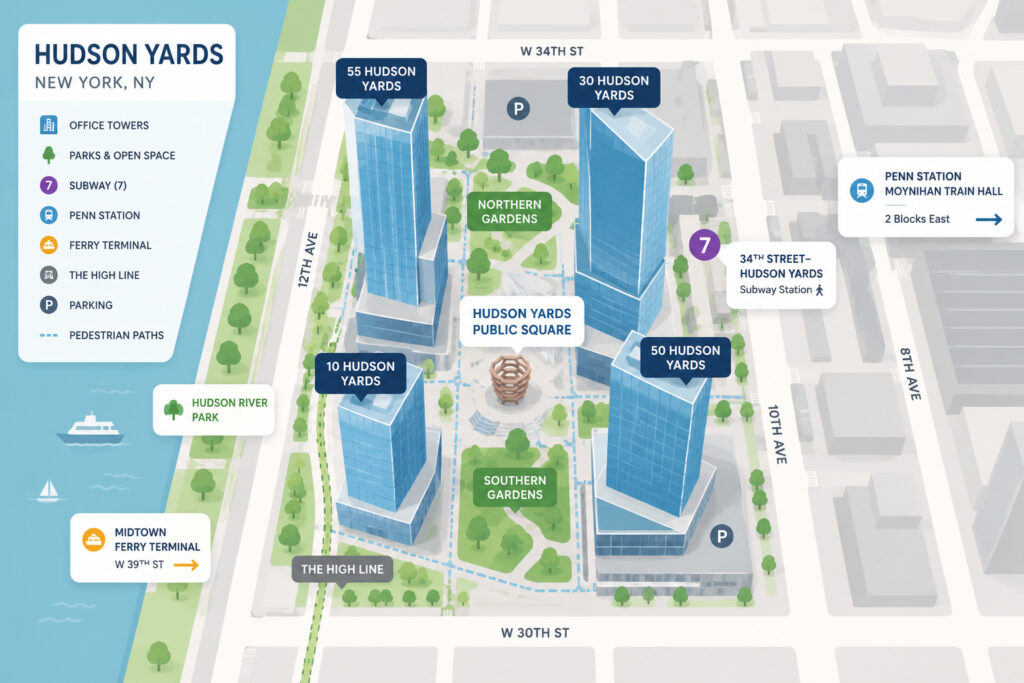
In tenant terms, Hudson Yards office space means the modern office cluster on Manhattan’s Far West Side, centered on the 34 St–Hudson Yards station, Hudson Boulevard, the High Line edge, and the newer towers around Tenth Avenue. The core inventory includes 10 Hudson Yards at 1.8 million square feet, 30 Hudson Yards at 2.6 million square feet, 50 Hudson Yards at 2.9 million gross square feet, 55 Hudson Yards at 1.3 million square feet, and a future 1.4 million square foot building at 70 Hudson Yards.
That distinction matters. A private suite inside 31 Hudson Yards is not the same product as a full-floor direct lease in 50 Hudson Yards. Likewise, a smaller office on the edge of the district is not the same value proposition as a large-block headquarters floor inside the core campus. If you treat every result as interchangeable, you will compare the wrong spaces, misread the rent, and waste valuable tour time.
Hudson Yards also sits in a broader Midtown West movement. Premium buildings keep winning demand while older stock struggles harder to compete. That pattern explains why this district shows up so often for tenants who value modern systems, wellness features, strong amenity packages, and efficient floorplates.
Where Hudson Yards Starts and Why Tenants Target It
Tenants pay attention to Hudson Yards because it solves several common office problems at once. First, the district offers newer construction. Second, the buildings deliver large and efficient floors. Third, the transit story is much stronger than many first-time searchers assume, especially once you factor in the 7 line terminal, direct station connections, and the walkability of the boulevard system.
Commuting convenience shapes office value more than marketing does. 30 Hudson Yards has a direct underground connection to the No. 7 station. 50 Hudson Yards provides direct access to that station. 55 Hudson Yards sits just across from it. 70 Hudson Yards will stand adjacent to the train entrance. That cluster gives Hudson Yards real transit gravity for teams that need predictable access rather than vague neighborhood prestige.
Amenity depth also changes the leasing equation. The campus combines restaurants, services, retail, fitness, public space, and day-to-day convenience in one concentrated zone. Official building pages highlight outdoor terraces, sky lobbies, valet or private arrival options, direct restaurant access, and hospitality-style support. Those features do not replace rent discipline, but they do shape recruiting, client experience, and employee attendance.
The market backdrop supports that premium position. Manhattan leasing rebounded sharply in 2025, with strong demand for top-tier space and a record number of leases above $100 per square foot. More recently, Manhattan sublease inventory dropped below 11 million square feet in the second quarter of 2026, which indicates real absorption rather than empty marketing talk. When premium inventory tightens, Hudson Yards tends to stay in the tenant shortlist.
Still, the district is not automatically right for every company. Some teams need cheaper edge inventory. Others care more about Grand Central proximity or downtown client access. The smart move is not to assume Hudson Yards fits. The smart move is to test whether Hudson Yards solves your commute, brand, layout, and growth needs better than your alternatives.
The Buildings That Define the Market
10 Hudson Yards works best for tenants who want a large modern tower with column-free interiors, floor-to-ceiling glass, and an established office environment at the southern end of the district. The building totals 1.8 million square feet and opened in 2016, which makes it newer than most Midtown inventory without carrying the “future delivery” timing risk of an unbuilt project.
30 Hudson Yards is the giant identity play. It rises more than 100 stories, totals 2.6 million square feet, stands at 1,296 feet, and carries direct underground subway access. This tower fits tenants that want skyline prominence, major floor area, outdoor terraces, and a building that reads as headquarters space rather than ordinary office stock.
50 Hudson Yards delivers the broadest large-floor story in the district. Officially, it is New York City’s fourth-largest commercial office tower, with 2.9 million gross square feet, direct 7 train access, multiple street entrances, private sky lobbies, and floors that can accommodate more than 500 people each. For large teams that want efficiency and density without sacrificing experience, 50 Hudson Yards sits at the center of the conversation.
55 Hudson Yards offers a slightly different feel. It totals 1.3 million square feet, sits by the High Line and Hudson Park & Boulevard, and stands just across from the 7 train. The building is trophy-grade, yet it often appeals to tenants who want a more tailored image than the biggest supertalls provide. In practice, it bridges the gap between full-campus prestige and a more boutique decision set.
70 Hudson Yards adds the future lane. The project totals 1.4 million square feet, rises 717 feet, sits next to the 7 train entrance, and will include terraces, conferencing space, wellness facilities, and a multimedia studio. Public reporting also tied the tower to one of the largest post-pandemic office commitments in the country, which signals that tenants still pre-commit when the product is strong enough.
One more point matters here. Search results also pull 31 Hudson Yards into the conversation because that address supports private offices and flexible suites. That option can make sense for a small team, a short term, or a swing-space need. Yet it does not define the whole Hudson Yards office market, and tenants should not let a serviced-office result stand in for a district-wide lease search.
Space Types, Pricing, and Availability
Hudson Yards does not have one simple rent number. It has a pricing band, and that band widens fast once you separate core trophy space from edge inventory, furnished space, and smaller non-core offices. Public search snippets for the query show a core Hudson Yards office block quoted around the mid-$100s per square foot for 7,460 to 50,692 rentable square feet, while LoopNet shows smaller nearby spaces at roughly $36 to $50 per square foot or in the low $40s on fringe blocks west or north of the core towers. Meanwhile, premium Manhattan leasing has produced huge volumes of $100-plus deals, and nearby trophy peers in the broader district have posted rents well above that threshold.
That spread tells you something important. “Hudson Yards office space cost” is the wrong first question. The better question is: which Hudson Yards product are you pricing? Direct lease, sublease, prebuilt, furnished, coworking, partial floor, full floor, or future-delivery block all price differently. Term length, build-out condition, credit, and expansion rights change the deal as much as the headline rent does.
You also need to price the full occupancy cost, not just base rent. Rentable versus usable square footage changes the math. Additional rent can include tax escalations, operating expense increases, and utilities. HVAC beyond business hours can cost extra. Build-out allowances, free rent, security deposits, and sublease rights should all sit on the same decision sheet before you compare two options.
Availability behaves the same way. Some public pages show large direct blocks, some show flexible suites, and some show only the filtered inventory that platform can display at that moment. LoopNet’s live Hudson Yards lease search surfaced seven results when we reviewed it, including coworking at 31 Hudson Yards, small offices on side streets, and large blocks at Morgan North. That is helpful, but it is not the whole market, and it proves why tenants should verify live stacking plans before they anchor on a public count.
If you want a clean starting point for live tenant options, use our Hudson Yards office inventory. When you start negotiating, keep our NYC commercial leasing guide open so you can compare rent structure, allowances, and exit rights with a sharper eye.
How to Choose the Right Hudson Yards Deal
Start with team size and timing. A small group that needs speed may prefer a furnished suite or short-term private office. A growing company often does better with a prebuilt direct lease or a clean sublease. A larger group should usually test partial-floor and full-floor options first, because Hudson Yards shines when a tenant can fully use modern floorplates and shared building systems.
Next, pressure-test the layout. Do not chase a famous address if the floor does not work. Ask whether the space supports your headcount density, meeting mix, reception needs, pantry location, security approach, storage, and future expansion. Column-free interiors, wide glass lines, and larger floorplates sound great, but the actual plan still has to support the way your team works each day.
Then move to lease structure. Request simple side-by-side proposals that show base rent, annual increases, free rent, improvement money, electricity, after-hours HVAC, cleaning, delivery condition, and sublease or assignment flexibility. Good tenants win by comparing apples to apples. Weak tenants lose by touring first and asking hard questions later.
One final rule matters in Hudson Yards more than in many neighborhoods. Do not confuse spectacle with value. A tower can look perfect and still cost too much for your actual use case. The right deal balances image, access, build quality, term flexibility, and all-in cost. When those pieces line up, Hudson Yards can be exceptional. When they do not, even a famous tower becomes an expensive mismatch.
Hudson Yards Office Space FAQ
Where is Hudson Yards office space located?
The core office cluster sits on Manhattan’s Far West Side around Tenth Avenue, Hudson Boulevard, and the 34 St–Hudson Yards station. In practical tenant terms, that means the office market stretches around 10, 30, 50, 55, and 70 Hudson Yards, plus nearby supporting inventory.
What kinds of tenants choose Hudson Yards?
The district draws firms in finance, media, law, consulting, technology, beauty, and other professional sectors. That mix matters because it confirms Hudson Yards functions as a serious business district, not just a retail destination or a tourism backdrop.
What offices are in 30 Hudson Yards?
30 Hudson Yards houses major corporate users and large headquarters-style occupancies. The tower’s size, terraces, and direct subway connection explain why searchers often jump straight to that address when they really mean the district as a whole. Still, it is only one building inside a larger office ecosystem.
Is coworking the same as Hudson Yards office space?
No. Coworking and private suites are one subset of the market. They can work for speed, short terms, or small teams, especially at 31 Hudson Yards. Yet a serviced office should sit inside your search, not replace a district-wide review of direct leases, subleases, and prebuilt options.
Can you legally live in a rented office space?
In practice, no. Office space is not lawful residential space unless the building and unit have been formally converted and approved for residential occupancy. New York’s rules on legal occupancy and loft conversion make that distinction clear, so tenants should not treat office space as live-work housing unless the paperwork, use, and certificate history support it.
Is Hudson Yards office space ever for sale?
Sometimes, yes, but that is a different lane from the main search intent. Most live results for this phrase revolve around leasing, subleasing, flexible offices, and building overviews rather than broad sale inventory. If you need an office condo or an investment sale, treat that as a specialized search from the start.
What should a tenant ask before signing?
Ask about rentable versus usable square footage, delivery condition, HVAC hours, electricity, tax pass-throughs, build-out money, free rent, expansion rights, and sublease language. Those items decide whether a space stays affordable after the excitement of the tour wears off.
The Tenant Takeaway
Hudson Yards office space is not one building, one landlord page, or one coworking result. It is a premium West Side office district that includes trophy direct leases, large future blocks, flexible suites, edge inventory, and headquarters-grade towers with direct subway access and modern infrastructure. The tenants who win here define the right product first, then negotiate the right economics.
If you want a live shortlist instead of guesswork, start with our Hudson Yards office inventory and use our Commercial Leasing Guide to pressure-test every proposal. We represent tenants, so we focus on leverage, clarity, and fit. That is how you secure Hudson Yards office space that works in the real world, not just on a search results page.
Our job is simple: protect your budget, sharpen your search, and negotiate the right office for your team.
Fill out our 📋 online form or give us a call today 📞 212-967-2061 — let’s find the right options for your business.