How to Lease an Office in Hudson Yards
A tenant-first guide to leasing in Hudson Yards
The breakdown; Tenants want to know what counts as Hudson Yards, what space types appear, what pricing means, how the process works, and how to avoid a bad deal. The current market hints at those questions, yet they leave the hard part unfinished.
Hudson Yards also deserves a tighter explanation than most give it. The district includes iconic new inventory along Tenth Avenue and Hudson Boulevard, but public listing pages often spill into nearby blocks on West 35th Street, West 36th Street, and Ninth Avenue. That blend changes pricing, product type, and expectations. A tenant who misses that point can compare the wrong spaces from the start.
If you want a broader neighborhood snapshot first, see our Hudson Yards office, Hudson Yards office space, and Hudson Yards offices pages.
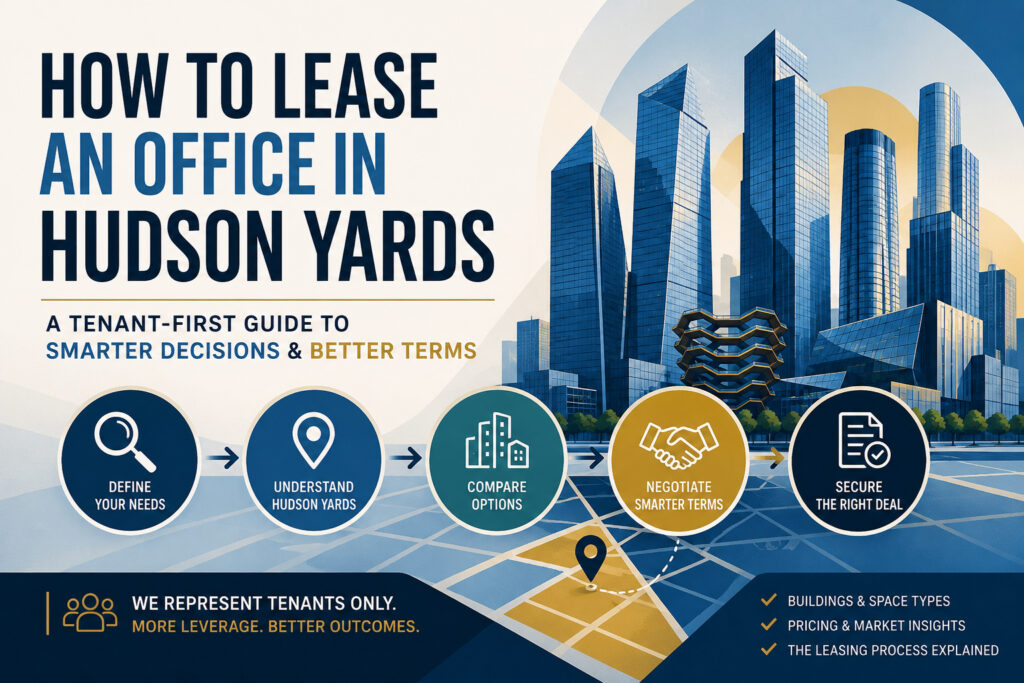
What this hunt for Space means
For a tenant searching the neighborhood this usually means one of five things.
They may want a true direct lease. That means space from the landlord, with a negotiated term, rent structure, legal lease, and build-out path.
They may want a sublease. That means taking space from an existing tenant, often for a shorter term and a faster move.
They may want a prebuilt suite. That means a finished office with rooms, pantry, and furniture-ready infrastructure.
They may want a furnished or licensed office. Search engines often treat this as part of the same topic, even when the contract is not a traditional lease.
They may simply want to know where to begin. AI summaries and the follow-up prompts Search Query show that most people ask about pricing, office types, transit, and neighborhood comparisons right away.
A serious tenant should therefore sort the market before touring anything.
Direct lease: best for control, brand, and longer terms.
Sublease: best for speed, shorter commitments, and occasional value.
Prebuilt direct space: best for turnkey occupancy without giving up lease control.
Licensed or flexible space: best for swing space, testing a team, or very small groups.
That distinction sounds simple. In practice, it decides your economics, your timeline, and your risk.
What Hudson Yards office space costs today
Pricing today shows a wide spread across the map. In the supply, sources show Hudson Yards office rent near $120 per square foot. Another shows an average around $43 per square foot with an average size near 76,833 square feet. Class A asking rents from the $90s into the $150s and higher. That is not a contradiction. It is a product-mix problem.
The cheaper numbers usually fold in edge-of-district inventory, smaller side-street spaces, non-trophy buildings, or listing data that casts a wider map than many tenants expect. The higher numbers usually point toward newer core towers, premium views, larger floorplates, stronger amenity packages, and direct landlord product. Public listings now show that Hudson Yards search inventory can stretch from a few hundred square feet to blocks above 300,000 square feet, and that range alone can distort any “average” number.
The official major-tower pages reinforce that point. One core tower totals about 2.6 million square feet, rises above 100 stories, offers outdoor terraces, and connects directly underground to the 7 train. Another totals about 2.9 million gross square feet, stands over 1,000 feet tall, and can hold more than 500 people per floor in some blocks. A third contains about 1.3 million square feet and sits just across from the 7 train entrance. A fourth totals about 1.8 million square feet, carries LEED Platinum, and offers column-free interiors with floor-to-ceiling glass. That is premium stock, and its pricing behaves like premium stock.
The broader Manhattan market also helps frame Hudson Yards. JLL’s first-quarter 2026 data, as reported publicly, put overall Manhattan vacancy near 13.5%, with overall asking rent around $85.31 per square foot and direct Class A asking rent around $95.49 per square foot. A July 2026 market roundup also noted that second-quarter vacancy estimates from major firms clustered roughly between 13.4% and 14.4%, even though methodologies varied. That means Hudson Yards sits inside a tightening prime-market backdrop, not a soft one.
At the high end, pricing pressure has stayed real. A nearby West Side trophy tower reported rents from $125 to $225 per square foot. Separately, Manhattan logged a surge in $100-plus deals during 2025, and Hudson Yards ranked among the submarkets where supply tightened sharply. In other words, tenants still have choices, but the best large blocks and best prebuilt options do not linger forever.
Sublease math changed too. JLL reported that Manhattan sublease inventory dropped to under 11 million square feet in Q2 2026, less than half the late-2022 peak. That trend matters for Hudson Yards users because many tenants treat sublease space as the “discount lane.” When the overhang shrinks, timing matters more, and landlords gain leverage on direct space.
For a deeper pricing breakdown, read our Hudson Yards office space cost page.
How to lease an office in Hudson Yards
Start with headcount, not rent.
Define how many people you need to seat today. Then add growth. Next, decide whether you need full attendance, hybrid seating, or hoteling. A bad requirement creates a bad tour list.
Choose the contract structure early.
Decide whether you want a direct lease, a sublease, or a short-term licensed office. Google’s current results treat those as one topic. Your search should not.
Draw the map before you tour.
Some search results use “Hudson Yards” loosely. Public listings can reach into fringe blocks along Ninth Avenue and upper West 30s streets. If your team wants true core Hudson Yards, say so. If you welcome fringe value nearby, say that too.
Set your occupancy date with discipline.
A direct lease with construction usually needs more runway than a prebuilt suite. A sublease can move faster. A licensed suite can move fastest, but it gives up the most control.
Tour by use case, not by hype.
Bring one list for full-floor or large-block options. Bring another for partial-floor prebuilt space. Keep furnished swing space separate. That approach stops apples-to-oranges comparisons.
Underwrite the real cost.
Base rent is only the opening number. A tenant should also test electricity, cleaning structure, after-hours HVAC, furniture, IT, cabling, legal work, and moving cost. Build-out time has value too.
Negotiate the business points first.
Pin down rent, free rent, tenant improvement money, term, contraction or expansion rights, delivery condition, and assignment language before the long-form lease eats your calendar.
Match lease length to business certainty.
A fast-growing team should not lock itself into the wrong footprint. On the other hand, a stable user should not overpay for short-term flexibility it does not need.
Review the building rules carefully.
Freight access, security procedure, bike storage, visitor flow, signage rules, and work-letter timing shape daily operations. Premium towers often offer better systems, but each building still runs differently. Official Hudson Yards pages highlight direct subway access, valet access, bike storage, concierge-level service, and strong food and amenity depth in the core inventory.
Move from short list to leverage.
Do not fall in love with one option too fast. Real leverage comes from credible alternatives. Even in a tighter market, the tenant who keeps two or three workable paths usually negotiates better.
If you want current availabilities after reading the process, review Hudson Yards office space for lease, Hudson Yards office space for rent, and Hudson Yards office for rent.
How to choose the right Hudson Yards space
A company with a large, branded, long-term requirement should focus first on the core towers. Those buildings offer the biggest floorplates, the strongest infrastructure, and the cleanest identity play. In Hudson Yards, that often means direct 7 train access, LEED-level building systems, major amenity packages, and floors that handle dense teams more efficiently.
A company that wants speed should widen the search. Public inventory near Hudson Yards currently includes smaller blocks on nearby side streets, plus selective prebuilt or flexible options. The size spread in public listings runs from very small suites to very large blocks, which makes the neighborhood more flexible than many first-time searchers assume.
A company that cares most about employee experience should test the commute, not just the brochure. The 34 Street–Hudson Yards station serves the 7 and <7> and has entrances on Hudson Boulevard at both 34th and 35th Streets. Some of the newest buildings connect directly or sit immediately beside that station access. That can save meaningful minutes every day.
A company that wants light and layout flexibility should study the interiors closely. One major tower in the district promotes column-free floors and floor-to-ceiling windows. Another emphasizes massive floorplates and the ability to seat more than 500 people on one floor. Another pairs terraces and river-to-river views with direct subway access. Those features matter when you compare efficiency, density, and culture.
A company that wants the Hudson Yards address without full trophy pricing should decide how much “core” it truly needs. Some teams need the main district. Others simply need the West Side ecosystem, newer stock nearby, and a workable walk to the same amenities. Search results often blur that line. Good tenant planning does not.
If your next question is building fit, use our best Hudson Yards office buildings for tenants page.
Common questions about leasing in Hudson Yards
Is Hudson Yards only the new tower cluster
No. Search engines often blend the core district with nearby West 30s inventory. Public listings tied to this search currently include addresses on Tenth Avenue, West 35th Street, West 36th Street, Ninth Avenue, and the main Hudson Yards spine. A tenant should decide whether “Hudson Yards” means the core, the fringe, or both.
What kinds of office space show up for this search
You will see direct leases, subleases, prebuilt suites, furnished offerings, and coworking-style options. Google, Bing, and Yahoo all surface that mix for this query today. That is why one page talks landlord inquiries, another shows listing averages, and another pushes flexible space.
Why do the prices look so different from page to page
Because the pages do not measure the same thing. Some results mix fringe geography. Others mix coworking or furnished product. Some focus on premium direct space. Others rely on listing averages. The supplied SERPs show that exact problem.
What transit matters most in Hudson Yards
The 34 Street–Hudson Yards station is accessible, opened in 2015, and serves the 7 and <7>. It has entrances on Hudson Boulevard at 34th and 35th Streets. Several core office towers also market direct or near-direct station access.
Is coworking the same as leasing an office
No. A traditional office lease gives you negotiated lease rights, term control, and more customization. A licensed office or coworking arrangement can work well for speed, small teams, or swing space, but it answers a different business need.
How does Hudson Yards compare with older Midtown inventory
Hudson Yards generally wins on new systems, modern floorplates, amenity depth, and branding power. Older Midtown inventory can still win on price, train variety, and niche layouts. The right answer depends on commute pattern, culture, image, speed, and budget. Official building pages in Hudson Yards stress large efficient floors, LEED credentials, subway access, High Line access, and deep food and service infrastructure.
The right next move for a tenant
If you are early in the process, start broad. Read our Hudson Yards office space overview first. Then review Hudson Yards office space cost to set a real budget.
If you already know you need active inventory, go straight to Hudson Yards office space for lease and Hudson Yards office space for rent. Those pages help you move from concept to actual options faster.
If your team still needs building-level fit analysis, use best Hudson Yards office buildings for tenants. That is the fastest way to match size, image, commute, and timing before you tour anything.
Need some defined Options?
We represent tenants. Our work starts with your requirement, not a landlord’s listing. When you lease in Hudson Yards with a tenant-first plan, you make cleaner comparisons, keep leverage longer, and end up with a space that fits the business instead of forcing the business to fit the space.
Fill out our 📋 online form or give us a call today 📞 212-967-2061 — let’s find the right options for your business.