Hudson Yards vs Manhattan West Office Space
The Fast Answer
Choose Hudson Yards when your office must project scale, polish, and a flagship identity. The district centers on ultra-modern towers, large floor plates, stronger skyline drama, and an all-day mixed-use environment built around major office towers, retail, dining, and public space. Official materials also show major office inventory in 10 Hudson Yards, 30 Hudson Yards, 50 Hudson Yards, and 55 Hudson Yards, with featured current suites on our site at 50 Hudson Yards, 55 Hudson Yards, and The Spiral.
Pick Manhattan West when your workforce depends on Penn Station, Moynihan Train Hall, or a fast rail commute from New Jersey, Long Island, or Amtrak corridors. The campus sits in a tighter footprint, feels more unified at street level, and currently shows a wider spread of directly marketed availabilities across One, Two, and Four Manhattan West, while Five Manhattan West is fully leased.
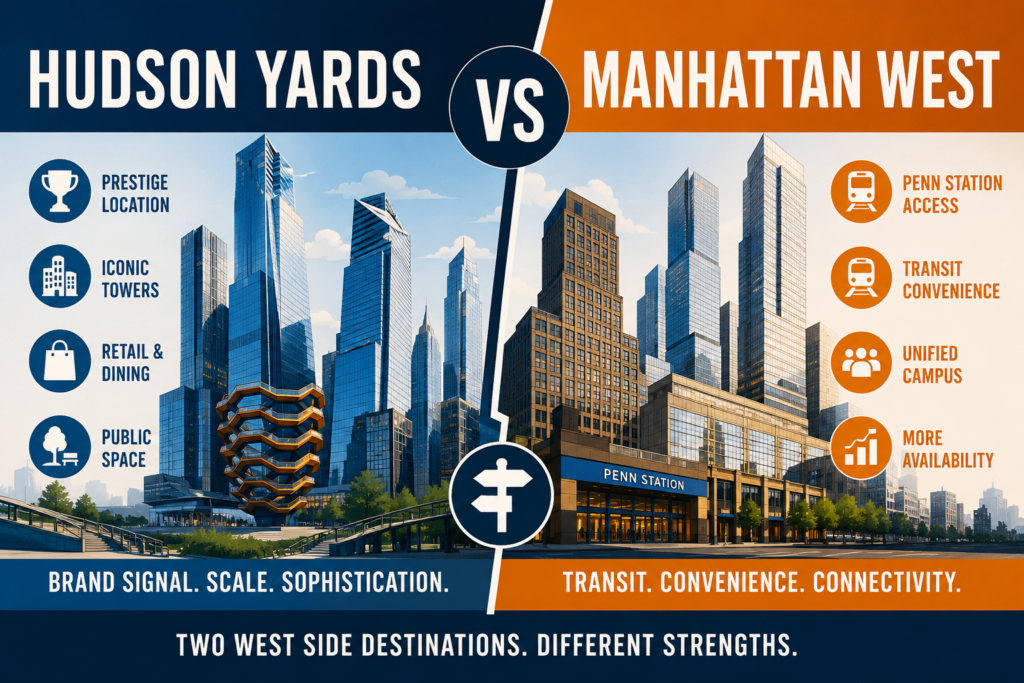
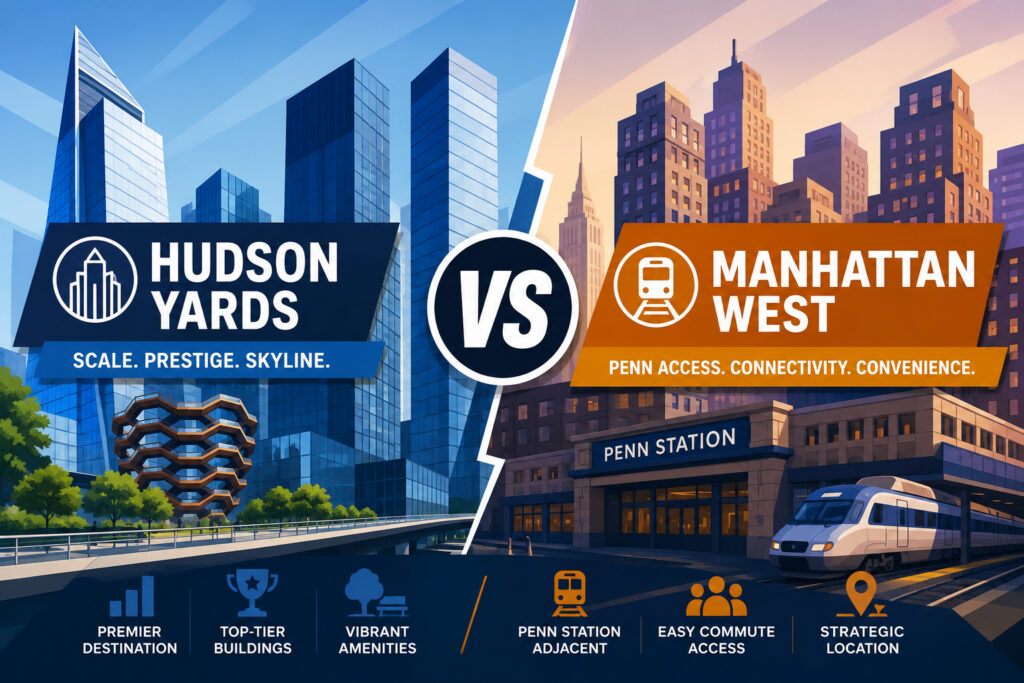
For most tenants, the real choice is simple. Hudson Yards wins on brand signal and trophy presence.Manhattan West wins on Penn adjacency and campus convenience. Once you know which of those matters more, the shortlist gets easier.
What These Two Names Actually Mean
Hudson Yards is the larger neighborhood and redevelopment district on Manhattan’s Far West Side. In everyday leasing language, people use the term in two ways. Sometimes they mean the broader district. At other times, they mean the newer office cluster anchored by the biggest towers west of Tenth Avenue. The neighborhood runs roughly from West 30th Street to West 41st Street and from Eighth Avenue to the Hudson River.
Manhattan West is not a separate borough-within-a-borough. Instead, it is a distinct mixed-use campus within the broader West Side redevelopment zone. It sits between Ninth and Tenth Avenues and between West 31st and West 33rd Streets, directly beside Moynihan Train Hall and Penn Station, and just east of the core Hudson Yards towers. In practical tenant terms, that means Manhattan West is part of the same westward office shift, yet it behaves like its own office campus with its own plaza, circulation, and identity.
That distinction matters because many tenants searching this topic are asking different questions under one phrase. Some want a neighborhood comparison. Others want a campus comparison. A third group really wants to know whether One and Two Manhattan West compete with 50 Hudson Yards, 55 Hudson Yards, and The Spiral for the same type of tenant. The answer is yes, but they do so with different strengths.
Commute and Daily Access
The commute question decides more searches than rent alone. Hudson Yards has the clear advantage for teams who value direct access to the 34 Street–Hudson Yards station and a cleaner west-side arrival into a newer office environment. It also works well for firms that want to feel closer to the High Line, Hudson River views, and the western edge of Midtown. Official Hudson Yards materials position the district as a connected community and highlight the office towers at 10, 30, 50, and 55 Hudson Yards as core work destinations.
Manhattan West, however, has the stronger case for rail-heavy commuter patterns. Its own site says the campus sits steps from Moynihan Train Hall, Penn Station, and Madison Square Garden, and it also ties into the High Line–Moynihan Connector. That means a shorter, easier arrival for many employees coming from New Jersey Transit, Long Island Rail Road, Amtrak, and Penn-based subway lines. For firms with a large suburban workforce, that daily time savings can matter more than almost anything else.
This is where tenant priorities often split. A company with a strong East Side client flow may like the 7 line convenience and newer west-side setting at Hudson Yards. By contrast, a company with a commuter map centered on Penn often leans toward Manhattan West because the arrival sequence is simpler and less exposed to weather. Both districts work. Yet the last five minutes of the commute usually feel easier at Manhattan West, while the destination effect often feels bigger at Hudson Yards.
Space, Floor Plates, and Current Availability
If your requirement is large, contiguous, headquarters-quality space, Hudson Yards has an unusually deep bench of true trophy inventory. Official Hudson Yards materials show 10 Hudson Yards at 1.8 million square feet, 55 Hudson Yards at 1.3 million square feet, and 50 Hudson Yards spanning an entire city block with private sky lobbies and terraces. Our current building page for 50 Hudson Yards describes roughly 2.9 million square feet of total area built for large-scale occupancy and modern infrastructure. The Spiral at 66 Hudson Boulevard adds another 2.85 million square feet in a 66-story tower with cascading terraces and large, flexible plates.
Manhattan West brings a different shape of supply. Its official leasing page states that the campus contains six million square feet of office space across four buildings. It also posts current availabilities in unusually plain language: 60,556 RSF at One Manhattan West, 346,000 RSF at Two Manhattan West, and 122,633 RSF at Four Manhattan West, while Five Manhattan West is marked fully leased. The same page also outlines real floor-plate logic rather than vague brochure talk. One Manhattan West averages roughly 31,500 to 33,500 RSF in its upper ranges, while Two Manhattan West averages about 35,300 to 37,000 RSF, and Four Manhattan West offers boutique-style 15,000 RSF office levels plus an 11,446 RSF penthouse with a 2,000 SF terrace.
That mix creates a practical difference. Hudson Yards feels strongest when you want statement space, large-block planning, or a top-tier tower identity. Manhattan West feels stronger when you want choice across several size bands, including big blocks, boutique floors, and build-to-suit options in a campus that remains close to Penn.
The current suite-level examples on our site reinforce that split. As of mid-2026, our Hudson Yards inventory highlights an 11,907 SF furnished option at 50 Hudson Yards, 10,853 SF and 10,680 SF suites at 55 Hudson Yards, and several options at The Spiral, including approximately 8,968 SF, 10,517 SF, 13,850 SF, and 20,840 SF. That suggests a premium district where high-end smaller and mid-size suites do exist, but where many tenants still search the area for larger, flagship-grade occupancy.
If you want to review live examples in that lane, start with office space at The Spiral, a Hudson Yards prebuilt suite, a furnished partial-floor Hudson Yards office, or a headquarters-style Hudson Yards space. Availability shifts quickly, so the best comparison always comes from the live shortlist rather than a stale brochure.
Cost, Value, and Lease Strategy
Hudson Yards competes in Manhattan’s premium pricing tier. Manhattan’s overall office market tightened sharply through 2025 and into 2026, while top-tier space became scarcer and more expensive. JLL data reported by the market press showed a surge in $100-plus per square foot leasing in 2025, with Hudson Yards named among the areas where premium supply tightened. By mid-2026, Cushman data cited in the press showed direct availability across major trophy towers falling to 4.4%. In other words, the upper end of the market is no longer loose.
That does not mean Manhattan West is cheap. It means Manhattan West often gives tenants a wider value spectrum. The campus combines brand-new towers, build-to-suit blocks, boutique inventory, and repositioned space within the same west-side orbit. Therefore, the negotiation path can differ by building. A tenant who cannot justify prime Hudson Yards economics may still land in a first-class west-side product at Manhattan West without giving up Penn adjacency.
The smarter way to compare these districts is not to ask, “What is the ask?” Ask instead, “What am I buying for the premium?” In Hudson Yards, the premium usually buys newer infrastructure, stronger views, larger contiguous blocks, deeper destination amenities, and a more explicit trophy signal. Over at Manhattan West, the value case usually centers on time-to-transit, a tighter campus feel, and more flexibility across building types. That difference matters even more once build-out costs, furniture reuse, free rent, landlord work, and timing pressure enter the conversation.
If budget is your opening filter, review our Hudson Yards office space cost guide first. If leverage matters more than headline rent, the right answer may be a carefully timed search across both districts rather than a narrow focus on one block.
Amenities, Image, and Employee Experience
Hudson Yards sells a larger stage set. The office experience ties into destination retail, dining, public art, hospitality, and open space in a way few Manhattan submarkets can match. The official work site frames it as a connected district built for shopping, dining, and discovery, while also highlighting the concentration of major office tenants and the strong identity of 10, 30, 50, and 55 Hudson Yards. For tenants that recruit aggressively, host clients often, or care about first impressions, that package carries real weight.
Manhattan West feels more intimate and more legible at ground level. Its own site describes the campus as the heartbeat of the West Side and emphasizes the plaza, the retail-and-dining mix, special events, outdoor space, and the direct relationship to Moynihan Train Hall and the High Line connector. That tends to appeal to tenants who want a polished office district without the scale or theatrical feel of a larger mega-development.
Image also works differently in each district. Hudson Yards often reads as global, corporate, vertical, and bold. Manhattan West often reads as curated, transit-smart, campus-driven, and slightly more grounded. Neither posture is better by default. The better choice depends on whether you want your office to feel like a skyline statement or a tightly run arrival experience.
For tenants narrowing buildings inside Hudson Yards, our guide to the best Hudson Yards office buildings for tenants can help sort the district by fit rather than hype.
Best Fit by Tenant Type
Choose Hudson Yards if your team needs flagship identity. This lane works best for headquarters users, image-sensitive financial firms, large legal footprints, major advisory practices, and technology firms that want one address to double as a recruiting tool. It also fits companies that care about terrace access, premium infrastructure, newer systems, big views, and a stronger “arrival” moment. Official Hudson Yards and current building data support that positioning across 50 Hudson Yards, 55 Hudson Yards, and The Spiral.
Choose Manhattan West if your team needs Penn-first logistics. This lane fits firms with many commuters from New Jersey, Long Island, Westchester rail connections through Penn, or frequent Amtrak travel. It also suits tenants that want a modern setting with several inventory styles, including very large blocks at Two Manhattan West and smaller boutique-style options at Four Manhattan West.
Choose Hudson Yards if you want the bigger district experience. Here, the neighborhood itself acts like part of the amenity package. Shops, dining, plazas, the High Line edge, and the larger office cluster all strengthen that effect.
Choose Manhattan West if you want the cleaner campus logic. Here, movement feels tighter. Arrival feels easier. The overall footprint is simpler to understand and use day after day.
If you are a midsize tenant, do not assume Hudson Yards is only for giant users. Our current inventory shows prebuilt and partial-floor opportunities around the ten-thousand-square-foot range inside premium Hudson Yards towers, including suites at 50 Hudson Yards, 55 Hudson Yards, and The Spiral.
If you are asking whether Manhattan West is “in” Hudson Yards, the practical answer is yes and no. It sits inside the broader west-side redevelopment story, yet in real leasing conversations it operates as its own campus next to Penn and Moynihan. That is why tenants compare them directly rather than treating them as identical.
If you are stuck, use this rule. Pick Manhattan West when commute friction is the problem. Pick Hudson Yards when branding, scale, and premium experience are the priority.
Looking for Nearby Options?
Before any tour, it helps to pressure-test the real brief. Review our how to lease an office in Hudson Yards guide, then compare live options such as a Hudson Yards full-floor unit, a partial-floor Hudson Yards unit, or a Hudson Yards sublease office space option. That way, the discussion moves from theory to leverage.
Fill out our 📋 online form or give us a call today 📞 212-967-2061 — let’s find the right options for your business.