Best Hudson Yards Office Buildings for Tenants
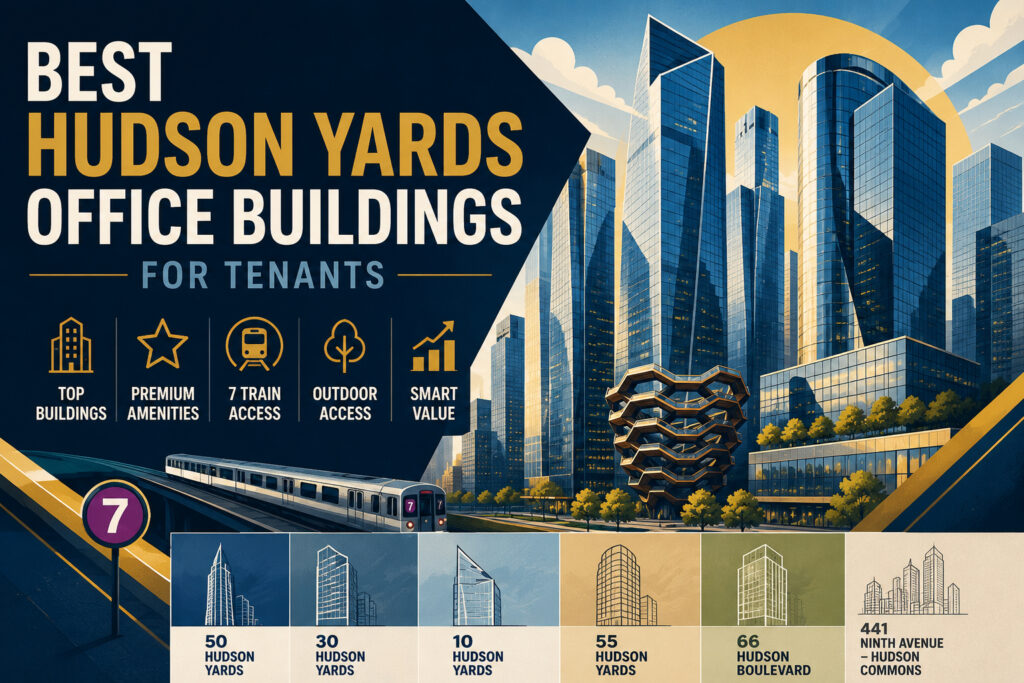
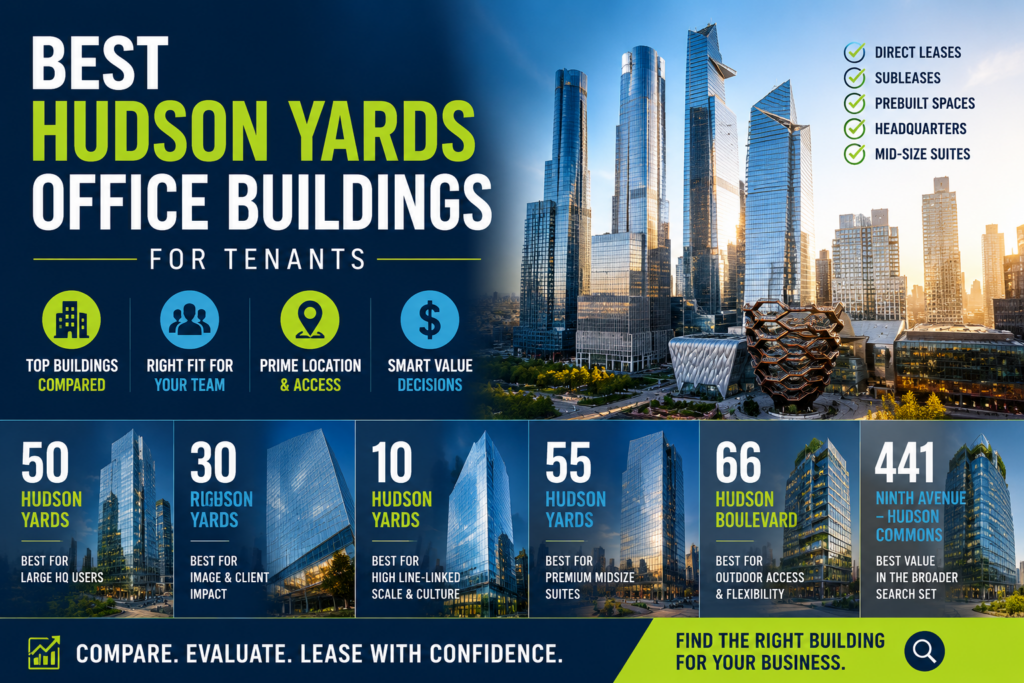
The short answer looks like this. 50 Hudson Yards fits the largest headquarters users best. 30 Hudson Yards wins when image and client impact matter most. 10 Hudson Yards gives modern, High Line-linked scale with strong culture appeal. 55 Hudson Yards stands out for premium midsize suites and a more traditional corporate tone. 66 Hudson Boulevard leads for outdoor access and flexible smaller direct options, while 441 Ninth Avenue – Hudson Commons often gives tenants the smartest value play in the broader search set.
Quick takeaway: there is no single best Hudson Yards office building for every tenant. There is only the best Hudson Yards building for your size, layout, commute, budget, and timing.
This guide covers direct leases, subleases, and prebuilt suites. It does not confuse long-term office strategy with short-term coworking inventory. That distinction matters because the district attracts tenants who care about permanence, recruiting, hospitality, and operational performance, not just a mailing address.
What tenants should compare before they rank any building
Start with the commute. Hudson Yards works best when a building gives easy access to the 7 train and a walkable route to Penn Station, Moynihan, NJ Transit, LIRR, and Amtrak. That is why the core towers remain strong for headquarters users and why Penn-adjacent options keep appearing in the same search lane. The best address on paper can lose if the daily trip feels harder than a nearby alternative.
Then compare floor plates. Large, clean, column-free floors help tenants fit more people, reduce waste, and keep whole departments together. That matters most in 50 Hudson Yards, 30 Hudson Yards, 10 Hudson Yards, and 55 Hudson Yards. On the other hand, if you need a polished suite around 10,000 to 15,000 square feet, layout quality can matter more than raw size.
After that, look at occupancy speed. Hudson Yards no longer means a raw floor and a full build every time. Current visible options on our site include a 67,058 SF sublet, a 45,942 SF headquarters sublet, a 30,314 SF full-floor direct lease, an 11,907 SF furnished direct suite, a 10,853 SF furnished sublet, a 10,680 SF prebuilt direct suite, a 13,850 SF direct suite at The Spiral, and a 16,178 SF direct lease at Hudson Commons.
Amenities also separate these buildings. Some users want a formal headquarters experience with concierge, valet, and discreet arrivals. Others want terraces, daylight, lounges, and event space. 50 Hudson Yards emphasizes dedicated entrances, bike storage, valet parking, subway access, and concierge service. 66 Hudson Boulevard leans hard into landscaped terraces and a top-floor clubhouse. Hudson Commons adds terraces on nearly every level, a tenant lounge, conference space, parking, showers, and bike storage.
Finally, sort the building by tone. Some companies want a bold skyline statement. Some want a polished legal or finance feel. Others want a more design-forward culture signal. That difference explains why one tenant shortlists 30 Hudson Yards, while another picks 55 Hudson Yards or 10 Hudson Yards. “Best” starts to make sense only after you define what your team wants to project.
The best buildings by tenant profile
Best for true headquarters scale
50 Hudson Yards is the strongest answer for tenants that need scale first. The tower rises about 1,011 feet, totals roughly 2.9 million square feet, and delivers a full-block, column-free setup built for dense planning and major contiguous occupancy. The building also connects directly into the district’s wider transit, retail, dining, and infrastructure network, which helps large occupiers run a smoother daily operation.
This tower also suits tenants that want a modern hospitality layer around a large office footprint. Official materials emphasize dedicated entrances, bike storage, seamless subway access, valet parking, and concierge service. For many tenants, that package matters as much as height. It reduces friction for staff, visitors, and senior leadership.
Current visible space confirms that the building is not only for giant full-floor users. Our site also shows an 11,907 SF furnished direct suite in the tower. That makes 50 Hudson Yards unusually strong because it can serve both the mega-user and the tenant who wants trophy quality without taking a massive block.
Best for image, skyline presence, and client impact
30 Hudson Yards remains the district’s clearest prestige answer. The tower contains about 2.6 million square feet, reaches 1,296 feet at the tip, and offers direct access to the 7 line plus easy walking access to Penn Station. It works well for tenants that want scale, views, and a strong arrival sequence for clients.
The building also supports real headquarters functionality. Our current 45,942 SF headquarters sublet spans two floors and includes 18-foot ceilings, branding potential, event and conferencing space, a sky lobby food hall and café, wellness amenities, and access to a 7,000-square-foot terrace. That is not generic trophy marketing. That is the kind of package that can change how a firm uses its office.
If your search intent centers on “nicest” or “most impressive,” 30 Hudson Yards belongs on the shortlist. Yet its best fit stays narrow. This tower suits companies that want scale and visibility more than quiet privacy. Teams that prefer a less theatrical environment often land elsewhere.
Best for culture, branding, and modern creative-corporate use
10 Hudson Yards gives tenants a different kind of strength. The building rises about 895 feet, contains roughly 1.8 million square feet, holds LEED Platinum certification, and connects directly to the High Line and the surrounding public realm. That last point matters because very few major Midtown office buildings feel this integrated with outdoor space and the neighborhood around them.
This is the building for teams that want a polished headquarters feel without the hardest-edged supertall identity. It tends to fit creative-corporate companies, consulting groups, design-led firms, and brands that value employee experience as much as traditional prestige. Large users also benefit from clean planning grids, strong daylight, and efficient floor plates.
The visible space mix makes that flexibility clear. Our pages show a 67,058 SF sublet, a 30,314 SF full-floor direct lease, a 23,324 SF furnished option, and a 20,222 SF furnished option. In other words, 10 Hudson Yards can work for a major user, a growth-stage firm, or a tenant that needs sharper occupancy timing.
Best for a more traditional premium corporate tone
55 Hudson Yards often fits the best tenant brief when a company wants Hudson Yards quality without the loudest tower profile. The building totals about 1.3 million square feet, rises 780 feet, sits just across from the 7 station, and carries LEED Gold certification. It also features large, column-free floors and generous ceiling heights.
That combination makes 55 Hudson Yards especially strong for law, finance, private capital, and professional services users. These tenants usually value layout discipline, executive office potential, efficient perimeter rooms, and a refined client-facing tone. The building delivers that tone better than more overtly design-driven options.
The current visible suite sizes reinforce the point. Our site shows a 10,853 SF furnished sublet and a 10,680 SF prebuilt direct suite. Both layouts lean office-heavy and client-friendly. For many midsize tenants, that matters more than a giant tower lobby.
Best for outdoor access and flexible premium suites
66 Hudson Boulevard stands out because its value proposition is easy to understand. The tower rises 1,031 feet, spans 2.85 million square feet, and builds outdoor space into the experience on every floor through its cascading terraces. Official materials also show smaller “Spiral Suites” with custom layouts, furnishings, full amenity access, ready-from-day-one delivery, and flexible terms up to 11 years.
This makes 66 Hudson Boulevard one of the best answers for tenants who want Hudson Yards energy but do not need a giant block. Many floors measure about 43,348 RSF, yet the official suite inventory also includes 5,700 SF, 8,968 SF, 10,517 SF, and 13,850 SF options on higher levels. That range is rare in a trophy-quality tower.
Our site currently links to an Office Space at the Spiral at 13,850 square feet, and the building page lists other visible options at 20,840, 10,517, and 8,968 square feet. For tenants that want daylight, fresh air, terraces, hospitality, and a direct lease path under full-floor size, 66 Hudson Boulevard deserves serious attention.
Best value in the broader Hudson Yards search set
441 Ninth Avenue – Hudson Commons belongs in this conversation because tenants search broadly, not by strict neighborhood lines. The building totals about 710,211 square feet, offers floor plates from roughly 16,000 to 50,000 square feet, includes 14-foot slab heights, and places terraces or balconies on nearly every level. It also adds an 8,000-square-foot lounge and conference center, bike storage, showers, café service, and parking for up to 140 vehicles.
This is the best answer for tenants who want modern West Side space without paying full flagship-tower positioning for every square foot. It brings design, outdoor space, and amenity strength, yet it usually feels less formal and less expensive than the most prominent Hudson Yards addresses. That difference can create real leverage for midsize tenants.
A current example on our site is Hudson Yards Offices for Lease at 16,178 square feet. The listing highlights floor-to-ceiling glass, LEED Platinum status, and outdoor space on nearly every floor. For many tenants, this is where “best” means smartest, not flashiest.
Best future option for tenants planning ahead
If your move date sits farther out, watch 70 Hudson Yards. The project broke ground in June 2025, sits directly adjacent to the 7 train, and is expected to span about 1.4 million square feet with late-2028 completion targeted in current reporting. That matters because true new supply at the top end of Manhattan remains limited.
This is not a current move-in answer. Still, it belongs on the list for tenants planning large future relocations. Search intent around “best Hudson Yards buildings” already includes the next wave of product because the district’s strongest users often plan years ahead, not months ahead.
What the market looks like right now
Hudson Yards still commands a real premium. Our current district guide places the area around $120 per square foot, while public inventory in the neighborhood often lands from the low $120s into the $150s. The same page contrasts that with lower Manhattan-wide and Midtown average asking rent figures, which helps explain why Hudson Yards attracts tenants that prioritize building quality, efficiency, and image over pure rent minimization.
That premium also sits inside a tighter high-end market. In June 2026, Cushman reported that direct availability across 32 Manhattan trophy towers had dropped to 4.4% of inventory. JLL also reported that Manhattan sublease inventory fell below 11 million square feet in Q2 2026, less than half the late-2022 peak. Those two signals matter because they show why premium space now draws faster attention and why good subleases disappear sooner.
Visible Hudson Yards inventory on our site confirms that the district now offers several leasing paths at once. You can target sublet scale through the 67,058 SF option or the 45,942 SF headquarters block. You can pursue direct, faster occupancy through the 30,314 SF full-floor unit, the 11,907 SF furnished suite, the 10,680 SF prebuilt suite, the 13,850 SF suite at The Spiral, or the 16,178 SF Hudson Commons option.
So when should a tenant act? Act early if you need a large direct block, a unique terrace package, or a prebuilt suite in a flagship tower. Act more selectively if you can use a sublet, because sublets can still create value and speed, but the best ones now face stronger competition than they did even a year ago.
How to choose the right building for your requirement
If you need under 15,000 square feet
Start with 55 Hudson Yards, 66 Hudson Boulevard, 50 Hudson Yards, and Hudson Commons. They currently show the most useful mix of direct suites, furnished options, terrace-driven offices, and polished client-facing layouts in the 8,000 to 15,000 square foot range.
If you need 15,000 to 35,000 square feet
Focus on 10 Hudson Yards, 66 Hudson Boulevard, and Hudson Commons. That range tends to reward tenants who compare layout efficiency, move-in timing, and transit convenience, not just tower prestige. A 30,000-square-foot full floor can feel dramatically different from a 20,000-square-foot partial, even when both sit in trophy inventory.
If you need more than 35,000 square feet
Move 50 Hudson Yards and 30 Hudson Yards to the top. Keep 10 Hudson Yards close behind. Then watch 70 Hudson Yards if your timeline stretches. At this size band, real scale, elevator performance, stacked-block continuity, and branding value start to outrank boutique charm.
If you need faster occupancy
Look for prebuilt direct space and quality sublets first. Right now the best visible examples include the 11,907 SF furnished direct suite, the 10,680 SF direct prebuilt suite, the 10,853 SF furnished sublet, the 13,850 SF direct suite at The Spiral, and the 16,178 SF direct lease at Hudson Commons.
If commute drives the decision
Bias toward the buildings that give the cleanest 7 train access and the shortest Penn walk. That usually keeps 30 Hudson Yards, 50 Hudson Yards, 10 Hudson Yards, 55 Hudson Yards, and 1 Manhattan West in the same touring set. Search engines reflect that overlap because tenants compare the West Side user experience as one ecosystem, not as separate silos.
Questions tenants usually ask
Is Hudson Yards only for huge tenants
No. The district earns its reputation from large headquarters blocks, but the current visible market also includes multiple suites around 10,680 to 13,850 square feet, a 16,178 square foot direct lease, a 30,314 square foot full floor, a 45,942 square foot headquarters sublet, and a 67,058 square foot multi-floor sublet. That range is far broader than many tenants expect.
Which building gives the best outdoor experience
66 Hudson Boulevard leads that category because terraces reach every tower floor and the building adds a top-floor clubhouse with an open-air terrace. 10 Hudson Yards also scores well because of its direct High Line relationship. Hudson Commons stays competitive because nearly every level offers terrace or balcony access.
Which building feels most polished for legal, finance, or private capital users
55 Hudson Yards usually fits that brief best. Its floor plates are large and column-free, the building sits just across from the 7 station, and the current visible inventory includes office-heavy 10,853 and 10,680 square foot suites that support a more traditional professional-services layout.
Which building works best for a statement headquarters
50 Hudson Yards wins when contiguous scale matters most. 30 Hudson Yards wins when skyline presence and client impression sit at the center of the brief. Many large tenants tour both because the final choice often comes down to tone, not quality.
Do nearby Penn and Hudson Boulevard buildings count in this search
Yes, in practice they do. The uploaded SERP scan shows search engines mixing core Hudson Yards towers with nearby West Side buildings, maps, listing pages, and broader office guides. That reflects real tenant behavior. Users often search “Hudson Yards” even when the winning space ends up on Hudson Boulevard or closer to Penn.
Which class of office buildings command the highest rents here
Trophy and top-end Class A buildings command the highest rent. Hudson Yards sits above broader Manhattan averages because the district offers new construction, stronger systems, better amenities, and cleaner large-block planning. Current reporting also shows that supply in Manhattan’s top trophy stock has tightened sharply, which supports rent resilience at the high end.
What is the best single rule for choosing a Hudson Yards building
Match the building to the business model. Choose 50 Hudson Yards for scale, 30 Hudson Yards for presence, 10 Hudson Yards for culture, 55 Hudson Yards for premium midsize suites, 66 Hudson Boulevard for terraces and flexible premium space, and Hudson Commons for value inside the same West Side conversation.
Looking for an Office
We represent tenants, not landlords. That matters in Hudson Yards because the district rewards precise matching, not generic touring. If the goal is to secure the right building, the right lease structure, and the right timing, the smartest move starts with a tenant-first comparison, not a building-first pitch.
Fill out our 📋 online form or give us a call today 📞 212-967-2061 — let’s find the right options for your business.