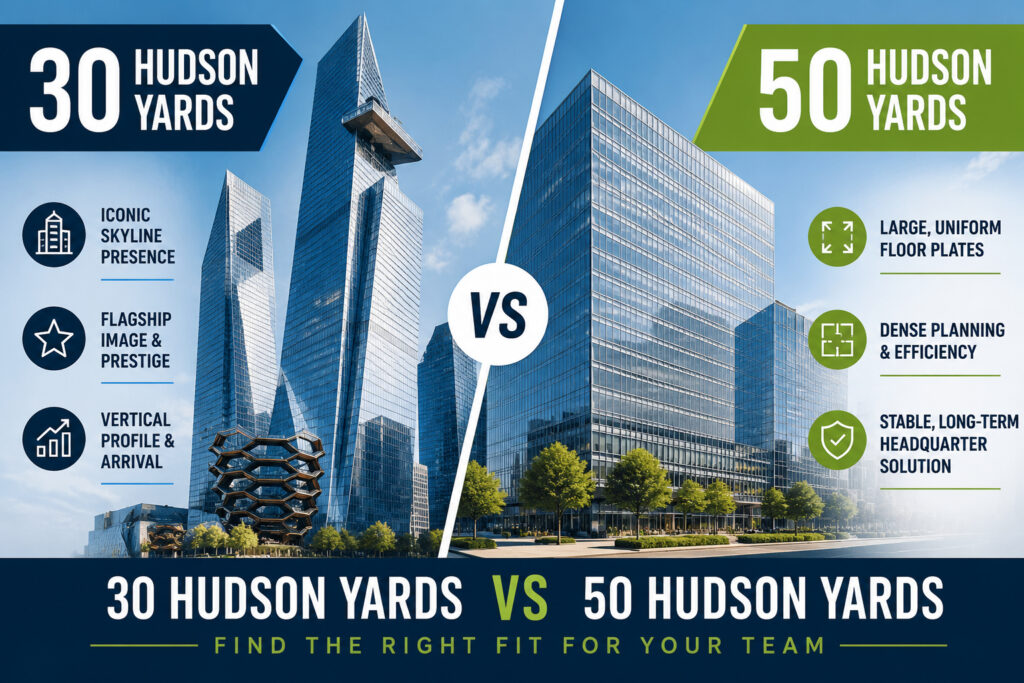
30 Hudson Yards vs 50 Hudson Yards Office Space
Two buildings dominate this decision. Both sit in Hudson Yards. Yet each one solves a different office problem.
One tower wins on skyline presence. The other wins on raw operational scale. Because of that, the right choice depends less on prestige alone and more on how your team works.
We represent tenants only. We compare buildings through fit, timing, economics, and leverage. Then we help you tour, negotiate, and secure the space that works best.
If you want the district view first, start with our broader Hudson Yards office space guide. If you already know the neighborhood and need the cleanest building comparison, keep reading.
Start with the short answer
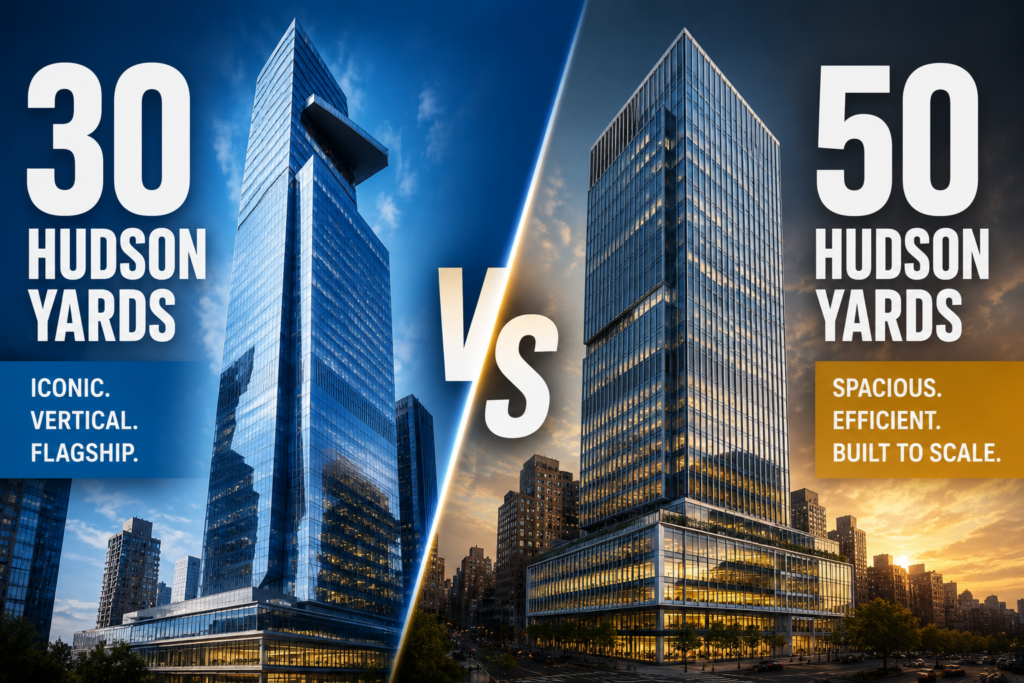
30 Hudson Yards usually fits firms that want a stronger visual identity, a more vertical corporate profile, and a true flagship feel. The tower rises higher, feels more dramatic, and delivers a sharper sense of arrival.
By contrast, 50 Hudson Yards usually fits firms that need larger, more uniform floor plates, denser planning, and cleaner long-term headquarters efficiency. The building feels broader, calmer, and more operationally powerful.
That difference matters. It shapes headcount per floor. It shapes build-out strategy. It shapes how clients, recruits, and employees experience the office every day.
Here is the fastest way to frame the choice:
| Category | 30 Hudson Yards | 50 Hudson Yards |
|---|---|---|
| Best overall fit | Flagship identity, brand presence, executive profile | Large-scale headquarters, dense planning, major contiguous blocks |
| Approximate size | About 2.6 million square feet | About 2.9 million square feet |
| Height and scale | Taller, slimmer, more vertical | Shorter, broader, more full-block |
| Floor plate feel | Large, but more tailored by stack and elevation | Very large, highly efficient, more uniform |
| Best for | Finance, media, client-facing leadership teams | Big enterprise users, institutional groups, major consolidations |
| Arrival experience | More theatrical and skyline-driven | More private, polished, and discreet |
| Tenant impression | Iconic and high-profile | Powerful and quietly elite |
| Headcount logic | Strong for premium multi-floor identity | Strongest for big floor loads and dense team planning |
| Amenity tone | Lifestyle energy and destination value | Privacy, hospitality, and controlled executive convenience |
| Decision in one line | Choose 30 for profile | Choose 50 for scale |
If your company wants the building to say something before a meeting starts, 30 often wins. If your company wants the floor plate to solve years of growth, 50 often wins.
What each building actually offers
30 Hudson Yards sits at 500 West 33rd Street. The tower rises above 100 stories and reaches roughly 1,296 feet. It brings river-to-river views, a dramatic lobby experience, direct access to the district’s retail core, and a strong destination feel.
That last point matters more than many tenants expect. The office does not feel isolated. Instead, it feels embedded in a full, modern district. Teams that care about energy, brightness, and client impression tend to feel that difference fast.
50 Hudson Yards sits at 415 Tenth Avenue, near West 34th Street. The building spans a full block and contains roughly 2.9 million square feet. It rises to about 58 stories and a little over 1,000 feet, but height is not the story here. Size is.
The tower brings very large floor plates, private sky-lobby style experience, strong security, and cleaner large-user functionality. In simple terms, 50 does not try to feel taller. It tries to work better for huge occupancies.
That creates a real contrast.
30 Hudson Yards feels like a landmark office tower with exceptional scale.
50 Hudson Yards feels like a headquarters machine with extraordinary polish.
Neither framing is better by itself. The right answer depends on what your lease must accomplish.
Floor plates, planning, and headcount
This is where the decision gets real.
Most tenants start with views, branding, and neighborhood buzz. Smart tenants finish with floor plates, core position, usable perimeter, and stacking logic. Those factors decide how the office actually performs.
30 Hudson Yards offers large floors and strong planning flexibility. It can support headquarters occupancy, major trading uses, and premium executive layouts. Lower floors can handle very large populations. Upper floors then sharpen the identity story through elevation, light, and view lines.
Still, 30 often feels more vertical in how it organizes a company. That can help firms that want leadership floors, client-facing levels, separate operating groups, or a more segmented stack. It often suits businesses that like a layered internal hierarchy.
50 Hudson Yards gives you a different advantage. Its floor plates run bigger, broader, and more consistently efficient. Several floors can support exceptional density. Some users can place more than 500 people on a single floor, which remains rare in Manhattan.
That changes everything for a headquarters search.
Large floor plates reduce inter-floor friction. They simplify circulation. They tighten communication paths. They also lower the daily drag that comes from spreading one team across too many levels.
So ask one direct question:
Do you want the company to rise through the building, or spread across powerful floors?
If you want the first answer, 30 deserves a hard look. If you want the second answer, 50 often pulls ahead.
How this affects different layout styles
A law firm or advisory group may care about perimeter office count, reception quality, and client-facing conference placement. In that case, both towers can work, but 30 often feels more statement-driven.
A financial user may care about floor load, infrastructure, security, and trading or high-density planning. That logic often tilts toward 50, although select floors at 30 can still work very well.
A media or executive-heavy occupier may favor image, vertical prestige, dedicated identity, and a stronger “top of the market” presence. That pattern often favors 30.
A large enterprise that wants to consolidate scattered teams into a more efficient home usually prefers 50. The reason stays simple. Bigger, more uniform plates create fewer compromises.
What smaller tenants should know
Neither tower starts as an obvious answer for small teams. Hudson Yards inventory skews larger. Trophy economics also hit smaller users harder.
That does not rule out the buildings. It just changes the path.
Smaller tenants usually enter through a polished prebuilt, a furnished suite, or a sublease. That route can cut construction time and reduce initial cash burn. If speed matters more than custom build-out, that route often makes more sense.
For current examples, we can show a high-floor Furnished Hudson Yards Office that aligns with the big-block, polished feel many tenants associate with 50 Hudson Yards. On the 30 side, we can also show a headquarters-style Hudson Yards Office Space Headquarters opportunity for users that need larger scale and stronger identity.
Image, arrival, and daily experience
Some office decisions live on spreadsheets. This one does not.
Both towers command respect. Both deliver premium finishes. Both support top-tier workplace design. Yet the emotional feel changes the moment you arrive.
30 Hudson Yards projects height, drama, and skyline signal. It feels like a destination. The lobby, the vertical rise, and the link to one of the district’s major attractions all add energy. For some firms, that helps recruiting. For others, it helps client perception. For leadership teams, it can reinforce a corporate story.
50 Hudson Yards feels more controlled. The building reads as private, broad-shouldered, and composed. Its arrival experience leans less theatrical and more executive. That works especially well for firms that value discretion, security, and institutional seriousness.
Put another way:
30 Hudson Yards says, “Look where we are.”
50 Hudson Yards says, “Look how well this works.”
Neither tone wins every assignment.
If your firm entertains clients often, hosts recruiting events, or wants the office to feel unmistakably iconic, 30 can carry that burden elegantly. If your firm wants a quieter luxury, more discreet movement, and a less public-facing identity, 50 may feel smarter.
Lifestyle versus privacy
30 ties more directly into the district’s lifestyle story. Employees notice the neighborhood energy. Visitors notice the views. The building feels woven into retail, dining, and public activity.
50 brings excellent convenience too, but the tone shifts. It emphasizes privacy, refined hospitality, and controlled access. That distinction matters for executive teams, regulated users, and firms that prioritize operational calm.
The result does not show up on a stacked plan. Still, it shows up every day in how the workplace feels.
Commute, access, and neighborhood feel
Both buildings benefit from Hudson Yards access and the West Side’s upgraded connectivity. The 7 train matters. Penn Station matters. Moynihan matters. The district now works far better than the old “too far west” label suggests.
30 Hudson Yards enjoys a direct underground connection to the 7 train and sits close to the retail core. That supports a smooth employee routine. Teams can move between transit, office, and amenities with very little friction.
50 Hudson Yards also offers excellent access, including a direct relationship to the subway and a very strong walk to Penn Station and Moynihan. That makes it a serious contender for companies with regional commuters from New Jersey, Long Island, Westchester, and Connecticut.
No tenant should treat this as a tie without context.
For some users, 30 feels more plugged into the center of the campus. For others, 50 feels slightly easier for broader commuter flow and private arrival patterns. Your employee map decides which difference matters more.
Which building feels better during the workday
30 often feels more animated. Teams step out into a more active district environment. Lunch, retail, and informal meeting options feel close at hand.
Meanwhile, 50 can feel more self-contained. Employees still get the neighborhood benefits, but the tower itself offers a more insulated daily rhythm. Some firms love that. Others want more buzz.
A tenant with a younger, client-facing, culture-heavy team may lean toward 30. A tenant with a more private operating style may feel stronger alignment with 50.
Pricing, availability, and deal structure
Tenants often ask one version of the same question:
Which building costs more?
The honest answer is that both sit at the top end of the West Side market. Exact economics shift by floor, condition, lease term, timing, view line, landlord work, and market leverage. One headline rent never tells the full story.
Still, there are patterns.
50 Hudson Yards often carries a sharper premium for top-tier direct space, especially when the space sits high, arrives prebuilt, or offers strong identity and immediate occupancy. The building’s scarcity, scale, and institutional appeal support that premium.
30 Hudson Yards can price aggressively too, but the story often changes more by situation. Direct deals, recaptured space, and sublease inventory can produce wider variation. That means 30 sometimes presents more opportunistic angles if timing lines up.
So do not reduce this choice to face rent.
Look at these five items instead:
First, how much work the space needs.
Next, how long the landlord needs to deliver it.
Then, how much free rent supports the deal.
After that, how much improvement money comes with the lease.
Finally, whether a sublease can buy speed and discount.
Those items decide the real number.
Availability changes the strategy
Inventory in these towers moves fast. Large blocks do not sit forever. Quality subleases can disappear even faster.
That creates two different leasing paths.
If you need a custom headquarters with a long planning window, direct space matters more. If you need speed, prebuilt delivery, or a cleaner initial capital story, sublease and furnished options matter more.
For tenants that need more context before comparing live options, our Hudson Yards office space cost guide breaks down the economics that usually move a West Side deal. If your team expects sublease inventory to drive the decision, our Hudson Yards sublease office space page will help frame what to watch.
Which tenants fit each tower
This page works best when it tells you not just what the buildings are, but who usually fits them.
30 Hudson Yards usually fits best if your firm wants:
A sharper skyline identity.
A more vertical headquarters story.
A more dramatic client arrival.
Large floors with a stronger flagship feel.
A workplace that blends office power with neighborhood energy.
That profile often suits finance, media, executive-heavy firms, leadership-driven occupancies, and companies that treat office image as a real business tool.
50 Hudson Yards usually fits best if your firm wants:
Massive contiguous floors.
Cleaner departmental consolidation.
A more private executive tone.
High-density planning with fewer compromises.
A building that feels built for scale first.
That profile often suits giant enterprises, institutional users, major financial occupiers, large technology groups, and firms that need the office to function like a platform.
When 30 wins even if 50 looks bigger
Sometimes a company does not need the largest plate. It needs the best story.
A premium advisory group may care more about identity than density. An executive-led firm may value image, elevation, and client impact over maximum efficiency. A branded company may want “wow” more than “spread.”
In those cases, 30 can beat 50.
When 50 wins even if 30 looks more iconic
Sometimes the opposite happens.
A company may admire 30, then realize the operating model demands consolidation, growth flexibility, and large single-floor teams. Once that becomes clear, 50 often wins because the stack solves the business more cleanly.
That is why tenants should never stop at impressions. Beauty matters. Workflow matters more.
Questions tenants usually ask before touring
Is 30 Hudson Yards better than 50 Hudson Yards?
Not overall. It is better for certain goals. Choose 30 when identity, skyline profile, and client impression steer the search. Choose 50 when large-floor efficiency, security, and consolidation lead the brief.
Is 50 Hudson Yards bigger than 30 Hudson Yards?
Yes. 50 Hudson Yards contains more square footage. It also offers larger, more uniform floor plates. That gives it the edge for major headquarters users.
Which tower feels more prestigious?
Both sit in the trophy tier. Still, prestige expresses itself differently. 30 feels iconic and visible. 50 feels elite and controlled. Your brand decides which version fits better.
Which building works better for a headquarters?
For most very large headquarters searches, 50 usually has the advantage. Its floor plates, stacking logic, and enterprise efficiency make long-term planning easier. Yet 30 remains a strong headquarters choice for firms that value profile as much as planning.
Which building feels better for clients?
That depends on what you want them to feel. 30 creates a more dramatic impression. 50 creates a more discreet one. High-energy brands may prefer 30. Private capital or institutional groups may prefer 50.
Which building works better for employees?
Both offer excellent workplace conditions. The split comes down to culture. Employees who value buzz, destination feel, and visual drama may lean toward 30. Employees who value calm, scale, and a more refined daily rhythm may lean toward 50.
Which building offers better views?
30 usually wins the pure skyline drama question because of height. 50 still delivers major views, especially on upper floors, but the tower sells scale and quality more than altitude.
Which one makes more sense for a fast move?
A polished sublease or furnished suite can change the answer fast. In practice, the best fast-move option depends on live inventory, not the tower name alone. We track that closely and can point you to space that matches your move date.
What if we need 10,000 to 20,000 square feet?
That size band can work in either building, but inventory rules the outcome. Prebuilt and furnished suites often matter most there. For related options across the district, see our Hudson Yards office space for lease and Hudson Yards office space for rent pages.
What if we need 40,000 square feet or more?
That is where the comparison becomes especially important. Large users should study floor plate efficiency, core placement, stacking flexibility, elevatoring, and future expansion rights. At that scale, 50 often gains ground, but 30 still competes strongly when image and multi-floor identity matter.
The final verdict for tenants
30 Hudson Yards and 50 Hudson Yards do not compete on the same terms. They share a neighborhood, but they serve different priorities.
Choose 30 Hudson Yards if you want a true flagship address, a stronger skyline signature, and a workplace that feels elevated in every sense. It works best when brand impact, front-door impression, and executive presence matter as much as pure efficiency.
Choose 50 Hudson Yards if you need large, powerful floors, clean departmental planning, and a quieter form of prestige. It works best when scale, operational discipline, and long-term headquarters logic shape the decision.
If you are still deciding, do not start with the building brochure. Start with your headcount, floor needs, move date, build-out appetite, and the image you want the office to project. That process almost always reveals the right tower.
Your Office Inquiry
For a fuller neighborhood ranking, visit our guide to the best Hudson Yards office buildings for tenants. If you want the leasing roadmap next, review how to lease an office in Hudson Yards. When you are ready to compare live options, we will build the list around your timing, square footage, and goals rather than forcing your requirement into the wrong building.
Fill out our 📋 online form or give us a call today 📞 212-967-2061 — let’s find the right options for your business.