Hudson Yards Office Space for Rent
Hudson Yards Office Space for Rent
This guide clears up that confusion. Here, “office space for rent” means every tenant-facing option that a real occupier may consider in Hudson Yards. That includes direct leases, subleases, furnished space, move-in-ready suites, and short-term flexible options.
Why this search gets messy
Google and the other engines do not read this keyword one way. Some results treat it as a broad neighborhood search. Other results treat it as a request for a single tower, a directory of live listings, a flexible office solution, or a quick answer to pricing and location questions. The supplied SERP file shows all of those intent lanes at once.
That split matters. A building page may answer architecture, tenants, or floor plans. A directory page may show counts, asking rents, and filters. A flexible office page may quote monthly seat pricing instead of annual rent per square foot. When tenants compare those pages without context, the market looks more contradictory than it really is.
What renters usually need first
Most renters need four answers right away. First comes location fit. Next comes deal type. Then comes real budget. After that, timing decides which spaces actually work.
Hudson Yards helps tenants who want newer buildings, strong transit access, polished amenities, and a west-side location near Penn Station and the High Line. The SERP capture also shows Google highlighting direct 7 train access, a short walk to Penn Station, newer LEED-certified towers, river views, and amenity-rich office stock.
If you want a broader district overview before drilling into rentals, start with Hudson Yards office space. When you want a narrower inventory path, review Hudson Yards office for rent and compare it with Hudson Yards office space for lease.
Where Hudson Yards Fits in Manhattan
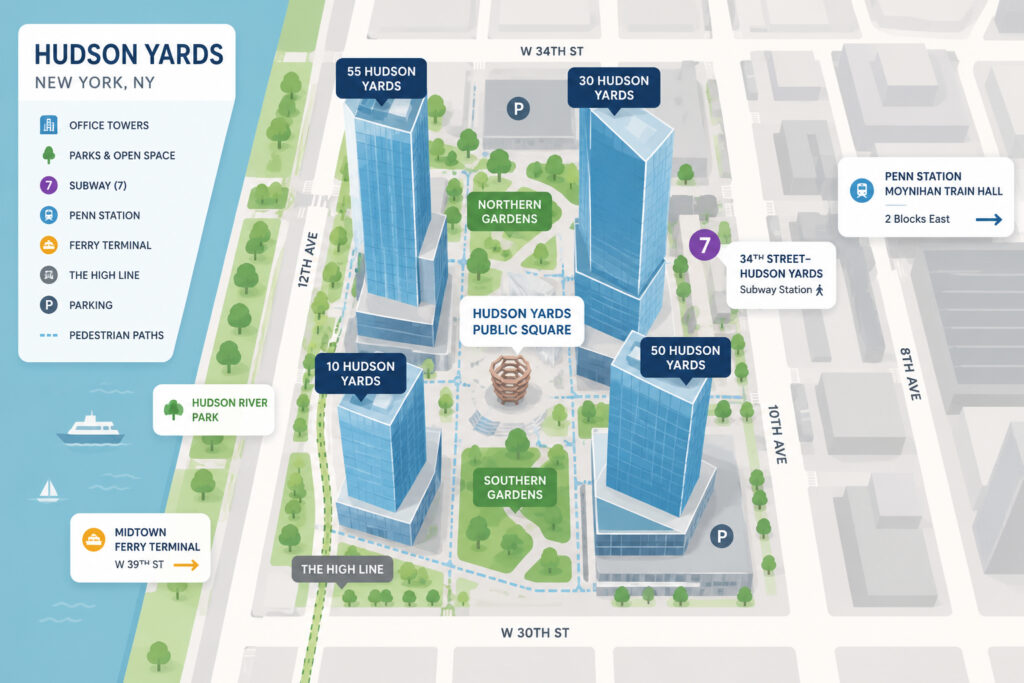
Hudson Yards sits on Manhattan’s Far West Side. For most tenants, that means modern inventory near the west side of Midtown, the 34th Street-Hudson Yards subway stop, Penn Station, Moynihan Train Hall, and the High Line. The SERP file highlights that transit picture directly, and broader market reporting shows why newer west-side inventory keeps attracting demand.
The neighborhood wins tenants for practical reasons. Newer buildings support stronger HVAC, better elevator systems, larger glass lines, better light, and heavier amenity programs than much of older Midtown stock. Recent reporting also shows that companies moving into newer Hudson Yards offices have used better workplace quality to pull more people back on-site.
Why modern space matters here
Recent Manhattan leasing data points in one direction. Tenants still compete hard for premium office product, even while older inventory struggles. The Wall Street Journal reported that Manhattan leased 23.2 million square feet in the first nine months of 2025, the strongest pace for that span since 2006, while competition for premium space kept pushing rents higher. Reuters also reported renewed investor appetite for top-quality New York offices as return-to-office patterns strengthened.
That context matters in Hudson Yards. This submarket caters to occupiers who value high image, efficient build-outs, newer systems, and strong employee experience. As a result, the district tends to attract finance, law, consulting, media, enterprise, and technology users rather than pure bargain hunters.
Why some search results focus on one building
Many search results narrow to a single tower. Others surface floor plans, owners, or tenant rosters. The SERP capture makes that clear through building-specific results and related follow-up questions.
For a renter, though, building trivia should stay secondary. Floorplate efficiency matters more than fame. Lease form matters more than curiosity. Management quality, expansion room, build-out condition, delivery timing, and economics should drive the decision long before a tenant gets pulled into a single-building rabbit hole.
If you want a district-level route, not a single-building route, browse Hudson Yards offices and then compare Hudson Yards office for a different path into the neighborhood.
What Rent Means in Hudson Yards
“For rent” does not mean one thing here. In Hudson Yards, the phrase covers several occupier formats. The SERP file shows that broad interpretation clearly through direct-lease marketplaces, flexible office operators, building pages, and tenant-guides that reference lease, sublease, and furnished inventory together.
Direct lease
A direct lease usually fits tenants who want control, branding, and longer-term stability. This option works well when a company needs custom rooms, dedicated reception, security control, growth rights, or a more permanent hub.
Rents in this lane usually appear as annual cost per rentable square foot. In the supplied SERP file, Google’s AI summary places Hudson Yards office space at roughly $80 to $150+ per square foot per year, while another current listing portal snippet shows an average of $85.78 per square foot. That range tells you the submarket sits in the premium end of Manhattan, but it also shows why one quote should never define your budget.
Sublease
A sublease usually fits tenants who need speed, existing improvements, or shorter remaining term. This route can work well when a team wants built conference rooms, furniture, and immediate use without waiting for a full construction cycle.
Sublease inventory also changes faster than direct inventory. Manhattan-wide reporting from mid-2026 shows sublease supply shrinking sharply as tenants absorb space and landlords recapture some blocks for direct deals. That trend can tighten move-in-ready choices in premium areas, including west-side Manhattan.
Furnished and move-in-ready space
Furnished space sits between a classic lease and a flexible suite. In many cases, the key attraction is time. A built office with desks, meeting rooms, and cabling can save months of planning compared with raw space.
The SERP landscape for this keyword clearly reflects that demand. Bing surfaces our own neighborhood page with “lease, sublease, furnished offices, pricing, buildings, and tenant leasing guide” in the snippet, while other results surface ready-to-go or flexible formats in the same result set. That tells you searchers want immediate-use options, not only long-term blank canvases.
Flexible suites
Flexible suites serve smaller teams, project groups, and companies that want hospitality-style service with lower setup friction. This route helps when headcount may change fast or when a tenant wants to test the neighborhood before signing a larger lease.
That said, flexible space is not the whole market. The supplied SERP file shows one flexible-office result with five options and starting pricing from $500 per person per month, while Google’s AI summary states flexible or coworking choices often start around $500 to $1,000 per person per month. Those numbers can help a small team benchmark fast, but they do not replace a full market check across direct and sublease inventory.
Current Hudson Yards Costs
The most useful answer on price is not one headline number. Instead, renters should understand which pricing system a result uses and what inventory type it covers. The current SERP file shows why. One source snippet reports 13 office listings with an average price of $43 per square foot and a very large average size. Another shows 22 available spaces with an average of $85.78 per square foot. A third result on Bing shows 46 listings. Flexible-office results quote monthly seat pricing, not annual square-foot pricing.
Those figures do not actually conflict as much as they appear to. Large blocks can pull average size far upward. Directory feeds can differ by timing, geography, space type, and whether they include direct listings, subleases, partial floors, or broader map boundaries. Search engines also display stale counts at times, while available suites change daily.
A practical reading of the market
If you need a working benchmark, start here. Premium direct space in Hudson Yards usually lives in the upper Manhattan office band rather than the bargain band. The supplied SERP summary places that zone around $80 to $150+ per square foot annually, and recent Manhattan market reporting confirms that premium offices continue to outperform older stock on both demand and pricing.
If you run a small team, the better first budget may be monthly, not annual. Flexible suites in the SERP file begin around $500 per person per month, while Google’s summary pushes that early benchmark toward $500 to $1,000 per person per month. That makes flexible space easy to compare for teams that think in seats, not square footage.
Why averages fool renters
Average asking rent does not equal your deal. Nor does average size describe your real options. A marketplace with very large availabilities can report a lower or distorted average that tells you little about a 3,000-square-foot search.
Likewise, a premium portal may skew toward newer product and show a higher average. That still does not mean every tenant pays that figure. Build-out condition, floor height, window line, term, concessions, furniture, and landlord motivation can all shift real occupancy cost from one option to the next. Recent Manhattan reporting also shows that tenants continue to pay a premium for better product, while weaker offices lag behind.
What future supply could mean
Renters should also watch future delivery. Reporting in 2025 showed a major new Hudson Yards tower securing about 800,000 square feet from one occupier, with additional inventory still to lease before completion later this decade. That future supply may create new big-block options, but today’s high-quality inventory still competes in a tight premium market.
How to Choose the Right Hudson Yards Space
The right Hudson Yards office depends less on prestige and more on fit. Searchers come to this keyword from different angles, so the smartest way to choose space is to sort by team size, move-in timing, lease structure, and layout needs before you sort by building image.
Choose by team size
A very small team often values speed and all-in simplicity. In that case, a flexible suite or small furnished office may beat a direct lease on effort alone. The SERP file supports that pattern by surfacing flexible office results and per-person pricing alongside neighborhood office listings.
A growing team usually needs a different approach. Once headcount rises, layout efficiency starts to matter more than branding alone. Dedicated conference rooms, privacy, storage, and room to grow can shift the answer toward a prebuilt sublease or a direct lease with better test-fit efficiency.
A larger tenant, by contrast, should think first about block size and expansion path. Search-result averages show very large available blocks in the market mix, which means big users can sometimes find serious scale here. At the same time, that same large-block inventory can hide the true picture for smaller tenants.
Choose by timing
If you need to move fast, start with furnished and built space. That route cuts decision steps and usually narrows the number of vendors involved. When time matters most, the perfect raw space often loses to the very good office that already works.
If you have more time, direct leasing opens more control. Longer planning windows improve your choice set, especially in a premium district where layout, furniture, and employee experience all shape long-term occupancy quality. Manhattan market data shows that top-tier inventory remains competitive, so early action still matters.
Choose by layout, not just rent
Search results often surface floor-plan questions for Hudson Yards. That is not a distraction. It is a clue. Layout efficiency changes how far your rent dollars actually go.
A bright, efficient layout can support better density with fewer compromises. Poor planning does the opposite. Tenants should ask whether the space supports private offices, open seating, meeting rooms, pantry use, phone rooms, and future growth without wasting square footage on awkward dead zones.
Choose by lease form
Direct, sublease, furnished, and flexible space each solve a different problem. None is universally best. The supplied SERP file proves that renters use this phrase to find all four at once.
Use direct leasing when control matters most. Use sublease when speed and built improvements matter most. Use furnished suites when speed and convenience both matter. Use flexible space when headcount uncertainty makes a long commitment risky.
For a broader comparison of neighborhood inventory before you decide, use Hudson Yards office space as the starting point, then narrow to Hudson Yards office for rent for current tenant-facing options.
Hudson Yards Office Space for Rent FAQ
How much does it cost to rent an office in Hudson Yards
Current search-result data shows a premium direct-rent range around $80 to $150+ per square foot annually, with one listing source averaging $85.78 per square foot and another showing $43 per square foot across a different listing set. Flexible options in the current SERP file start around $500 per person per month, and Google’s summary pushes that working range toward $500 to $1,000 per person per month. In short, quote style and inventory type matter as much as the number itself.
Does Hudson Yards offer modern office space
Yes. The current SERP file highlights newer LEED-certified office towers, wellness-focused amenities, river views, and direct High Line access. Broader Manhattan reporting also shows that occupiers continue to favor newer, premium office product over older stock.
Where is Hudson Yards located
Hudson Yards sits on Manhattan’s Far West Side near the 34th Street-Hudson Yards subway stop, Penn Station, Moynihan Train Hall, and the High Line. The supplied SERP file states direct 7 train access and a short walk to Penn Station.
Why do search results show different numbers of listings
Because they index different inventory. Today’s SERP capture shows counts ranging from 13 to 46 listings, plus separate flexible-office results. Some platforms track large direct blocks. Others emphasize broader directory inventory, subleases, or flexible suites. Timing also changes the count because office availability moves fast.
Why do some pages focus on one tower instead of the whole neighborhood
Because this keyword carries both neighborhood intent and building intent. The supplied Google, Bing, and Yahoo screens all show building-level pages, marketplace pages, flexible-space pages, map results, and follow-up question prompts. Renters should use those pages for context, then return to a neighborhood-level comparison before choosing a space.
Is Hudson Yards only for very large tenants
No. Search results for this keyword include large direct blocks, smaller move-in-ready offices, furnished suites, and flexible options with per-person pricing. That means the neighborhood can work for enterprise users, mid-size firms, and smaller teams, but the right format changes by timing and budget.
Tenant Representation
We represent tenants only. That means we compare direct deals, subleases, furnished offices, and flexible options with your interests first. When you are ready, we can narrow Hudson Yards choices by budget, size, timing, layout, and lease type, then help you negotiate from strength.
Fill out our 📋 online form or give us a call today 📞 212-967-2061 — let’s find the right options for your business.