Hudson Yards Office Space for Lease
Hudson Yards Means Direct, Modern, High-Performance Office Space
For most tenants, Hudson Yards office space for lease means direct space in newer, highly amenitized buildings on Manhattan’s Far West Side. It usually points to landlord-controlled space, not a short sublease, not a coworking membership, and not a vague neighborhood overview. In practice, tenants want clear answers on cost, size, location, term, build-out, timing, and negotiating leverage.
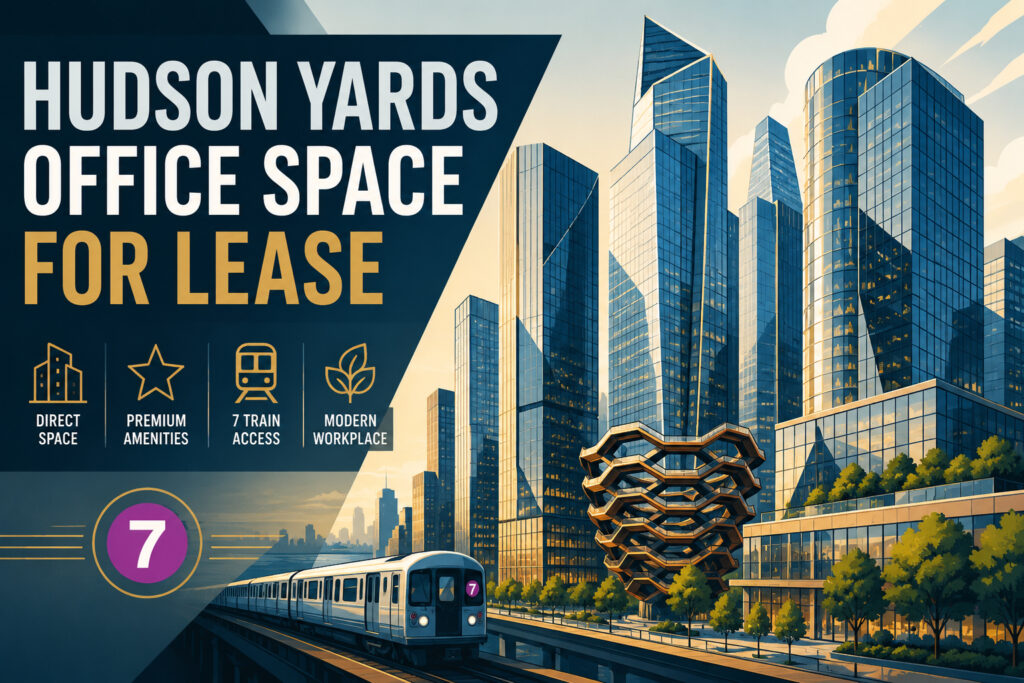
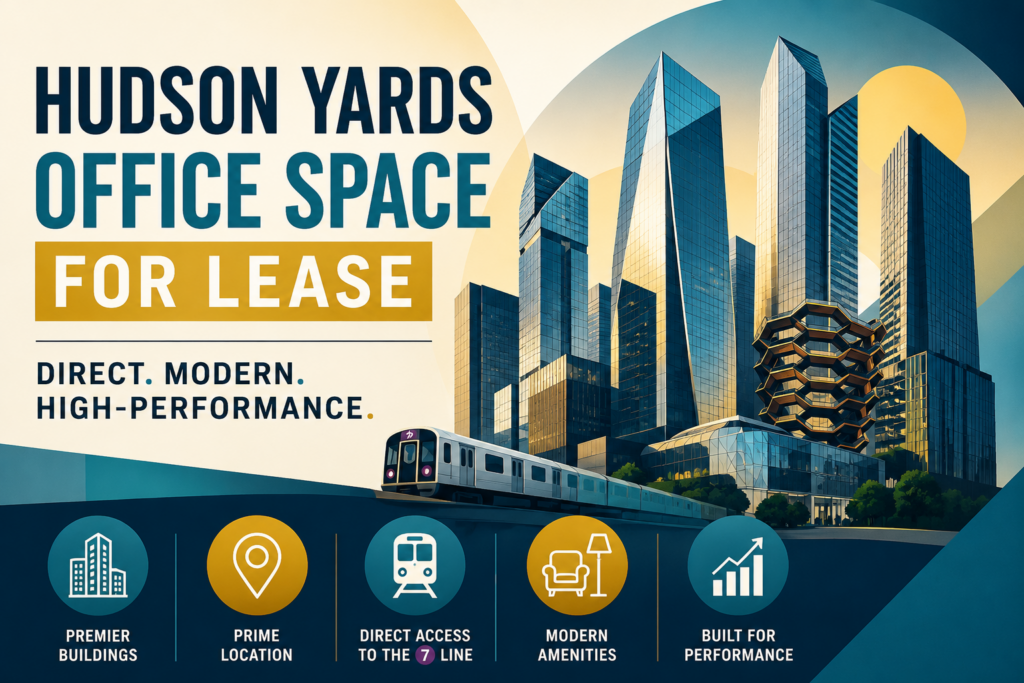
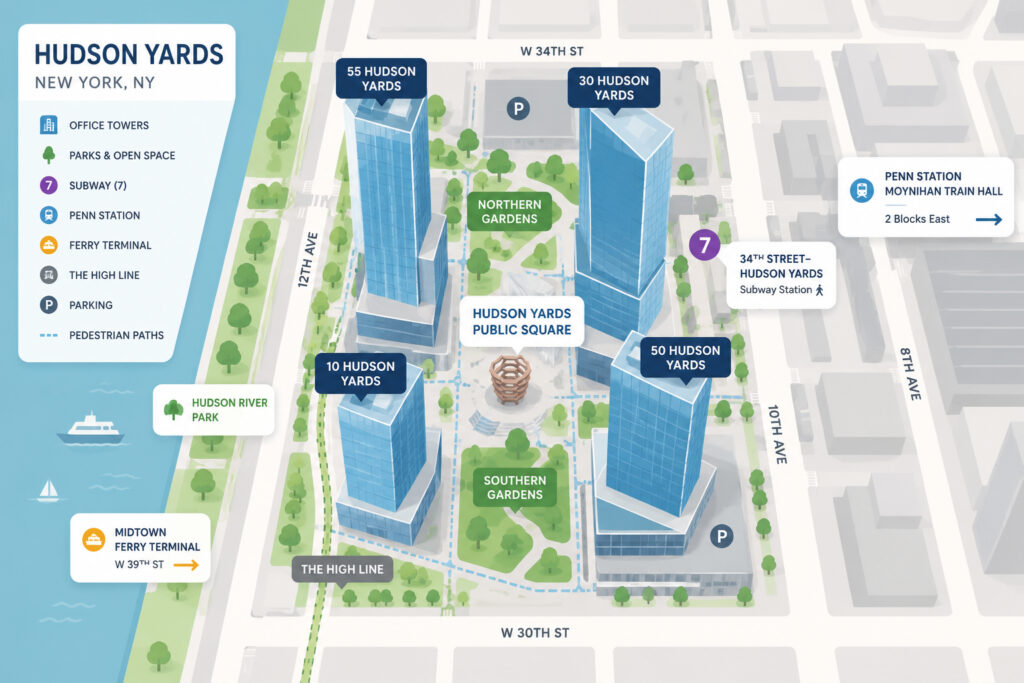
Hudson Yards stands apart because the district clusters large, modern office product in one place. The neighborhood includes major office towers with direct access to the No. 7 subway line, strong public-space design, and immediate connections to retail, dining, hotel, and outdoor amenities. One tower links directly to the High Line. Another sits across from the subway entrance. A newer tower in the district offers terraces on every floor and a top-floor amenity club.
That package matters more now than it did a few years ago. Manhattan office demand has shifted toward high-quality buildings with better transit access, stronger amenities, and better in-office attendance patterns. Recent market reporting shows direct availability at 32 trophy towers shrank to 4.4% of inventory, while Manhattan office utilization also outperformed other major U.S. cities.
What Counts as Hudson Yards Office Space for Lease
Tenants usually mean one of four direct-lease lanes when they type this phrase into Google.
| What the tenant usually wants | What it means in practice | Best fit |
|---|---|---|
| Small direct office | Prebuilt or suite space in a new tower | Teams that need speed and polished delivery |
| Mid-size partial floor | Direct lease on part of a floor | Firms growing into a premium address |
| Full-floor opportunity | One full floor or stacked floors | HQ, trading, legal, finance, and client-facing teams |
| Build-to-suit direct lease | Raw or lightly improved space with landlord participation | Tenants with custom planning needs |
That distinction matters because SERPs often blur direct space with serviced suites, short-term furnished options, and general listing directories. The current results for this keyword also surface related searches around specific tower names, floor plans, tenants, ownership, and rents. In other words, users do not only want listings. They also want plain-English context for what each option represents.
The neighborhood’s direct office inventory skews big and premium. Official tower pages identify 10 Hudson Yards as a 1.8-million-square-foot office tower, 30 Hudson Yards as a 2.6-million-square-foot tower, 50 Hudson Yards as a 2.9-million-gross-square-foot tower, 55 Hudson Yards as a 1.3-million-square-foot building, and The Spiral at 66 Hudson Boulevard as a 2,850,000-square-foot office tower. Those numbers show why Hudson Yards searches attract everyone from boutique firms to full-floor headquarters users.
At the same time, the market also offers smaller direct choices than many tenants expect. The Spiral’s current leasing page shows prebuilt suites as small as roughly 5,700 rentable square feet, alongside full floors in the low-to-upper 40,000 rentable square foot range. It also advertises flexible terms up to 11 years on its suite product. That range shows why Hudson Yards is not only for mega-tenants. Smaller and midsize companies can still enter the district if they target the right product type.
If you want live inventory context while you read, compare this guide with our current Hudson Yards office space, Hudson Yards office, and Hudson Yards offices pages.
Which Buildings and Space Types Appear in This Search
When tenants search this phrase, they often encounter tower-specific pages. That happens because building names function like subtopics inside the broader search.
10 Hudson Yards usually appears for tenants who want a proven office tower with strong architectural identity and a direct High Line connection. The building holds LEED Platinum certification, stands 895 feet tall, and was designed to support flexible tenant fit-outs with technologically advanced infrastructure.
30 Hudson Yards usually appears when tenants search for large-block space, prestige, and transit integration. The official office page describes a 2.6-million-square-foot tower with river-to-river views, outdoor terraces, direct underground access to the No. 7 station, and immediate access to restaurants and retail.
50 Hudson Yards often shows up for full-floor users, major headquarters searches, and tenants prioritizing large floorplates. The official page says the building exceeds 2.9 million gross square feet, includes private sky lobbies, offers large floorplates, and can accommodate more than 500 people per floor.
55 Hudson Yards surfaces for tenants who want a modern office building with a more classic exterior feel and immediate proximity to the subway. The official page places it directly across from the No. 7 station and notes LEED Gold design and a 1.3-million-square-foot scale.
The Spiral appears in searches because it expands the Hudson Yards leasing conversation beyond the core campus. Its official materials emphasize outdoor terraces on every level, open floor plans, flexible suite terms, and a 66th-floor amenity club. The building’s location page also maps it directly into the same West Side office ecosystem that tenants compare against Hudson Yards proper.
This explains why building-specific search suggestions keep appearing in Google and Bing. Users want more than “office space in Hudson Yards.” They want to know which tower type matches their needs. They also want to understand whether a result refers to a direct lease, a short-term furnished suite, or a flexible workspace product.
A practical tenant lens helps. If your team needs a fast move, prebuilt suites and partial floors should lead your search. If your operation needs custom planning, higher density, or specialized infrastructure, full-floor or raw direct space makes more sense. When recruiting and client experience matter most, the right decision often comes down to which building layout supports your daily workflow, not which tower has the loudest online profile.
What Hudson Yards Office Space Costs
There is no single Hudson Yards rent number that tells the whole story. Search results themselves prove the point. Current SERP snippets show widely different figures, including low-$40s per square foot averages on one directory, mid-$80s on another, and AI summaries around $120 per square foot. Those gaps exist because many platforms blend very different inventory types, lease structures, sizes, and delivery conditions into one headline.
A better way to think about price starts with market position. Hudson Yards competes in Manhattan’s premium office tier. Recent market reporting tied to JLL described Manhattan’s average asking rent at roughly $85 per square foot, noted that top-tier rents start at least 15% above that level, and said trophy supply has tightened sharply. Another recent market report summarized Midtown trophy asking rents above $132 per square foot in late 2025. Hudson Yards sits squarely in that scarcity-driven part of the market.
That means tenants should underwrite effective rent, not only headline rent. Start with the face rate. Then adjust for free rent, landlord work contribution, moving costs, furniture, power density, and the difference between delivered prebuilt space and raw space. A “cheaper” raw block can cost more by the time construction, design, IT, and downtime enter the budget. A higher face-rate prebuilt can end up cheaper if it cuts months off occupancy and reduces upfront capital needs.
Space size also changes the number. Smaller prebuilt suites often command higher per-foot pricing because the landlord has already invested in design and construction. Full floors can offer better relative economics per foot, yet they raise the total commitment sharply. Specialized layouts can push costs higher again if you need private offices, trading infrastructure, internal stairs, conference centers, or high-end client areas.
Timing matters too. Manhattan’s top-end market has tightened as direct trophy availability fell and large tenants kept targeting modern space. That trend reduces slack in the best buildings and can narrow your negotiating room on the most desirable blocks. Waiting until your current lease runs short can leave you choosing from what is left, not from what fits best.
Direct Lease Versus Sublease, Furnished, and Flexible Space
A direct lease means you sign with the landlord. That structure gives you the clearest long-term control over term, renewal rights, signage, build-out, expansion, and economics. Hudson Yards tenants searching “for lease” usually mean this lane, especially when they want stability, a custom fit, or a long-term flagship address.
A sublease means another tenant controls the lease and offers you all or part of its space. Subleases can move fast and sometimes reduce upfront build-out work. However, the term may end when the prime lease ends, expansion rights may be limited, and the design may reflect someone else’s workflow. In a neighborhood where direct trophy availability is tightening and sublease supply across Manhattan has dropped sharply from its peak, some landlords now reclaim former sublease blocks and re-offer them as direct leases.
Furnished or serviced space solves a different problem. It works for project teams, satellites, swing space, and smaller groups that value speed over long customization. That is why SERPs for this keyword often surface flexible-office providers and suite pages next to direct-lease content. Those results are relevant, but they do not answer the same question as a tenant seeking a classic landlord direct lease.
The simplest way to separate the options is this:
| Option | Best for | Main upside | Main tradeoff |
|---|---|---|---|
| Direct lease | Long-term HQ or established office | Control, stability, negotiation room | Longer process |
| Sublease | Near-term occupancy | Speed, possible furniture, shorter setup | Limited term control |
| Furnished suite | Small teams and satellites | Fast start, cleaner capex profile | Higher all-in cost per foot |
| Flexible workspace | Short-term uncertainty | Minimal commitment | Least control and least permanence |
For most headquarters-quality users, the direct lease wins because it aligns the real estate plan with the operating plan. If your team expects growth, wants a branded environment, or needs predictable occupancy rights, direct leasing stays the strongest long-term structure. If your headcount outlook still shifts month to month, a shorter furnished solution can still bridge the gap without locking you into a wrong-sized commitment.
Prebuilt Versus Raw Space, Lease Length, and Floor Size
Prebuilt space means the landlord already designed and constructed the office. You tour a finished suite or floor, approve minor edits, and move faster. This route suits tenants that need speed, cost visibility, and a modern look without managing a full construction program. The existence of current prebuilt suites in new Hudson Yards-area towers, including smaller ready-to-go offerings, shows that this path now plays a real role even in trophy buildings.
Raw space gives you an open floor, or near-open floor, that you can tailor to your operation. That option works best when your program drives the real estate plan. Law firms, financial firms, creative headquarters, and high-density operators often choose raw or lightly improved space when they need a layout that no generic prebuilt can deliver. Hudson Yards towers promote large floorplates, flexible fit-outs, and high-density modern office planning precisely because that demand exists.
The lease term should match the delivery condition. A shorter term can work for fully built suites because the landlord already absorbed much of the construction effort. Raw space usually needs a longer commitment because design, permitting, and construction take time and money. Current marketing at one newer tower includes flexible terms up to 11 years on suite product, which shows how landlords may segment terms by delivery type.
Floor size changes the strategy again. Full floors in Hudson Yards can cross 40,000 rentable square feet in newer towers. That setup delivers privacy, cleaner circulation, better branding, and easier future layout control. Partial floors can fit tenants that want a premium address without taking more space than they use. Smaller prebuilt suites lower the entry threshold further and help tenants test the district before making a larger long-term move.
Concessions and tenant improvement packages still matter. Recent market reporting says free rent and landlord build-out contributions remain healthy even as premium Manhattan availability contracts. That is good news for tenants, but not every deal earns the same package. Credit strength, size, term, delivery condition, and leasing velocity still shape the economics. In Hudson Yards, the best strategy is not “ask for everything.” The best strategy is to ask for the package that matches your use case and keeps effective occupancy cost under control.
Here is the practical difference:
| Space type | Move-in speed | Design control | Upfront complexity | Best tenant profile |
|---|---|---|---|---|
| Prebuilt suite | Fast | Moderate | Low | Teams that value speed |
| Prebuilt full floor | Medium | Moderate | Moderate | Firms needing image plus scale |
| Raw partial floor | Medium to slow | High | High | Custom users with moderate scale |
| Raw full floor | Slowest | Highest | Highest | HQ users and specialized operations |
How to Evaluate a Hudson Yards Lease Before You Sign
Start with the occupancy plan. Do not begin with the brochure. Build your square footage target from actual attendance, office-to-desk ratio, meeting load, client-facing needs, growth assumptions, and in-office policy. One major Hudson Yards occupier reported office attendance rising to 80% after moving into its new space, up from 40% before the move. That kind of attendance shift can break a space plan that looked fine on paper.
Next, rank the buildings by workflow fit. Some teams need a direct High Line connection and more creative energy. Others need giant floorplates, dense seating, and room for hundreds of people on one level. Certain users value every-floor terraces and hospitality-heavy amenity programs. A lease search becomes much easier once you know which building traits actually matter to your business.
After that, compare effective economics, not marketing language. Ask these questions on every direct option:
What is the face rent?
How much free rent is included?
What construction contribution comes with the deal?
Is the space delivered prebuilt, upgraded, or as-is?
How much time will design and construction require?
What does the all-in occupancy cost look like in year one and over the full term?
Then review expansion and contraction logic. Hudson Yards can work for fast-growing firms, but only if the lease supports growth. Ask about rights on adjacent space, first offers, early renewals, assignment language, and signage. If you expect a headcount jump, it is better to solve that issue during negotiation than after the building tightens further. Manhattan’s top-end supply has already moved in that direction.
Do not ignore timing. Future large-block supply in the district may stay constrained. One planned Hudson Yards tower secured an 800,000-square-foot anchor commitment before completion, which signals that prime future space can disappear long before delivery. If you need a major block, early planning gives you leverage. If you need only a smaller prebuilt suite, timing still matters because the best finished product often moves first.
Finally, remember what the Search Results miss (Google, Bing, and or Yahoo). The right Hudson Yards lease is not the one with the fanciest photo. It is the one that lines up with your headcount, move date, culture, capital plan, and risk tolerance. That is why tenants should compare direct lease structure, construction path, and total occupancy cost before falling in love with a tower name.
Common Questions About Hudson Yards Office Space for Lease
How much does Hudson Yards office space cost?
Expect premium pricing because Hudson Yards competes in Manhattan’s top office tier. Headline numbers vary widely across the SERPs, so tenants should underwrite effective rent, not a single portal average. Modern direct space can price well above the Manhattan average, especially in trophy product with tight availability.
Does Hudson Yards offer modern office space?
Yes. The district’s major towers emphasize large floorplates, high-density planning, terraces, advanced infrastructure, direct subway access, and integrated amenity programs. Official tower materials highlight LEED design, floor-to-ceiling glass, sky lobbies, outdoor space, and flexible configurations across multiple buildings.
Where is Hudson Yards located?
Hudson Yards sits on Manhattan’s Far West Side and connects directly to the 34th Street-Hudson Yards No. 7 subway station. The district also ties into the High Line and Hudson Boulevard public realm, which helps explain why office, retail, dining, and public space show up together in many search results.
Is Hudson Yards only for very large tenants?
No. The neighborhood clearly serves major headquarters users, but it also offers smaller direct suites and partial-floor options. Current official availability at one nearby flagship tower ranges from suites around 5,700 rentable square feet to full floors approaching 48,000 rentable square feet.
Should a tenant choose direct lease or sublease in Hudson Yards?
Pick a direct lease if you want control, branding, longer terms, and stronger future rights. Choose a sublease only if speed or short-term flexibility outweighs long-term control. In today’s tightening high-end market, direct leases often provide the cleaner long-term solution.
Is Hudson Yards worth the premium?
For many tenants, yes. The district offers modern infrastructure, strong amenities, transit access, and a workplace environment that supports in-person attendance. Yet the premium only makes sense when your team will actually use those advantages. A smaller prebuilt suite or a partial floor can often capture the neighborhood’s value without forcing an oversized commitment.
If you want to continue the search with live inventory, start with our current Hudson Yards office space, compare options on our Hudson Yards office page, and review broader availability on Hudson Yards offices.
Find an Office in Hudson Yards
Search results for this phrase mix several different things. You will see directory pages, official tower leasing pages, flexible-office pages, neighborhood guides, and AI summaries. That mix explains why many tenants land on pages that show listings, but do not explain what the market really is, what “for lease” actually means, or how one option differs from another.
We represent tenants, not landlords. That focus matters in Hudson Yards, where pricing, build-out terms, and delivery conditions can change fast from tower to tower. Our job is to help you compare direct lease options clearly, protect leverage in negotiations, and choose space that fits your team, budget, and timeline.
Fill out our 📋 online form or give us a call today 📞 212-967-2061 — let’s find the right options for your business.