Security Deposits for AI Startup Office Leases
What AI Office Lease Incentives Mean in Manhattan
An AI company does not receive a special Manhattan rent category simply because it develops artificial intelligence. Instead, landlords negotiate concessions around the tenant, space, lease term, credit profile, timing, and competing demand.
That distinction matters in 2026.
Manhattan office availability fell to 12.5% in August 2026, its lowest level since September 2020. Total available inventory reached 65.40 million square feet. Sublet inventory fell to 10.07 million square feet, its lowest level since August 2019.
Meanwhile, artificial intelligence companies leased 1.50 million square feet across 63 Manhattan transactions during the first half of 2026. That volume almost doubled the entire 2025 total. AI tenants also represented more than one-third of technology-sector leasing.
Those conditions change the negotiation.
A landlord with several vacant floors may offer substantial economics to secure a qualified tenant. Another owner may have several competing proposals for one turnkey floor. That owner may offer far less.
Therefore, the right question is not:
“What incentive does an AI company get?”
The better question is:
“What combination of free rent, construction money, flexibility, and lease protections can this company negotiate for this space?”
That approach also matches the issues tenants now encounter most often. Current market research highlights free rent, tenant improvements, flexible structures, expansion rights, turnkey offices, and security requirements.
The current Manhattan negotiating environment
The market has strengthened considerably.
Manhattan tenants completed 29.91 million square feet of leasing through August 2026. That total ran 9.4% above the same 2025 period. Current activity could produce the strongest annual leasing volume since 2000.
During the first half alone, Manhattan recorded 22.80 million square feet of leasing. The overall Q2 asking-rent average reached $78.03 per square foot.
For AI companies, Midtown South remains especially competitive. The submarket captured 75.1% of technology leasing during 2026’s first half.
That demand affects incentives in several ways.
Move-in-ready space attracts faster competition. A polished office may save months of design and construction. Consequently, another tenant may value that same advantage.
Raw or dated space can create greater negotiating leverage. However, a larger allowance means little if construction costs consume it.
Longer commitments can support larger concessions. The landlord can spread upfront costs across more years of rent.
Strong financials matter. Early-stage companies often lack long operating histories. Landlords therefore examine cash, funding, revenue, guarantees, and lease exposure.
Timing also matters. A landlord may value immediate occupancy before quarter-end or year-end. Another owner may prefer a later start that matches existing tenancy.
Our broader Manhattan commercial leasing guide explains how these variables connect throughout a transaction.
What counts as an office lease incentive?
An incentive is any negotiated economic or contractual benefit that improves the tenant’s deal.
Free rent and tenant improvement money receive the most attention. Yet they represent only part of the package.
| Lease incentive | Tenant benefit | Why it matters to an AI company |
|---|---|---|
| Free rent | Reduces early occupancy costs | Preserves cash during hiring or relocation |
| Tenant improvement allowance | Funds qualifying construction | Supports technical and workplace requirements |
| Landlord turnkey work | Shifts construction responsibility | Reduces execution risk and management time |
| Early access | Allows work before rent starts | Helps cabling, furniture, testing, and setup |
| Furniture inclusion | Reduces upfront capital | Supports fast occupancy |
| Cabling or technology contribution | Offsets infrastructure costs | Helps teams with dense technical requirements |
| Expansion rights | Preserves access to more space | Protects against rapid headcount growth |
| Contraction rights | Limits future footprint risk | Helps uncertain growth planning |
| Renewal rights | Protects future occupancy | Reduces relocation risk |
| Assignment and sublease flexibility | Creates an exit path | Matters during acquisitions or strategy changes |
| Reduced deposit exposure | Preserves working capital | Important for venture-backed companies |
| Delayed rent commencement | Aligns rent with usable delivery | Protects against construction delays |
Our detailed NYC office leasing incentives guide covers the broader concession framework.
The important point remains simple. The largest headline concession does not automatically create the best lease.
A tenant should measure every benefit against total occupancy cost, flexibility, and execution risk.
What Free Rent and Tenant Improvements Can an AI Company Negotiate?
Free rent and tenant improvements often represent the largest negotiable dollars in a Manhattan office lease.
However, no responsible broker should promise a universal number.
Current signed transactions show why.
One major Manhattan office portfolio reported 8.8 months of average free rent during 2026’s first half. Those deals also averaged $91.89 per rentable square foot in tenant improvements. Their average term reached 8.5 years.
During that portfolio’s second quarter alone, the averages changed sharply. The signed leases carried 4.5 months of free rent and $58.77 per square foot in tenant improvements. Average lease length fell to 5.8 years.
Technology transactions provide another useful benchmark. A Manhattan technology-market study found 2025 deals averaged 13.3 months of rental abatement. Tenant improvement allowances averaged $131.70 per square foot.
These figures do not conflict.
They cover different portfolios, spaces, tenants, terms, and transaction periods. The variation proves why tenants must compare actual proposals.
How free rent really works
“Free rent” usually means a negotiated period when the landlord waives specified rent obligations.
Yet that phrase can hide important differences.
A landlord might waive base rent while still collecting electricity charges. Another lease may continue operating expense obligations during abatement.
Some transactions place free months at the lease beginning. Others stagger free periods across several years.
A landlord might also separate construction time from true rent abatement.
For example, three months needed to finish construction should not automatically count as three free operating months. The tenant could receive no practical benefit during an unusable period.
Therefore, negotiate these dates separately:
Possession date: when the tenant gains access.
Delivery date: when the landlord satisfies required delivery conditions.
Lease commencement: when the contractual term begins.
Rent commencement: when specified rent obligations start.
Expiration date: when the lease term ends.
Small differences between those definitions can carry large economic consequences.
Our free-rent guide for Manhattan office tenants explains the issue in greater detail.
What strengthens a free-rent request?
Longer lease terms usually give the landlord more time to recover concessions.
A stronger credit profile can also help. So can a larger transaction or meaningful expansion commitment.
Alternatively, a tenant may gain leverage by comparing several genuinely acceptable buildings.
Vacant space duration matters too. An owner carrying a floor for months may value immediate rent commencement differently.
Building quality changes the equation. Highly competitive turnkey space may generate multiple offers. Older or less polished inventory often creates more room for negotiation.
Finally, transaction timing can influence economics. Owners sometimes prioritize occupancy, leasing milestones, or near-term revenue.
None of those factors operates alone.
What is a tenant improvement allowance?
A tenant improvement allowance, or TI allowance, gives the tenant a negotiated construction budget.
Landlords usually express the allowance per rentable square foot.
For example, a $100-per-square-foot allowance on 10,000 rentable square feet creates a $1 million construction budget.
However, the lease controls how the tenant can use that money.
Our tenant improvement allowance guide explains common allowance structures.
Another TI allowance resource explains reimbursement mechanics and construction planning.
What can an AI company use TI money for?
The answer depends entirely on negotiated language.
Typical qualifying work may include partitions, doors, ceilings, flooring, lighting, electrical upgrades, and permanent HVAC work.
Technical companies should pay particular attention to infrastructure.
Additional power distribution may matter. So may supplemental cooling, secure rooms, acoustic treatment, and specialty electrical work.
Network infrastructure creates another issue. Landlords may classify structured cabling differently from permanent building improvements.
Furniture presents similar challenges. Standard TI language may exclude desks, chairs, monitors, televisions, and movable equipment.
Therefore, never assume the allowance covers technology merely because the tenant operates an AI business.
Review the permitted-cost definition line by line.
Our guide to budgeting for furniture, cabling, and IT explains those separate cost categories.
The TI allowance is not the same as cash
A $1 million allowance does not necessarily mean the landlord hands over $1 million at signing.
Most leases require documented reimbursements.
The tenant may need paid invoices, contractor affidavits, lien waivers, permits, and completion evidence. Some leases require landlord approval before work begins.
Reimbursement timing deserves negotiation too.
A company funding construction upfront may face significant cash exposure. Slow reimbursement can therefore hurt even when the stated allowance looks generous.
Tenants should also negotiate these points:
| TI issue | What the tenant should determine |
|---|---|
| Eligible costs | Exactly which hard and soft costs qualify |
| Reimbursement schedule | When the landlord releases funds |
| Draw procedure | Whether multiple progress draws are allowed |
| Documentation | Which invoices, waivers, and approvals apply |
| Unused allowance | Whether any balance disappears or converts |
| Overages | Who pays construction above the allowance |
| Project management | Whether landlord fees or markups apply |
| Design approval | How quickly the landlord must respond |
| Construction deadline | When the tenant must spend the allowance |
| Restoration | What the tenant must remove later |
These details can matter more than another five dollars per square foot of headline TI.
Turnkey work can beat a larger allowance
Some tenants immediately chase the largest construction contribution.
That strategy can backfire.
Suppose one raw office includes a substantial TI allowance. The project still needs architects, permits, contractors, furniture, cabling, and months of execution.
Another suite already includes functional offices, meeting rooms, pantry, power, and furniture.
The second option may require less landlord money because someone already paid for the improvements.
Yet it could create lower total occupancy costs.
That comparison matters especially for AI companies hiring quickly.
A furnished and turnkey Manhattan office can convert real estate from a construction project into an operating asset.
A simple concession example
Consider a hypothetical 10,000-square-foot lease at $85 per square foot.
A seven-year term produces $850,000 of first-year base rent. Ignoring escalations, seven years total $5.95 million.
Assume the tenant negotiates ten months of base-rent abatement.
Those free months carry approximately $708,333 of nominal value.
The resulting rent-only effective rate falls to roughly $74.88 per square foot annually. That calculation ignores future escalations and other rent.
Now assume the landlord also provides $120 per square foot of TI.
That creates another $1.2 million construction allowance.
Do not simply subtract that $1.2 million from rent and call it savings.
The company may need every dollar for construction.
A tenant should instead model rent savings and construction funding separately.
That approach reveals the real deal.
How AI Companies Should Compare Direct Leases, Subleases, and Turnkey Space
AI office lease incentives depend heavily on which legal structure the company selects.
A direct lease, sublease, and flexible office arrangement do not produce identical economics.
Direct leases
A direct lease creates a relationship between the tenant and building owner.
This structure usually provides the strongest opportunity for landlord-funded improvements.
It also supports longer terms, renewal rights, expansion options, and customized construction.
Direct leases suit companies that value stability and control.
However, they may require more time.
Legal negotiation can take longer. Construction may also delay occupancy unless the suite already exists.
A scaling AI company should examine direct space when its growth horizon supports a multi-year commitment.
Our guide to common Manhattan office lease terms provides additional context.
Subleases
A sublease can solve a different problem.
Existing tenants often offer furnished offices with substantial improvements already installed.
Consequently, the incoming company can avoid much of the initial capital requirement.
Subleases can also provide shorter remaining terms.
That flexibility helps companies waiting for another funding cycle or uncertain headcount.
Yet traditional landlord concessions work differently.
The prime landlord usually does not provide a new TI package directly to the subtenant.
Instead, economic value may appear through lower rent, furniture, existing cabling, or a sublandlord contribution.
The subtenant also inherits constraints from the underlying lease.
Landlord consent may apply. Expansion rights may remain limited. The available term cannot exceed the master lease.
Our current Manhattan office sublets show how widely these structures vary.
Turnkey does not describe the legal lease
“Turnkey” describes condition, not necessarily lease structure.
A turnkey suite may come through a direct lease.
Another turnkey office may exist as a sublease.
The important question concerns capital and timing.
Can your team occupy the space with modest additional work?
That answer should include furniture, data, power, security, meeting rooms, and workplace density.
Consider a current 11,239-square-foot Flatiron full-floor sublease. The offering comes furnished and wired.
Its existing layout includes 48 workstations. The floor can potentially support approximately 90 workstations.
A growing team could compare that structure against a 14,739-square-foot furnished NoHo full floor. That office supports approximately 98 people and offers a three-to-five-year sublease term.
Neither option automatically produces the better deal.
One may fit immediate density better. The other may better match term, location, or growth.
“As-is” space needs a different calculation
An as-is lease may offer attractive face rent.
However, the tenant accepts more work.
Walls might need changes. Lighting could need replacement. Existing furniture may not fit the team.
Technical infrastructure may also require substantial upgrades.
Therefore, compare as-is rent only after creating a realistic construction budget.
Our as-is versus prebuilt office guide explains that tradeoff.
Flexible office agreements
Flexible or managed offices can work as temporary bridges.
They can provide rapid occupancy and limited upfront construction.
However, an AI company should not confuse convenience with low long-term cost.
These structures usually provide less control over expansion, branding, security, and lease economics.
A company needing several months before a permanent move may still find them useful.
Our guide to short-term office space for AI startups covers that narrow use case.
Compare structures on one worksheet
Do not compare a $70 direct lease against a $60 sublease using face rent alone.
The cheaper number can become more expensive after other costs.
Build one model covering the same period.
| Cost or benefit | Direct lease | Sublease | Turnkey direct lease |
|---|---|---|---|
| Base rent | Compare | Compare | Compare |
| Free rent | Often negotiable | Sometimes negotiated with sublandlord | Often negotiable |
| TI allowance | Often available | Usually limited | May be lower |
| Existing furniture | Varies | Frequently included | Sometimes included |
| Construction cost | Can be significant | Usually lower | Often lower |
| Cabling | Tenant may install | May already exist | Varies |
| Move-in time | Variable | Often faster | Often faster |
| Expansion rights | Negotiable | Usually limited | Negotiable |
| Renewal rights | Negotiable | Limited by master lease | Negotiable |
| Security requirement | Negotiable | Structure varies | Negotiable |
| Legal complexity | Standard lease negotiation | Master lease plus consent | Standard lease negotiation |
The lowest total occupancy cost should matter more than the lowest asking rent.
Speed has economic value
AI companies often hire faster than traditional office planning cycles.
A workplace delay can create real costs.
Employees may scatter across temporary locations. Recruiting can suffer. Management may spend time solving workspace problems.
For that reason, a functional office available immediately may deserve a higher face rent.
Our guide to how fast an AI company can lease Manhattan office space addresses that timing question directly.
A prepared company can sometimes secure move-in-ready space quickly.
Complex construction changes the timeline substantially.
The best incentive may be an existing installation
Consider what another tenant has already paid to create.
Conference rooms have value. So do phone rooms, pantry infrastructure, workstations, wiring, and supplemental HVAC.
A company may receive those improvements through the transaction price.
That economic benefit rarely appears as a formal TI allowance.
For example, a 5,331-square-foot furnished Flatiron sublease already includes workstations, offices, conference rooms, and breakout space.
A company comparing that office against an empty shell should assign value to the existing installation.
Otherwise, the spreadsheet favors the wrong option.
Where Manhattan Incentives and Office Economics Differ
Manhattan is not one office market.
AI companies often search several neighborhoods simultaneously because each submarket offers different economics.
That wider comparison creates negotiating leverage.
Midtown South: demand meets limited turnkey inventory
Midtown South remains the center of Manhattan technology leasing.
Technology companies directed 75.1% of their first-half 2026 leasing activity there. AI firms contributed substantially to that demand.
That concentration affects negotiating behavior.
Flatiron, NoHo, SoHo, Hudson Square, Union Square, and nearby districts attract teams seeking talent access and collaborative environments.
Well-built floors can therefore move quickly.
A tenant may still negotiate concessions. However, waiting for a landlord to improve every term can cost the company its preferred space.
Current options illustrate the range.
A scaling company can compare the 11,239-square-foot furnished Flatiron floor against a 5,664-square-foot furnished Flatiron office. The smaller space combines an existing modern installation with a flexible term structure.
Another team may prefer the 14,739-square-foot NoHo full floor, which supports a larger collaborative footprint.
Published availability can change quickly. Therefore, treat every listing as a current comparison point rather than guaranteed inventory.
SoHo and Hudson Square: culture, access, and growth pressure
SoHo and Hudson Square can suit companies that value downtown talent access without moving into the Financial District.
Older loft-style buildings may offer character and flexible layouts.
Newer or substantially renovated properties can command materially different economics.
AI tenants should pay close attention to cooling, power, elevator access, floor loading, and connectivity.
A beautiful loft does not automatically provide suitable technical infrastructure.
Likewise, a prestigious address cannot compensate for inadequate after-hours HVAC.
The best incentive in these neighborhoods may involve landlord work rather than additional free rent.
An owner might improve electrical capacity, replace HVAC components, or complete partitions before delivery.
Those commitments should appear clearly in the work letter.
Flatiron and NoMad: compare furnished value against direct control
Flatiron and NoMad often give tenants several routes to occupancy.
A company may find furnished subleases, existing installations, and direct full-floor opportunities within a few blocks.
That variety makes the district useful for negotiation.
For example, the 11,239-square-foot furnished Flatiron sublease runs through May 2028. Its wired setup supports faster occupancy.
A direct lease may offer stronger long-term protections.
However, the direct option might require more capital and construction time.
Therefore, compare the value of flexibility against the value of control.
Midtown and Grand Central: broad inventory creates different leverage
Midtown offers far more than trophy towers.
A company can evaluate traditional Class A buildings, renovated properties, prebuilt suites, furnished floors, and smaller offices.
Transit often drives decisions here.
Teams recruiting across multiple boroughs may value Grand Central, Penn Station, or major subway connections.
Larger inventory can also create better side-by-side comparisons.
However, premium space has tightened significantly.
Across Manhattan, strong demand has reduced availability to 12.5%. Prime space can be much scarcer than the overall figure suggests.
Therefore, tenants should distinguish broad market vacancy from usable vacancy.
A 10,000-square-foot AI company does not compete for every available Manhattan office.
It competes for spaces matching size, condition, location, power, term, timing, and price.
That usable inventory may represent only a small fraction of the headline market.
Hudson Yards: premium buildings can change the concession equation
New construction and major renovations attracted 5.18 million square feet of Manhattan leasing during 2026’s first half. Midtown South captured almost half that activity.
Premium West Side buildings can therefore offer outstanding workplace quality without offering the deepest concessions.
A tenant considering this market should evaluate amenity value against effective cost.
For example, a current 20,222-square-foot furnished Hudson Yards sublease offers immediate occupancy. Its negotiable term can run through May 2032.
A different 11,907-square-foot furnished Hudson Yards office comes through a direct lease and already has a prebuilt installation.
The two structures create very different negotiation paths despite sharing a neighborhood.
Downtown: lower starting rents can create another form of incentive
Lower Manhattan deserves serious attention from cost-conscious AI companies.
Current reporting shows renewed leasing momentum and rising rents there. Yet Downtown still offers a meaningful pricing gap against many Midtown locations.
The advantage comes from starting economics, not only free rent.
A company paying materially less annual base rent may save more than another tenant receiving extra abatement elsewhere.
That is why geographic flexibility creates leverage.
One current 2,573-square-foot furnished Financial District sublease offers move-in-ready occupancy through February 2028.
For a larger requirement, a 10,115-square-foot furnished full-floor Financial District office provides immediate direct-lease availability.
Another 2,573-square-foot Financial District furnished office has marketed at $39 per square foot.
Those examples show why tenants should compare neighborhoods before deciding what “incentive” means.
The neighborhood should support the operating model
AI companies should not choose locations through rent alone.
Consider employee commutes, recruiting, client access, operating hours, and future hiring.
Technical needs matter too.
A team that collaborates intensively may value a large single floor.
Another company may need private rooms for sensitive work.
Hardware-oriented teams can require stronger power and specialized cooling.
Client-facing businesses may prioritize conference facilities and building quality.
Our Manhattan neighborhood comparison for AI companies explains those tradeoffs.
How to Negotiate the Incentive Package Without Losing the Space
The strongest negotiating strategy does not begin by demanding maximum free rent.
It begins by creating alternatives.
A landlord negotiates differently when the tenant has several credible choices.
Therefore, we prefer to compare multiple spaces using the same economic framework.
Start with the company’s real occupancy requirement
Headcount alone does not answer the space question.
An AI team should determine how people actually work.
How many employees attend daily?
How many hires could arrive during the lease?
Does the team need large collaborative areas?
Will engineers need quiet rooms?
How many video calls occur simultaneously?
Does the company host clients?
Will teams work nights or weekends?
Does sensitive work require additional access controls?
Those questions change the ideal footprint.
They also affect landlord negotiations.
For example, a company expecting rapid growth may value expansion rights more than two additional free months.
Our broader AI company office tenancy guide covers these occupancy decisions.
Separate immediate need from growth capacity
AI companies frequently face uncertain hiring curves.
Taking too little space creates one risk.
Taking excessive space creates another.
The solution may involve contractual optionality.
A company can negotiate a right of first offer on adjoining space.
Another transaction might include a right of first refusal.
A larger lease may allow phased occupancy.
Some landlords may discuss expansion options on specified floors.
Contraction rights are harder to secure. However, they can create meaningful protection in longer transactions.
Termination options may also work under defined conditions.
Each right has a price.
A tenant should compare that price against the cost of relocating early.
Do not confuse ROFO and ROFR
A right of first offer usually gives the tenant an early opportunity to negotiate available space.
A right of first refusal generally responds to a third-party transaction or offer.
Lease language controls both mechanisms.
Therefore, the label matters less than the actual procedure.
Define which spaces qualify.
Specify notice requirements.
Address timing.
Clarify whether existing tenants, renewals, or other rights take priority.
An expansion right that cannot realistically operate provides little protection.
Prepare financial information before negotiating
Startups sometimes treat financial disclosure as an afterthought.
Landlords rarely do.
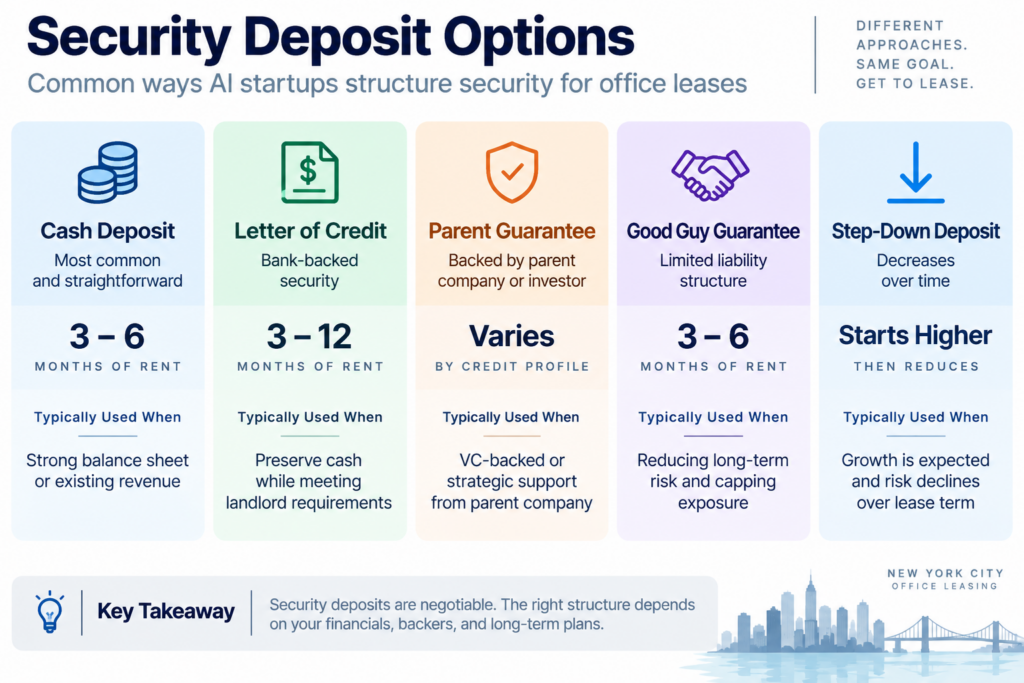
An owner considering a young company may evaluate current cash, fundraising history, revenue, investors, operating history, and projected lease exposure.
The landlord may request a substantial security deposit.
A letter of credit can sometimes replace cash security.
Other transactions may involve guarantees.
Instead of arguing only about deposit size, negotiate the burn-off.
For example, security might decline after revenue milestones, additional funding, or timely lease performance.
The exact structure depends on landlord acceptance and legal documentation.
A strong proposal anticipates these concerns before lease drafting.
Negotiate the LOI as though dollars already matter
The letter of intent usually establishes major business points.
Therefore, vague language can create expensive problems later.
A strong office LOI should address:
| Business point | Tenant question |
|---|---|
| Premises | Exactly how many rentable square feet? |
| Term | When does it begin and end? |
| Base rent | What starting rate applies? |
| Escalations | How does rent increase? |
| Free rent | Which charges receive abatement? |
| TI allowance | How much and what costs qualify? |
| Delivery | What must the landlord complete? |
| Possession | When can setup begin? |
| Furniture | What remains in the space? |
| Electricity | How will the tenant pay? |
| Operating expenses | What base year or structure applies? |
| Taxes | Which increases pass through? |
| Security | Cash, letter of credit, or another form? |
| Expansion | What rights cover nearby space? |
| Renewal | What future term rights apply? |
| Sublease | What consent and recapture rules apply? |
| Assignment | What happens during financing or acquisition? |
| Restoration | What must the tenant remove? |
A tenant loses leverage when major business questions wait until the lease document.
Make landlords compete on identical terms
Suppose three buildings provide proposals.
Building A offers lower rent.
Building B offers more TI.
Building C offers an existing installation and earlier possession.
Comparing the proposal PDFs will not reveal the best option.
Normalize every deal.
Use the same assumed term.
Use the same expected occupancy date.
Estimate identical furniture and technology requirements.
Calculate remaining construction costs.
Model escalations.
Include operating expenses and electricity.
Add moving costs, legal costs, and restoration exposure where relevant.
Then calculate effective cost.
Only after that process should a company decide whether another free month matters.
Negotiate free rent and TI together
Landlords consider total concession packages.
Therefore, requesting maximum TI and maximum free rent may not produce the optimal result.
A company needing little construction could prioritize more rent abatement.
Another tenant may prefer less free rent and additional TI.
A turnkey user might request furniture or technology concessions instead.
The negotiation should follow the company’s actual capital needs.
Protect against construction delay
A lease can look excellent until the office arrives late.
For landlord work, establish clear delivery requirements.
Define plans and specifications.
Set landlord completion obligations.
Address delays.
Determine whether rent starts despite unfinished work.
Include outside dates when appropriate.
For tenant work, confirm permitting access and contractor rules.
Review freight elevator restrictions.
Check after-hours work requirements.
Identify building-approved contractors where applicable.
A strong allowance cannot recover lost months if the delivery structure fails.
Technical diligence should happen before commitment
AI companies can have ordinary office needs.
Some have unusually demanding requirements.
Either way, inspect the building systems before signing.
Confirm available electrical capacity.
Review internet carriers.
Understand riser access.
Test cellular connectivity where necessary.
Evaluate HVAC schedules.
Determine whether supplemental cooling can operate around the clock.
Ask about emergency power where relevant.
Review security and access procedures.
Confirm whether equipment creates structural or electrical issues.
The lease should support the actual operating model.
Do not leave cabling until move-in
Data infrastructure often falls between real estate and technology budgets.
That gap creates delays.
Map workstation locations early.
Identify conference-room technology.
Determine Wi-Fi access point locations.
Plan server or network closets.
Review security systems.
Then clarify what the landlord, existing tenant, and incoming company each provide.
A furnished office with usable wiring can produce substantial hidden value.
Conversely, obsolete cabling has little value simply because it exists.
Keep alternatives alive until execution
A tenant can lose negotiating leverage after verbally choosing one building.
Therefore, continue evaluating viable alternatives until the transaction becomes sufficiently certain.
That approach does not require gamesmanship.
It requires disciplined risk management.
Another suitable office protects the company if lease language changes.
A backup also helps when construction issues emerge.
In today’s tighter market, that preparation matters more because strong spaces can disappear quickly.
AI-Specific Lease Protections That Can Matter More Than Free Rent
The phrase “AI office lease incentives” often makes tenants focus on landlord dollars.
Yet the right clauses can create more value than another month of abatement.
Expansion rights
Growth can happen between funding rounds.
A company may sign for 8,000 square feet and need 15,000 sooner than expected.
Expansion rights can reduce that risk.
However, generic language provides limited protection.
Identify specific adjacent spaces when possible.
Define the notice process.
Set pricing mechanics.
Understand whether another tenant holds superior rights.
Also determine when the landlord may lease the space elsewhere.
The strongest right matches a realistic hiring timeline.
Assignment rights
Artificial intelligence companies can experience rapid corporate change.
Financing can alter ownership.
A merger can change the legal tenant.
An acquisition can happen before lease expiration.
Therefore, assignment language deserves careful review.
The lease should distinguish ordinary transfers from major corporate transactions.
Qualified affiliate transfers may deserve different treatment.
Merger and acquisition provisions also matter.
Legal counsel should negotiate the final language.
However, the business issue belongs in the real estate strategy from day one.
Sublease rights
No company can forecast seven or ten years perfectly.
Sublease rights create flexibility.
A tenant may later have excess space.
Alternatively, it may need to leave Manhattan or consolidate operations.
The lease can determine how difficult that exit becomes.
Review landlord consent standards.
Understand recapture rights.
Check profit-sharing provisions.
Examine marketing restrictions.
Clarify whether the tenant can sublease portions of the premises.
A technically strong office may remain valuable to another tenant later.
That flexibility has economic value today.
Renewal rights
Renewal options reduce future relocation uncertainty.
However, a vague “fair market” clause can create disputes.
The lease should define the process.
Notice periods matter.
Valuation methods matter.
Concession assumptions can also matter.
A renewal option does not always guarantee the same economics available to a new tenant.
Therefore, model the clause rather than simply checking its existence.
Early access
Early access can help a fast-moving company occupy efficiently.
The tenant might install furniture, cabling, security, and technology before rent commencement.
However, early access needs clear rules.
Who insures the space?
Which contractors can enter?
Does access trigger any rent?
Can employees work there before commencement?
Those details belong in writing.
After-hours HVAC
This issue receives too little attention.
Many AI teams operate beyond conventional business hours.
Engineers may work late.
Global teams may hold evening calls.
Some technical equipment may require continuous cooling.
A building that charges heavily for after-hours HVAC can increase occupancy costs.
Another property may include broader operating hours.
Compare both before signing.
A lower rent can lose its advantage through recurring building charges.
Power and cooling rights
Most AI companies do not train large models inside ordinary Manhattan offices.
However, teams can still maintain dense equipment and technical rooms.
Some may conduct hardware testing.
Others simply need reliable network and cooling infrastructure.
Ask how much power enters the premises.
Determine whether upgrades are possible.
Understand who pays for them.
Confirm supplemental HVAC locations and condenser-water availability where relevant.
A landlord contribution toward those improvements can function as a valuable lease incentive.
Privacy and secure work
AI companies often handle proprietary information.
Some also work with regulated or confidential client data.
Office design can therefore matter.
Glass conference rooms may need privacy treatment.
Visitor access may require stronger controls.
Sensitive teams may need dedicated rooms.
A shared reception arrangement may create concerns for some businesses.
These needs should influence the office search before negotiations begin.
Future headcount should not dictate every square foot
Some fast-growing technology companies have taken substantially more space than current staffing requires.
Recent market reporting has documented unusually aggressive growth assumptions among AI occupiers.
That strategy can work when growth arrives.
It can also create unnecessary fixed costs.
Instead, calculate three scenarios.
Base case: expected hiring.
Growth case: faster hiring after successful funding or revenue growth.
Downside case: slower hiring or improved space efficiency.
Then test every proposed office against all three.
Optionality can outperform empty desks.
Space efficiency still matters
A beautiful headquarters does not excuse poor planning.
Measure usable workstation capacity.
Count conference seats.
Evaluate phone rooms.
Look at circulation.
Check how private offices affect density.
Understand rentable versus usable square footage.
A 10,000-square-foot floor can function very differently from another 10,000-square-foot floor.
Layout efficiency can effectively reduce rent without changing the lease rate.
Our guide to what office space costs an AI company in Manhattan connects rent, size, and operating requirements.
Public Tax Programs and Landlord Lease Incentives Are Different
Some companies searching for AI office lease incentives actually mean government incentives.
Those programs require a separate analysis.
A landlord concession comes through lease negotiation.
A public incentive comes through a tax or economic-development program.
Do not combine the two without confirming eligibility.
Manhattan does not offer universal AI-company free rent
There is no blanket Manhattan program that automatically grants free rent because a company develops artificial intelligence.
Landlords negotiate free rent privately.
Public programs follow statutory eligibility rules.
Industry type may matter for some programs. Location, company history, employment, building age, lease structure, and relocation details can matter more.
Therefore, an AI company should never budget a public benefit until qualified advisers confirm eligibility.
Commercial Rent Tax can affect Manhattan occupancy costs
New York City imposes Commercial Rent Tax on many commercial tenants in Manhattan south of 96th Street.
The general rules include annual rent thresholds and available credits.
Therefore, a tenant should model applicable CRT alongside base rent. Official guidance provides specific exemptions and calculations.
That cost can affect two spaces differently.
A proposal that appears cheaper before taxes may not remain cheaper afterward.
Lower Manhattan has distinct programs
Certain qualifying Lower Manhattan properties can participate in the Commercial Revitalization Program.
The program focuses on eligible older commercial or mixed-use buildings.
Benefits can include property-tax abatements and Commercial Rent Tax reductions under defined conditions.
Building age matters.
Location matters.
Lease terms matter.
Required capital improvements may also apply.
Therefore, a tenant should identify possible benefits before finalizing economics.
Public incentives should enter the analysis early
Timing can determine eligibility.
A company may need to apply before specific milestones.
Another program may impose lease-length requirements.
Relocation history may matter.
Employment commitments can affect benefits.
For those reasons, tell the broker, accountant, and tax counsel early when public incentives influence the location decision.
Do not wait until after lease execution.
A tax incentive is not a landlord concession
This distinction prevents double counting.
Suppose a landlord provides ten free months.
The same company qualifies for a separate tax benefit.
Those are two different economic sources.
Model both separately.
Likewise, do not let a landlord present a public benefit as though the owner funded it.
A strong comparison identifies who provides each dollar.
Lower rent can matter more than a tax program
Public incentives should not drive a company into the wrong office.
A building may qualify for a benefit but require costly construction.
Another property may offer lower rent and a superior installation.
A third location might provide better employee access.
Therefore, compare net economic results rather than incentive labels.
The office still has to work.
AI Office Lease Incentives: Tenant Questions Answered
What free rent can an AI company negotiate in Manhattan?
There is no universal AI-company free-rent schedule.
Current 2026 signed Manhattan leases show material variation by term and portfolio. One large office portfolio averaged 8.8 free months during 2026’s first half.
Its Q2 transactions averaged only 4.5 months.
Technology-focused 2025 market data showed a higher 13.3-month weighted average.
Your actual result will depend on the building, term, condition, credit, size, and competing demand.
How much tenant improvement money can an AI company receive?
Current benchmarks again vary widely.
One major Manhattan portfolio averaged $91.89 per rentable square foot during 2026’s first half. Its second-quarter average reached $58.77 per square foot.
Technology leases during 2025 averaged $131.70 per square foot in another dataset.
Those figures serve as context, not entitlement.
A landlord may provide far more for a long-term raw-space lease.
Turnkey space may justify a smaller allowance because the improvements already exist.
Are landlords giving AI companies special discounts?
Generally, not simply because the tenant works in artificial intelligence.
AI companies can look attractive because many grow quickly and receive substantial financing.
However, landlords still evaluate credit and lease risk.
Strong demand can actually reduce concessions for the best AI-oriented spaces.
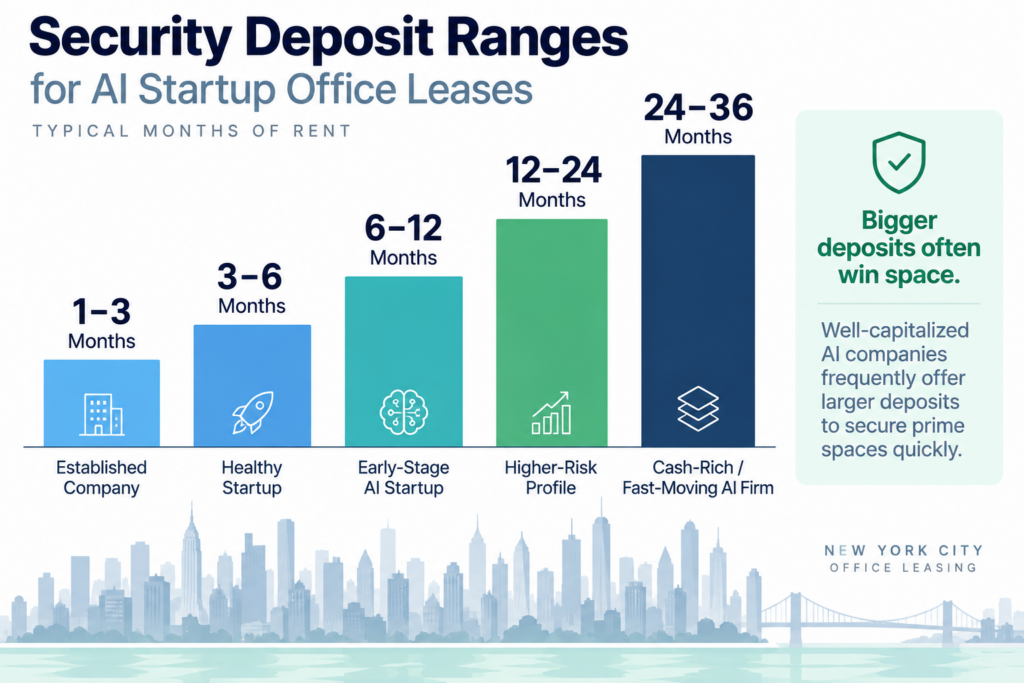
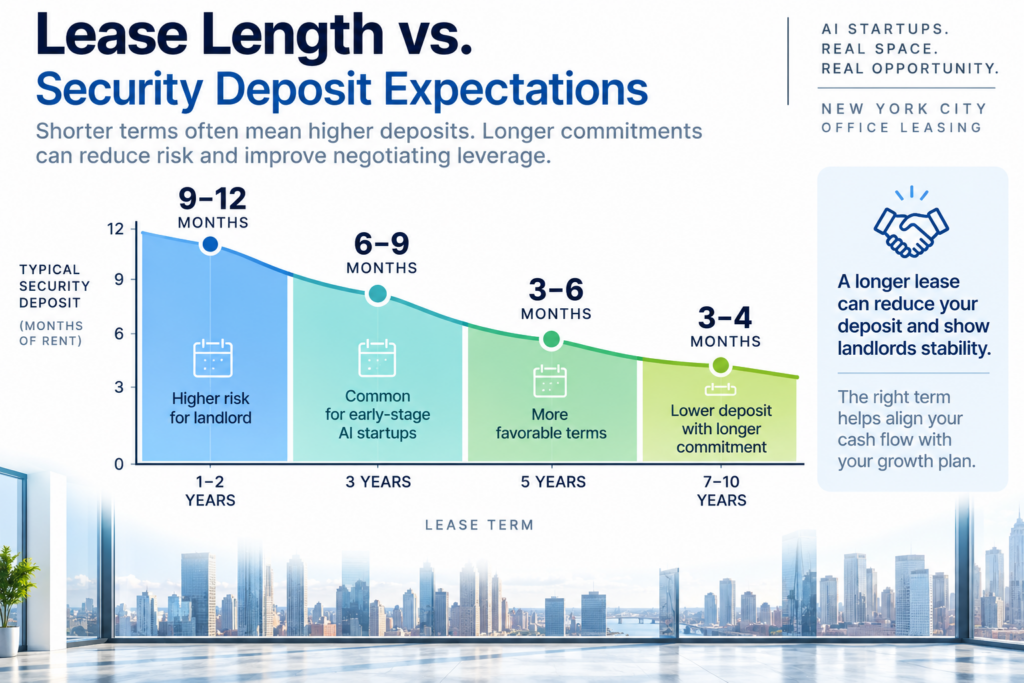
Why would an AI startup receive a larger security deposit?
A young company may lack a long operating history.
Landlords therefore focus on default risk.
Cash balance, revenue, financing, guarantees, and lease term can influence security.
The tenant can negotiate amount, form, and possible future reductions.
Can venture funding help the lease negotiation?
Strong funding can improve the landlord’s view of tenant credit.
However, financing alone does not guarantee better economics.
The landlord may still examine cash burn, revenue, investor profile, term, and total obligation.
A funded company should present its financial story clearly.
Is a letter of credit better than a cash security deposit?
Sometimes.
A letter of credit can preserve a different balance-sheet structure than a cash deposit.
Yet banks charge fees and require their own arrangements.
Landlords also impose specific letter-of-credit requirements.
The tenant’s finance team and counsel should compare both structures.
Can the security deposit decrease later?
Possibly.
Tenants can request burn-down provisions.
A reduction might follow timely lease performance, financial milestones, or another negotiated trigger.
The landlord must accept the structure.
Put any reduction formula in the lease.
Does a longer lease always create more free rent?
Not always.
Longer terms can support larger concessions because landlords receive more future rent.
However, building demand still matters.
A sought-after office may command strong economics even with a long term.
Likewise, a challenged space may receive aggressive concessions for a shorter commitment.
Should an AI startup sign five or ten years?
The answer depends on growth visibility and capital.
A longer term can unlock more TI and stronger landlord economics.
It can also create future excess-space risk.
Expansion, contraction, assignment, and sublease rights should therefore influence the term decision.
Is a sublease cheaper than a direct lease?
Sometimes, but not automatically.
A sublease may offer a lower face rent, furniture, and existing improvements.
A direct lease may provide free rent and landlord-funded construction.
Compare total occupancy costs over the same period.
Our AI office sublease guide addresses this decision specifically.
Does a sublease include free rent?
It can.
The sublandlord may offer rent abatement as part of the economics.
However, that concession does not operate like landlord free rent under a new direct lease.
Review the sublease and master lease together.
Can an AI company receive furniture for free?
Existing furniture can remain through a direct lease or sublease.
The parties may transfer it for no additional charge.
Another deal may assign a negotiated value.
Document ownership clearly.
Also determine who removes furniture at expiration.
Will the landlord pay for data cabling?
Possibly, but never assume it.
Traditional TI language may exclude movable technology and certain low-voltage work.
Negotiate cabling eligibility directly.
Also confirm whether existing cabling remains usable.
Will TI cover servers or computing equipment?
Usually, tenant improvement money focuses on real-property improvements.
Movable computing hardware often falls outside standard definitions.
However, supporting electrical or cooling work may qualify.
Lease language decides the answer.
Can a landlord pay for supplemental HVAC?
Yes, that can form part of negotiated landlord work or tenant improvement work.
The parties must also address ongoing operating expenses.
A company needing continuous cooling should model those costs before signing.
Can an AI office get 24/7 access?
Many Manhattan office buildings provide round-the-clock access.
However, access and full building services are different matters.
HVAC may operate only during standard hours.
Freight access can also have separate schedules.
Confirm every operational requirement.
Why is Midtown South so popular with AI companies?
Technology demand remains heavily concentrated there.
During 2026’s first half, Midtown South captured 75.1% of Manhattan technology-sector leasing.
The area combines established technology clusters with multiple office formats.
That popularity can also reduce leverage for the best move-in-ready floors.
Is Downtown Manhattan cheaper for AI companies?
It can offer lower starting economics than many Midtown locations.
However, building class matters considerably.
A premium Downtown tower can still command premium pricing.
Compare actual spaces rather than neighborhood averages.
Current Financial District office options can also provide furnished and short-term alternatives.
Should an AI company take more space than it needs today?
Not automatically.
Extra space can support rapid hiring.
It also creates fixed costs if growth slows.
Consider expansion rights before paying for unused capacity.
Scenario planning usually produces a better decision than aggressive forecasting alone.
How much space should an AI company lease?
Start with peak daily attendance rather than total payroll.
Then add hiring assumptions, meeting demand, private rooms, support areas, and circulation.
Finally, test the layout.
Two equal-sized floors can accommodate very different teams.
What happens when an AI company outgrows its office?
Several paths may exist.
The tenant could exercise expansion rights.
It might lease adjoining space.
Another company may sublease the original office.
A relocation could also make sense.
Planning those possibilities before signing improves flexibility.
Should an AI company negotiate a right of first offer?
Growth-oriented companies should at least evaluate one.
The right can provide early access to nearby availability.
However, the clause needs realistic timing and clear space definitions.
A poorly drafted right may offer little practical value.
What is more valuable, free rent or TI?
The answer depends on the space.
A tenant entering a finished office may benefit more from rent abatement.
A tenant building from raw condition may need every available TI dollar.
Compare your remaining capital requirement before choosing.
What is more valuable, TI or turnkey construction?
Turnkey work can outperform a larger allowance when it transfers execution risk to the landlord.
The tenant avoids construction management and some overage exposure.
However, the landlord’s standard layout may not suit every team.
Review plans before assigning value.
Can an AI company negotiate both free rent and TI?
Yes.
Many direct leases include both.
Current Manhattan signed-deal data confirms that landlords continue granting both forms of concession.
The amount depends on the specific transaction.
Can an AI company negotiate early access before rent starts?
Yes, in many transactions.
Early access can support furniture installation, cabling, security, and testing.
The lease should define permitted activities and insurance requirements.
Avoid language that accidentally starts rent early.
What happens if landlord construction finishes late?
The lease should address that before work begins.
Possible protections include delayed rent commencement and outside delivery dates.
The exact remedy depends on negotiation.
Legal counsel should review the final provisions.
Does free rent include operating expenses?
Not necessarily.
A landlord may waive base rent while collecting other charges.
Electricity, operating expenses, taxes, or other additional rent may continue.
Read the abatement clause rather than relying on the phrase “free rent.”
How should an AI company compare two incentive packages?
Convert both into the same economic model.
Include base rent, escalations, free rent, TI, construction, furniture, electricity, taxes, operating expenses, and technology costs.
Then add flexibility and timing.
The better lease may not have the lowest asking rent.
How quickly should a company decide on a strong turnkey office?
Quickly does not mean carelessly.
However, Manhattan availability has tightened substantially during 2026.
Sublet inventory also sits at its lowest level since 2019.
Prepare financial information and legal comments early.
That preparation lets the company move quickly without skipping diligence.
What should an AI company negotiate before lease lawyers start drafting?
Settle the major business points first.
Rent, abatement, TI, work, term, security, delivery, expansion, renewal, and transfer rights belong in the LOI discussion.
Unresolved business terms become more difficult after document drafting begins.
Do AI companies need a tenant broker for lease incentives?
A landlord knows its own economics.
The tenant needs comparable alternatives across landlords, submarkets, and lease structures.
We represent tenants in that comparison.
Our role includes space selection, proposal analysis, concession negotiation, and coordination through the transaction.
Does tenant representation increase the rent?
Commercial brokerage economics depend on the transaction structure.
The important tenant question concerns representation and conflicts.
A company should know who represents the landlord and who represents its interests.
We represent the office tenant.
What information should the company prepare before seeking proposals?
Prepare current headcount, expected hiring, target occupancy date, preferred neighborhoods, budget, and term.
Add technical requirements.
Include power, cooling, security, connectivity, and after-hours use where relevant.
Financial information may become necessary during landlord underwriting.
What is the biggest mistake when negotiating AI office incentives?
Focusing on one concession creates risk.
A tenant can win extra free rent while losing on construction.
Another company may secure a large TI package but accept poor expansion rights.
The correct goal is the strongest complete transaction.
What is the second biggest mistake?
Negotiating only one acceptable building.
Without alternatives, the tenant has limited leverage.
A genuine shortlist creates better information and better negotiating power.
Can an AI company negotiate incentives after choosing the office?
Yes, but leverage usually improves before making an unconditional commitment.
Compare competing proposals first.
Continue resolving major economics through the LOI.
Then let counsel convert those business terms into lease language.
Are current concessions disappearing?
No.
Current signed lease data still shows meaningful free rent and TI.
However, stronger Manhattan demand has changed the balance.
The best spaces may receive less aggressive economics than weaker inventory.
Availability also continues tightening.
Does a lower vacancy rate mean every landlord has leverage?
No.
Manhattan contains many submarkets and building types.
One floor can attract several tenants while another remains vacant nearby.
Condition, size, location, quality, and timing determine real negotiating leverage.
What does “effective rent” mean?
Effective rent adjusts headline rent for specified concessions.
Different analysts use different formulas.
Therefore, review the exact assumptions.
For tenant decisions, we model actual expected cash flows instead of relying on one shorthand rate.
Why does rentable square footage matter?
Landlords quote most Manhattan office economics against rentable square footage.
However, employees occupy usable space.
Therefore, layout efficiency matters alongside the rentable figure.
An inefficient floor can increase effective cost per employee.
Can existing furniture count as an incentive?
Absolutely.
Quality furniture can reduce upfront capital and shorten move-in time.
However, the tenant should inspect condition and quantities.
Also document whether ownership transfers.
Can a wired office be more valuable than a lower-rent empty office?
Yes.
Cabling, conference technology, security, and internet setup require money and time.
A functioning installation may outweigh modest rent differences.
Verify the system rather than trusting a “wired” label.
Do public incentives change the office decision?
They can.
However, eligibility rules can be complex.
Treat any public program as a separate benefit.
Never assume qualification before receiving appropriate professional guidance.
What Manhattan office options should a growing AI company compare today?
The answer depends on headcount, move date, term, and budget.
Smaller teams can examine furnished Downtown or Midtown South spaces.
Mid-sized companies can compare full floors across Flatiron, NoHo, Midtown, and Downtown.
Larger teams can evaluate premium direct leases and substantial subleases.
Current examples include an 11,239-square-foot Flatiron furnished floor, a 14,739-square-foot NoHo floor, and a 20,222-square-foot Hudson Yards sublease.
How should an AI company start the process?
Start with operating needs rather than available listings.
Define the team, timing, technical requirements, term, and acceptable economics.
Then compare several genuinely workable spaces.
Only after that should negotiations establish the value of each incentive.
What should the final decision optimize?
Optimize for total occupancy cost, execution certainty, employee utility, and future flexibility.
Free rent belongs in that calculation.
Tenant improvements belong there too.
So do security, expansion rights, furniture, technical infrastructure, and move-in timing.
The winning transaction should support the business after the concession period ends.
Compare current concessions.
We represent Manhattan office tenants throughout the search and lease negotiation. We compare direct leases, subleases, and turnkey offices using one tenant-side economic model. Our work focuses on what your company pays, receives, controls, and risks.
Start with your headcount, preferred move date, target neighborhoods, term, budget, and technical requirements. We can then compare available spaces against current landlord economics. That process shows which “incentive” actually creates value.
The goal is not simply to obtain the most free rent. The goal is to secure the strongest Manhattan office lease for the company you operate today and the company you expect to become.
Start Your Office Search Today
We represent Manhattan office tenants, not landlords. Our job is to compare options, concessions, risks, and lease structures from the tenant’s side. We negotiate the economics before your AI company commits.
Fill out our 📋 online form or give us a call today 📞 212-967-2061 — let’s find the right options for your business.