What Does Office Space Cost for an AI Company in Manhattan?
An AI company does not pay a special “AI office rent” in Manhattan. The building, neighborhood, lease structure, floor condition, size, and term determine the price. However, AI teams often pursue high-quality space, fast occupancy, flexible growth rights, strong connectivity, and dependable building systems.
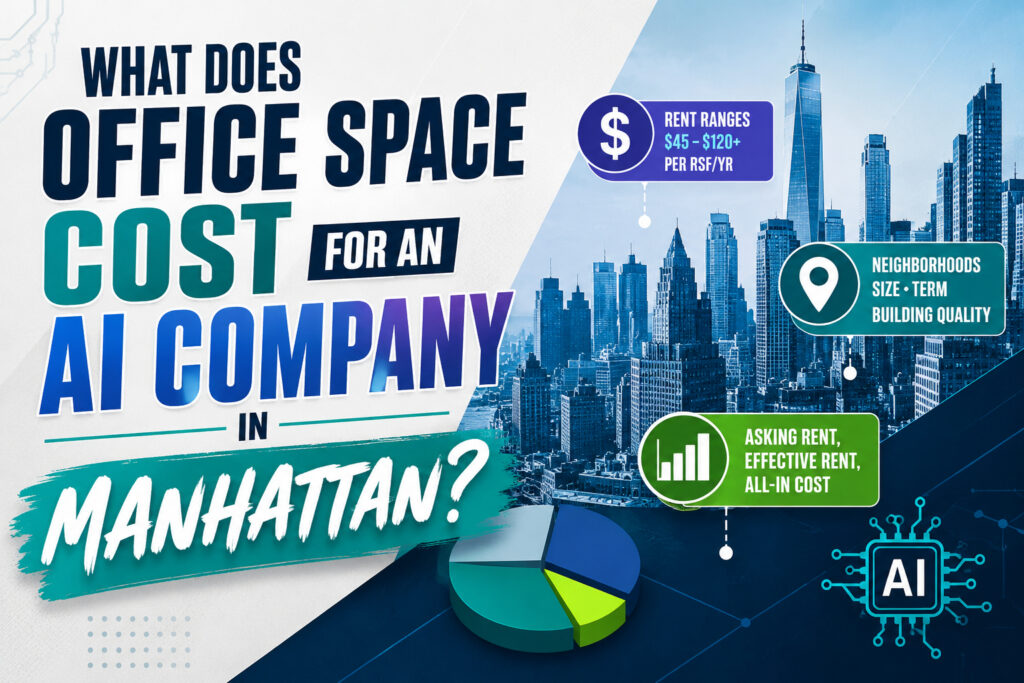
For a practical 2026 budget, many Manhattan AI companies will encounter asking rents from roughly $45 to $120+ per rentable square foot annually. Premium Class A and trophy space can move well beyond that range. Meanwhile, value subleases can fall below ordinary direct-lease pricing.
Current market reports place Manhattan’s broad average asking rent between roughly $73 and $80 per square foot. Different research methods create different averages. That spread itself explains why one Manhattan “average rent” cannot price your actual office.
The same reports show an even larger difference between submarkets. Midtown South averages roughly $79 to $81 per square foot overall. Yet its Class A average reaches about $104.50. Downtown sits much lower, around the high-$50s to low-$60s overall.
That distinction matters for AI companies. Current leasing activity has concentrated heavily in high-quality Manhattan space, particularly Midtown South. AI-related demand has also helped absorb available sublease inventory.
The supplied market benchmark shows why tenants often receive conflicting answers. Some results discuss annual rent per square foot. Others discuss monthly private-office pricing, neighborhood costs, startup stages, or unusually expensive individual transactions.
A useful answer must therefore separate asking rent, monthly rent, effective rent, all-in occupancy cost, and upfront cash. Those numbers can differ substantially.
What an AI Company Should Budget for Manhattan Office Space
Start with a simple formula:
Annual base rent = rentable square feet × annual asking rent per square foot
Then divide by 12 for the monthly base rent.
A 5,000-square-foot office asking $85 per square foot produces $425,000 of annual base rent. That equals approximately $35,417 monthly before other occupancy costs.
However, that monthly figure still does not answer the real budgeting question.
Your actual office budget has several layers.
| Cost measure | What it tells you | Why it matters |
|---|---|---|
| Asking rent | The landlord’s quoted annual rate | Useful for initial comparisons |
| Face rent | The contractual rental rate | Drives the lease schedule |
| Effective rent | Rent after negotiated concessions | Better comparison between proposals |
| Occupancy cost | Rent plus recurring office expenses | Better operating-budget number |
| Upfront cash | Deposit, furniture, construction, legal and moving costs | Protects runway |
| Cost per employee | Total occupancy divided by actual workplace population | Helps compare footprints |
| Cost per usable foot | Occupancy cost measured against space behind your door | Exposes inefficient layouts |
Current Manhattan averages only provide a starting point. One Q2 2026 dataset reports a $80.17 Manhattan average. Another reports $78.03. A third reports $72.83 overall and $84.79 for Class A.
Therefore, a founder should not ask only, “What is the Manhattan average?”
A better question asks:
What will a suitable office cost after we account for location, condition, concessions, construction, growth, and the lease term?
What different office sizes mean in monthly rent
The following examples show base rent only. They do not include electricity, internet, furniture, taxes, escalations, or buildout.
| Office size | $55/SF | $75/SF | $95/SF | $120/SF |
|---|---|---|---|---|
| 2,500 RSF | $11,458/month | $15,625/month | $19,792/month | $25,000/month |
| 3,500 RSF | $16,042/month | $21,875/month | $27,708/month | $35,000/month |
| 5,000 RSF | $22,917/month | $31,250/month | $39,583/month | $50,000/month |
| 7,500 RSF | $34,375/month | $46,875/month | $59,375/month | $75,000/month |
| 10,000 RSF | $45,833/month | $62,500/month | $79,167/month | $100,000/month |
| 15,000 RSF | $68,750/month | $93,750/month | $118,750/month | $150,000/month |
| 20,000 RSF | $91,667/month | $125,000/month | $158,333/month | $200,000/month |
These calculations also reveal an important budgeting rule. Square footage can matter more than saving several dollars per square foot.
Consider a 6,000 RSF floor at $70 per square foot. Base rent equals $420,000 annually.
Now compare a highly efficient 5,000 RSF floor at $78. Base rent equals $390,000.
The second office asks $8 more per square foot. Nevertheless, it costs $30,000 less annually.
Layout efficiency can therefore beat a lower asking rent.
Our Manhattan office sizing guide provides a useful starting point before you compare rents. Current planning ranges often place dense layouts around 100–125 square feet per person. Balanced workplaces may require roughly 125–175 square feet per person.
Why a 20-person AI company and a 20-person law firm can need different offices
AI companies often favor larger open working areas, project rooms, phone rooms, and collaboration zones. Some also need dedicated technical rooms.
A traditional professional firm may allocate more space to perimeter offices. Consequently, identical headcounts can produce very different square-footage requirements.
Hybrid attendance changes the equation again.
A 40-person company might only expect 28 employees during peak attendance. In that situation, designing for 40 permanent seats can waste expensive Manhattan space.
Conversely, some engineering teams work together in person most days. Those companies should not assume a generic hybrid seating ratio.
Use peak expected attendance, not payroll alone.
For a deeper size progression, the AI startup office-space roadmap covers footprints from approximately 2,000 square feet through larger growth-stage requirements.
Base rent is not the same as cash burn
Suppose your company leases 5,000 RSF at $85 per square foot.
The headline numbers look simple:
Annual face rent: $425,000
Monthly face rent: approximately $35,417
Now suppose the negotiated five-year package includes eight free months.
Straight-lining those free months reduces the rent component to about $30,694 per month across the entire term.
Assume the landlord also contributes $75 per square foot toward improvements. That equals $375,000 across 5,000 square feet.
After treating both concessions as economic credits, the example falls near $24,444 monthly, or about $58.67 per square foot annually.
That number still excludes future rent increases and other occupancy expenses.
More importantly, a tenant-improvement allowance does not automatically become spare cash. Your construction may consume every dollar.
Effective rent therefore requires a complete model rather than one subtraction.
For a broader explanation, review our guide to the true monthly cost of office space. Current Manhattan pricing also appears in our 2026 cost-per-square-foot guide.
How Manhattan Neighborhoods Change the Cost
Manhattan does not operate as one office market.
Crossing a few avenues can change the building stock, availability, floorplate, transportation profile, and landlord expectations. Moving between submarkets can change rent even more.
As of Q2 2026, broad Midtown asking-rent measures sit around the upper-$70s through mid-$80s. Midtown South sits around $79 to $81 overall. Downtown measures roughly $57 to $61 in major current datasets.
Those averages hide the options that an actual AI company tours.
Flatiron and the Madison Square corridor
Flatiron usually belongs near the top of an AI company’s comparison list.
The area offers loft offices, boutique floors, renovated older stock, and premium modern buildings. Strong transit also gives growing companies access to employees coming from several directions.
Demand can make the best small floors surprisingly expensive.
Current Midtown South Class A asking rent averages about $104.50 per square foot in one Q2 dataset. The broader submarket average remains much lower.
That difference shows why “Flatiron rent” cannot fit into one number.
A smaller team can compare a 3,150 RSF turnkey Flatiron office with a 5,000 RSF furnished West 21st Street office. Teams seeking more meeting capacity can examine a 5,594 RSF prebuilt Flatiron sublease.
Larger growth-stage teams can also compare a 9,979 RSF furnished full-floor sublease against an 18,500 RSF direct full-floor opportunity.
Best fit: companies that value centrality, recruiting appeal, loft character, and proximity to other technology businesses.
Budget warning: paying a Flatiron premium makes little sense when the company only needs generic open office space.
NoMad
NoMad can bridge the gap between Flatiron’s startup environment and Midtown’s larger commercial inventory.
The neighborhood provides renovated lofts, traditional office properties, full floors, and relatively efficient commuter access.
That mix can suit a scaling company that wants Midtown South character without focusing exclusively on Flatiron’s tightest blocks.
A currently indexed 5,000 RSF furnished NoMad office illustrates the type of turnkey footprint that growth-stage teams often evaluate.
The broader NoMad neighborhood discussion explains why the district can work between corporate and creative environments.
Best fit: AI teams that need approximately 3,000 to 15,000 square feet and want a central Midtown South location.
Cost question: compare NoMad against Flatiron before assuming the more famous block offers better value.
SoHo
SoHo creates a different office decision.
Many tenants value the neighborhood for high ceilings, historic loft character, natural light, and strong brand presentation. Scarcity can make attractive floors expensive.
A small AI company might consider a 2,691 RSF turnkey SoHo office. Another could compare a 3,592 RSF boutique loft with a 5,550 RSF furnished Broadway loft.
A larger team can review an 8,000 RSF modern SoHo full-floor office. Very large requirements can compare a 30,000 RSF furnished full floor.
Best fit: companies that treat design and workplace identity as recruiting or brand tools.
Budget warning: do not pay for architectural character unless your team values it.
Hudson Square
Hudson Square has become a major technology office district.
Its building stock includes older loft structures, comprehensively modernized properties, and large-scale institutional offices. Many floors also provide the open layouts that engineering teams prefer.
Current AI and technology leasing has reinforced Midtown South’s strength. Major 2026 reports show continued tightening across the submarket.
Smaller companies can compare a 2,530 RSF furnished Hudson Square office with a 3,191 RSF furnished Varick Street office.
That comparison can expose an important difference. One space may maximize seating. Another may provide better meeting rooms, privacy, or usable efficiency.
Best fit: growing AI, software, product, and engineering groups that prioritize open floors and modernized infrastructure.
Cost warning: the best Hudson Square lofts can compete with premium Midtown South pricing.
Chelsea
Chelsea offers one of Manhattan’s widest office mixes.
The neighborhood includes older lofts, boutique buildings, modern towers, and spaces near major transportation hubs. That diversity creates both value and premium opportunities.
A 5,000-square-foot company can start with our 5,000 RSF furnished Chelsea full-floor office. A smaller team can consider a 4,095 RSF Chelsea sublease.
Companies should compare the east and west sides of Chelsea carefully.
An attractive west-side building may offer design, light, and amenities. However, a Flatiron-adjacent Chelsea loft can provide faster access to multiple subway lines.
Best fit: companies seeking creative layouts, larger open areas, or access to both Midtown South and the west-side technology corridor.
Budget warning: “Chelsea” alone does not describe the commute or office product.
Union Square and the 14th Street corridor
Union Square gives tenants exceptional transportation access.
That advantage can reduce commute friction without forcing a company into a traditional Midtown tower.
The surrounding blocks contain renovated loft offices, smaller prebuilt suites, and full-floor opportunities. Recent leasing has also tightened office availability around the district.
Our 14th Street startup office guide explains the local building and layout mix.
Best fit: teams with employees commuting from several boroughs, New Jersey, or different Manhattan neighborhoods.
Cost warning: a transit premium can make sense when it improves attendance and recruiting.
Grand Central and Midtown East
Midtown East changes the proposition.
Here, a tenant often trades loft character for transportation, professional building management, modern infrastructure, and corporate-grade services.
Current Midtown asking-rent averages sit around $85 in one report and $86.18 in another. Another methodology places overall Midtown lower, while reporting $88.50 for Class A.
Those averages include many building types.
A growing AI team can compare a 7,518 RSF high-end prebuilt Midtown East office against a 10,500 RSF furnished full-floor option.
The second listing currently displays a $51-per-square-foot asking rate. That example demonstrates why live inventory can diverge dramatically from submarket averages.
Best fit: AI companies serving enterprise clients, prioritizing transit, or requiring professionally managed buildings.
Budget warning: do not assume every Midtown East office carries a trophy-building price.
Penn Station, Garment District, and Midtown West
This corridor can produce one of the most useful comparisons for cost-conscious technology teams.
Employees gain access to major commuter rail and subway services. Meanwhile, older stock and subleases can offer lower pricing than prime Park Avenue or Flatiron.
A currently indexed 6,000 RSF West 37th Street furnished sublease displays a $34-per-square-foot asking rent. The floor includes both offices and open workstations.
For a more premium comparison, review a 4,776 RSF furnished Penn Plaza sublease. A larger company can examine an 18,641 RSF Class A Penn Station office.
Best fit: teams that prioritize commuter access, usable space, and budget efficiency.
Cost warning: an inexpensive second-floor loft and a redeveloped Class A tower belong in different comparison sets.
Financial District and Downtown
Downtown deserves serious consideration when price matters.
Current Q2 data places Downtown’s overall asking rent around $56.66 to $61.34 per square foot. One dataset places Class A around $63.60.
That is meaningfully below many Midtown South and Midtown measures.
A small team can compare a 2,573 RSF furnished Downtown sublease currently showing a $39-per-square-foot rate.
A larger company can examine a 5,300 RSF Class A office or an 8,755 RSF prebuilt office.
For approximately 10,000 square feet, a 10,120 RSF full-floor Downtown opportunity currently displays a $39-per-square-foot asking rate.
The neighborhood can therefore create a meaningful runway advantage.
Best fit: companies that prioritize space economics, larger floors, modernized buildings, or access to Lower Manhattan.
Budget warning: compare employee commute patterns before choosing Downtown only because the rent looks lower.
Why Lease Structure Can Matter More Than the Asking Rent
Two Manhattan offices can ask identical rent and produce very different financial outcomes.
The difference often comes from the lease structure.
A $75 direct lease with substantial concessions can beat a $65 deal that requires major construction. Conversely, a furnished sublease at $70 can outperform both when speed matters.
Therefore, tenants should compare complete deal economics.
Direct leases
A direct lease gives the company a contractual relationship with the building owner.
Longer direct terms can support significant construction contributions. They can also provide renewal rights, expansion language, and greater control over the premises.
However, direct leases usually create the longest commitment.
That tradeoff matters for an AI company with unpredictable headcount.
A direct lease can work well when the company already understands its likely three-to-seven-year workplace plan. It becomes riskier when the firm cannot forecast staffing beyond several quarters.
Current Manhattan demand has strengthened significantly. Q2 leasing remained above recent historical averages, while availability continued falling.
As quality supply tightens, tenants should not assume every landlord will offer the same flexibility.
Prebuilt and specification suites
A prebuilt suite can reduce one of the largest hidden costs: time.
The landlord has already completed most construction. Therefore, the tenant can avoid a lengthy design and build process.
Prebuilt space can also limit upfront capital.
However, convenience has a price.
The landlord may offer less improvement money because the office already contains an installation. Your company may also need to accept a layout designed for another generic user.
Compare prebuilt options by asking one practical question:
How much of this office would we change after moving in?
If the answer includes walls, conference rooms, cabling, lighting, pantry work, and HVAC changes, the prebuilt advantage may disappear.
Subleases
A sublease can provide excellent value for a fast-growing AI company.
Many subleases include furniture, conference rooms, cabling, and a finished pantry. The shorter remaining term can also reduce long-term risk.
Yet a sublease introduces different constraints.
You inherit an existing term. The direct tenant may have negotiated restrictions that affect alterations, signage, access, or assignment.
A sublease also offers less certainty beyond its expiration.
For a bridge office, those compromises can make sense.
Consider the 5,594 RSF furnished Flatiron sublease, the 9,979 RSF Flatiron full-floor sublease, or the 4,776 RSF Penn Plaza sublease. Each represents a different size and positioning strategy.
Flexible private offices
A flexible private office uses a different pricing model.
Providers often quote a monthly amount per office or per desk. Therefore, comparing that number directly with annual rent per square foot creates a misleading result.
Current market benchmarks place Manhattan private-office desks around the high hundreds of dollars monthly per person. The supplied benchmark includes approximately $785 monthly per private-office desk.
That structure can make sense for a very small team.
Nevertheless, cost per seat rises quickly as headcount grows. A 25-person company paying $785 per seat would spend approximately $19,625 monthly before premium rooms or added services.
A conventional office may produce a lower long-term occupancy cost at that point.
However, flexible space avoids major construction and furniture expenses.
Compare all-in cost against all-in cost, not a membership fee against base rent.
Purchasing an office
An office condominium represents another cost lane entirely.
Ownership replaces a rent commitment with a capital decision. Financing, common charges, taxes, transaction costs, improvements, and eventual resale value enter the analysis.
A growing AI company should also consider flexibility.
Owning a fixed footprint can become restrictive when headcount changes rapidly.
For most venture-backed growth companies, a purchase decision should follow a stable long-range space plan. It should not serve as a substitute for comparing current lease economics.
The effective-rent formula that matters
For a simple comparison, calculate:
Total contractual base rent
minus free rent
minus applicable landlord economic contributions
plus tenant-funded occupancy costs
divided across the lease term
Then compare that figure across competing buildings.
Do not stop there.
Model annual escalations separately. Include expected operating or tax adjustments. Add utilities and after-hours HVAC assumptions.
Finally, separate one-time cash from recurring expense.
A dollar of security deposit affects cash differently from a dollar of annual rent. Likewise, a construction payment affects runway immediately.
Free rent does not always mean free occupancy
Landlords can structure abatements differently.
A lease might provide free base rent while the tenant still pays electricity or other charges. Another deal may defer commencement until substantial completion.
Those structures create different cash flows.
Therefore, ask the attorney and broker to identify exactly which charges continue during the abatement period.
Avoid treating “eight months free” as a complete economic description.
Tenant-improvement money can transform the comparison
Construction contributions matter most when the space needs work.
Suppose one landlord asks $82 per square foot and offers a substantial buildout contribution.
Another asks $75 but delivers the office in poor condition.
The cheaper face rent can become the more expensive office.
Construction costs remain elevated nationally, while New York ranks among the highest-cost fit-out markets. That makes existing condition especially valuable.
For AI companies, electrical, supplemental cooling, secure rooms, specialty cabling, and acoustic changes can increase the gap.
Security deposits affect runway
Security does not belong in effective rent exactly like base rent.
Nevertheless, founders should include it in the cash model.
A landlord may ask an early-stage company for more protection than an established profitable tenant. Financial strength, lease length, landlord investment, and guarantee structure influence that request.
Rather than recreating the entire security-deposit issue here, use our dedicated guide to security deposits and guarantee terms.
Treat the deposit as negotiable working capital.
A large letter of credit may preserve cash but create bank requirements. A large cash deposit can remove capital from operations.
Model both.
Commercial Rent Tax can enter the budget
Qualifying commercial tenants in Manhattan south of 96th Street may face New York City Commercial Rent Tax.
Current city rules generally apply when annual or annualized gross rent reaches at least $250,000, subject to credits and exemptions. The standard framework produces a 3.9% effective rate after the statutory base-rent reduction. Specific small-business credits can change liability.
Do not simply add 3.9% to every Manhattan office proposal.
Eligibility, credits, location, income, and other rules matter.
Instead, identify potential exposure during budgeting. Then have the appropriate tax professional confirm the calculation.
How Much Space Does an AI Company Actually Need?
Rent becomes expensive when a company sizes the office incorrectly.
A bad space plan can waste more money than a mediocre rent negotiation.
Consider a company paying $80 per square foot.
Every unnecessary 1,000 rentable square feet costs $80,000 annually before other expenses.
Over five years, that equals $400,000 of face rent before escalations.
Therefore, headcount planning deserves as much attention as rental rates.
Early-stage AI teams
A small founding team often needs less space than it expects.
For roughly 8 to 15 people, an efficient office might fall near 1,500 to 3,500 rentable square feet. The exact number depends on attendance and meeting needs.
A team with heavy customer calls needs more phone rooms.
Founders hosting investors may need a credible conference room.
Hardware work can require extra technical space.
By contrast, a coding-heavy team with few visitors can use a compact open plan.
Current small-space examples include a 2,530 RSF Hudson Square office, a 2,691 RSF SoHo office, and a 3,150 RSF Flatiron office.
These examples also show why square footage alone tells an incomplete story.
A floor seating 30 people does not necessarily suit a 30-person company.
Meeting rooms, privacy, circulation, pantry size, and workplace density still matter.
Scaling teams
At approximately 20 to 50 people, layout becomes more important.
Departments begin to form.
Engineering may require focus zones. Product teams need project rooms. Sales groups create more calls. Leadership may need confidential meeting space.
A 5,000 RSF office can work very differently depending on the floorplan.
Compare the 5,000 RSF Chelsea full floor with the 5,000 RSF furnished West 21st Street office and the 5,000 RSF NoMad office.
Identical square footage does not create identical capacity.
One floor may devote more space to offices. Another may favor workstations.
Therefore, calculate cost per useful seat after reviewing the plan.
Growth-stage AI companies
Teams moving toward 50 to 100 employees often enter the 7,500 to 15,000 RSF range.
However, attendance patterns can move that requirement substantially.
A company that expects 70 employees daily may need much more space than a 100-person hybrid organization.
Examples across Manhattan include an 8,000 RSF SoHo office, an 8,755 RSF Downtown office, and a 9,979 RSF Flatiron full-floor sublease.
Around 10,000 square feet, expansion planning becomes critical.
Moving 70 employees twice within three years can cost far more than negotiating growth rights upfront.
Larger headquarters requirements
Above approximately 15,000 square feet, the search changes.
Full-floor and contiguous-block economics become more important.
Building infrastructure also matters more because the tenant may operate several IT rooms, larger meeting facilities, events, and extended-hour schedules.
Current examples include an 18,500 RSF Flatiron floor, an 18,641 RSF Penn Station office, and a 20,222 RSF Hudson Yards office.
Larger headquarters searches should also evaluate adjacent expansion opportunities.
An extra floor that becomes available later can carry major strategic value.
Do not size an office from funding stage alone
“Seed,” “Series A,” and “Series B” can provide rough context.
They do not create reliable square-footage standards.
One funded company may employ eight people.
Another may have 80.
A research-heavy organization may need more technical space. A software team using cloud infrastructure may need little specialized hardware.
Therefore, size the office using operations rather than fundraising vocabulary.
Start with:
Peak daily population × target space ratio
Then add required rooms.
Finally, compare that program against actual floorplans.
Plan the next office before signing the current one
Fast-growing AI companies face an unusual real estate problem.
Too little space can force an expensive early move.
Too much space can burn capital for years.
The answer does not always involve taking excess square footage immediately.
Instead, negotiate flexibility.
Useful tools can include expansion rights, rights of first offer, adjacent-space preferences, assignment rights, sublease rights, and renewal options.
A shorter bridge lease can also work.
The right strategy depends on how much confidence the company has in its hiring plan.
Our short-term AI office guide and AI growth roadmap cover those structures in more depth.
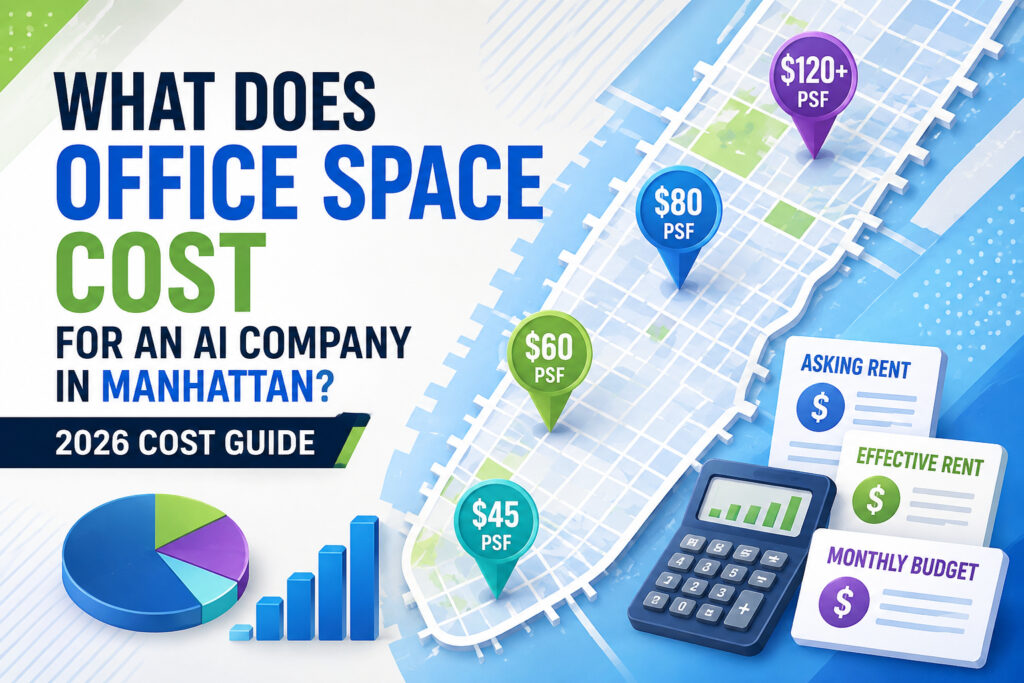
Live Manhattan Inventory Shows Why Averages Can Mislead
Averages tell you about markets.
Listings tell you what your company can actually compare.
Our currently indexed inventory includes more than 1,400 Manhattan commercial building listings across direct leases, subleases, and other office products. Individual listing conditions and pricing can change quickly.
Therefore, treat the following examples as a live comparison framework, not a permanent price sheet.
| Approximate size | Area | Current listing type | Useful comparison |
|---|---|---|---|
| 2,530 RSF | Hudson Square | Direct | Small turnkey growth office |
| 2,573 RSF | Downtown | Sublease | Furnished value option |
| 2,691 RSF | SoHo | Direct | Small premium loft |
| 3,150 RSF | Flatiron | Direct | Turnkey technology layout |
| 3,191 RSF | Hudson Square | Direct | Furnished small-team option |
| 3,592 RSF | SoHo | Direct | Boutique loft comparison |
| 4,095 RSF | Chelsea | Sublease | Modern high-floor option |
| 4,776 RSF | Penn Station | Sublease | Premium commuter location |
| 5,000 RSF | Chelsea | Sublease | Furnished full-floor layout |
| 5,000 RSF | Flatiron | Direct | Furnished Midtown South office |
| 5,000 RSF | NoMad | Sublease | Turnkey loft comparison |
| 5,300 RSF | Downtown | Direct | Class A value comparison |
| 5,594 RSF | Flatiron | Sublease | Meeting-rich turnkey floor |
| 6,000 RSF | Midtown West | Sublease | Lower-cost furnished comparison |
| 7,518 RSF | Midtown East | Direct | Upgraded Class A comparison |
| 8,000 RSF | SoHo | Direct | Premium modern loft |
| 8,755 RSF | Downtown | Direct | Larger prebuilt office |
| 9,979 RSF | Flatiron | Sublease | Full-floor growth option |
| 10,120 RSF | Downtown | Sublease | Large value comparison |
| 10,500 RSF | Grand Central | Sublease | Furnished Midtown floor |
| 18,500 RSF | Flatiron | Direct | Scaling headquarters floor |
| 18,641 RSF | Penn Station | Direct | Large Class A footprint |
| 20,222 RSF | Hudson Yards | Sublease | Premium headquarters option |
| 30,000 RSF | SoHo / Hudson Square | Sublease | Large furnished full floor |
| 45,942 RSF | Hudson Yards | Sublease | Multi-floor headquarters block |
The listing pages currently span small turnkey suites through large headquarters blocks. Several also demonstrate how subleases and older buildings can price below broad market averages.
That creates a better way to budget.
Do not compare “Flatiron versus Downtown” only at the neighborhood level.
Compare actual floors with similar:
size + condition + term + layout + infrastructure + occupancy date
Then calculate the economic difference.
A $39 Downtown office versus an $80 Midtown South office
Assume two 10,000 RSF offices.
At $39 per square foot, annual base rent equals $390,000.
At $80, annual base rent equals $800,000.
The face-rent difference reaches $410,000 each year.
That does not automatically make the cheaper floor better.
Perhaps the Midtown South floor needs no construction. Maybe the Downtown option requires significant improvements.
Conversely, perhaps both offices arrive furnished and operational.
In that situation, the lower Downtown rent can preserve millions across a longer lease.
This is exactly why actual inventory must sit beside market averages.
A smaller expensive floor can still win
Now compare 4,000 RSF at $100 with 6,000 RSF at $75.
The first costs $400,000 annually.
The second costs $450,000.
Therefore, the apparently expensive building saves $50,000 because the floorplate fits more efficiently.
This scenario appears often in Manhattan.
Older office floors can contain awkward columns, oversized corridors, or layouts your company cannot use.
Look beyond price per square foot.
Furnished inventory deserves a separate column
Furniture has economic value.
So do existing conference rooms, cabling, pantry installations, access controls, and IT closets.
A furnished office can reduce move-in spending and shorten occupancy time.
However, used furniture that your team immediately replaces has little economic value.
Assign a realistic number.
Do not accept “fully furnished” as an automatic concession.
Time has a cost
An AI company leaving temporary space may need an office quickly.
Suppose a raw direct lease saves $5 per square foot.
Yet construction delays occupancy four months.
The company may then pay temporary-office costs while funding design, legal work, IT, furniture, and project management.
A more expensive prebuilt floor can become cheaper overall.
Therefore, include the cost of delay in the comparison.
AI-Specific Requirements That Can Change Manhattan Office Cost
The phrase “AI-ready office” can become meaningless without a technical definition.
Most AI software companies do not need data-center infrastructure inside their Manhattan headquarters.
Cloud-based companies may need ordinary office electrical capacity, excellent connectivity, and reliable cooling.
However, another AI company may run high-powered local workstations, test equipment, or substantial server hardware.
That difference can change both the building shortlist and the construction budget.
Electrical capacity
Start by understanding what the team will actually plug in.
Standard laptops and monitors create one load profile.
Dense workstations, local GPU hardware, lab equipment, UPS systems, or server racks create another.
Do not assume a premium building automatically supports every requirement.
Ask for electrical information before the lease reaches final negotiation.
Then have the appropriate technical professional confirm the load.
An office that requires major electrical work can quickly erase a rent discount.
Cooling and HVAC hours
Cooling can matter more than electricity for some technical teams.
Many Manhattan buildings provide HVAC during defined business hours. Additional evening or weekend service may carry separate charges.
That matters for teams with extended working hours.
It matters even more for rooms containing heat-producing hardware.
Therefore, ask four questions early:
What are standard HVAC hours?
What does after-hours service cost?
Can the system support the intended equipment?
Can the tenant install supplemental cooling if needed?
The cheapest face rent can become expensive when after-hours HVAC runs constantly.
Fiber and carrier access
Reliable connectivity matters to nearly every technology company.
However, requirements differ.
A cloud-oriented software team may care about carrier options and rapid installation.
Another organization may require diverse pathways, redundant services, or a dedicated demarcation strategy.
Ask which carriers already serve the building.
Then verify the installation timeline.
A beautiful office without usable connectivity on move-in day creates an operational problem.
Secure technical rooms
AI companies can handle valuable intellectual property, customer information, proprietary datasets, and sensitive development work.
That does not mean every company needs specialized secure construction.
Still, many teams benefit from a lockable IT room, controlled access, and clearly separated visitor areas.
A floor with those features already in place can save money.
Conversely, retrofitting access systems and secure rooms can add cost.
Acoustic privacy
Engineering work and customer calls often compete for the same floor.
An open office may look efficient on a floorplan. Yet poor acoustics can make it unusable.
Phone booths, focus rooms, acoustic treatment, and small meeting rooms all consume square footage.
Therefore, a dense desk count should never serve as the only capacity measure.
A 5,000 RSF office that “fits 50 desks” may not support 50 people effectively.
24-hour access
Some technical teams operate outside conventional office hours.
Confirm building access rules before signing.
Also confirm freight access, visitor procedures, weekend protocols, and after-hours building services.
A 24-hour access card does not necessarily include 24-hour HVAC.
Those details belong in the operating-cost comparison.
Local compute versus cloud compute
This distinction deserves special attention.
An AI company using cloud infrastructure should not automatically pay a premium for unusually heavy office power.
Another team may genuinely need substantial local hardware.
Therefore, define the compute strategy before brokers screen buildings.
Otherwise, the company can overpay for infrastructure it never uses.
The opposite mistake creates greater risk.
A tenant may sign a beautiful loft and discover that the intended hardware requires expensive upgrades.
Expansion capacity
Rapid growth can create the largest hidden cost.
Current AI-related leasing activity has increased substantially, while much of that demand has focused on Midtown South. Manhattan’s broader quality-office supply has also tightened.
That makes expansion planning more important.
Ask whether the building contains:
adjacent suites,
future full-floor availability,
other floors with similar layouts,
short-term swing space,
or realistic rights over future vacancies.
Do not pay for empty expansion space unless the probability justifies it.
Sometimes the better solution uses contractual rights rather than vacant desks.
Confidentiality during the office search
Real estate decisions can reveal hiring plans, funding expectations, or growth forecasts.
An AI company preparing a major expansion may not want every owner or market participant seeing the same headcount plan.
Keep the initial search disciplined.
Share enough information for the landlord to evaluate credit and operational needs.
However, avoid spreading sensitive technical details unnecessarily.
The office should support confidential work after occupancy as well.
Building quality does not always equal AI suitability
A premium lobby does not guarantee the best engineering workplace.
Likewise, an older loft does not automatically create technical problems.
Evaluate the actual systems.
An older renovated property can provide excellent connectivity, tenant-controlled HVAC, and flexible open floors.
A newer tower can offer superior infrastructure but charge premium rent.
Neither category automatically wins.
Use our AI-optimized Manhattan office guide and Midtown flexible AI office guide as deeper technical filters.
How to Compare Manhattan Office Proposals Without Missing the Real Cost
The strongest office decision usually comes from a comparison sheet.
Do not rely on memory after touring ten buildings.
Record the same information for every finalist.
Compare rent on the same basis
First, normalize the square footage and annual rent.
For every office, record:
rentable square footage
usable square footage, when available
asking rent
negotiated face rent
annual escalations
lease term
free rent
construction contribution
Without that normalization, two proposals can look more similar than they really are.
Compare space efficiency
Calculate the effective number of workstations and rooms.
Then estimate peak daily attendance.
A useful comparison might show:
Office A: 5,500 RSF, 32 useful seats
Office B: 5,000 RSF, 35 useful seats
Office B may deserve a higher per-square-foot rent because it uses space better.
The office-space sizing guide provides broader space-per-person benchmarks.
Compare construction exposure
Next, classify each space.
Turnkey: little meaningful work required.
Prebuilt: usable now, but some modifications may help.
Second-generation: existing installation requires adaptation.
White box: basic shell preparation exists, but substantial work remains.
Raw: tenant needs a major buildout.
Then estimate the tenant-funded difference.
A cheap raw floor can lose against an expensive furnished sublease very quickly.
Compare move-in dates
Ask when your team can actually work from the office.
Lease signing does not equal occupancy.
Construction approvals, permits, furniture, cabling, security, landlord work, and connectivity can affect the date.
Therefore, put usable occupancy date into the financial model.
Every month of temporary space has a cost.
Compare recurring building charges
Base rent only starts the analysis.
Depending on the lease, tenants may face:
real estate tax adjustments,
operating expense adjustments,
electricity charges,
after-hours HVAC,
cleaning arrangements,
internet and telecom,
insurance,
and other building-specific charges.
Specific structures vary by lease.
Consequently, avoid applying a generic “20% add-on” to every Manhattan office.
Read the proposal and lease.
Compare Commercial Rent Tax exposure
A larger Manhattan requirement can cross the relevant rent thresholds quickly.
For example, 5,000 RSF at $60 produces $300,000 of annual base rent.
That does not automatically establish the final city tax liability.
However, it should trigger a closer review of Commercial Rent Tax rules and applicable credits. Current city guidance sets the basic threshold at $250,000 of annualized gross rent, subject to exemptions and credits.
Include potential tax exposure before approving the budget.
Compare upfront capital
A startup can afford the monthly rent and still dislike the upfront cash requirement.
Model:
security,
construction overages,
furniture,
cabling,
AV equipment,
moving,
legal fees,
insurance deposits,
and temporary overlap rent.
That gives finance leaders a realistic cash requirement.
For an AI company protecting runway, this number can decide the transaction.
Compare flexibility as an economic asset
Flexibility has value even when you cannot assign it a perfect dollar figure.
A below-market office with no sublease flexibility can become expensive if headcount falls.
A slightly higher rent with workable transfer rights can reduce future risk.
Likewise, expansion rights can prevent a disruptive relocation.
Review assignment and sublease language carefully.
Our guide to office sharing and sublease consent addresses one part of that issue.
Compare security and guarantee exposure separately
Do not mix personal liability into a simple rent calculation.
A low-rent deal with an aggressive guarantee can carry more risk than a higher-rent alternative.
Similarly, a substantial cash security requirement can hurt an early-stage company’s working capital.
Evaluate:
cash security,
letter-of-credit requirements,
guarantee scope,
burn-down provisions,
and surrender conditions.
Use the dedicated security and guarantee guide for that analysis instead of creating an AI-specific version of the same issue.
Compare the commute
Rent is visible.
Employee resistance is harder to quantify.
A company saving $100,000 annually may regret the decision when the location damages attendance or recruiting.
Map the actual workforce.
Measure travel from major employee concentrations.
Then compare the locations.
A highly connected neighborhood can justify some rental premium.
However, perceived prestige rarely justifies a poor commute by itself.
Compare cost per occupied seat
For hybrid companies, cost per payroll employee can distort the result.
Instead, consider both:
annual occupancy cost ÷ total employees
and
annual occupancy cost ÷ peak in-office population
The second figure reveals what each physical seat really costs.
It can also expose overbuilt offices.
Compare downside scenarios
Do not model only the optimistic growth plan.
Run at least three cases.
Growth case: headcount rises quickly.
Base case: hiring follows the current plan.
Downside case: headcount freezes or contracts.
Then ask whether the proposed lease still works.
A good office should survive more than one forecast.
Compare renewal and relocation risk
A short lease reduces commitment.
However, it can increase future relocation risk.
A long lease creates stability.
Yet it can trap a fast-changing company in the wrong footprint.
Neither term structure wins universally.
Estimate where the company could stand at expiration.
Then decide whether flexibility or stability deserves more value today.
The Practical Answer for AI Companies Comparing Manhattan Offices
For 2026 budgeting, the broad Manhattan market sits around the $73 to $80 per-square-foot range, depending on the dataset. Class A averages run higher. Premium individual buildings can run far above those figures.
Midtown South remains one of the most important areas for AI and technology companies.
Its Q2 average sits around $79 to $81 per square foot across major reports. Class A asking rent reaches roughly $104.50 in one current dataset.
Midtown spans a wider range.
Current broad measures sit around the upper-$70s through mid-$80s. Individual premium floors can climb far higher.
Downtown remains the strongest broad value comparison.
Major Q2 reports put overall Downtown asking rents around the upper-$50s to low-$60s. Live inventory can fall beneath those market averages.
So what should an AI company actually budget?
A small early-stage team: often starts by comparing roughly 1,500 to 3,500 RSF.
A 20-to-40-person team: often lands around 3,000 to 7,500 RSF, depending on attendance.
A 40-to-80-person company: commonly evaluates approximately 7,500 to 15,000 RSF.
A larger growth organization: may need 15,000 to 30,000+ RSF, especially with high attendance or headquarters functions.
Those figures serve as planning ranges, not formulas. Workplace program and peak attendance should drive the final size. Our sizing resources provide more detail.
Is $100 per square foot expensive for an AI office in Manhattan?
It depends on what you receive.
At $100 per square foot, 5,000 RSF costs $500,000 annually before other charges.
That rate can make sense for an efficient, fully built, premium Midtown South office with strong infrastructure.
It can also represent poor value in an inefficient older floor needing substantial construction.
Compare effective rent and condition.
Do not judge the rate alone.
Can an AI startup find Manhattan office space below $50 per square foot?
Yes, some current inventory falls below $50.
Examples include a 6,000 RSF Midtown West sublease displaying $34 per square foot. Downtown examples currently show 2,573 RSF and 10,120 RSF at $39 per square foot.
Availability and terms can change.
Therefore, confirm each listing before using it as a final budget assumption.
Does an AI company need Class A office space?
No.
Some AI companies benefit from Class A systems, amenities, security, and professional management.
Others perform perfectly well in modernized Class B loft buildings.
Technical requirements should determine the building filter.
Brand goals and employee expectations matter too.
Do not pay for a building class because the company uses artificial intelligence.
Is Midtown South always the best location?
No.
Midtown South remains a major technology center. Current leasing data also shows strong demand there.
However, Midtown can offer stronger commuter access for some teams.
Downtown can deliver substantial savings.
Penn Station can benefit regional commuters.
Hudson Yards can provide modern headquarters infrastructure.
The best neighborhood depends on your people and budget.
Should a startup choose a sublease or direct lease?
Choose the structure that matches the business horizon.
A sublease can offer furniture, speed, and a shorter commitment.
A direct lease can offer greater control, concessions, and longer-term stability.
Neither product always costs less.
Model the entire term.
Is coworking cheaper for an AI company?
It can be cheaper for a very small team.
However, per-desk pricing becomes expensive as headcount rises.
Private flexible offices also provide less control over expansion, branding, security, and layout.
Compare the monthly all-in cost against a furnished sublease before assuming either wins.
How much should an AI company spend on office space?
There is no reliable universal percentage of revenue.
A profitable mature company and a venture-backed startup operate with different financial structures.
Instead, compare occupancy against runway, headcount, expected growth, and the office’s role in operations.
Calculate the downside case too.
A rent budget that works only after perfect hiring growth creates unnecessary risk.
What is the biggest hidden Manhattan office cost?
For many tenants, the biggest mistake is not one fee.
It is choosing the wrong footprint.
Paying for 2,000 unnecessary square feet can dwarf smaller expense items.
Construction overages can create another major surprise.
An inefficient lease term can cost even more when the business changes.
What is more important than the asking rent?
Effective occupancy cost per useful seat.
That number captures more of the decision.
Calculate it after accounting for concessions, usable capacity, required construction, and recurring costs.
Then compare each finalist on the same basis.
Why do Manhattan office averages vary between reports?
Research groups track different inventories and use different methodologies.
One Q2 2026 report puts Manhattan asking rent at $80.17. Another reports $78.03. Another reports $72.83.
None of those figures prices your specific floor.
Use averages to understand direction.
Use actual competing spaces to make the lease decision.
Are Manhattan office choices getting tighter in 2026?
Yes, especially for quality space.
One Q2 report shows Manhattan availability falling to 14.4%. Another puts availability at 13.0%. Midtown South availability reached 12.7% in one current measure.
Meanwhile, Manhattan leasing activity remains strong by recent historical standards.
Consequently, a tenant should not confuse remaining vacancy with unlimited choice.
The best-built, best-located floors can move faster than the overall numbers suggest.
Are AI companies actually affecting Manhattan office demand?
Yes.
Current research identifies AI as a significant technology-sector demand driver. New York’s AI-company footprint has expanded materially during the recent growth cycle.
Separate 2026 market reporting shows hundreds of thousands of square feet of AI leasing during the first half. Much of that activity concentrated in Midtown South.
However, that trend does not mean every AI startup should imitate large transactions.
Your office should fit your own hiring plan.
When should an AI company start looking?
Start when you can define four things with reasonable confidence:
your peak attendance,
your desired move date,
your maximum occupancy budget,
and your acceptable lease horizon.
A furnished sublease can move much faster than a custom direct lease.
Large spaces also need more time.
Therefore, the right search period depends on the product.
What should the first office tour accomplish?
Do not tour simply to see attractive offices.
Use the first round to test your assumptions.
Ask whether the target square footage feels correct.
Check whether engineers have enough quiet space.
Evaluate transit.
Confirm the building systems.
Then narrow the second tour to floors that survive those tests.
What should an AI company bring to negotiations?
Bring a complete economic target.
That target should include maximum face rent, desired term, concession expectations, deposit limits, construction needs, expansion requirements, and timing.
Also prepare financial information that supports the tenant’s credit story.
A clear proposal can improve negotiations because the landlord understands what will close the deal.
What is the best way to compare a Manhattan shortlist?
Build an effective-rent matrix.
For every space, include:
rentable and usable square footage
base rent and escalations
free rent
landlord contribution
construction gap
estimated electricity and HVAC
furniture value
security requirement
tax exposure
move-in date
term and flexibility rights
Then add operational factors.
Score commute, floor efficiency, technical fit, privacy, and expansion.
The cheapest face rent rarely wins every category.
The best AI office is the space that supports the team at the lowest risk-adjusted occupancy cost.
Review Available Offices Today
We represent office tenants, not landlords. We compare direct leases, subleases, and suitable Manhattan inventory from the tenant’s side. Get an effective-rent comparison for your shortlist before committing to a space.
Fill out our 📋 online form or give us a call today 📞 212-967-2061 — let’s find the right options for your business.