Do Tenants Save More by Taking “As-Is” Space with a Workletter Credit, or by Accepting a Landlord’s Prebuilt?
Two Paths to Move-In
When leasing Manhattan office space, tenants often face two options:
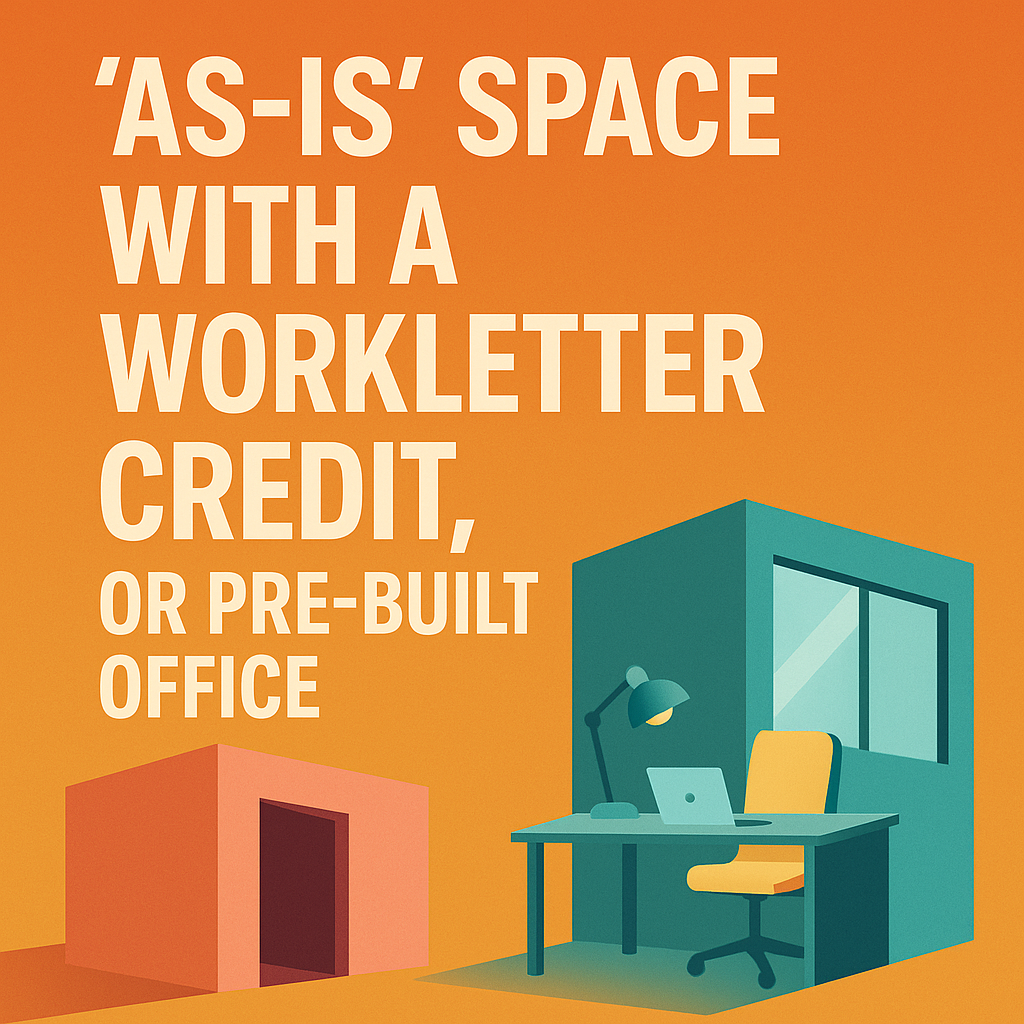
- As-Is Space with a Workletter Credit – The landlord delivers the space in its current condition and offers the tenant an improvement allowance (usually expressed as $/SF) to customize the build-out.
- Landlord Prebuilt – The landlord renovates the space in advance, delivering a turnkey suite with glass-front offices, a pantry, cabling, and lighting already installed.
For budget-conscious firms, deciding between these paths isn’t just about aesthetics—it’s about cost, timing, and control.
How Workletter Credits Work
Definition: A workletter credit (often called a TI allowance) is the amount a landlord provides toward construction.
- Typical ranges in 2025:
- Class A Midtown: $80–$120/SF
- Class B Midtown South: $40–$70/SF
- Tenants manage their own build-out, often with an architect and contractor.
Example:
A 10,000 RSF lease in a Midtown tower with a $100/SF allowance provides $1,000,000 for improvements. If the custom build-out costs $130/SF ($1.3M total), the tenant must fund the extra $300,000 out of pocket.
Pros:
- Complete control over layout and finishes
- Ability to match brand standards (conference sizes, workstation density, wellness rooms, etc.)
- Often negotiable—larger tenants can push for higher allowances
Cons:
- Upfront cash outlay if costs exceed allowance
- Longer delivery timeline (6–12 months for design + permits)
- Construction risk on tenant’s shoulders
How Prebuilt Space Works
Definition: A prebuilt is space the landlord has already renovated into a generic but modern configuration.
- Typically includes: glass office fronts, open workstation areas, pantry, new carpet/lighting.
- Sizes range from 2,500–15,000 RSF, geared toward small to midsize firms.
Example:
A 7,500 RSF prebuilt suite in Midtown South may be marketed at $72/SF, fully built. Tenants move in within weeks, with only furniture and branding required.
Pros:
- Speed-to-occupancy—move in within 30–60 days
- Minimal upfront construction spend
- Landlord absorbs construction risk and cost overruns
Cons:
- Layout is generic; may not fit a tenant’s workflow
- Fewer customization options (e.g., pantry placement fixed)
- Rent sometimes includes a slight markup to recover build-out cost
Cost Comparison: Side by Side
Scenario: 10,000 RSF in Midtown East
| Option | Base Rent | Landlord Contribution | Tenant Out-of-Pocket | Delivery Timeline | Total Effective Cost (Year 1) |
|---|---|---|---|---|---|
| As-Is w/ Workletter | $80/SF | $100/SF allowance ($1M) | $300K extra | 9–12 months | Rent $800K + $300K capex = $1.1M |
| Prebuilt | $84/SF (slight rent premium) | Landlord delivers built | $0 | 1–2 months | Rent $840K + furniture = ~$900K |
Tenant Profiles: Who Benefits from Each
Prebuilt Tenants
- Startups and growth firms that prioritize speed and cash preservation
- Nonprofits and small practices needing efficient, plug-and-play layouts
- Tenants with uncertain long-term headcount (shorter-term leases often tied to prebuilts)
As-Is + Workletter Tenants
- Professional services firms (law, finance) needing client-facing space
- Larger tenants (15,000+ RSF) where custom layouts impact productivity
- Long-term occupiers willing to invest upfront for a 7–10 year stay
Negotiation Tips
- For Workletter Deals:
- Push for higher $/SF allowances if vacancy is high
- Negotiate free rent during build-out period
- Cap landlord approval timelines to prevent delays
- For Prebuilts:
- Ask for rent concessions to offset the landlord’s markup
- Request “modest modifications” (e.g., extra huddle rooms) before signing
- Confirm what furniture, cabling, and branding costs remain your responsibility
Tenant Takeaway
The choice between as-is with a workletter and prebuilt space comes down to priorities:
- Speed + low upfront cost = Prebuilt
- Customization + long-term control = Workletter
In 2025’s Manhattan market, many midsize tenants choose prebuilts to avoid construction headaches and conserve cash. But for firms investing in a flagship office, the workletter path still delivers long-term value.
Where NewYorkOffices.com Fits In
At NewYorkOffices.com, we guide tenants through these trade-offs every day. We’ll:
- Benchmark workletter credits by building class and location
- Compare effective rent vs. out-of-pocket capex
- Negotiate free rent, caps, and customizations to tilt the economics in your favor
If you’re weighing prebuilt vs. workletter space, we can help you model the numbers and secure the best deal for your business.
Fill out our 📋 online form or give us a call today 📞 212-967-2061 — let’s find the right office for your business.