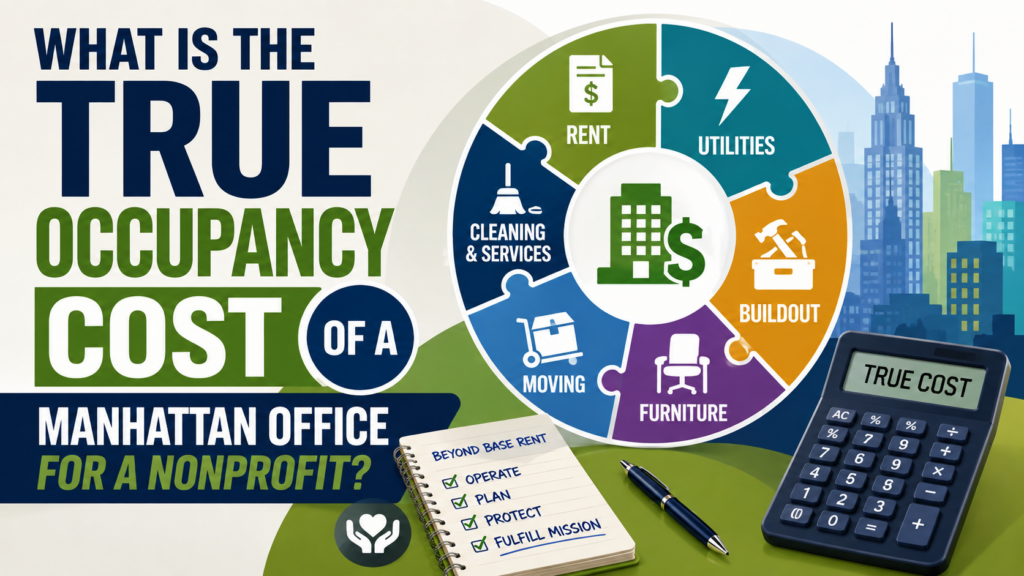
What Is the True Occupancy Cost of a Manhattan Office for a Nonprofit?
A nonprofit should never build its Manhattan office budget around asking rent alone. True occupancy cost measures every dollar required to secure, build, operate, and eventually leave the office. That means rent, additional rent, utilities, cleaning, construction, technology, furniture, moving, and other obligations all matter.
Quick answer: A $75-per-square-foot Manhattan office does not necessarily cost $75 per square foot to occupy.
The economic cost can rise substantially after the nonprofit adds operating expenses and capital costs.
Conversely, concessions and a tax-efficient lease structure can lower the effective cost.
That distinction matters because nonprofits usually operate under tighter capital constraints than commercial tenants. Every unnecessary office dollar competes with program spending, staffing, fundraising, and reserves.
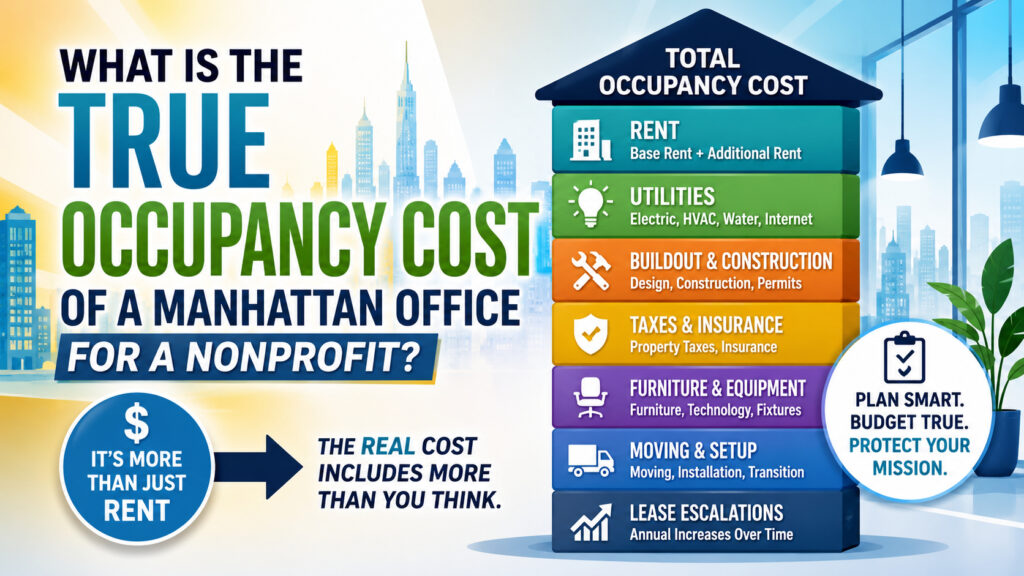
The true number starts after base rent
Manhattan landlords usually quote conventional office rent as an annual dollar amount per rentable square foot, or RSF. Therefore, a 5,000-RSF office asking $75 per square foot carries $375,000 of annual face rent. That equals $31,250 per month before other charges.
The basic calculation looks simple:
Annual base rent = rentable square feet × annual asking rent
Monthly base rent = annual base rent ÷ 12
However, that calculation only identifies the starting rent. It does not necessarily show the nonprofit’s actual occupancy burden.
A complete model should separate three different numbers.
Cash occupancy cost measures what the nonprofit expects to pay during a given operating year. It includes rent, additional rent, utilities, insurance, cleaning, and recurring services.
Upfront occupancy cost captures cash needed before operations begin. Buildout, furniture, cabling, technology, moving, deposits, consultants, and legal work belong here.
Effective occupancy cost spreads concessions and capital costs across the lease term. That measure gives boards and finance teams a better comparison between competing offices.
For example, a cheaper raw office can require enormous capital before move-in. Meanwhile, a higher-rent furnished suite may require very little capital.
Consequently, the lowest asking rent does not always produce the lowest occupancy cost.
Our Manhattan office pricing guide explains the underlying rent calculation in greater detail.
Manhattan rent is only the first benchmark
As of the second quarter of 2026, one major Manhattan market survey placed overall asking rent at $72.83 per square foot. Class A asking rent reached $84.79 per square foot.
Location created an even wider spread. The same Q2 2026 data placed Midtown around $76.98 per square foot. Midtown South averaged $81.14, while Downtown averaged approximately $56.66.
Those averages do not establish what a specific nonprofit should pay. They simply provide market context.
Premium buildings can exceed those averages by a wide margin. Older buildings and certain subleases can fall well below them. Floor, views, condition, lease term, credit, amenities, and landlord motivation can change pricing within one block.
More importantly, asking rent and occupancy cost measure different things.
Consider two hypothetical 5,000-RSF choices:
| Office | Asking Rent | Annual Face Rent | Initial Condition |
|---|---|---|---|
| Office A | $65 PSF | $325,000 | Raw or heavily altered |
| Office B | $75 PSF | $375,000 | Built and furnished |
Office A appears $50,000 cheaper each year. Yet a $500,000 construction difference could erase several years of that savings.
Current Manhattan supply has also tightened. One Q2 2026 data series placed availability at 13.0%, its lowest level since October 2020. Prime options have tightened faster than the broader market.
Therefore, nonprofits should compare economic packages, not advertised rates.
For additional context, see our NYC office cost guide.
Rentable area can change the budget before rent does
A nonprofit may need 5,000 square feet for its people and programs. That does not automatically mean it should search for 5,000 RSF.
Manhattan leases usually distinguish between usable square feet and rentable square feet. Usable area generally represents space within the tenant’s occupancy. Rentable area adds an allocation for building common areas.
The difference creates what tenants commonly call a loss factor.
Suppose a nonprofit needs 5,000 usable square feet. Assume the proposed building produces a 30% loss factor.
The approximate requirement becomes:
5,000 USF ÷ 0.70 = 7,143 RSF
At $70 per rentable square foot, annual rent reaches roughly:
7,143 × $70 = $500,010
The nonprofit therefore spends about $500,000 to secure roughly 5,000 usable square feet.
Efficiency can overturn a rent comparison.
Imagine another building charges $75 per square foot but offers a substantially more efficient floor. Its higher rent could still generate a lower cost for each usable square foot.
That issue becomes especially important for nonprofits with counseling rooms, classrooms, clinics, storage, training areas, interview rooms, or private offices. Each program requires actual usable area.
Do not compare buildings through RSF alone. Instead, compare usable area, rentable area, seating capacity, program capacity, and annual occupancy cost together.
Our Manhattan loss-factor guide explains that calculation. The office sizing guide also helps translate staffing into a workable requirement.
Additional rent needs its own line-by-line audit
“Additional rent” can become one of the most misunderstood phrases in a Manhattan office lease.
A tenant may hear that a lease is “gross” and assume nothing else applies. That assumption can create future budget surprises.
Many conventional Manhattan office leases use a full-service or modified-gross structure. Base-year building costs may already sit inside the starting rent. The tenant then pays defined increases after that base period.
That distinction matters.
A nonprofit should not automatically add the building’s entire tax bill and operating cost to first-year base rent. Instead, the lease must identify what the landlord already includes.
Real estate tax escalations commonly measure increases above a defined tax base. Operating-expense clauses can work similarly. Other leases use different escalation formulas.
Electricity may come through direct metering, submetering, or a fixed per-square-foot charge. Standard HVAC may cover only defined building hours. After-hours cooling can create another charge.
Cleaning can sit inside rent or outside it. Security, freight elevator use, supplemental HVAC, condenser water, storage, generator use, and access cards can also create costs.
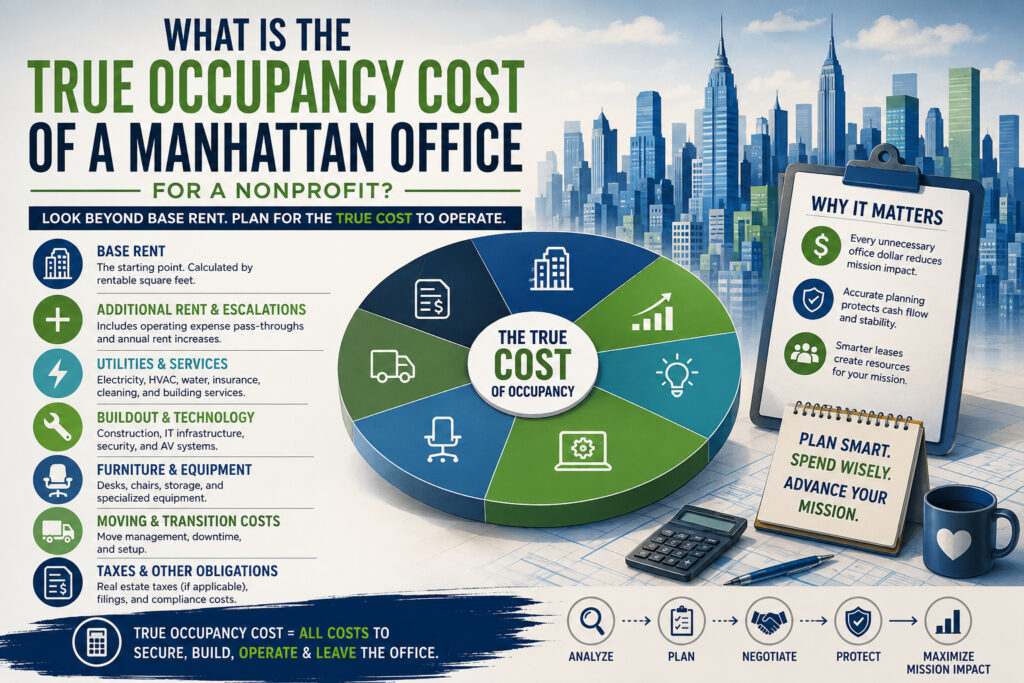
The nonprofit should therefore build a lease matrix showing:
| Cost | Included? | Starting Cost | Escalation Method |
|---|---|---|---|
| Base rent | — | Known | Fixed bumps or formula |
| Real estate taxes | Sometimes | Lease-specific | Base-year increase |
| Operating expenses | Sometimes | Lease-specific | Base-year or formula |
| Electricity | Varies | Usage or fixed | Utility changes |
| Cleaning | Varies | Contract-specific | Service increases |
| Overtime HVAC | Usually separate | Usage-based | Building schedule |
| Insurance | Tenant cost | Policy-specific | Renewal pricing |
Our commercial leasing guide provides a broader framework for reviewing these obligations.
Nonprofit tax status can materially change the economics
Nonprofit status deserves separate analysis because several tax concepts often get mixed together.
First, federal nonprofit status does not automatically eliminate a landlord’s real estate taxes from an ordinary commercial lease. New York City’s standard property-tax exemption generally requires qualifying ownership and qualifying use.
That means a nonprofit occupying an ordinary leased suite can still face real estate tax escalations under its lease.
However, qualifying nonprofit structures can create very different results.
New York law allows property used for certain charitable, educational, religious, hospital, and related purposes to qualify under specific exemption rules. The structure, ownership interest, organizational purpose, and actual use all matter.
A leasehold condominium structure can become relevant for larger, long-term nonprofit occupancies. City tax rulings confirm that qualifying nonprofit ownership of a leasehold condominium can support real property tax exemption under applicable conditions.
That strategy does not fit every nonprofit or every building. Transaction costs, lease length, condominium documents, use restrictions, landlord cooperation, and tax advice all matter.
A separate issue involves New York City’s Commercial Rent Tax. Qualifying nonprofit religious, charitable, or educational organizations can receive exemption. Other nonprofit organizations may also qualify under specified conditions.
Therefore, do not put “property tax exempt” into the budget because the tenant has nonprofit status.
Instead, ask:
What exemption applies, to which tax, under what structure, and during which years?
That question can change millions of dollars across a long lease.
Buildout, furniture, technology, and moving can rival rent
Construction can create the largest difference between face rent and true occupancy cost.
New York remains one of America’s most expensive office fit-out markets. A 2026 cost benchmark placed New York City hard construction costs around $220.62 per square foot.
When that benchmark includes soft costs, technology, audiovisual systems, furniture, and related components, the modeled total reaches roughly $330.92 per square foot.
Those figures describe a benchmark project, not every nonprofit buildout. Reusing existing improvements can dramatically lower the requirement.
That is why second-generation space can carry exceptional value for nonprofits.
Existing offices, conference rooms, kitchens, wiring, flooring, lighting, and furniture may eliminate major capital items. A well-matched prebuilt can also reduce design and construction time.
Tenant improvement allowances help, but they do not make construction free.
Suppose a project costs $250 per square foot. The landlord contributes $150 per square foot.
The nonprofit still faces a $100-per-square-foot funding gap.
Across 10,000 square feet, that equals $1 million.
Furthermore, furniture, IT equipment, moving, specialty cabling, security systems, signage, professional fees, and deposits may fall outside the landlord’s allowance.
Boards should therefore request two budgets before approving a lease:
Lease budget: rent and recurring occupancy expenses.
Project budget: every dollar required to open the office.
A space with existing infrastructure can sometimes beat a cheaper shell by a remarkable margin. That advantage grows when the nonprofit values capital preservation.
A worked nonprofit occupancy budget shows the real difference
Consider a hypothetical nonprofit evaluating a 5,000-RSF Manhattan office at $75 per square foot.
The figures below illustrate the calculation. Except for the referenced construction benchmark, the supplemental amounts represent underwriting assumptions.
| Occupancy Item | Illustrative Annual Amount |
|---|---|
| Base rent | $375,000 |
| Electricity | $16,250 |
| Cleaning or supplemental service | $12,500 |
| Internet and telecom | $18,000 |
| Tenant insurance | $7,500 |
| Facilities and miscellaneous occupancy | $15,000 |
| Recurring cash occupancy | $444,250 |
The recurring figure already equals $88.85 per RSF, before future escalation costs.
Now assume the nonprofit chooses a substantial custom fit-out.
A 2026 New York benchmark places a broad all-in office fit-out around $330.92 per square foot.
At 5,000 square feet, that benchmark produces:
5,000 × $330.92 = $1,654,600
Assume the negotiated landlord contribution equals $150 per square foot.
That contribution totals $750,000.
The remaining modeled capital requirement becomes:
$1,654,600 − $750,000 = $904,600
Spread evenly across a ten-year term, the simple annual capital allocation equals $90,460. That calculation excludes financing costs.
Add it to recurring occupancy:
$444,250 + $90,460 = $534,710 annually
The economic occupancy cost now reaches approximately $106.94 per RSF.
A $75 asking rent has therefore become a modeled cost above $106 per square foot.
This example also explains why a furnished or efficiently prebuilt office can outperform a lower-priced raw floor.
Our true monthly office cost guide provides another way to organize the monthly calculation.
The best nonprofit office is the one that protects the mission
The smartest cost reduction usually happens before lease negotiations begin.
Start with usable requirements rather than a convenient round square-footage target. An oversized office creates rent, electricity, cleaning, furniture, and construction costs simultaneously.
Next, compare existing conditions carefully. Reusing rooms, cabling, furniture, lighting, and kitchens can preserve substantial capital.
Then, model each proposal across the entire lease term. Include rent increases, tax escalations, operating costs, concessions, construction, and exit obligations.
A strong comparison should measure at least four outputs:
Annual cash cost shows what finance must fund each year.
Effective cost per RSF makes lease economics easier to compare.
Effective cost per usable square foot exposes inefficient buildings.
Cost per supported employee or program seat connects real estate spending with operations.
Timing also matters. Manhattan’s office market tightened during 2026, particularly for desirable space. Current data show declining availability alongside continued demand.
As a result, delaying the search can reduce choices in specific building classes and locations.
Is Downtown always cheaper for a nonprofit?
Not always. Downtown’s current average asking rent sits below Midtown and Midtown South. Yet construction, efficiency, commuting, and additional rent can reverse the result.
Should a nonprofit choose the lowest rent?
Usually not without comparing the complete economics. Lower rent can hide inferior efficiency, high construction requirements, or weak concessions.
Does nonprofit status eliminate real estate taxes?
Not automatically. The exemption depends on ownership, use, organizational eligibility, and transaction structure.
Is a tenant improvement allowance free money?
No. It forms part of the negotiated lease economics. Landlords may balance stronger allowances against rent, term, credit, or other concessions.
What should a board approve before lease signing?
Approve the lease obligation and the complete capital plan together. Also review future escalations and realistic exit obligations.
The core question is not, “What is the rent?”
It is:
“What will this office consume from our nonprofit’s budget from the day we commit until the day we leave?”
Review a List of Custom Options
We represent office tenants, not landlords. Our role is to expose those economics before a nonprofit commits to space. We compare leases, occupancy costs, and negotiating terms from the tenant’s side.
Fill out our 📋 online form or give us a call today 📞 212-967-2061 — let’s find the right options for your business.