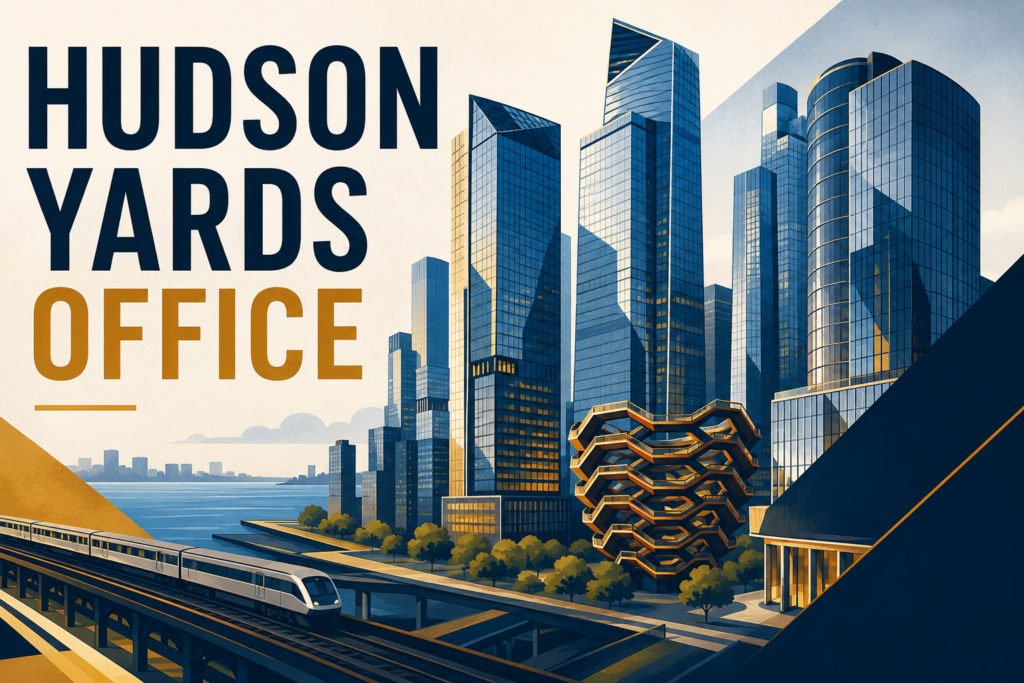
Hudson Yards Office
Hudson Yards office space at a glance
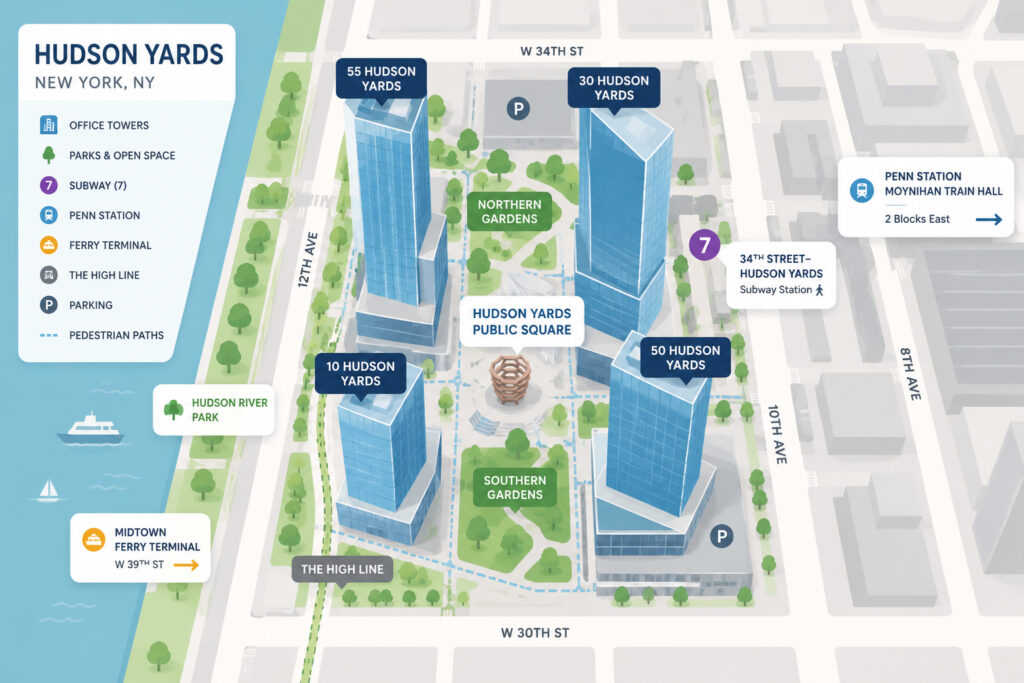
Hudson Yards gives tenants some of Manhattan’s newest office space. The district sits between Tenth and Twelfth Avenues, from West 30th to West 34th Streets. The core also rises over a working rail yard, where two platforms bridge more than 30 active tracks and three rail tunnels.
The office inventory spans several major towers. One building offers about 1.8 million square feet. Another offers about 2.6 million square feet. A full-block tower adds about 2.9 million square feet. A High Line-edge office building contributes about 1.3 million square feet. Another 1.4 million square feet now moves forward just north of the core.
For current availability, start with Search Office Listings and compare the district’s main options through the West 30th tower, the supertall at West 33rd Street, the full-block tower at West 34th Street, the High Line-edge tower, and the nearby Hudson Boulevard option.
Why tenants choose Hudson Yards
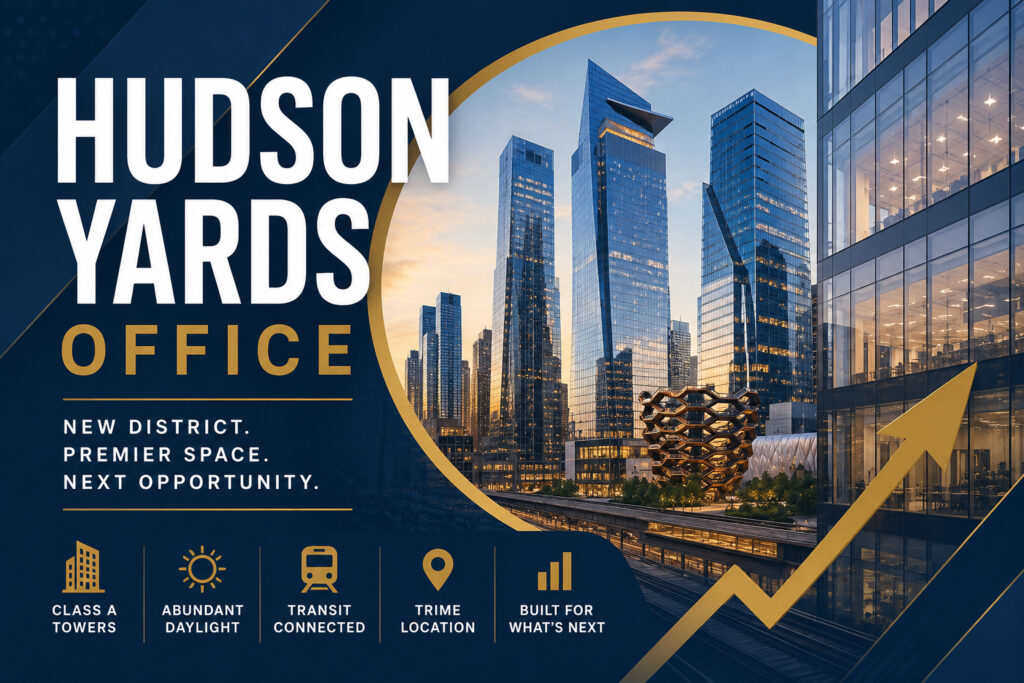
New construction drives much of the appeal here. Tenants get large floor plates, strong daylight, modern mechanical systems, and polished arrival experiences. The tower at West 30th Street rises 895 feet and carries LEED v2009 Platinum. The tower at West 33rd Street rises 1,296 feet, tops 100 stories, and connects directly to the No. 7 subway.
Scale also sets Hudson Yards apart. The full-block tower at West 34th Street spans 2.9 million square feet and covers an entire city block. Upper-level floor plates in that building reach roughly 49,748 rentable square feet on a published core plan. The next office tower north of the current core adds another 1.4 million square feet beside the No. 7 entrance.
Talent attraction matters just as much as architecture. One office tower links directly to the High Line and the public square. Another sits across from the subway entrance. Another offers seamless subway access, bike storage, valet parking, and a porte cochère. Those details shape commute quality, recruiting, and daily attendance.
Market conditions also support the district’s premium position. Reuters reported Manhattan office utilization reached 79.9% of pre-pandemic activity in January 2025. Another report put Manhattan leasing at 23.2 million square feet during the first nine months of 2025, the strongest such stretch since 2006. The Financial Times also reported a record number of Manhattan leases above $100 per square foot in 2025, driven by demand for high-end space and stronger employee amenities.
Where Hudson Yards sits and how the commute works
Hudson Yards occupies Manhattan’s far West Side. The district runs from West 30th Street to West 34th Street, between Tenth and Twelfth Avenues. That placement keeps it close to Midtown, the riverfront, Hudson Boulevard, and the Penn Station corridor.
Transit starts with the No. 7 train. The district’s official transportation page calls it the main conduit to and from Hudson Yards. Penn Station sits only two blocks east, which gives teams easy access to regional rail and multiple subway lines. Nearby bus service includes the M34-SBS, M12, and M11. The Midtown ferry terminal also sits at West 39th Street and the West Side Highway.
Bike access adds another advantage. Hudson River Park offers a practical north-south cycling route. The district also notes daily bike storage on site. Drivers benefit from immediate West Side Highway access, but many occupiers choose this district because regional rail and subway access reduce commute friction.
The public realm strengthens the address. The High Line connects directly into the southern part of the district. The official West 30th tower page also notes a dramatic 60-foot public passageway through the building where the elevated park continues through the site. If your team wants a firmer brief before touring, review Office Leasing Basics and Planning Your Manhattan Office Lease.
Core buildings and space options
The office product breaks into several clear choices. The tower at West 30th Street gives tenants about 1.8 million square feet, a 895-foot profile, direct High Line access, and one of the district’s strongest wellness stories. The supertall at West 33rd Street offers about 2.6 million square feet, over 100 stories, river-to-river views, and a direct underground link to the No. 7.
The full-block tower at West 34th Street targets very large users. It spans about 2.9 million square feet, rises 58 stories, and ranks among New York’s largest office towers by leasable area. The nearby High Line-edge office building offers a smaller but still substantial 1.3 million square feet, a 780-foot height, LEED Gold design, and an entrance just across from the No. 7 station.
That range gives tenants useful flexibility. Large occupiers can solve for headquarters needs, growth floors, and long-term expansion. Mid-sized firms can target a full floor, a strong partial floor, or a premium prebuilt suite. Teams that want a nearby alternative can also compare the adjacent Hudson Boulevard tower without giving up the same commute pattern.
Future supply matters too. The next office tower in the district rises 717 feet and adds 1.4 million square feet. Its official property page places it next to the No. 7 entrance and describes large terraces, efficient floorplates, conferencing space, wellness facilities, and a dedicated multimedia studio. That future inventory matters for tenants with longer planning windows.
Hudson Yards office rent and lease structure
Hudson Yards competes in Manhattan’s premium pricing tier. Newer systems, larger plates, stronger light, better views, and deeper amenity packages support that position. Recent reporting also showed that top-end Manhattan office space captured record activity in 2025, including a record count of leases above $100 per square foot.
No single asking rent tells the whole story here. Floor height changes value. View corridors change value. Timing changes value. Build-out scope, free rent, improvement allowance, lease term, and expansion rights move the final economics just as much as the headline number. That is why direct space, furnished space, and second-generation space should enter the same comparison.
Start early if your team needs a large block or a custom build-out. Premium Manhattan leasing strengthened through 2025, while owners and lenders regained confidence in highly amenitized Class A buildings. Better preparation usually creates better leverage. Before tours, review Terms of the Lease, Altering the Space, The Professionals You Need When Leasing an Office, and the Office Space Calculator.
Daily life, amenities, and employee experience
Hudson Yards works because the office day feels mixed-use, not isolated. Employees can arrive by rail or subway, move through a modern lobby, grab coffee, meet clients, and step outdoors without a long detour. The district’s official transportation and amenity pages show how tightly the office product connects to retail, food, services, and open space.
The amenity base runs deep. The district lists coffee, casual food, dining, cocktails, apparel, beauty services, eyewear, concierge services, and child care within the neighborhood. That variety helps long workdays feel easier. It also gives firms more options for informal meetings, client lunches, and after-work events.
Open space adds major value. The High Line reaches the district directly, while the public square and surrounding pedestrian realm soften the feel of a dense office cluster. One office tower even carries the park through a 60-foot public passageway. Another office building sits at the intersection of the High Line and Hudson Park & Boulevard. That blend of office space and outdoor access is rare in Manhattan.
Hudson Yards office FAQs
Where is Hudson Yards office space located? Hudson Yards sits between Tenth and Twelfth Avenues from West 30th to West 34th Streets. The No. 7 serves the district directly, and Penn Station stands about two blocks east.
Is Hudson Yards a premium office location? Yes. The district combines new construction, large floor plates, strong sustainability credentials, and direct transit access. Recent Manhattan leasing data also shows sustained demand for high-end office product.
What happened with Hudson Yards? The district rose over a working rail yard through one of New York’s most complex construction programs. Two platforms bridge active tracks and rail tunnels, while hundreds of caissons anchor the project into bedrock. The No. 7 extension opened there in 2015.
How tall is the tallest office tower in the district? The tallest existing office tower in the core rises 1,296 feet and climbs past 100 stories. Its official building page also describes it as the second-tallest office tower in New York.
What drives Hudson Yards office rent the most? Building quality drives the first layer. After that, floor size, views, term, build-out cost, timing, and current supply shape the deal. Manhattan’s recent flight to quality strengthens each of those factors.
Is more office space still coming? Yes. The next office tower north of the current core now moves forward with 1.4 million square feet. The official property page also places it beside the No. 7 entrance and frames it as the next phase of Hudson Yards office growth.
Work with a tenant broker
Our advice aligned with your space needs, budget, and timing. It also lets us compare Hudson Yards against every serious alternative before you sign. We represent tenants only. We compare every real Hudson Yards option, then negotiate against the full market. When you are ready, use Search Office Listings or Contact a Broker to start your search.
Fill out our 📋 online form or give us a call today 📞 212-967-2061 — let’s find the right options for your business.