Is Flatiron Good for Office Space?
Yes, for many companies it is. But not for the simplistic reason most neighborhood guides give.
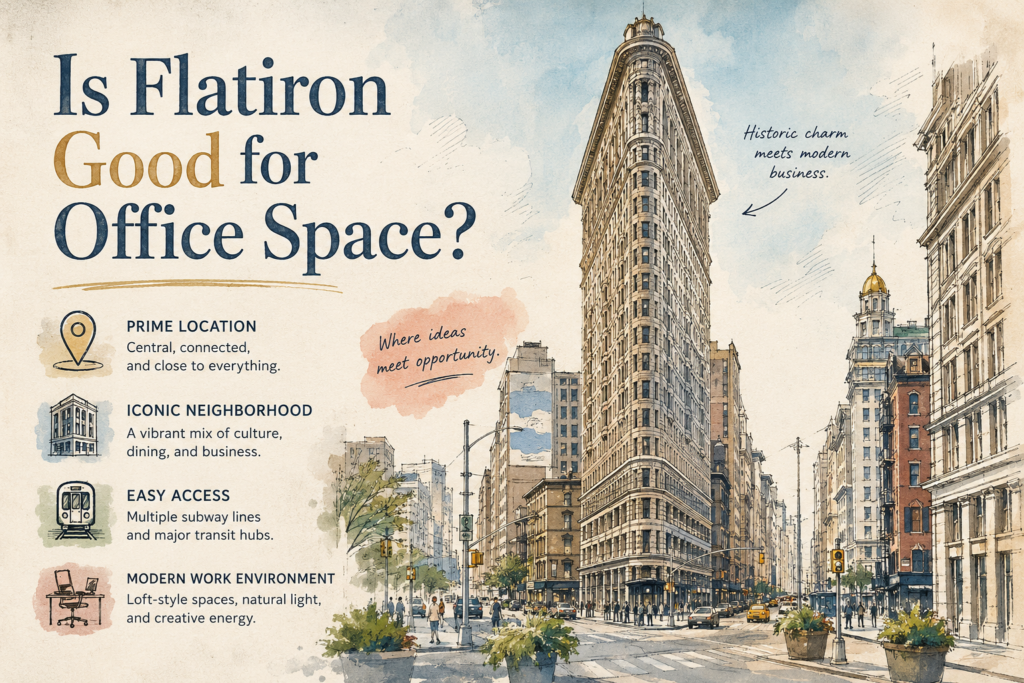
Flatiron is good for office space because it combines several advantages that are hard to find in one Manhattan submarket at the same time: unusually strong transit access, a dense mix of restaurants and services, a large stock of historic loft buildings with personality, and an increasingly credible set of modern trophy or amenity-heavy options for larger tenants. Recent district data also show real leasing momentum rather than nostalgia alone. Availability has been improving, major tenants continue to expand, and employee visits in the district have moved meaningfully higher.
That said, Flatiron is not the right answer for every business. If your top priority is simply paying the lowest possible Manhattan rent, there are cheaper alternatives. If you need huge, hyper-efficient, brand-new tower floors at commodity pricing, Flatiron will not always be the easiest market. And if your team does not care about neighborhood identity, recruiting appeal, or client-facing presence, you may be paying for benefits you do not fully use. Midtown South asking rents are materially above Downtown Manhattan on average, and Flatiron sits inside that stronger Midtown South pricing environment.
So the honest answer is this: Flatiron is one of Manhattan’s best office neighborhoods for companies that want a workplace to help with hiring, culture, collaboration, and brand perception. It is less compelling for pure cost-minimizers.
Why Flatiron works so well for office users
The first reason is transit. Union Square is one of the city’s largest transportation nodes, with eight subway lines converging there and more than 35 million travelers annually, while nearby stations and PATH access widen the catchment area even more. Official district reporting also showed 15.3 million subway rides in the Flatiron/NoMad area in Q1 2025, up 7% from the prior year, and 14.2 million subway rides around the district in Q3 2024. For mixed-borough teams and hybrid attendance patterns, that kind of access is not just convenient; it directly improves the odds that people will actually come in.
The second reason is that Flatiron genuinely performs like a live neighborhood, not just a cluster of office buildings. Q3 2025 district reporting showed ground-floor occupancy holding at 85%, with food and drink making up 44% of businesses. Q3 2024 reporting showed nearly 60,000 average weekday employee visits in September and more than 3.7 million office employee visits in that quarter alone. That matters because the best office neighborhoods are not only about the office itself. They are about the quality of the workday outside the office: lunch options, coffee meetings, after-work catchups, quick errands, park access, and a street environment people do not resent. Flatiron’s restaurant density, Madison Square Park adjacency, and pedestrian-oriented Broadway improvements all strengthen that equation.
The third reason is demand from serious tenants. This is not a district surviving only on small startups and coworking operators. In Q1 2025, IBM expanded at One Madison Avenue, bringing its footprint there to 362,092 square feet. IBM’s flagship office at One Madison spans 270,000 square feet across five floors and is designed for collaboration, client engagement, and innovation. Goodwin signed a lease to relocate its New York office to 200 Fifth Avenue overlooking Madison Square Park, and Chime signed 84,000 square feet at 122 Fifth Avenue. In Q2 2025, the district also logged major leases from Goodwin Proctor at 200 Fifth Avenue, Pinterest at 11 Madison Avenue, and LeParc Coworking at 287 Park Avenue South. That kind of tenant mix tells you Flatiron is attractive not only to creative firms, but also to law, finance, fintech, AI, and enterprise users that can afford to be selective.
There is also a qualitative reason that should not be underestimated: Flatiron feels like somewhere people want to work. NYC Tourism describes the neighborhood as rich in Beaux-Arts and cast-iron architecture, dining, and Madison Square Park amenities. Hubble’s current Flatiron guide emphasizes the same pattern from the occupier side: central location, strong connectivity, creative and tech density, walkability, and a better in-office experience. That is not fluff. In the hybrid era, the neighborhood itself has become part of the office product.
The office stock is better and more varied than many tenants assume
A lot of Manhattan tenants still think of Flatiron as a loft-only market. That is partly true and partly outdated.
The older truth is still real: much of Flatiron’s inventory consists of historic loft buildings adapted for modern office use. Current neighborhood guide describes the district as a market where historic loft stock has been updated for contemporary tenants. That is exactly why creative firms, agencies, studios, and startup teams have been drawn there for years. They want high ceilings, large windows, authentic architectural character, and floor plans that can feel more human than a generic Midtown tower.
But the outdated part is the assumption that Flatiron cannot serve bigger or more amenity-driven occupiers. That is no longer true. At 200 Fifth Avenue, BXP highlights frontage on Madison Square Park, rooftop terraces, outdoor courtyards, Eataly on the ground floor, and layout flexibility with 60,000-square-foot floor plates. At 122 Fifth Avenue, Bromley says the building’s $100 million repositioning created one of the most modern loft products on Lower Fifth Avenue, with 27,000- to 34,000-square-foot floor plates, 11-foot-6-inch to 13-foot-5-inch ceilings, and large contiguous blocks. And at One Madison, SL Green and the building’s official site position the property as a future-forward, wellness-heavy workplace with 100% fresh air HVAC, a 7,000-square-foot tenant lounge, a 6,200-square-foot indoor event space, a 5,000-square-foot rooftop terrace, and a curated amenity package that now sits inside a fully leased trophy redevelopment.
That variety is one of Flatiron’s biggest advantages. In practical terms, companies can choose between classic loft identity and modern Class A polish without leaving the neighborhood. Many competing pages hint at this, but they do not make the key strategic point clear enough: Flatiron is good for office space because it gives tenants more than one version of “good.” It can be park-front trophy space, renovated Lower Fifth Avenue loft product, plug-and-play prebuilt space, or smaller side-street creative suites.
What Flatiron costs right now
Flatiron is not cheap, but it is also not one monolithic rent band.
At the broader market level, Midtown South averaged $84.37 per square foot in CBRE’s Q1 2026 report and $80.27 per square foot in Colliers’ Q1 2026 report. Lower Manhattan was much lower in the same period, at roughly $59.08 per square foot in CBRE and $61.70 per square foot in Colliers. That means a tenant choosing Flatiron is usually paying a premium for geography, product type, and neighborhood quality, not stumbling into some mysterious pricing anomaly.
Inside Flatiron itself, current marketed examples show how wide the range can be. CommercialCafe’s current inventory includes examples like 873 Broadway at $35 per square foot, 39 West 14th Street at $52, 37 Union Square West at $60, 37 West 20th Street at $59 to $72, and 44 West 18th Street at $78 per square foot annually. That is a useful reminder that “Flatiron rent” depends heavily on the exact building, frontage, improvements, and block. Loft stock on side streets can price very differently from park-adjacent or newly repositioned product.
Flexible private offices are a different equation again. Hubble’s current Flatiron guide says private office pricing varies by size, building, and amenities, and uses an average desk price benchmark of about $640 per month. WeWork’s Flatiron page makes the same tradeoff from another angle: higher monthly bundled cost in exchange for faster move-in, included services, meeting rooms, support staff, and flexible commitments. For small or hybrid teams, that all-inclusive structure can actually be rational even when the nominal per-seat number looks high, because it avoids furniture, fit-out, internet, cleaning, and operational overhead.
So the right way to think about Flatiron pricing is not “expensive” versus “affordable.” It is premium neighborhood, mixed product set. Some spaces will be far cheaper than people assume. Others will absolutely push toward trophy-level numbers. The neighborhood is good for office space because it lets a tenant choose the premium they are actually paying for.
Who should choose Flatiron and who probably should not
Flatiron is a particularly strong fit for firms that use office location as part of the business itself. That includes venture-backed startups that want recruiting credibility, design and media companies that want authentic loft character, client-facing professional firms that benefit from a central and polished address, and hybrid teams that need a neighborhood people will willingly commute into. From occupier guide, to inventory description, and the district’s own leasing data all point in the same direction: Flatiron remains especially well suited to technology, creative, media, and professional-services users who value flexibility, access, and environment.
It is also stronger than some people realize for larger tenants. One Madison’s full lease-up, IBM’s long-term commitment, Goodwin’s move to 200 Fifth, and Chime’s lease at 122 Fifth all show that Flatiron is not merely a small-suite startup market. If your firm wants a central Midtown South address with better culture and lifestyle credentials than a generic tower district, Flatiron has become increasingly compelling even at larger scale.
Where Flatiron is less compelling is just as important. If your top objective is minimizing occupancy cost, Lower Manhattan is meaningfully cheaper on average. If you need large, ultra-efficient, commodity-style floors without paying for neighborhood cachet, other submarkets may pencil better. And because much of Flatiron’s inventory is older loft stock, not every building will offer the same mechanical systems, ceiling uniformity, column-free efficiency, or institutional amenity package that a new-build or newer-generation tower can offer. Flatiron’s strength is character plus convenience plus demand. If those are not your priorities, the premium may not be worth it.
Final verdict
If the question is simply, “Is Flatiron good for office space?”, the best honest answer is yes.
It is one of Manhattan’s strongest office neighborhoods for companies that care about employee experience, brand perception, central location, and flexible building choices. The district’s leasing momentum, improving availability picture, heavy commuting volumes, and continued attraction to major tenants all support that conclusion. Recent market and district data do not describe a nostalgic office market coasting on an old reputation. They describe an active and increasingly competitive one.
But Flatiron is good for office space in a specific way. It is good when you want an office to feel strategic rather than merely functional. It is good when you value loft character or design-forward amenity packages. It is good when your employees are spread across Manhattan, Brooklyn, Queens, and New Jersey and you want a location with real commuting logic. It is less good when your only goal is rent minimization.
If your company wants Manhattan presence without giving up neighborhood energy, Flatiron deserves to be near the top of the shortlist.
FAQ
Is Flatiron too expensive for a small company?
Not automatically. Midtown South averages are high, but current Flatiron listings still show meaningful range, from mid-$30s product to space in the $50s, $60s, and upper $70s per square foot. Small teams can also use private-office operators, where Hubble’s current benchmark is about $640 per desk per month.
Are there still real loft offices in Flatiron?
Yes. Much of the district still consists of historic loft buildings adapted for office use, which is one reason Flatiron remains attractive to creative, media, and design-oriented users.
Is Flatiron only good for startups?
No. Startups and creative firms still fit the neighborhood well, but recent leasing and occupancy data show demand from larger legal, finance, AI, and enterprise tenants too, including IBM, Goodwin, Pinterest, and Chime.
What is Flatiron’s biggest office advantage?
The strongest edge is the combination of central transit access, live-work-play neighborhood quality, and a building mix that spans authentic lofts and highly amenitized Class A product. Very few Manhattan submarkets combine those as well as Flatiron does.
Flatiron continues to attract companies that want more than just office space, offering a rare combination of creative energy, landmark architecture, transit accessibility, and long-term business credibility in the center of Manhattan. If your company is evaluating office space in Flatiron, NewYorkOffices.com can help you compare buildings, negotiate aggressively, and secure the right space at no cost to your business.
Fill out our 📋 online form or give us a call today 📞 212-967-2061 — let’s find the right office for your business.