Documents Needed to Lease Office Space NYC
The direct answer
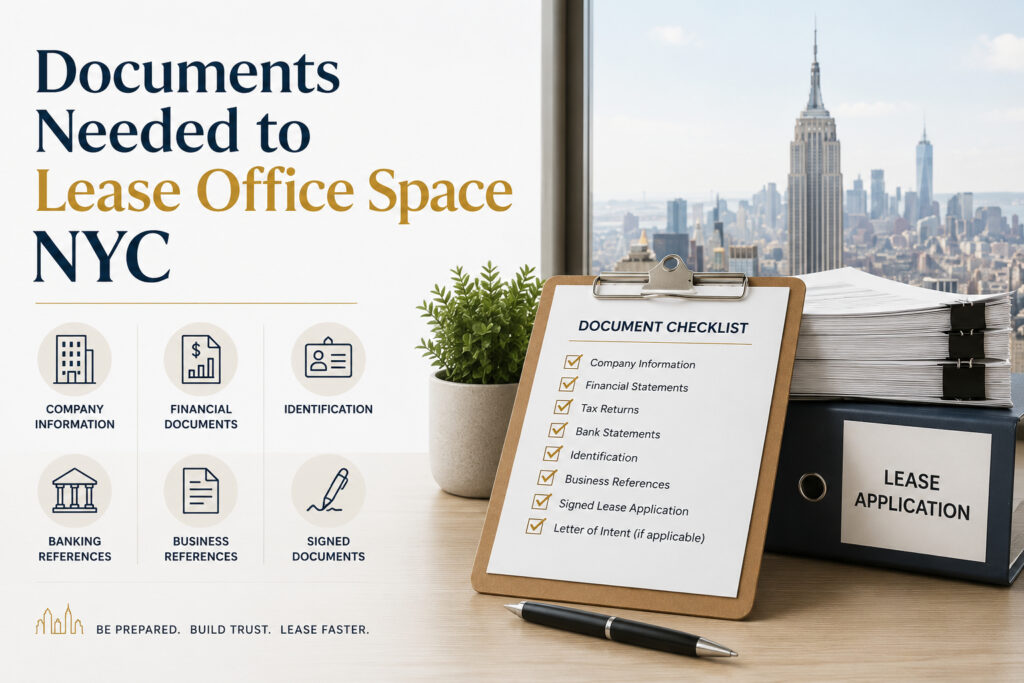
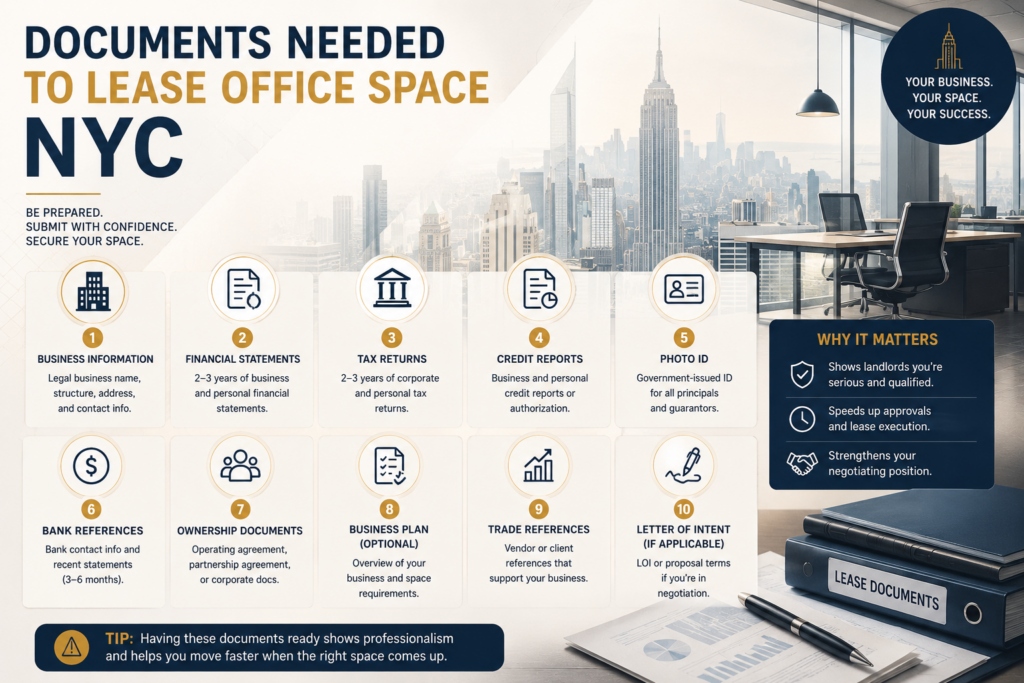
Most NYC office landlords want five things from you: proof of identity, proof your company legally exists, proof you can pay, proof your business can lawfully operate in the space, and proof you can insure and stand behind the lease. In practice, that usually means a commercial lease application, entity formation papers, an EIN, principal IDs, recent tax returns, bank statements, profit and loss reports, a balance sheet, a short business description, references, credit authorization, and insurance information. Public NYC commercial leasing guidance and city commercial-space application packets show that same core underwriting pattern.
No single landlord uses the exact same checklist. Still, the overlap is strong enough that you should build one clean digital package before you tour seriously. That package should live in a shareable folder, use consistent file names, and include both a short summary deck and full backup documents. The more organized you look, the faster underwriting usually moves.
This matters even more now. Manhattan office demand strengthened in early 2026, with availability tightening to roughly 13.7% to 14.5% and average asking rents landing around $77.55 to $80.42 per square foot, depending on source and methodology. Better buildings tighten first, so a weak document package can cost you time, leverage, or the space itself.
Documents you need to prepare
Identity and company formation
Start with the basics. Landlords want the full legal name of the tenant, the names of principals, contact details, and government photo ID for each person who will sign or guarantee the lease. A city commercial-space application also asks for date of birth, tax ID, and business phone information, which shows how identity review often begins.
Next, prove that your business exists in the right form. That usually means your certificate of incorporation, articles of organization, partnership papers, or other formation document, plus any state filing receipt or good-standing support you keep internally. New York’s business formation resources confirm that corporations and LLCs file formal entity documents with the state, and city commercial-space applications specifically call for a business certificate or certificate of incorporation when applicable.
You should also include your federal tax ID confirmation. The IRS issues EINs for free, and businesses use them to identify the entity for tax and reporting purposes. If you do not already have one, get it before serious lease discussions begin.
If your business sells taxable goods or taxable services, add any tax registration that applies to your operation. In New York, businesses that must collect sales tax need a Certificate of Authority. That certificate does not appear in every office lease package, but it often belongs in the operating-readiness folder.
Financial strength documents
This is the core of most approval packages. Landlords usually want business tax returns, personal tax returns for closely held firms, recent bank statements, and current financial statements that show revenue, cash, and debt. A city commercial-space application asks for three years of individual federal returns, three years of business returns if applicable, and documentation for cash and assets. It also asks applicants to disclose gross receipts, banking relationships, credit lines, and lenders.
For most office tenants, your minimum financial package should include these items in one set: recent business tax returns, recent personal tax returns if you own the company, the latest profit and loss statement, the latest balance sheet, and recent business bank statements. Add a short cover sheet that explains unusual swings in revenue, one-time losses, recent funding, or owner distributions. That context can matter as much as the raw numbers.
If you are a newer company, do not wait for the landlord to guess your story. Include current cash on hand, committed funding, a twelve-month cash-flow forecast, and a short narrative that explains runway, revenue model, and hiring plans. A city commercial-space package explicitly requires a twelve-month cash-flow analysis, and general NYC lease guidance explains that weaker financial history often leads to a larger security deposit or a guaranty request.
Business use and operating fit
Landlords do not underwrite money alone. They also underwrite use. Be ready with a short business description, your website, a one-page company overview, and a plain-English explanation of how you will use the office. A city application asks for the proposed business, the products or services offered, and the applicant’s experience in the field. That same logic applies to office deals, even when the use sounds simple.
Include any licenses, permits, registrations, or professional credentials your business must hold. The city’s commercial-space materials ask for copies of licenses needed to operate the proposed business and ask applicants to identify permits, issuing agencies, issue dates, and expiration dates. Meanwhile, the city’s business wizard makes clear that permit needs vary by use and that businesses should generate a custom city, state, and federal requirement list before opening.
For an office tenant, this rule matters in a specific way. Your use clause and the building’s legal records must match. City lease guidance notes that an office lease often permits general office use, but the building still needs a legal occupancy path for that use. A certificate of occupancy states the legal use and permitted occupancy type, and no one may legally occupy a building until the city issues a CO or TCO.
Risk control documents
Many NYC office deals also require a security package. That can include a security deposit, a letter of credit, a guaranty, or a combination of those tools. City leasing guidance says the security deposit often equals a number of months’ rent, commonly about two months, though the amount changes with rent level, tenant strength, and whether a guaranty sits behind the lease.
Expect landlords to ask for insurance readiness before lease signing. City commercial-space application materials require proof of commercial general liability insurance and either workers’ compensation coverage or a waiver form in the listed context. Broader city lease guidance also notes that landlords usually require commercial general liability insurance and personal property insurance, and may require the landlord, manager, and lender to sit on the policy as additional insureds.
If a landlord wants to run personal credit, plan for written consent. A city commercial lease applicant consent form requires each principal to authorize a search of personal and business credit history. Federal credit law also limits consumer reports to permitted purposes and written consumer instructions in certain cases, so this consent step should never surprise you.
Documents you should request before you sign
Legal use and occupancy records
Do not stop at the tenant checklist. Ask for the building-side documents, too. Before you sign, request the current certificate of occupancy or temporary certificate of occupancy, and confirm that the actual floor and suite align with your intended office use. If the building predates the modern CO requirement, ask for proof of legal use, such as a letter of no objection when applicable.
This step protects you from a basic but expensive mistake. Private permission from a landlord does not override city occupancy rules. If a space lacks the right legal use, your move-in, build-out, or sign-off can stall fast.
Draft lease, work letter, and cost schedules
Ask for the draft lease early. Then ask for every exhibit that changes money or timing. That includes the work letter, building rules, alteration rules, insurance specifications, house hours, access rules, cleaning scope, utility method, and any rider that shifts repair or compliance costs to you. City leasing guidance warns tenants not to rely on oral promises and explains that utilities, overtime HVAC, alteration responsibility, and additional rent all depend on the lease text.
You should also request the landlord’s estimate of additional rent and whatever backup the landlord will share on real estate tax and operating expense history. City leasing guidance says office tenants commonly pay more than base rent and should ask for an estimate of those added costs before planning the deal. It also explains that electricity often becomes a separate charge, either through direct metering or landlord submetering.
When build-out matters, request a written approval path. Get clear dates for plan review, landlord comments, permit filing, building access for contractors, inspections, and delivery condition. City leasing guidance lays out that many projects require architect plans, landlord review, filings, contractor hiring, construction, and inspections before minor finishing and move-in.
Accessibility and compliance allocation
Ask one blunt question before you sign: Who pays for accessibility issues, and who defends them? City accessibility guidance tells tenants to review lease responsibility for making both exterior and interior space accessible, because many NYC leases place that burden on the tenant or leave the issue unclear. The same guidance also says accessibility laws still apply even in older or landmark conditions.
That means you should request any prior accessibility correspondence, known claims, recent alteration plans, and the lease language that allocates compliance. If the space needs work, push that discussion forward before legal review drags on. Late surprises here can wreck both budget and timing.
Space-side due diligence that tenants often miss
A strong tenant package wins attention. A strong due-diligence package protects you after approval. So request the floor plan, rentable and usable square footage assumptions, internet and telecom conditions, service hours, freight and loading rules, after-hours HVAC charges, and any form the landlord requires for sublease, assignment, or future signage. City lease guidance makes clear that additional rent, utilities, service hours, and assignment or sublease rights all live in the lease, not in marketing language.
If you want a deeper tenant-side playbook, pair this page with the Commercial Leasing Guide, How to Get Approved for Office Space, and How to Evaluate and Negotiate Telecom and Internet Infrastructure in an Office Lease. Those topics sit right next to the document question in the real approval process.
Timing, approvals, and special cases
When each document matters
Before proposals. Have your entity papers, EIN, IDs, business summary, and license checklist ready first. That lets you move from tours to proposals without a paperwork scramble. City leasing guidance shows that the lease path begins with space selection and proposal work, not with lawyers rescuing missing basics later.
After you shortlist space. Send the financial package early. That means tax returns, bank statements, current P&L, balance sheet, cash support, and any explanation memo. If you wait until the lease draft arrives, you give away time and leverage.
During lease drafting. Finalize the guaranty form, insurance specs, deposit structure, and alteration path. City guidance explains that security deposit, guaranty, insurance, and contingency rights all deserve careful negotiation before you sign.
Before move-in. Confirm legal occupancy, permits, approved plans, contractor access, inspections, and final insurance certificates. The city’s sample timeline places those items between lease execution and actual occupancy.
How long approval usually takes
Give yourself more time than you want to need. The city’s sample timeline shows many steps before occupancy, including space selection, proposal work, architect review, legal review, insurance research, lease execution, plan submission, permit review, contractor selection, construction, and inspections. For many Manhattan office requirements, tenant-side market guidance also recommends starting the search well in advance, often six to twelve months before the desired move date, especially when you need build-out or a narrow target set.
That does not mean every office lease takes months. Small, prebuilt, or plug-and-play suites can move faster. However, custom layouts, heavier approvals, and weak tenant documents push almost every step longer.
Startups, small firms, and first-time tenants
If your company lacks years of operating history, do not pretend you look like a mature corporate tenant. Replace missing history with stronger current proof. Show cash, funding, a forecast, founder resumes, references, and a clean explanation of your business model. City guidance notes that a tenant entity with low financial worth often triggers a larger security deposit or a guaranty, and a city commercial-space application asks directly about experience, cash flow, references, and tax history.
If you expect a guaranty request, push for a limited version. City lease guidance explains the difference between a full guaranty and a partial “good guy” structure. It also warns tenants to avoid clauses that turn a partial guaranty into a disguised full-risk obligation through accelerated rent, extra performance liability, or repayment of landlord concessions.
If your use depends on a permit or license, ask for a lease contingency right. City lease guidance says you should consider a termination right when the business requires a license or permit and you cannot secure it despite reasonable efforts. That point matters less for ordinary office use than for highly regulated uses, but it still belongs on your radar when the space raises unusual compliance issues.
NYC cost, compliance, and FAQ
Market context that shapes negotiation
The documents needed to lease office space in NYC do not live in a vacuum. They live inside a market. Early 2026 data showed a firmer Manhattan market, with strong leasing activity, tighter availability, and asking rents that rose into the high-$70s or low-$80s per square foot on average, depending on the source. That does not erase negotiation power, but it does reward tenants who come prepared.
If you want live inventory after you organize your package, start with Grand Central office space, Midtown South offices, and Financial District office space. The Manhattan database on the site lists more than 1,400 office listings and updates daily, which makes it useful once your paperwork is ready and you need to move from theory to actual tours.
If pricing confuses your budgeting, read How Does Office Space Pricing Work in Manhattan? and What Are the Most Common Office Lease Terms in Manhattan?. Those pages help you translate a quote into a real monthly obligation, which keeps your financial package grounded in the deal you are actually signing.
The compliance issue many tenants miss
If your office sits in Manhattan south of 96th Street, one more document issue may follow the lease. The city charges commercial rent tax to covered tenants when annual or annualized gross rent reaches at least $250,000, subject to exemptions and credits. The posted tax rate is 6% of base rent, but the normal 35% base-rent reduction lowers the effective rate to 3.9%, and smaller tenants may qualify for credits or exemption relief under the listed rules.
That matters for records, too. The city requires covered tenants to keep lease records, rent records, location records, occupancy period records, and related agreements, and it says leases and similar agreements should remain available for at least three years after lease expiration. In other words, the document job does not end when the ink dries.
FAQ
What documents do I need to lease office space in NYC if I want the shortest possible answer?
Bring a clean package with formation documents, EIN proof, principal photo ID, a completed application, recent tax returns, recent bank statements, current financial statements, a short company summary, references, required licenses, and insurance readiness. Add a credit authorization if the landlord asks to screen the principals. That checklist covers the items that appear most often in city commercial-space application materials and general lease underwriting.
Do I need a personal guarantee?
Not always. However, many smaller or newer tenants do. City lease guidance says guaranty demands often depend on the tenant entity’s financial condition and on the size of the security deposit.
How much security deposit should I expect?
There is no universal rule. City guidance says the deposit usually equals a number of months of rent, often about two months, but the amount changes with rent level, tenant strength, and the guaranty structure. Stronger tenants can sometimes negotiate better terms over time.
What if my business is brand new?
Then your package must tell the story that history cannot tell yet. Use current cash, projected cash flow, funding proof, an owner summary, relevant experience, references, and a realistic explanation of your business plan. City materials show that experience, financial ability, cash support, and references matter in commercial review, while broader city leasing guidance explains why newer tenants often face extra deposit or guaranty demands.
Do office tenants need permits before signing?
Sometimes yes, often later, and always use-dependent. Basic office occupancy may need less licensing than food, medical, or assembly use, but the space still needs lawful occupancy and a fit between building records and your lease use clause. The city’s business wizard exists because permit needs vary by business, and the city’s occupancy rules make legal use non-negotiable.
What should I ask for from the landlord before I sign?
Ask for the draft lease, all exhibits, the work letter, insurance requirements, building rules, utility schedule, service hours, cost estimates for additional rent, and proof of legal occupancy. Also ask the lease to state who handles accessibility and build-out responsibility. Those points all sit inside city leasing and business-accessibility guidance.
Can the landlord refuse to renew my office lease?
Yes, unless your lease gives you a renewal right. City leasing guidance states that commercial landlords do not have to renew and may ask for any amount of rent once the term ends. That is why renewal language belongs in the first lease, not at the last minute. For deeper strategy, see What to Know About Renewal Options in a Manhattan Office Lease.
What is the biggest document mistake tenants make?
They prepare only what the landlord asks for. Smart tenants also collect the documents they need from the landlord. That means legal-use records, cost schedules, utility rules, accessibility allocation, and alteration approvals. A lease governs most of your rights, so the paper you request matters as much as the paper you submit.
Bottom line: if you want to lease office space in NYC without delays, build your package around legal identity, financial strength, lawful use, and risk control. Then match that package with serious landlord-side due diligence. Do both early, and you will move faster, negotiate cleaner, and avoid mistakes that thin competitor pages rarely explain.
Fill out our 📋online form or give us a call today 📞212-967-2061 — let’s find the right office for your business.