What Are the Most Common Office Lease Terms in Manhattan?
Common office lease terms NYC
“How long are NYC office leases?”, “What lease term should I choose for my office?”, “Office space lease term options in Manhattan”
Understanding Office Lease Terms in NYC: A Tenant’s Guide
One of the first and most important decisions you’ll face when leasing office space in Manhattan is the length of your lease term. Whether you’re a growing startup, an established firm, or launching a satellite office, your lease duration will directly affect your rent, flexibility, and ability to negotiate concessions.
This guide will explain the most common office lease terms in NYC, why landlords prefer certain durations, and how tenants can make strategic choices that align with business goals.
What Is a Lease Term?
In commercial real estate, the lease term is the period of time during which the tenant has the legal right to occupy the space. It begins on the lease commencement date and ends on the lease expiration date.
Lease terms are usually expressed in years — and in Manhattan, they typically range from 1 year for short-term plug-and-play suites to 10+ years for large or custom-built occupancies.
Typical Office Lease Terms in Manhattan
| Tenant Type | Common Lease Term | Notes |
|---|---|---|
| Solo/1–5 person business | 1 to 3 years | Often furnished suites or subleases |
| Startup or small company | 3 to 5 years | Prebuilts, limited TI, moderate landlord incentives |
| Midsize business (20–75 ppl) | 5 to 7 years | Access to better spaces, larger build-outs |
| Large enterprise | 7 to 15 years | Custom build-outs, major concessions, full floors |
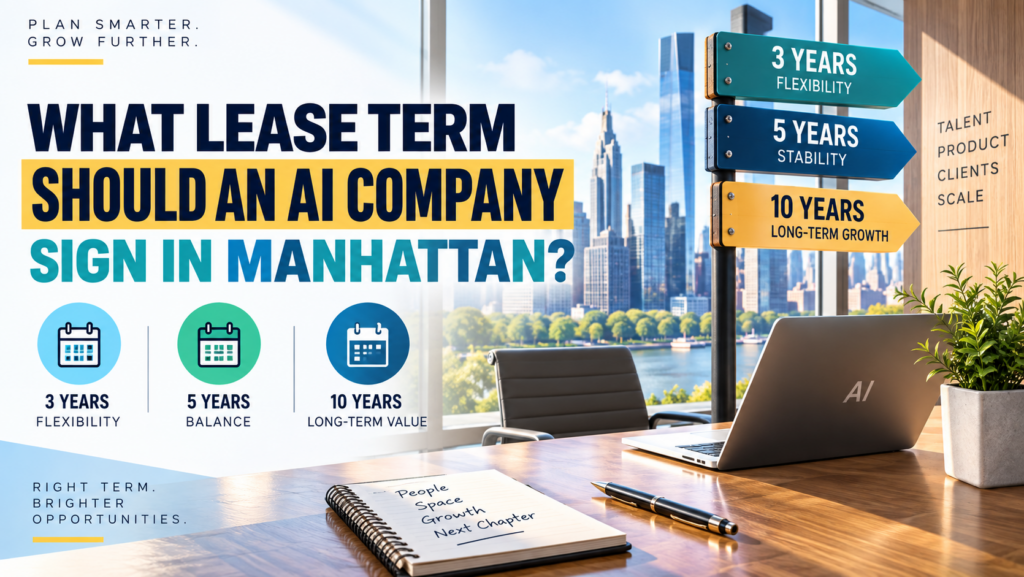
In Manhattan, 5 and 10-year terms are the most common for direct leases. Three-year deals are possible, especially in Class B buildings or for prebuilt suites, but some landlords require a minimum of five years, particularly in Class A towers.
How Lease Term Affects Incentives
The longer your lease term, the more negotiating power you have. Landlords are willing to invest more in tenants who commit for longer periods because it reduces turnover and ensures steady income.
Longer terms typically unlock:
- Higher tenant improvement (TI) allowances
- More months of free rent
- Better rent escalations
- Flexibility in layout or design
For example, a tenant signing a 10-year lease in a raw space might receive:
- 8 to 12 months of free rent
- $100/SF+ in TI allowance
- More favorable options to renew or expand
By contrast, a tenant signing a 3-year lease in a prebuilt suite may receive little or no TI allowance and limited negotiation flexibility — but gains speed and simplicity.
Short-Term Leases: When Do They Make Sense?
Shorter leases (1–3 years) are best suited for:
- Businesses in transition (growth phase, downsizing, or remote shift)
- Project-based teams or outposts
- Tenants testing a new market or location
- Companies waiting out market uncertainty
However, short terms often come with less generous concessions, limited customization, and higher effective rent (especially in coworking or plug-and-play subleases).
If flexibility is a priority, short-term deals work — but tenants should consider the potential cost of frequent relocations, brand disruption, and rising market rents on renewal.
Long-Term Leases: Who Should Consider Them?
Businesses should consider 5–10 year leases when:
- They plan to custom build or brand their space
- Stability and long-term occupancy are important
- They want to lock in favorable pricing and concessions
- The space has growth capacity and optionality
- They’re occupying larger spaces or full floors
Landlords often provide substantial TI, free rent, and access to building amenities for these tenants — especially in competitive submarkets like Midtown East or Hudson Yards.
Can I Renew or Extend My Office Lease?
Most leases include renewal or extension options, often defined as:
- A fixed extension term (e.g., “one additional five-year term”)
- Rent tied to fair market value or fixed increases
- Notice period (usually 6–12 months before expiration)
Tenants should carefully review these clauses and negotiate renewal rights during the initial lease. Some landlords may also offer early termination rights or expansion rights, particularly in larger deals.
How to Choose the Right Lease Term for Your Business
Your lease term should reflect your:
- Growth forecast
- Capital reserves (for build-out or relocation)
- Industry volatility
- Operational stability
A tenant rep broker can help you balance your desire for flexibility with the advantages of longer commitments — and may structure termination or expansion options into the lease to reduce risk.
People Also Search For:
- What is the average lease term for office space?
- Should I sign a 3 or 5-year lease?
- How long does a commercial lease last in NYC?
- Office lease incentives by term length
- Can I break an office lease early?
What is the average lease term for office space?
In Manhattan, the average lease term for traditional office space ranges from 5 to 10 years, depending on the tenant’s size, build-out requirements, and the type of building. Five-year terms are the most common baseline for midsize tenants, while larger tenants signing full-floor or custom spaces often commit to 10+ year terms to secure significant landlord concessions. Shorter terms — typically 1 to 3 years — are more common in prebuilt suites, subleases, or coworking spaces, but come with fewer incentives and less customization.
Should I sign a 3 or 5-year lease?
It depends on your business needs. A 3-year lease offers flexibility and is ideal for companies that anticipate change — such as startups, teams in transition, or firms testing a new market. However, it typically comes with fewer incentives, limited customization, and higher rent per square foot. A 5-year lease is the preferred minimum for landlords in Manhattan and gives tenants access to better build-out allowances, free rent, and more favorable renewal terms. If you want value and plan to stay put, 5 years is usually the better deal — provided the space fits your long-term needs.
How long does a commercial lease last in NYC?
Commercial office leases in NYC can range from 1 year to 15+ years, but most fall between 3 and 10 years. The exact length depends on several factors:
- Tenant size
- Type of space (prebuilt, raw, furnished, etc.)
- Class of building
- Negotiated terms
Landlords generally prefer 5–10 year commitments, especially in Class A buildings. Shorter terms are more likely in Class B properties, sublease opportunities, or spec suites. Tenants should be cautious with very short leases (under 3 years), as renewal options, concessions, and stability may be limited.
Office lease incentives by term length
In Manhattan, the longer your lease term, the more incentives landlords will offer. Here’s a general snapshot:
| Lease Term | Typical Incentives |
|---|---|
| 1–2 Years | Minimal to none; often “as-is” spaces |
| 3 Years | Modest free rent (1–2 months); limited TI allowance |
| 5 Years | 3–6 months free rent; $25–$60/SF TI allowance |
| 7–10 Years | 6–12+ months free rent; $65–$120/SF TI (raw spaces) |
| 10+ Years | Full custom build-outs, branding, termination options |
Incentives vary by building class, market cycle, and space condition. Landlords are more generous with longer leases because it improves asset value and reduces turnover.
Can I break an office lease early?
Breaking a commercial office lease in NYC is not easy — most leases do not allow unilateral early termination without significant penalties. That said, tenants have several options:
- Sublease the space (with landlord approval)
- Negotiate an early termination agreement (usually includes a fee)
- Use a termination clause, if it was pre-negotiated
- Assign the lease to another tenant, with landlord consent
Landlords are not obligated to release tenants early unless it’s spelled out in the lease. If early exit is a possibility, negotiate a termination option or flex clause before signing. A tenant rep broker can help structure this properly to protect your downside.
Final Word: Lease Term Is Strategy
In Manhattan, office lease terms aren’t just a number — they’re a negotiation tool, a budgeting factor, and a reflection of how you see your company evolving over time. The right term can maximize concessions, stabilize costs, and position your business to thrive.
Whether you’re looking for a quick 3-year plug-and-play or a custom-built 10-year lease, understanding market norms — and negotiating from a position of knowledge — will help you secure the space that fits both your vision and your timeline.
Fill out our 📋 online form or give us a call today 📞 212-967-2061 — let’s find the office for your business.