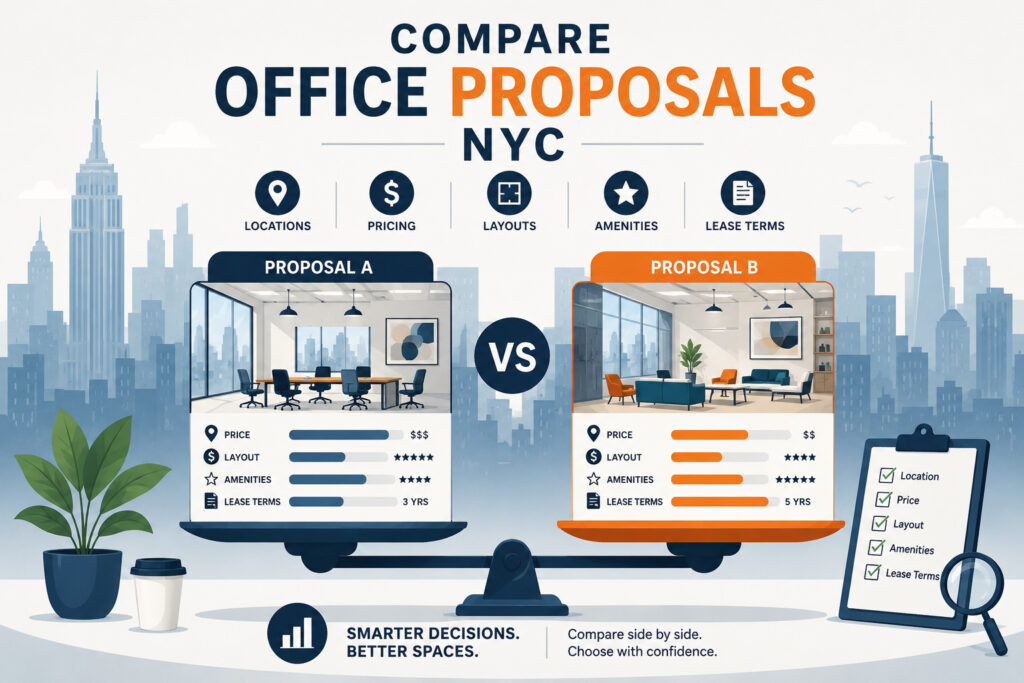
Compare Office Proposals NYC
Comparing office proposals in New York City starts with one hard truth. Headline rent does not decide the best deal. In Q1 2026, one major Manhattan report put availability at 13.7% and average asking rent at $77.55 per square foot. Another put availability at 15.1%. A third put overall asking rent at $73.13 per square foot. Those gaps matter. They show why tenants must score real proposals line by line instead of leaning on one market headline.
We represent tenants only. Our job is to compare every serious option, test the fine print, and protect your leverage. In standard NYC office leasing practice, the landlord usually pays the brokerage commission, though subleases and separate consulting arrangements can differ, so tenants should confirm that point in writing at the start.
Start with size before you compare money.
Use the Office Space Calculator and How Much Office Do I Need? to build a real requirement. Then review live inventory through Search Office Listings, Direct Leased Office Space, and Office Sublets. That database covers more than 1,400 Manhattan listings and updates daily, which gives tenants a strong starting point for true side-by-side comparison.
A proposal with the lowest asking rent can still lose. Loss factor, tax escalations, electricity, overtime HVAC, security deposit, build-out cost, internet readiness, and renewal rights often decide the real winner. Therefore, the smart move is simple: rank each proposal by full-term occupancy cost, usable efficiency, timing, and flexibility.
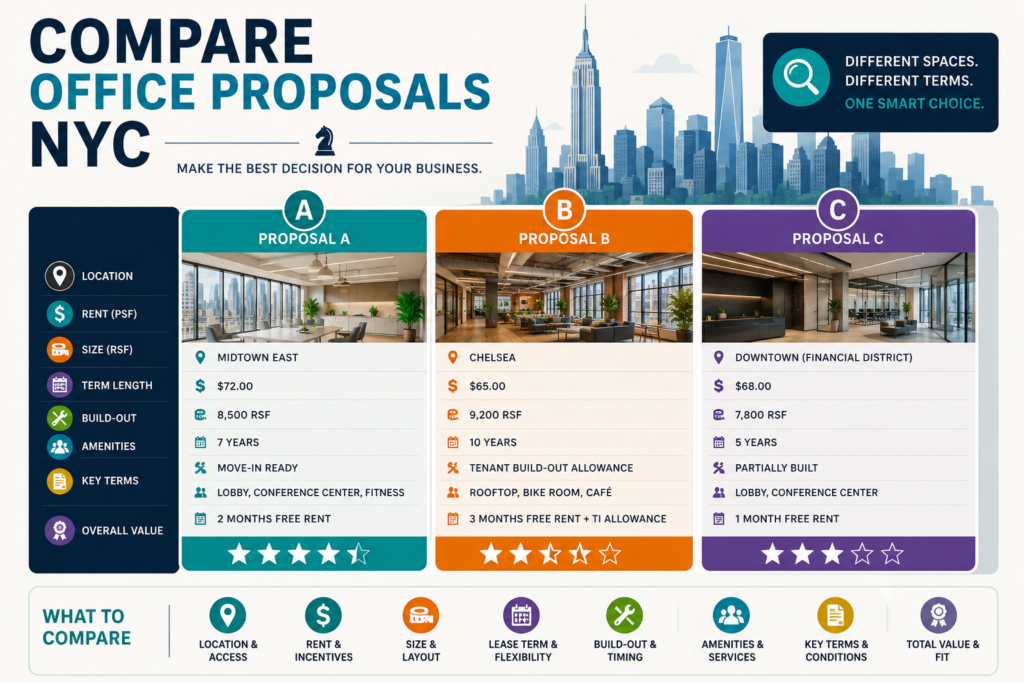
How NYC Work
An NYC office search usually moves through three business stages. First, the tenant team narrows location, size, and office type. Next, the broker gathers proposals from multiple landlords. After that, the tenant chooses a finalist, negotiates a term sheet or LOI, and then works from the lease draft. The City’s commercial leasing guide lays out that sequence clearly, and it identifies request-for-proposal work, term sheet work, lease negotiation, architect review, insurance research, plan review, contractor selection, and inspections as separate parts of one longer process.
At the proposal stage, the broker should gather terms from more than one landlord. The City guide says those proposals usually include lease length, base rent, additional rent, utilities, and the security deposit. That means a one-line quote is not enough. If the landlord will not show the cost structure, the service structure, and the timing structure, you do not have a real proposal yet. For more background, see the Commercial Leasing Guide.
The next stage is the term sheet or LOI. The City guide states that the LOI usually captures rent, term, deposit, and other basic business terms. It also warns tenants not to make payments or start alterations before the lease is signed. Just as important, the guide says tenants should include their must-have terms early because the landlord may refuse to revisit them later. In other words, treat the LOI as non-binding in form, but serious in substance.
Then the lease arrives. That document deserves real scrutiny. The City guide says a commercial tenant’s rights are almost all governed by the lease, that the landlord’s first draft usually heavily favors the landlord, and that oral promises do not count if the final lease leaves them out. Every important item must appear in writing. So if a proposal promises free rent, after-hours HVAC, a delivery condition, or future flexibility, that promise must survive into the lease and its riders.
Legal use comes next. Every serious comparison must confirm the building’s legal occupancy path before the tenant ranks economics. NYC Buildings states that a Certificate of Occupancy sets the legal use and permitted occupancy type of a building, and no one may legally occupy the property until the City issues a CO or TCO. The City leasing guide also tells tenants to check the CO and zoning records during due diligence. So if a proposal looks cheap but the legal use, layout, or approval path does not fit your business, that proposal belongs at the bottom of the stack.
Timing also shapes the process. The City’s sample timeline runs from research and tours to proposal work, architect review, legal review, insurance, lease signing, plan filing, contractor hiring, construction, and inspections. Recent Manhattan tenant guidance also recommends starting six to twelve months before the desired move date when build-out, approvals, or tight requirements matter. Fast deals exist. Still, serious comparisons usually start earlier than tenants expect.
How to Rank Office Proposals Side By Side
Rank full-term occupancy cost, not Year One rent. Base rent is only the base. The City guide says additional rent can include operating expense increases, real estate tax increases, fixed annual percentage increases, or other pass-throughs. The same guide says tenants should ask the landlord or broker for estimates of those added costs before planning the deal. So your ranking model should include base rent, additional rent, electricity, internet, overtime HVAC, cleaning, freight, parking, taxes such as CRT when applicable, and any one-time move or build-out cost. Then subtract free rent, landlord work, and tenant improvement dollars.
Model size two ways. Compare every proposal by rentable square feet and by usable square feet. The City guide explains that base rent usually applies to rentable area, which includes a share of common areas, while usable area is the space you actually control. BOMA also states that the purpose of its office standard is to calculate rentable area, a core leasing metric. Therefore, you should ask for the exact common-area share, measure usable area with your architect when needed, and calculate the real cost per usable foot before you rank the deal. If you want a deeper tenant-side explainer, read Loss Factor What You Need to Know in Manhattan Office Leasing.
Translate concessions into cash value. Free rent, tenant improvement allowance, landlord work, delivered conditions, and rent commencement timing all change the economics. The City guide says rent abatements are common when alterations are needed and are best discussed during the term sheet stage. It also notes that tenant improvement allowance covers initial alterations. That means a proposal with a higher quoted rent can still beat a cheaper quote if the landlord funds more work, starts rent later, or delivers the suite in move-in condition. For build-out issues, compare your quotes against Tenant Improvements in Manhattan Office Leases and How to Secure the Best Office Lease.
Score term, escalation, and renewal in one block. The City guide says lease term, additional rent, and renewal rights all shape the long-term risk of a lease. It adds that commercial landlords do not have to renew your lease, and it suggests negotiating renewal rights with either fixed increases or fair market formulas. So do not rank only base rate. Rank term length, annual escalations, expense escalations, renewal mechanics, notice deadlines, and any cap on a future renewal rate. If you need a renewal primer, use What to Know About Renewal Options in a Manhattan Office Lease.
Score cash drag and guaranty risk early. The City guide says the landlord will generally require a security deposit at lease signing and that the amount usually equals a number of months’ rent, commonly two, though conditions vary. The same guide explains that a business owner may also face a personal guaranty, and that a true good guy guaranty should not force the guarantor to pay accelerated rent, extra performance obligations, or repayment of TI, free rent, or brokerage commission. Those clauses can change the risk profile far more than a small rent difference. Review those items next to Understanding the Security Deposit in Manhattan Office Leasing and Good Guy Clause.
Rank operations, not just economics. The City guide states that the lease should define utilities and services, including electricity, water, heat, air conditioning, passenger and freight elevator service, and possibly gas, cleaning, and directory listings. It also says building-wide HVAC usually runs only during the hours stated in the lease, and after-hours use often triggers overtime charges. Add service response standards, freight rules, guest rules, and internet infrastructure to that review. If your team relies on dense cabling, multiple carriers, or quick installs, compare the proposals against How to Evaluate and Negotiate Telecom and Internet Infrastructure in an Office Lease.
Score flexibility before you fall in love with the space. The City guide explains that assignment and sublease rights matter because tenants often need to resize, relocate, or share space before the term ends. It adds that most landlords require prior written consent, but tenants can negotiate a reasonableness standard. Expansion rights, contraction rights, giveback rights, and future subletting rules should all sit on your scorecard. A modest rent discount can disappear fast if the lease traps you in the wrong footprint.
Finally, score timing and certainty. A proposal is only as good as its path to possession. The City’s sample timeline includes plan review, DOB submission, contractor hiring, construction, inspections, and minor finishing before move-in. Therefore, compare delivery date, possession date, rent start, landlord review deadlines, permit assumptions, contractor access, certificate issues, and the risk of slippage. A slower cheap proposal can lose to a faster clean proposal if your current term ends soon or your team needs immediate occupancy.
Current NYC Benchmarks for Comparing Proposals
Manhattan entered 2026 with real momentum. Colliers reported 11.78 million square feet of leasing in Q1 2026, the strongest first quarter since 2014. That same report put Manhattan availability at 13.7%, average asking rent at $77.55 per square foot, and sublet availability at 10.86 million square feet, down nearly 30% from the prior year. Those numbers tell tenants two things. Good space is moving. Yet sublet supply still gives the market depth.
Use submarket bands, not just the citywide average. In Q1 2026, Colliers put Midtown asking rent at $84.74 per square foot with 12.6% availability. Midtown South came in at $80.27 with 13.4% availability. Downtown came in at $61.70 with 16.8% availability. That spread is large. A Downtown proposal and a Midtown proposal rarely compete on rent alone, so your comparison must include commute, image, layout, speed, and concession value.
Expect research reports to differ. CBRE’s Q1 2026 Manhattan report put availability at 15.1%. Cushman’s Q1 2026 MarketBeat put overall asking rents at $73.13 and Class A asking rents at $83.25. Those are not errors. They reflect different methodologies and inventories. The lesson for tenants is simple: use market reports for context, but use proposal modeling for decisions.
Flexible office also needs its own benchmark set. Hubble reported that New York City coworking inventory reached 15.3 million square feet in Q1 2026 and that average Manhattan private-office asking prices sat at about $785 per desk per month. Marketed private-office quotes for furnished short-term space can still land much higher in practice, with a recent NYC flex-office guide placing many Manhattan private offices in a roughly $1,000 to $1,800 per desk monthly band. Therefore, compare flex quotes against their bundled services, speed, term, and privacy level, not against bare direct-lease PSF alone.
Term length affects these benchmarks. Manhattan direct leases most often run five or ten years, while three-year deals still appear in prebuilt suites and some Class B situations. The City guide also says free rent often appears at the start of a lease when build-out time is needed. So when a landlord offers a shorter term, ask what you are giving up in TI, free rent, renewal protection, and future leverage.
For neighborhood-driven searches, benchmark against live inventory instead of general averages. Use Grand Central office space, Financial District office space, and the broader Where Can I Find an Office? guide when you need to compare live options by commute, term, and office type. Those pages matter because the real question is never “What is Manhattan rent?” The real question is “What does my best workable option cost in the exact district my team can use?”
Direct Lease, Sublease, and Flex Office Compared
A direct lease usually wins when the tenant needs control. That route gives the strongest hand on branding, layout, privacy, future renewal leverage, and custom infrastructure. It also lines up best with larger teams, specialized systems, secure rooms, or long-term planning. However, direct leases usually bring longer terms, more legal work, more approval steps, and greater exposure to build-out timing.
A sublease usually wins when speed and near-term cost matter most. Manhattan still carried 10.86 million square feet of sublet availability in Q1 2026, and the City guide explains that sublease rights sit at the heart of lease flexibility in a changing business plan. Many sublets arrive built, furnished, or partially built. That can cut design time, lower up-front spend, and simplify the move. If this path fits your needs, compare Office Sublets with the broader Office Subletting resource before you rank direct options above them.
Flex office wins when the tenant needs speed, short commitment, and bundled service. Hubble’s Q1 2026 data showed expanding coworking inventory and average private-office desk pricing below traditional headline lease math, while newer Manhattan guides note that true month-to-month space usually means a private office inside shared managed space. Flex space can move fast. Some market guides say certain teams can occupy within days after signing a license. Yet the tradeoff is softer control, fewer custom rights, and a pricing model that can become expensive as team size or term length grows. Compare those options with Month-to-Month NYC Office before you sign a short-term license that acts like a long-term commitment.
Small teams should compare flex and sublet very carefully. One Manhattan cost guide notes that coworking can become more expensive than leased space on a per-head basis once teams move above roughly five to seven people. Another recent month-to-month guide says tenants seeking privacy and a term of two years or longer should compare sublets and all office listings before signing a flexible membership. So if your team expects to grow soon, run the numbers twice: once for today, and once for the headcount you expect within a year.
Many tenants should use a hybrid path. Start with plug-and-play space when timing forces speed. Then use that short runway to negotiate a stronger direct lease with better leverage. This approach works well when a company faces a fast expiration, a delayed build-out, or a short trial run in a new neighborhood. In those cases, compare Move-In Ready Offices and How to Secure the Best Office Lease alongside live direct inventory.
Hidden Costs and Lease Clauses That Change the Winner
Additional rent flips rankings all the time. The City guide says office tenants often pay one or more of the following on top of base rent: a share of rising operating expenses, a share of rising real estate taxes, fixed annual rent bumps, or other escalations such as wage-driven pass-throughs. It also tells tenants to ask for estimates before they plan the deal. So do not compare only the quoted PSF. Compare the landlord’s estimate of added cost, the base year assumptions, and the growth risk over the full term. For budgeting help, use How Does Office Space Pricing Work in Manhattan?.
Utilities and building-service rules also deserve their own line items. The City guide says the lease should define electricity, water, heat, air conditioning, elevator service, and possibly cleaning. It also warns that building-wide HVAC usually runs only during lease-stated hours and that after-hours use usually triggers an overtime charge. So if your team works late, runs weekends, or depends on freight access, compare those costs before you call one proposal cheaper. Many “cheap” quotes only stay cheap during standard business hours.
Security structure can change the winner even when rent looks equal. The City guide says deposits commonly equal about two months of rent, though the amount varies by tenant strength, rent level, and guaranty structure. It also explains that smaller or newer tenants often face guaranty requests, and that a true good guy structure should end personal liability after the tenant vacates while avoiding accelerated rent and concession payback traps. If one proposal asks for a larger deposit, a letter of credit, or a broader guaranty, assign that cash drag and liability real weight in your ranking.
Renewal, assignment, and future subletting rights affect long-term leverage. The City guide says landlords do not have to renew a commercial lease by law. It also says tenants can negotiate renewal rights, sublease rights, and consent standards in advance. That means a proposal with weaker flexibility can cost more later even if it wins today on rate. Compare not only how you enter the deal, but also how you stay, resize, or exit the deal.
Legal-use and connectivity checks belong in every final review. NYC Buildings states that the CO controls legal use and permitted occupancy. Recent Manhattan telecom guidance also says network readiness varies sharply by building, carrier access, and installation timeline. So ask for the CO or TCO, confirm the permitted use, confirm fiber and carrier access, and test lead times for service installs before the lease closes. A proposal with strong rent but weak legal or digital readiness can slow move-in, wreck schedule, and raise cost after signing.
Commercial Rent Tax can matter more than many tenants expect. NYC Finance states that CRT applies to commercial tenants in Manhattan south of the center line of 96th Street when annual rent reaches at least $250,000. The posted tax rate is 6% of base rent, and the standard 35% base-rent reduction lowers the effective rate to 3.9%, with credits available in certain bands. So if two proposals sit near that threshold, compare the rent and the tax together. A quote that looks only slightly higher can cross into a very different annual occupancy cost.
Frequently Asked Questions
What should an NYC office proposal include?
A real office proposal should include lease length, base rent, additional rent, utilities, security deposit, and the other basic business terms that shape the deal. The City guide says those are standard proposal items. If the quote leaves out escalations, electricity, delivery condition, free rent, or timing, ask for a fuller proposal before you compare it to anything else.
Should I compare proposals by rentable square feet or usable square feet?
Use both measurements. The City guide says rentable area includes a share of common areas, while usable area is the space you directly control. BOMA also centers rentable area in office measurement. Therefore, tenants should compare the face rent on rentable area and the real occupancy cost on usable area. That is the only honest apples-to-apples method.
Is a letter of intent binding?
Usually not. The City guide says the LOI or term sheet is generally not a contract. Still, tenants should treat it seriously because the same guide warns that landlords may refuse to renegotiate key items later. Put your must-haves in early, but do not pay money or start work before the lease is signed.
How early should I request proposals in Manhattan?
Start earlier than you think. The City’s sample timeline shows many steps before occupancy, including proposal work, legal review, insurance review, plan review, filings, contractor hiring, construction, and inspections. Recent Manhattan guidance often recommends starting six to twelve months before the desired move date when build-out or narrow requirements matter.
What makes two equal-rent proposals very different in reality?
Loss factor, additional rent, free rent, TI, deposits, guaranty scope, HVAC rules, internet readiness, renewal mechanics, and move-in timing usually decide that contest. The City guide lays out those categories across rent, services, deposit, term, renewal, and legal due diligence. So the better proposal is not the one with the lower headline rate. The better proposal is the one with the lower full-term cost and the lower execution risk.
When does Commercial Rent Tax matter?
CRT matters for commercial tenants in Manhattan south of 96th Street when annual rent reaches at least $250,000, subject to exemptions and credits. NYC Finance states that the statutory rate is 6% of base rent and that the standard 35% reduction lowers the effective rate to 3.9%. If your proposal sits near that threshold, add CRT to the model before you rank the deal.
Can a sublet beat a direct lease?
Yes. A sublet often wins on speed, lower up-front work, and shorter commitment. Manhattan still carried deep sublet supply in Q1 2026, even after a sharp year-over-year drop. That said, direct leases usually win on control, renewal leverage, and custom build-out. So the answer depends on your timing, headcount, and privacy needs.
What should I review next if I want live options, not theory?
Start with Search Office Listings, then compare Direct Leased Office Space against Office Sublets. After that, read Questions to Ask Tenant Rep Broker NYC and What a Tenant Broker Should Actually Do. We work for tenants, not landlords, and standard NYC practice usually places the commission on the landlord side, which lets tenants add representation without a typical out-of-pocket brokerage fee in a standard office lease.
Fill out our 📋 online form or give us a call today 📞 212-967-2061 — let’s find the right office for your business.