How Nonprofits Can Negotiate Free Rent and Tenant Improvements in Manhattan
Yes. Nonprofits can negotiate free rent and tenant improvement allowances in Manhattan.
Neither concession comes automatically. The strongest package combines financial strength, lease term, space condition, competing proposals, and construction economics.
For a nonprofit, the best deal rarely means the lowest asking rent. A stronger lease can preserve cash, reduce construction exposure, and protect program continuity.
The phrase “nonprofit rent” can also describe two very different situations. One involves an organization leasing commercial office space. Another involves residential tenants receiving housing or rent assistance.
This guide addresses nonprofit organizations leasing Manhattan office space. It does not cover residential rent relief or housing assistance.
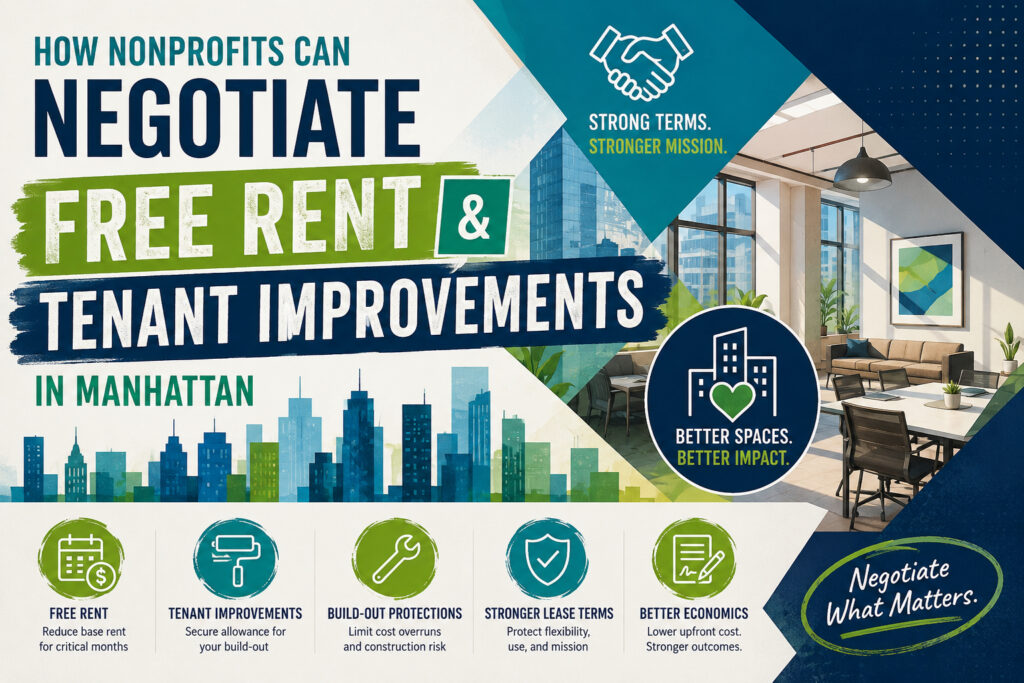
What Nonprofit Tenants Can Negotiate in Manhattan
A Manhattan office proposal contains far more than rent.
Free rent and tenant improvements often attract the most attention. However, those concessions sit inside a larger financial package.
A nonprofit should negotiate the whole transaction at once.
That package can include:
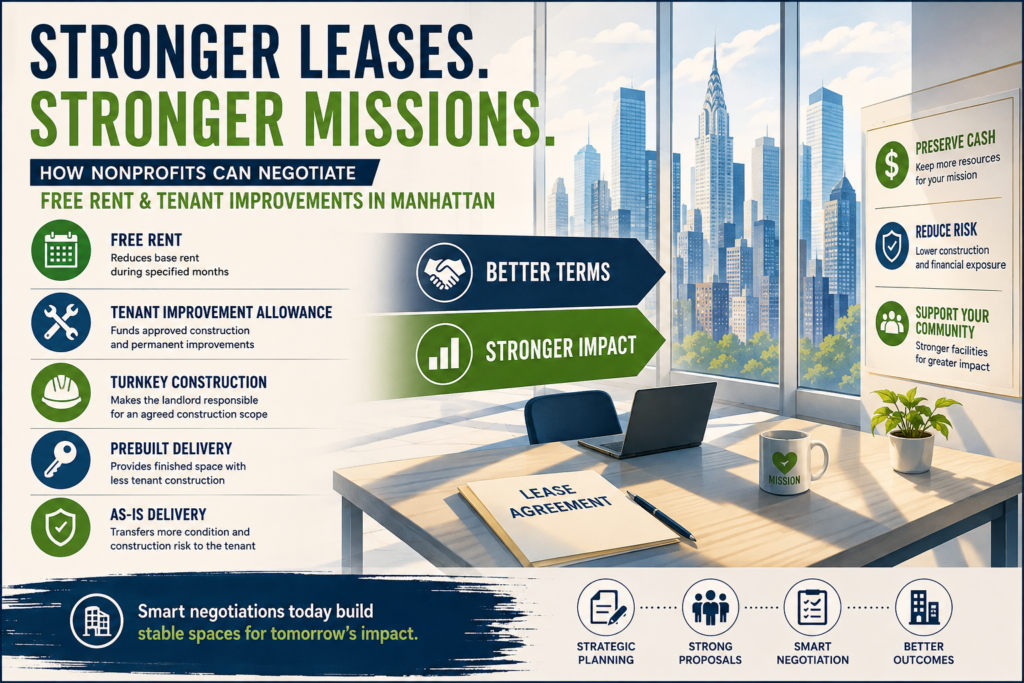
| Lease Term | What It Actually Changes |
|---|---|
| Free rent | Reduces base rent during specified months |
| Tenant improvement allowance | Funds approved construction and permanent improvements |
| Turnkey construction | Makes the landlord responsible for an agreed construction scope |
| Prebuilt delivery | Provides finished space with less tenant construction |
| As-is delivery | Transfers more condition and construction risk to the tenant |
| Security reduction | Preserves cash that otherwise sits with the landlord |
| Security burn-down | Releases security after successful payment history |
| Rent commencement protection | Prevents rent from starting before agreed delivery milestones |
| Expansion rights | Creates a path for future program growth |
| Contraction rights | Helps an organization reduce excess space later |
| Termination rights | Creates an exit mechanism under negotiated circumstances |
| Assignment and sublease rights | Adds flexibility when operations change |
| Renewal rights | Protects continued occupancy beyond the initial term |
| Restoration limits | Reduces move-out construction exposure |
| Operating expense protections | Controls future occupancy-cost increases |
| Tax protections | Clarifies which taxes apply and how the lease allocates them |
A nonprofit should therefore avoid negotiating free rent alone.
The same rule applies to a tenant improvement allowance.
A landlord can improve one concession while recovering value elsewhere. Higher rent, larger security, or weaker renewal rights can offset attractive headline incentives.
For a broader explanation, review our NYC office lease incentives and concession guidance.
What does free rent really mean?
Free rent usually means a temporary abatement of base rent.
It does not necessarily eliminate every monthly occupancy cost.
The lease may still require payments for electricity, after-hours HVAC, additional rent, or other services. Accordingly, the abatement language needs precision.
A nonprofit should identify exactly which charges disappear during the free period.
It should also identify when those free months begin.
That timing can matter as much as the number of months.
What does a tenant improvement allowance really mean?
A tenant improvement allowance provides money toward an agreed construction scope.
The lease usually expresses the allowance as dollars per rentable square foot. However, the lease should also state the maximum total dollar amount.
For example, a $100-per-square-foot allowance on 10,000 rentable square feet equals $1 million.
That figure sounds substantial.
Yet the organization must compare it against actual drawings, contractor pricing, permits, engineering, technology, furniture, and contingency costs.
Our detailed tenant improvement allowance guide explains the underlying structure.
Current Manhattan concession benchmarks
Current 2026 market conditions give nonprofit tenants useful reference points.
Recent Manhattan research reported a 12.4-month weighted average rent abatement for new leases during the first half of 2026. The same research reported a $140.02-per-square-foot average tenant improvement allowance.
Those figures do not create an entitlement.
They represent broad market averages across different buildings, lease sizes, terms, and tenant profiles. A particular nonprofit could receive more or considerably less.
Another major Manhattan landlord reported materially different concession levels within its own 2026 leasing activity. Its first-half portfolio averaged 8.8 free months and $91.89 per square foot of improvements.
That difference illustrates an important point.
A market average is a negotiating reference, not a landlord obligation.
What Manhattan rents look like now
One Q2 2026 market survey placed Manhattan’s average asking rent at $80.17 per square foot. Availability measured 14.4% under that firm’s methodology.
Midtown showed an $86.18-per-square-foot average asking rent and 12.7% availability. Downtown showed $61.34 per square foot and 16.6% availability.
Prime Midtown space presents a different negotiating environment.
One Q2 2026 measure put prime Midtown vacancy at only 2.2%. That scarcity can reduce leverage for highly sought-after space.
Different research firms define inventory, availability, and building categories differently. Therefore, tenants should compare trends rather than treat one dataset as universal.
For organizations prioritizing lower asking rents, our Downtown Manhattan value guide provides additional context.
Why Nonprofits Need a Different Concession Strategy
A landlord negotiates with the legal tenant that will sign the lease.
Therefore, nonprofit status alone does not produce free rent or construction money.
Mission can strengthen the story. Financial capacity strengthens the transaction.
A nonprofit should present both.
Mission matters, but credit drives the economics
A compelling mission can make a nonprofit an attractive building occupant.
Stable operations can also support a landlord’s leasing objectives.
However, the owner still evaluates rent-payment risk.
The organization should therefore make its financial case easy to understand.
That package can include recent financial statements, current budgets, cash balances, and funding schedules.
It can also explain major grants, contracts, memberships, donations, or recurring program revenue.
The goal is not to overwhelm the landlord.
Instead, the package should answer one central question:
Why can this organization reliably perform throughout the proposed lease term?
A concise financial narrative can strengthen negotiations before the lease draft begins.
Prepare the financial package before making serious offers
Landlords commonly request organizational and financial documents during lease underwriting.
A nonprofit can prepare these materials before final proposals arrive.
Useful documents may include:
| Document | Why It Helps |
|---|---|
| Organizational determination documents | Confirms legal and tax status |
| Recent audited or reviewed statements | Shows historical financial performance |
| Current operating budget | Shows present financial capacity |
| Year-to-date results | Demonstrates current performance |
| Cash and liquidity information | Helps address security concerns |
| Major funding schedule | Explains future revenue visibility |
| Existing lease history | Shows prior occupancy performance |
| Landlord references | Supports payment and operational credibility |
| Board authorization process | Clarifies approval timing |
| Signing authority | Prevents execution delays |
| Space-use description | Explains operations and occupancy needs |
Our office leasing document checklist covers the broader preparation process.
Restricted funds can change the preferred concession
A nonprofit may have substantial assets but limited unrestricted cash.
That distinction matters during construction.
A reimbursement-based TI allowance can force the organization to advance construction money first.
The landlord then reimburses approved expenses later.
Consequently, an impressive allowance can still create a serious cash-flow burden.
A cash-sensitive organization may prefer landlord-funded turnkey construction.
Another nonprofit may prefer reimbursement because it wants greater control over contractors and finishes.
The right answer depends on liquidity, internal staff, schedule, and project complexity.
Board approvals can become negotiating leverage
Many nonprofits need board, committee, lender, or funder approval before signing a major lease.
That process should not surprise the landlord at the end.
Instead, establish the approval sequence during negotiations.
A well-managed approval process can demonstrate institutional discipline.
It also helps both parties set realistic proposal and lease deadlines.
However, the nonprofit should avoid losing leverage through an unnecessarily long approval window.
Competing options can disappear while internal approvals continue.
Security deserves as much attention as free rent
A landlord may seek several months of rent as cash security.
Another owner may request a letter of credit.
Either requirement can trap significant nonprofit capital.
Consider a lease with $50,000 in monthly base rent.
A six-month cash deposit could immobilize $300,000.
That money cannot support programs, hiring, technology, or construction.
Therefore, negotiate security as an economic term.
Possible structures include a smaller initial deposit or a scheduled burn-down.
A landlord might reduce security after a period of timely payments.
The parties could also connect reductions to agreed financial milestones.
The actual structure depends on credit and landlord policy.
A longer lease can purchase more landlord capital
Landlords generally evaluate improvement spending against expected lease revenue.
Accordingly, a longer commitment can support greater upfront investment.
However, nonprofits should not sign unnecessary term solely to maximize TI.
A ten-year lease can create substantial exposure if programs, funding, or staffing change.
The organization should compare the extra concession against the added commitment.
Our guide to common Manhattan office lease terms explains this tradeoff in greater detail.
Nonprofits should negotiate flexibility before they need it
A mission can grow quickly.
Funding can also contract.
Therefore, a nonprofit should consider future space changes while the landlord still wants the deal.
Potential protections include expansion rights, contraction options, assignment rights, and sublease flexibility.
Some organizations should also explore a negotiated termination right.
Such a right may involve notice, repayment, or a termination payment.
Those economics belong in the original comparison.
They should not become an emergency discussion years later.
How Free Rent Should Work in a Nonprofit Office Lease
Free rent sounds simple.
The details can make it valuable, misleading, or nearly useless.
A nonprofit should negotiate when free rent starts, what it covers, and what happens after delays.
Separate the lease commencement date from rent commencement
These dates can mean different things.
The lease may commence before the tenant starts paying full rent.
That arrangement can give the nonprofit access for construction or preparation.
However, vague drafting creates risk.
A tenant should understand at least four dates:
Lease commencement establishes when the lease term legally starts.
Delivery establishes when the landlord gives possession.
Construction access establishes when tenant work may begin.
Rent commencement establishes when rent payments start.
Each event should match the negotiated business deal.
Do not let free rent disappear during landlord construction
Suppose the proposal offers ten months of free rent.
The landlord then needs four months to complete agreed work.
If the free period starts too early, construction can consume much of the concession.
That outcome weakens the economics.
Instead, tie rent commencement to a defined delivery milestone when appropriate.
For landlord work, the parties can use a substantial-completion standard.
The lease should define that term rather than rely on assumptions.
Define substantial completion carefully
Substantial completion usually means the space can support its intended use despite minor unfinished items.
However, the lease language controls.
A nonprofit should identify the required conditions.
Those conditions may include functioning HVAC, electricity, life-safety systems, bathrooms, and agreed construction.
Required permits or approvals may also affect occupancy.
The final punch-list process needs its own deadline.
A vague standard can trigger rent before the organization can operate effectively.
Distinguish landlord delays from tenant delays
Construction schedules involve both parties.
A landlord should not bear unlimited responsibility for tenant-caused changes.
Likewise, a nonprofit should not lose free rent because the landlord missed delivery obligations.
Therefore, the lease should identify both delay categories.
Tenant delay might include late plan approvals or post-approval design changes.
Landlord delay might involve incomplete base-building work or missed construction milestones.
Clear definitions reduce later disputes.
Ask whether free rent covers base rent only
Many tenants hear “free rent” and assume occupancy costs disappear.
The lease may say otherwise.
Some agreements abate only fixed base rent.
Other charges can continue.
Those charges may include electricity, supplemental HVAC, or other tenant-specific services.
Accordingly, model the actual monthly cash obligation during the abatement period.
Do not model a zero payment unless the lease creates one.
For more detail, see our guide to free rent in commercial office leases.
Front-loaded free rent is not the only structure
Landlords often place abatement at the beginning.
That approach helps tenants during construction, moving, and transition.
However, other structures can fit nonprofit cash flow better.
A tenant might request some free months later in the term.
For example, a grant-funded organization could value scheduled abatement around known funding gaps.
Another tenant may prefer all free rent upfront.
The economic value can differ because earlier savings usually help cash flow more.
Construction access can have separate value
Early access lets the nonprofit begin preparing space before full rent starts.
That access can shorten the overlap between old and new leases.
It can also reduce temporary-space costs.
However, access rights should address insurance, contractors, utilities, building rules, and responsibility for damage.
The lease should also explain whether early access starts any rent obligation.
Watch for concession recapture provisions
A landlord may seek repayment of free rent after a tenant default.
That language can create a large additional claim.
Counsel should review the trigger and calculation carefully.
A tenant may seek limits tied to serious uncured defaults.
It may also seek an unamortized calculation rather than full historical recapture.
The final language should match the negotiated risk allocation.
Free rent should solve an actual nonprofit problem
The organization should decide why it needs the abatement.
Possible goals include preserving cash during construction or funding a double-rent period.
Another goal may involve offsetting moving expenses.
A nonprofit could also use free rent to stabilize cash after a major capital campaign.
Once the goal becomes clear, the negotiation becomes more focused.
Free rent has the greatest value when its timing matches the organization’s actual cash need.
How Tenant Improvement Allowances Should Work
A TI allowance can carry more financial value than free rent.
It can also create greater execution risk.
The headline dollar figure tells only part of the story.
Start with a real construction budget
Never negotiate TI using a generic dollar target alone.
First, determine what the space actually needs.
A modest reuse project can cost far less than a complete office reconstruction.
Conversely, a complicated nonprofit use can require substantial investment.
Public-facing programs may need upgraded accessibility, bathrooms, acoustics, security, or waiting areas.
Training facilities may require more power and audiovisual infrastructure.
Counseling operations can require greater acoustic privacy.
High-density administrative uses can increase cooling and electrical needs.
Therefore, the program should drive the budget.
Current construction costs can exceed TI allowances
A detailed 2026 New York office fit-out benchmark placed hard construction costs near $220.62 per square foot. That same model reached $330.92 per square foot after several additional project categories.
Those figures describe a specific modeled scope.
They do not mean every nonprofit build-out will cost that amount.
However, they illustrate the gap that can exist between construction cost and landlord allowance.
Compared with the $140.02-per-square-foot H1 2026 Manhattan TI benchmark, the hard-cost difference equals about $80.60 per square foot.
On 10,000 square feet, that illustrative gap reaches approximately $806,000.
That calculation explains why nonprofits should price plans before finalizing the lease economics.
Our 2026 office build-out and furniture budget guide provides additional planning context.
Ask exactly what the allowance can fund
The work letter should define eligible TI expenses.
Typical construction categories can include partitions, flooring, ceilings, electrical distribution, HVAC work, and millwork.
The negotiated definition can also address architectural or engineering costs.
Permits and project-management expenses need specific treatment.
Furniture, computers, movable equipment, and moving costs often fall outside a standard improvement allowance.
However, the negotiated lease language controls the final eligible list.
A nonprofit should never assume a cost qualifies.
State both the per-foot allowance and maximum dollars
A per-square-foot figure can cause confusion when rentable area changes.
Therefore, include the allowance’s total maximum amount.
For example:
$125 per rentable square foot, based on 12,000 rentable square feet, for a maximum allowance of $1,500,000.
That structure removes unnecessary ambiguity.
It also helps finance teams build an accurate capital budget.
Understand rentable square feet versus usable square feet
A tenant may occupy fewer usable square feet than the lease’s rentable area.
The building’s loss factor creates that difference.
TI allowances often use rentable square footage.
Construction costs may relate more closely to the physical usable space.
Therefore, compare every proposal on the same measurement basis.
Otherwise, two apparently similar allowances can represent different economics.
Reimbursement creates a working-capital problem
Many TI structures require the tenant to spend money before receiving reimbursement.
That arrangement can strain a nonprofit.
Suppose the organization earns a $1.5 million allowance.
Contractors may still require substantial progress payments before the landlord funds reimbursement.
Therefore, negotiate the payment mechanics early.
Possible approaches include periodic draws or landlord direct-payment arrangements.
The parties can also establish a practical reimbursement schedule.
Do not wait until construction begins to discover the cash requirement.
Negotiate the draw requirements before signing
The landlord may require supporting documents before releasing TI funds.
Those requirements can include invoices, contractor affidavits, lien waivers, and other project records.
Final funding can also depend on completion documents.
The nonprofit should confirm that its contractor can produce every required item.
Finance staff should understand the submission process.
A complicated draw procedure can delay reimbursement even when the allowance looks generous.
Turnkey work can protect nonprofit cash
Under a turnkey structure, the landlord completes an agreed scope.
The tenant therefore avoids advancing much of the construction cost.
That approach can work well for organizations with limited unrestricted capital.
However, “turnkey” needs a detailed definition.
The agreement should include plans, specifications, finishes, quantities, and performance requirements.
Without detail, a turnkey promise can produce a basic space that misses operational needs.
Our work-letter and negotiated TI guide explains these structures.
Change orders can destroy a turnkey budget
A detailed plan protects both parties.
After approval, tenant-requested changes can increase cost and delay delivery.
Therefore, review room counts, outlets, doors, finishes, lighting, and HVAC requirements before final approval.
Public-facing nonprofits should also verify accessibility needs.
Organizations with confidential services should examine acoustic requirements.
Technology-heavy operations need sufficient power and cooling.
Small omissions can become expensive change orders later.
Prebuilt space can outperform a larger TI allowance
A nonprofit does not always need maximum construction dollars.
Sometimes, an existing installation already matches the program.
In that case, prebuilt or reusable space can reduce disruption and cash exposure.
The organization should compare the existing condition against its actual plan.
A $50-per-square-foot TI allowance in highly reusable space can beat $140 elsewhere.
The second option might require extensive demolition and reconstruction.
For the underlying comparison, review our as-is versus prebuilt office guide.
As-is space can work when reuse creates real savings
An as-is lease transfers more responsibility to the tenant.
That structure can still make sense.
For example, an organization may inherit usable offices, conference rooms, and pantry infrastructure.
It may only need paint, carpet, furniture changes, and modest cabling.
In that situation, the nonprofit might negotiate more free rent instead of extensive landlord construction.
However, confirm building systems before accepting the condition.
HVAC, electrical capacity, life safety, and accessibility deserve particular attention.
Small tenant-led work can sometimes create value
A nonprofit may reduce costs through limited self-managed work.
That approach can resemble commercial “sweat equity.”
The organization might manage minor cosmetic upgrades or furniture installation itself.
However, building rules still matter.
Licensed trades, permits, and landlord approval can limit which work the tenant controls.
Our office tenant sweat-equity guide explains when this approach can make economic sense.
Negotiate unused TI before the lease becomes final
A nonprofit may finish below the allowance.
The organization should decide what happens to the unused balance.
Without negotiated language, the tenant should not assume it receives that money.
Possible structures include a rent credit or additional abatement.
Another deal might simply return unused funds to the landlord.
The preferred choice depends on the organization’s budget.
Separate base-building work from tenant improvements
Some work should not consume a tenant’s improvement dollars without careful consideration.
A major building-system issue may belong in the landlord’s delivery obligation.
For example, inadequate base HVAC or defective life-safety infrastructure can create substantial costs.
Therefore, inspect the space before allocating the entire TI allowance.
An experienced architect or engineer can identify expensive deficiencies.
That review can change the negotiation before lease execution.
Restoration can turn today’s improvement into tomorrow’s liability
A nonprofit might spend heavily on offices, partitions, equipment, or specialized installations.
At lease end, the landlord could request removal under restoration language.
That obligation can create another capital event.
Therefore, negotiate restoration while the landlord wants the lease.
The agreement should clarify which installations may remain.
It should also identify any items requiring removal.
A broad “restore everything” obligation deserves careful review.
How to Build Negotiating Leverage Before the Lease
The strongest concessions usually come from process.
A nonprofit gains leverage when several credible alternatives compete for the same tenancy.
That leverage becomes weaker after the organization emotionally commits to one address.
Start with operating requirements, not addresses
First, define the program.
Determine headcount, visitor volume, meeting needs, storage, privacy, and accessibility.
Next, identify transit requirements.
Consider employee commutes, client access, agency proximity, courts, hospitals, donors, or program partners.
Then establish a maximum occupancy budget.
Only after those steps should the search narrow.
A famous address cannot compensate for poor operational fit.
Establish both a rent budget and capital budget
These budgets answer different questions.
Rent measures recurring occupancy cost.
Capital measures the cash required to open the office.
A nonprofit can afford one while struggling with the other.
For example, lower rent in unfinished space may require substantial construction.
A higher-rent prebuilt option may demand much less upfront capital.
Therefore, compare both budgets together.
Begin early enough to create alternatives
A Manhattan office relocation can involve touring, proposals, lease drafting, design, construction, and move planning.
A substantial build-out adds more schedule risk.
Our commercial leasing guide for NYC tenants recommends starting well before the desired occupancy date.
For complicated nonprofit requirements, nine to twelve months can represent a practical planning window.
Larger or specialized projects may need longer.
Simple prebuilt relocations may move faster.
The correct timeline depends on complexity.
Use multiple viable finalists
One available space creates a negotiation.
Several credible alternatives create leverage.
The nonprofit should keep competing options active through the proposal stage.
Each landlord should receive substantially comparable requirements.
That approach exposes differences in economics and delivery.
It also prevents one attractive concession from hiding weaker terms elsewhere.
Issue a detailed request for proposal
An effective RFP asks every finalist to price the same core terms.
Use a matrix that includes more than face rent.
| Proposal Item | What the Nonprofit Should Request |
|---|---|
| Premises | Exact rentable area and floor |
| Term | Initial lease length |
| Base rent | Full annual rent schedule |
| Escalations | Fixed or percentage increases |
| Free rent | Number and timing of abated months |
| TI allowance | Dollars per foot and total dollars |
| Delivery condition | As-is, prebuilt, turnkey, or defined work |
| Rent commencement | Exact trigger |
| Early access | Construction or installation access |
| Security | Cash, credit, or other structure |
| Security reduction | Burn-down timing and conditions |
| Operating expenses | Base year and adjustment method |
| Real estate taxes | Tenant share and calculation |
| Electricity | Inclusion or separate charge |
| HVAC | Standard hours and overtime charges |
| Cleaning | Included scope and schedule |
| Alterations | Approval procedure |
| Assignment | Transfer rights |
| Subletting | Ability to mitigate excess space |
| Expansion | Future growth rights |
| Contraction | Future reduction rights |
| Termination | Any negotiated early exit |
| Renewal | Option period and rent mechanism |
| Restoration | End-of-term removal obligations |
| Signage | Rights for public-facing organizations |
| Accessibility | Required delivery conditions |
| Construction timing | Milestones and outside dates |
The completed comparison should fit on one economic grid.
That grid becomes the decision document.
Negotiate concessions together
Assume one landlord offers additional free rent.
Before accepting, ask what changed elsewhere.
Did the rent increase?
Did the TI allowance fall?
Did the term extend?
Did security increase?
Did the delivery condition weaken?
Every concession has an economic relationship with the rest of the proposal.
Therefore, negotiate the package rather than one headline term.
Use space condition as a negotiating tool
A raw office and a high-quality existing installation require different capital.
The same asking rent cannot tell that story.
Bring an architect or contractor into serious finalist spaces.
Then estimate reuse, demolition, and required upgrades.
A space with usable infrastructure can create hidden value.
Another space may need costly work despite generous landlord incentives.
Use location differences intelligently
Current Manhattan data shows meaningful rent differences between Midtown and Downtown.
Yet location affects more than face rent.
A nonprofit should evaluate transit, client convenience, recruitment, building quality, and construction condition.
Downtown can offer lower average asking rents. Midtown may offer stronger access for some organizations.
However, submarket averages cannot replace building-level analysis.
A particular Downtown building can cost more than a Midtown alternative.
Likewise, an efficient existing installation can overturn the apparent location discount.
Do not mistake broad availability for unlimited leverage
Manhattan availability has declined materially from recent peaks.
One Q2 2026 measure reported 13.0% availability, its lowest level since October 2020. The same series peaked at 18.2% in February 2024.
Another Q2 measure put Manhattan availability at 14.4%, down 310 basis points year over year.
Therefore, the strongest buildings may not negotiate like distressed inventory.
A nonprofit should create competition before the best alternatives disappear.
Renewal tenants also need competition
An existing landlord has a major advantage.
Moving costs money and consumes staff time.
The owner knows that.
Therefore, a nonprofit approaching renewal should test outside alternatives.
That process provides real evidence about rent, concessions, and construction options.
Without competing choices, the renewal discussion can become one-sided.
How to Compare the Real Cost of Competing Deals
Asking rent does not determine the cheapest lease.
Neither does the largest TI allowance.
The nonprofit needs an effective economic comparison and a cash-flow comparison.
Those two analyses answer different questions.
Compare the entire rent stream
Start with base rent across the proposed term.
Then account for rent abatements.
Next, include the economic benefit of landlord-funded improvements.
After that, incorporate escalations and recoverable expenses.
The result provides a better view than face rent alone.
However, do not confuse a simplified effective rent with accounting treatment.
Lease accounting, budgeting, and negotiation analysis serve different purposes.
A higher asking rent can produce a cheaper deal
Consider two hypothetical 10,000-square-foot leases.
Both run for ten years.
For simplicity, the following example excludes escalations, pass-throughs, discount rates, and construction overruns.
| Term | Package A | Package B |
|---|---|---|
| Rent | $65/SF | $61/SF |
| Annual base rent | $650,000 | $610,000 |
| Free rent | 8 months | 4 months |
| TI allowance | $100/SF | $40/SF |
| Total TI | $1,000,000 | $400,000 |
| Simplified ten-year cost after these incentives | $5,066,667 | $5,496,667 |
| Simplified effective annual cost | $50.67/SF | $54.97/SF |
Package B has the lower asking rent.
Yet Package A produces the lower simplified economic cost.
The richer TI and free rent more than offset the higher face rent.
That difference totals about $430,000 across the simplified ten-year comparison.
This example demonstrates why nonprofit tenants should compare packages rather than rent quotes.
Economic value and cash flow are not identical
Suppose Package A requires the nonprofit to fund construction first.
Its $1 million TI may arrive through later reimbursement.
Package B might come fully furnished and ready for occupancy.
In that case, Package B could demand less immediate cash despite weaker headline economics.
Therefore, build a separate cash-flow schedule.
Show monthly rent, security, construction payments, reimbursements, moving costs, and double rent.
The timing can determine whether an otherwise attractive lease works.
Include double rent
Many organizations overlook lease overlap.
The old office may remain payable while the new office undergoes construction.
That overlap can consume hundreds of thousands of dollars.
Therefore, include existing rent through the actual move date.
A well-timed free-rent period can offset some overlap.
Early access can also reduce it.
Include furniture, technology, and moving
TI does not necessarily fund the entire project.
The nonprofit may still need furniture, audiovisual systems, computers, cabling, moving services, and security equipment.
Some projects also require consultants.
Accordingly, use a total project budget.
Do not call the remaining amount “unexpected” after signing.
Include operating expenses
Face rent provides only one part of occupancy cost.
The organization should model every recurring charge identified in the proposal.
Depending on the lease, these expenses may include electricity and supplemental HVAC.
Other charges can arise from special cleaning or after-hours services.
Tax and operating-expense provisions also need careful review.
A modest difference in recurring expenses can compound over a long lease.
Include escalation structure
Two starting rents can look almost identical.
Their future rent may diverge.
One proposal may use fixed annual increases.
Another may use percentage increases.
Therefore, model every year of the term.
A nonprofit budgeting with grants should pay particular attention to predictable increases.
A transparent schedule helps finance teams plan future occupancy costs.
Evaluate the security deposit as trapped capital
Security is not the same as rent.
However, it still consumes liquidity.
A $400,000 deposit could remain unavailable for years.
That capital has value to a nonprofit.
Therefore, include security requirements in the transaction comparison.
A smaller deposit can sometimes matter more than another free month.
Put construction overruns on the comparison sheet
Suppose the landlord provides $125 per square foot.
The nonprofit’s priced scope reaches $185 per square foot.
That leaves a $60-per-square-foot tenant contribution.
Across 15,000 rentable square feet, the gap equals $900,000.
That figure should appear beside the rent.
Otherwise, the proposal comparison understates the real occupancy commitment.
Compare turnkey work by scope, not label
Two landlords can both write “turnkey.”
Their promises may differ dramatically.
One package might include full-height glass, upgraded lighting, and substantial millwork.
Another may provide basic partitions and standard finishes.
Therefore, attach a detailed scope to every turnkey proposal.
Price differences can hide inside specifications.
Compare prebuilt value against future flexibility
A highly finished office can save construction money.
However, an inflexible plan can create operating problems.
For example, too many private offices may conflict with a collaborative program.
Insufficient meeting rooms may create scheduling pressure.
A nonprofit should therefore test the plan before assigning a reuse value.
Cheap space that does not function well can become expensive operationally.
Tax, Lease Protections, and Nonprofit-Specific Risks
Nonprofit status can affect certain tax issues.
However, tax exemption and landlord concessions are separate topics.
A nonprofit should not mix them during lease analysis.
Does nonprofit status automatically eliminate commercial rent tax?
No.
Eligibility depends on the organization’s status and applicable city rules.
Current city guidance provides exemptions for qualifying religious, charitable, and educational nonprofit organizations. Other nonprofit organizations may require additional exemption conditions.
Therefore, confirm the organization’s treatment with appropriate tax advisers.
Do not simply assume every nonprofit lease receives identical treatment.
Is commercial rent tax the same as property tax?
No.
Commercial rent tax concerns the tenant’s rent under applicable city rules.
Real property tax applies to the property itself.
A commercial lease can also allocate increases or tax obligations between landlord and tenant.
Therefore, analyze these items separately.
Does federal nonprofit status automatically create a property-tax exemption?
No.
Federal nonprofit recognition does not automatically produce a New York City real-property-tax exemption. City rules generally examine ownership and qualifying use, among other requirements.
That distinction matters for ordinary office leases.
A nonprofit tenant should not assume its status removes landlord real-estate-tax pass-throughs.
Counsel should review the actual lease structure and tax clauses.
Does a special nonprofit property structure change the analysis?
Potentially.
Ownership arrangements and specialized long-term structures can create different tax questions.
However, those transactions differ from an ordinary commercial office lease.
Property ownership, organizational use, structure, and eligibility can all matter.
Therefore, model those structures as separate legal and tax projects.
Our discussion of nonprofits in New York City’s office leasing market provides related leasing context.
Do not treat a “420-a” reference as automatic office rent relief
A standard Manhattan office lease does not become tax-free merely because the tenant holds nonprofit status.
Property-tax exemption rules require a more specific analysis.
Certain specialized structures may produce different results.
However, ordinary rent concessions remain commercial negotiation terms.
Free rent and TI do not depend automatically on a particular tax exemption.
Negotiate the permitted use broadly enough
A nonprofit’s activities can change.
A narrow use clause may become restrictive later.
For example, an organization may add training, counseling, administrative, or community functions.
Another group might add events or affiliated programs.
Therefore, the permitted use should accommodate reasonably anticipated activities.
At the same time, it must fit building rules and applicable law.
Public-facing nonprofits need stronger operational review
A traditional administrative office creates one type of building demand.
A high-visitor program creates another.
Public-facing nonprofits should examine elevator capacity, waiting areas, and accessibility.
Security procedures can also matter.
Restrooms, signage, and after-hours access deserve review.
The building’s operational rules can affect program delivery long after the concession period ends.
Accessibility needs belong in the lease plan
A nonprofit should identify accessibility requirements during planning.
Do not postpone that review until after signing.
An architect can evaluate circulation, doors, bathrooms, and other physical conditions.
The lease should assign responsibility for required work.
Otherwise, the tenant may consume TI funds correcting an unexpected condition.
Review HVAC before committing
Manhattan office HVAC varies significantly by building.
Standard service hours may not match program hours.
Weekend programs can create additional charges.
Evening events can do the same.
Therefore, ask about regular service, after-hours rates, zones, capacity, and controls.
A low-rent office can become costly when recurring HVAC charges rise.
Assignment and subletting rights protect future flexibility
A nonprofit’s funding or mission may change during a long lease.
Subletting can help mitigate excess space.
Assignment can matter during reorganizations or affiliations.
Therefore, review consent standards and profit-sharing provisions.
The lease may also address recapture rights.
Strong flexibility today can prevent a serious problem later.
Consider an early termination option when funding risk justifies it
Some nonprofits depend heavily on public contracts or concentrated funding.
A termination option can create protection.
However, landlords usually evaluate the economic cost of granting that flexibility.
The tenant may need to provide advance notice.
A termination payment may also apply.
The formula can reflect unamortized concessions or transaction costs.
A nonprofit should model that payment before accepting the clause.
Renewal options can carry hidden value
A renewal option creates future control.
It does not necessarily guarantee low rent.
However, it can reduce relocation risk.
The clause should identify the notice window and pricing mechanism.
The nonprofit should also ask whether future improvement dollars remain negotiable.
A renewal should not begin on autopilot.
Market-test the economics before exercising the option.
Service interruptions need practical remedies
A nonprofit can lose more than rent when essential building services fail.
Programs can stop.
Employees may lose productive workdays.
Visitors may need rescheduling.
Therefore, counsel should review service obligations and interruption provisions.
Critical uses may justify stronger protections than ordinary administrative offices.
Insurance requirements should match actual use
Public programs can produce different insurance requirements than traditional office use.
The lease may set minimum coverage levels.
A nonprofit should review those requirements before execution.
Insurance advisers can confirm costs and availability.
Do not discover a material premium increase after the organization commits.
The Negotiation Process From Search Through Signed Lease
A successful concession package develops in stages.
The nonprofit should not wait for the lease draft to raise major economic points.
By then, the landlord may consider those items settled.
Build the occupancy brief
Start with one concise document.
It should describe size, location, budget, timing, use, and special requirements.
Include anticipated headcount and visitor patterns.
State construction priorities.
Identify must-have accessibility or building-service needs.
This brief becomes the basis for comparing alternatives.
Tour with economics in mind
A tour should answer more than aesthetic questions.
Look at the existing installation.
Estimate how much can stay.
Consider where walls need to move.
Review windows, ceiling heights, lighting, and restrooms.
Ask about HVAC and power.
Also note furniture opportunities.
Every reusable element can reduce capital needs.
Narrow the list before detailed pricing
Not every toured office deserves an RFP.
Choose spaces that actually work.
Then create competition among credible finalists.
A shorter list allows deeper analysis.
It also reduces wasted architectural and legal work.
Price construction before the final business deal
A proposal can look attractive before plans exist.
Construction pricing often changes the ranking.
Therefore, develop at least a preliminary test fit.
Then obtain a reasonable cost opinion.
The nonprofit can use that information to negotiate TI or turnkey scope.
A landlord may respond differently when the tenant presents a documented budget gap.
Negotiate the letter of intent comprehensively
The letter of intent should address major economics.
That includes rent, free rent, TI, delivery, security, and term.
It should also address significant flexibility rights.
Doing so reduces surprises during lease drafting.
However, the parties should understand which LOI provisions remain nonbinding.
Counsel can advise on that issue.
Do not stop negotiating after choosing a building
Selecting a preferred property does not eliminate every open issue.
Construction details may still require negotiation.
Security can change after financial review.
Lease language can reveal risks that affect economics.
Accordingly, keep a credible backup option available when practical.
That discipline preserves leverage.
Coordinate broker, architect, contractor, counsel, and finance
Each adviser sees a different risk.
A broker compares market economics.
An architect evaluates function and design.
A contractor helps price the physical work.
Counsel analyzes legal obligations.
The nonprofit’s finance team evaluates affordability and cash timing.
Coordination among these functions prevents isolated decisions.
Avoid signing before the construction economics make sense
A lease commits the organization to rent.
The building may then become the nonprofit’s problem for years.
Therefore, understand the likely project cost first.
Confirm the allowance mechanism.
Verify important delivery obligations.
Model the cash requirement.
Only then can the board evaluate the complete commitment.
Frequently Asked Questions About Nonprofit Free Rent and Tenant Improvements
Can a nonprofit negotiate free rent in Manhattan?
Yes.
A nonprofit can negotiate rent abatement like another commercial office tenant.
The amount depends on lease term, building demand, credit, size, and market conditions.
Current H1 2026 Manhattan data showed a 12.4-month weighted average for new-deal rent abatements. That figure remains a benchmark rather than an entitlement.
How many free months should a nonprofit ask for?
Start with market evidence and the specific building.
Then consider construction time and lease length.
A ten-year deal can support a different request than a three-year deal.
The organization’s credit also matters.
Most importantly, compare the final concession against rent and TI.
Do not optimize free months in isolation.
Can a nonprofit receive a tenant improvement allowance?
Yes.
Nonprofit status does not prevent a landlord from providing TI.
The allowance reflects the overall lease economics.
Current H1 2026 Manhattan research placed average new-deal TI near $140.02 per square foot. Individual transactions can differ substantially.
Is $140 per square foot enough to build a Manhattan nonprofit office?
Not necessarily.
The answer depends on the existing condition and program.
A reusable office may require far less construction.
A complete build-out may require significantly more.
One detailed 2026 New York benchmark placed hard fit-out costs around $220.62 per square foot for its modeled scope.
Therefore, price the actual project before treating any TI figure as sufficient.
Are nonprofits entitled to better concessions than for-profit tenants?
No automatic rule creates that result.
A nonprofit can still present attractive occupancy characteristics.
However, the landlord will evaluate economics, credit, lease length, and re-leasing risk.
Mission should support the financial story rather than replace it.
Does a strong nonprofit mission help negotiations?
It can help position the organization.
For example, stable community services may support a compelling tenancy narrative.
However, the landlord still needs confidence in lease performance.
Therefore, combine mission information with clear financial evidence.
Does 501(c)(3) status eliminate office rent taxes?
Not automatically.
Different taxes follow different legal rules.
Qualifying organizations may receive commercial rent tax treatment under applicable city requirements. Property-tax exemption follows a separate analysis.
Tax advisers and counsel should confirm the organization’s facts.
Does nonprofit status remove real estate tax pass-throughs?
Do not assume so.
A standard lease can allocate property-tax increases to the tenant.
Federal nonprofit status does not automatically create a city property-tax exemption.
Review the lease’s tax clause separately.
Can free rent cover the construction period?
It can help, but timing matters.
The lease should state when abatement begins.
A nonprofit should avoid losing valuable free months while landlord work remains incomplete.
Tie the rent-start structure to agreed delivery conditions where appropriate.
Should rent start before improvements finish?
That depends on who controls the remaining work.
For landlord work, the nonprofit should seek clear completion triggers.
Tenant-caused delays require separate treatment.
The lease should define both categories.
What is substantial completion?
The lease should define it.
Generally, the concept focuses on whether agreed work has reached an operational completion point.
Minor punch-list items may remain.
However, the tenant should not rely on an undefined phrase.
Can TI pay for furniture?
Sometimes, but not automatically.
A standard TI definition often focuses on permanent improvements.
Furniture and movable equipment may fall outside that definition.
Therefore, negotiate eligible costs explicitly.
Can TI pay for architects and engineers?
The answer depends on the negotiated allowance language.
Ask whether soft costs qualify.
Then identify any caps or exclusions.
Do this before design invoices accumulate.
Can a nonprofit use TI for technology?
Possibly, depending on the lease.
Certain infrastructure may qualify while movable equipment does not.
Cabling, audiovisual systems, and computers can receive different treatment.
The work letter should identify eligible categories.
Does the landlord give the TI allowance upfront?
Often, the structure involves reimbursement or landlord-controlled construction.
The specific mechanism varies.
A nonprofit with limited unrestricted cash should focus on this issue early.
A large reimbursement allowance can still require substantial tenant financing.
Can a nonprofit negotiate progress payments?
Yes, the parties can negotiate payment mechanics.
A progress-draw structure may reduce the tenant’s funding burden.
The landlord may require supporting construction documents.
Therefore, align the draw process with contractor billing.
Can unused TI become free rent?
Only when the agreement allows it.
A nonprofit can request a conversion right during negotiations.
The landlord may accept, modify, or reject that request.
Do not assume unused construction funds automatically become cash.
Which is better, turnkey construction or a TI allowance?
Turnkey work can preserve cash and simplify project management.
A TI allowance can provide greater construction control.
Neither option wins universally.
The nonprofit should compare scope, cash timing, schedule, and change-order risk.
Is prebuilt office space better for a nonprofit?
It can be.
A strong existing installation can reduce construction cost and opening time.
However, the plan must support the organization’s operations.
Do not accept unsuitable space only because it looks finished.
Can an as-is office create a better deal?
Yes, when the existing condition fits.
A nonprofit might exchange major landlord construction for stronger rent economics.
That strategy works best when required alterations remain modest.
Technical due diligence still matters.
Can nonprofit staff or vendors perform minor improvements themselves?
Sometimes.
Building rules, lease terms, permits, and trade requirements control what the tenant can perform.
Small cosmetic projects may offer savings.
Major building-system work requires a different approach.
Should a nonprofit ask for an early termination right?
Consider one when future funding or program demand creates material uncertainty.
The landlord may require a termination payment.
Therefore, model the cost.
A difficult right that the organization can never afford has limited value.
Can security decrease during the lease?
A negotiated security burn-down can create that outcome.
For example, the parties might reduce security after timely payment history.
The landlord will evaluate credit before agreeing.
A nonprofit should raise the concept before lease execution.
Can a nonprofit avoid a personal guarantee?
The lease tenant usually signs through the nonprofit entity.
Landlords may still seek additional credit support when underwriting raises concerns.
A nonprofit can negotiate alternatives such as cash security or another agreed credit instrument.
The exact structure depends on the transaction.
Should a nonprofit accept more free rent instead of more TI?
Choose based on the actual capital plan.
Free rent helps recurring cash flow.
TI helps fund permanent construction.
A nonprofit facing a large build-out can value TI more.
Another organization entering finished space may prefer rent abatement.
What matters more, asking rent or net economics?
Net economics matter more.
A lower asking rent can produce a more expensive transaction after construction and concessions.
Conversely, higher face rent can become cheaper after substantial landlord contributions.
Always model the complete lease term.
Should a nonprofit choose Midtown or Downtown based on rent?
Rent should influence the decision, not control it.
Q2 2026 data showed a meaningful average asking-rent difference between Midtown and Downtown.
However, accessibility, staff travel, client needs, space efficiency, and construction condition can outweigh that spread.
Does higher Manhattan availability guarantee larger concessions?
No.
Availability varies sharply by quality, location, and building.
Prime Midtown space has remained especially tight.
A broadly tenant-favorable statistic does not guarantee leverage inside a highly competitive building.
When should a nonprofit begin negotiating its next office?
Begin before the existing lease creates urgency.
Complex projects deserve more time.
A nine-to-twelve-month planning window can work for many substantial Manhattan searches.
Larger construction programs can need longer.
Early planning creates more negotiating alternatives.
What should the nonprofit know before making an offer?
Know the maximum occupancy budget.
Also know the capital budget, desired term, and required delivery date.
The organization should identify program needs and future flexibility.
Finally, prepare enough financial information to support landlord underwriting.
Should an architect review the space before lease signing?
For meaningful construction, early architectural review can provide substantial value.
A test fit can expose functional problems.
It can also reveal likely construction scope.
That information improves TI negotiations.
Should a contractor price the plans before final lease economics?
Whenever practical, yes.
Early pricing turns a theoretical allowance into an actual capital analysis.
It can identify a funding gap before execution.
That gap becomes a negotiating issue rather than a post-signing surprise.
What should the nonprofit’s attorney review most closely?
Counsel should review the whole lease.
Particular attention often goes to commencement, construction, alterations, additional rent, defaults, assignment, insurance, and restoration.
Tax and operating-expense provisions also deserve careful review.
The attorney should understand the negotiated business terms before drafting changes.
Can a nonprofit negotiate new concessions when renewing?
Yes.
Renewal is another negotiation.
However, the tenant should create outside alternatives.
A landlord has less reason to improve economics when the existing tenant has no credible relocation option.
What is the biggest mistake nonprofits make with free rent?
Focusing only on the number of free months.
Timing and coverage can matter equally.
A concession that burns during construction may provide little operating benefit.
Compare its actual cash value.
What is the biggest mistake nonprofits make with TI?
Treating the allowance as the construction budget.
The two numbers are not the same.
A nonprofit needs independent project pricing.
It also needs a plan for any tenant-funded gap.
What is the most important negotiation principle?
Never negotiate one concession in isolation.
Free rent interacts with TI.
TI interacts with term.
Term interacts with security and flexibility.
Construction affects commencement.
Taxes and operating expenses affect effective occupancy cost.
The best nonprofit lease aligns all of those terms with the organization’s mission and financial capacity.
Tenant representation for nonprofit office negotiations
We represent office tenants, not landlords, during Manhattan lease negotiations.
Our role is to compare rent, free rent, TI, delivery, and lease risk across competing spaces.
We help nonprofit teams turn those terms into one defensible occupancy decision before counsel completes the lease.
Fill out our 📋 online form or give us a call today 📞 212-967-2061 — let’s find the right options for your business.