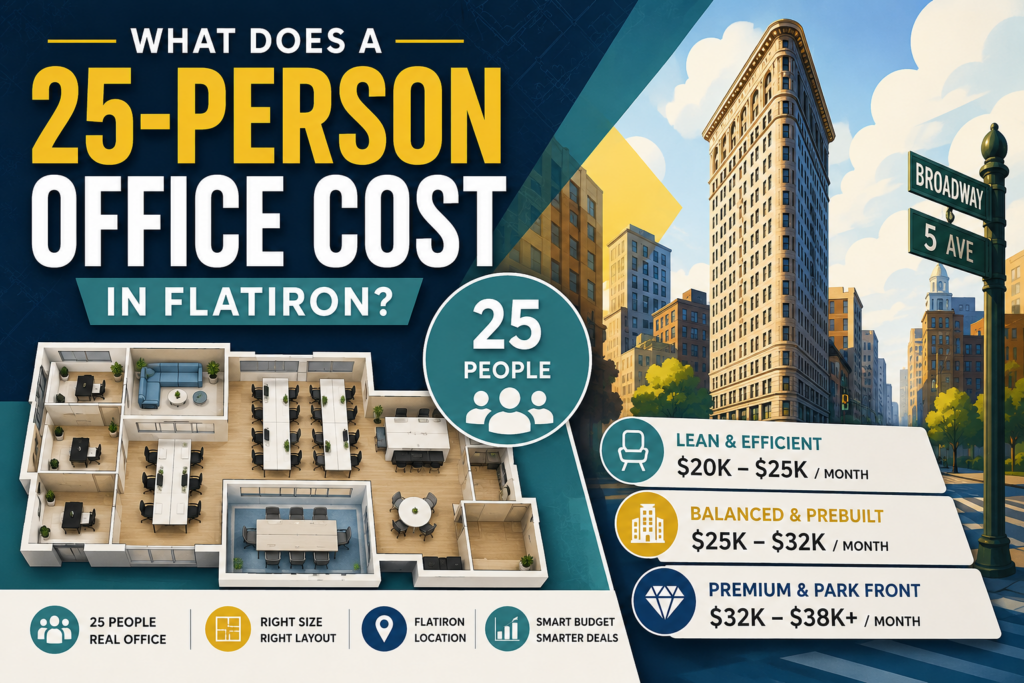
A true twenty-five-person office in Flatiron usually lands in a wider budget band than most tenants expect. Right now, the practical range starts around the high teens per month for efficient loft or sublease space, climbs into the mid-twenties to high-thirties for stronger prebuilt or direct lease options, and can move higher for park-front or premium Class A product. Flexible private suites can look cheaper at first glance, but those quotes often reflect shared-building team rooms, smaller desk counts, or hybrid attendance assumptions rather than a fully dedicated lease-style setup.
That range confuses tenants because the same search phrase covers several different products. Some pages describe a private room inside a shared office. Others describe a true leased suite. Still others list neighborhood rent averages without translating those numbers into real headcount, layout, and monthly occupancy cost. A better answer starts with one simple rule: price the office only after you decide how your twenty-five people will actually use it.
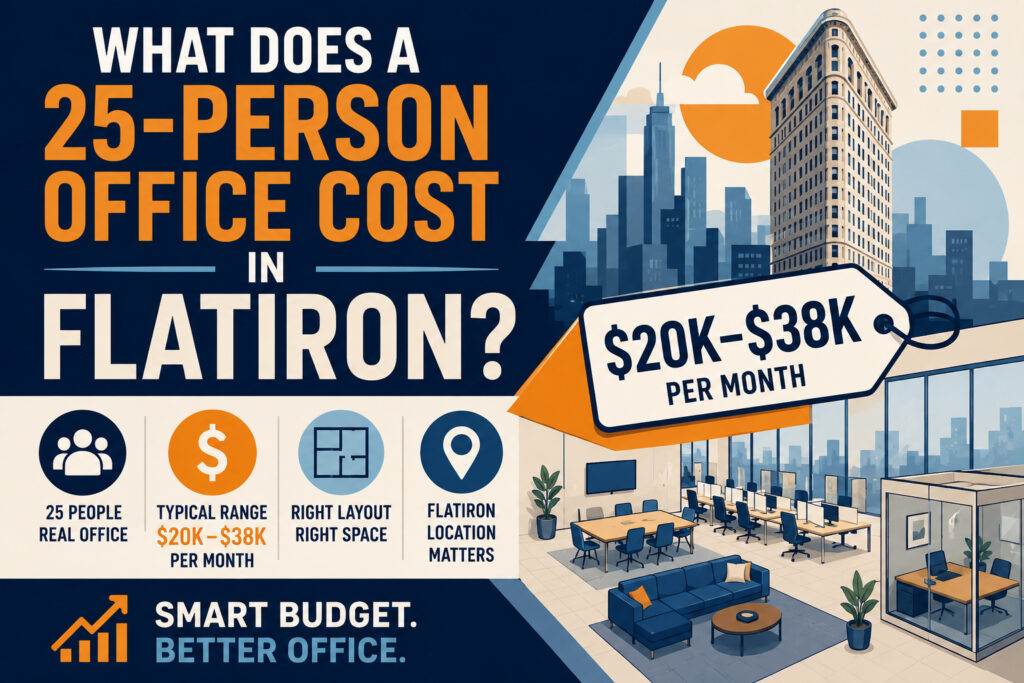
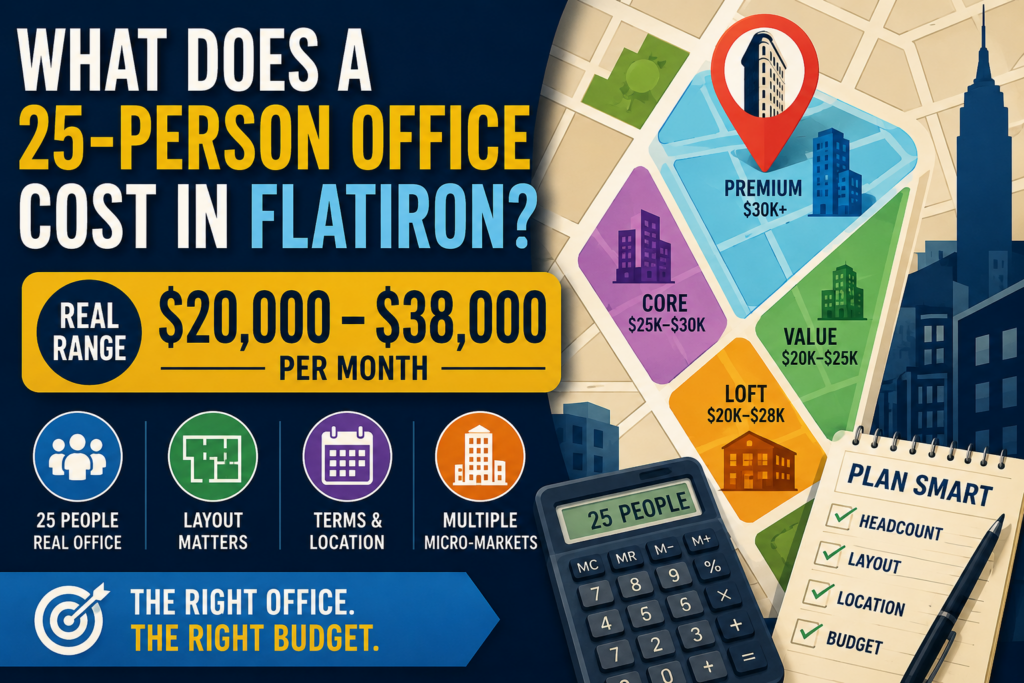
If you want one planning number, start here: most balanced twenty-five-person teams in Flatiron should budget roughly $20,000 to $38,000 per month for a real office search, depending on location, layout, term, and building quality. Teams that run leaner or hybrid can beat that. Groups that want prime frontage, more private rooms, or extra growth space often push above it.
Quick take:Flatiron is not one price band. It is several micro-markets packed into a small area. Your address, floor plate, and office type matter as much as your headcount.
Why the range moves so much
Flatiron price swings come from product mix first. A side-street loft, a furnished sublease, a polished prebuilt suite, and a private team room may all sit within a short walk of each other, yet they price like different worlds. Current market guides place the broader Flatiron and Union Square band around the high eighties per square foot on average, while current local commentary also shows side-street loft value in the sixties and premium corridor product reaching well above that.
Location inside Flatiron changes the math even faster. The east side and park-adjacent corridor usually carry the strongest premium. Broadway loft stock and west-of-core side streets often offer more character for less money. The Union Square edge can also widen your choices without taking you out of the same daily ecosystem. For many tenants, that matters more than chasing the most famous block.
Lease format drives cost just as hard. Direct leases can offer better control and longer-term value, but they add setup and operating line items. Subleases can reduce both time and effective cost, especially when furniture and wiring stay in place. Flexible suites simplify the budget because they bundle services, yet they also reduce layout control and can become expensive once your team needs more than a simple room count.
Finally, not every “twenty-five-person office” means twenty-five daily desks. Some teams need twenty-five assigned seats. Others need sixteen seats, one conference room, two phone rooms, and strong meeting-room access because attendance peaks only on certain days. That single difference can change your footprint by well over a thousand square feet. It can also decide whether a shared-office private suite works at all.
How much space the team really needs
Headcount helps, but peak attendance matters more. If all twenty-five people come in most days, you should not shop the same footprint as a hybrid team that peaks at fifteen or eighteen. In Flatiron, that mistake leads tenants into cramped layouts, weak meeting capacity, and fast second moves.
A practical planning frame looks like this. Dense open plans can work around 2,750 to 3,125 rentable square feet. Balanced layouts usually land closer to 3,200 to 4,400 rentable square feet. Private-office-heavy users can move into 5,000 to 6,000 rentable square feet for the same headcount. That is why a simple “twenty-five people equals twenty-five desks” shortcut rarely gives the right answer.
Loss factor matters too. Many tenants budget from the space inside the suite, then forget that Manhattan leasing quotes usually use rentable square feet. Once you account for common-area load, the real search target rises. A layout that needs about four thousand usable square feet can easily push well into the five-thousand-rentable-square-foot range in an inefficient building.
That is the real translation for this query. A twenty-five-person Flatiron office is not one size. It is usually a search between roughly three thousand and five thousand plus rentable square feet, with the final answer driven by privacy, collaboration, and growth plans.
Budget lanes that fit the search
The cleanest way to understand cost is to separate the search into budget lanes. Once you do that, the pricing picture becomes much easier to read.
Office type
Typical fit for a twenty-five-person search
Usual size lens
Practical monthly budget
Lean flex or hybrid private suite
Best for teams with lower daily attendance
Desk-based rather than square-foot-based
About $9,000 to $18,000+ all-in
Efficient loft or furnished sublease
Best for fast move-ins and value
About 3,000 to 3,800 RSF
About $17,000 to $28,000
Balanced prebuilt direct lease
Best for full-time teams that need privacy and meeting rooms
About 3,200 to 4,500 RSF
About $23,000 to $38,000
Premium loft or park-adjacent Class A
Best for stronger image and larger room count
About 3,500 to 5,000 RSF
About $30,000 to $47,000+
That first lane needs context. Current shared-office pricing in Flatiron includes smaller team-room products, monthly private offices, and desk-based suites that can undercut a traditional lease on paper. One current shared-office listing shows 20 to 24 desks at about $8,500 to $9,850 per month, while other guides place average twenty-five-desk private office budgets closer to the mid-teens. Large, high-touch team rooms can move far above that. So, yes, flexible space can work for a twenty-five-person company, but the quote only makes sense after you confirm the true seat count, privacy level, and what the operator includes.
The second lane is where many tenant searches become more rational. Efficient lofts and furnished subleases often give you a better cost-to-control balance than shared-office suites. Current market commentary shows Flatiron sublease asking rents below direct asking rents in the same submarket. That discount can matter a lot once furniture, wiring, and move-in speed enter the picture.
The third lane tends to fit the broadest group of twenty-five-person tenants. This is the “real office” zone. You get a private suite, a truer layout match, and enough room for one conference room, one smaller meeting room, pantry space, and modest growth. This is also the lane where current New York Offices examples make the most sense. The Flatiron team-size guide already shows current examples in the two-thousand-five-hundred to six-thousand-five-hundred square foot range, alongside pricing snapshots that help tenants frame the middle of the market before they tour.
The premium lane serves a narrower group, but it is real. If you want Park Avenue South address power, a bigger room count, stronger finish, or a full-floor feel, your monthly number climbs fast. The trade-off can still make sense for firms that depend on client presentation, executive privacy, or recruiting optics. However, that choice should follow business goals, not neighborhood mythology.
How to choose the right Flatiron setup
Start with the office type, not the rent roll. If speed matters most, look first at furnished and plug-and-play offices in Flatiron. Those spaces often let a team move with fewer vendors, fewer delays, and less waste. They also make it easier to compare real occupancy cost rather than just base rent.
Next, decide whether your team needs a true lease or a flexible suite. Flexible space works best when your attendance stays uneven, your term must stay short, or your leadership wants an all-in monthly number. A true suite works better when privacy, branding, room mix, and growth control matter more than operator convenience. Many teams outgrow the smallest private suite products sooner than they expect.
Then map the neighborhood correctly. Flatiron is small enough to tour in one day, yet varied enough to punish lazy shortcuts. Pair the core with Broadway loft stock. Pair the core with the Union Square edge. Pair polished product with value product. You will often learn more from that contrast than from ten similar tours in the same rent band. To widen the search without losing the same commuter logic, review office space near Union Square for Flatiron tenants and Park Avenue South vs. Broadway loft offices in Flatiron.
After that, translate your headcount into a real requirement. Do not guess. Use an actual room program. Count desks, offices, meeting rooms, pantry, storage, server space, and growth cushion. Our office space calculator and headcount planning guide make that step much easier before you ever set foot in a building.
Finally, judge each option on effective monthly occupancy, not advertised rent alone. Base rent matters. So do electric, internet, cleaning, furniture, move-in cost, cabling, meeting-room access, and the cost of taking too much space. One office can look cheaper by the square foot and still cost more once you finish the picture.
Questions tenants ask before they lease
Does a twenty-five-person office in Flatiron really need three thousand plus square feet? Usually, yes. Dense teams can land near the lower end. Balanced teams often need more. Private-office-heavy users need substantially more. The moment you add real meeting rooms, pantry space, and hiring cushion, the number climbs.
Can a hybrid company lease less than twenty-five desks? Absolutely. That is one of the biggest opportunities in this search. If your peak attendance sits around fifteen to eighteen, you may fit a smaller suite or a stronger shared-office private room. Just make sure the layout supports your actual peak days, not your average Wednesday.
Is sublease space usually cheaper than direct lease space in Flatiron? Broadly, yes. Current local reporting shows sublease asking rents below direct asking rents in the Flatiron and Union Square band. Subleases also often include furniture and wiring, which can lower move-in cost and compress your timeline.
What price per square foot should I use for early budgeting? Use a range, not one number. Value-oriented loft product can still show numbers in the sixties. Broader current submarket averages sit much higher. Premium corridor product can move well beyond that. For a real tenant search, square footage and location must travel together.
Should I choose a flexible suite or a real office lease? Choose the flexible suite when you need speed, short term, or a bundled monthly bill. Choose the real office when layout control, privacy, and long-term fit matter more. Most twenty-five-person firms should at least look at both before they decide.
Why do some quotes look far lower than others for the same team size? Because they are not quoting the same product. A desk-based private room inside a shared office is not the same thing as a leased suite with your own conference room, pantry, and branded front door. Apples-to-apples comparison is the only useful comparison.
What should I tour first if I need space fast? Start with plug-and-play subleases and furnished prebuilt suites. Those options already solve the hardest parts of a rushed move. Current Flatiron examples in the low-three-thousand to low-five-thousand square foot band show why that path often fits midsize teams best. Browse current Flatiron office space and the Flatiron team-size page before you schedule the first tour.
Work with a tenant broker
We represent tenants only. We translate headcount into a workable square-foot target, narrow the shortlist, and negotiate from the tenant side. If you want the right Flatiron office without wasting tours, we can line up options by budget, layout, timing, and growth.
Fill out our 📋online form or give us a call today 📞212-967-2061 — let’s find the right options for your business.