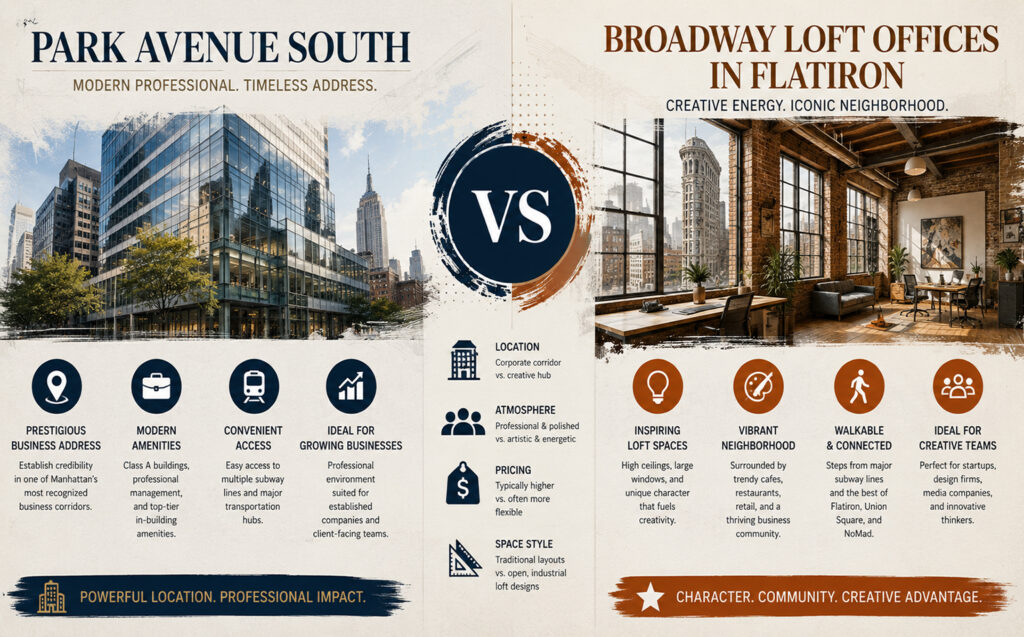
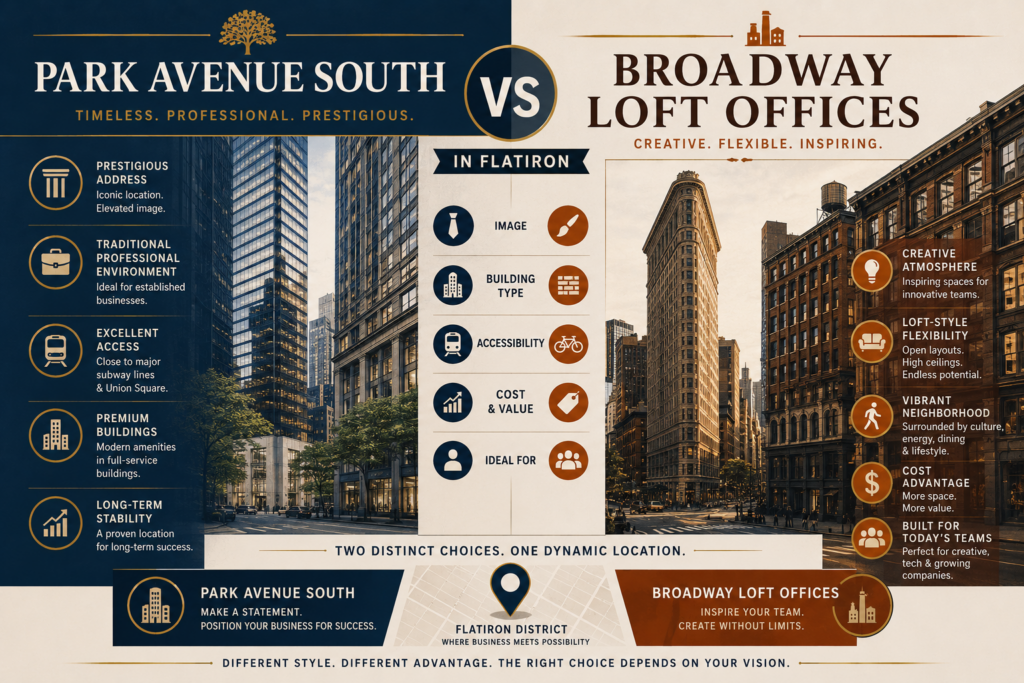
Park Avenue South usually wins when your team wants a more polished address, stronger Class A positioning, easier client-facing presentation, and faster access toward Grand Central and the east side. The corridor has also benefited from the latest AI-led leasing push in Midtown South, which has helped tighten better-quality inventory and reinforce its image as a higher-prestige choice.
Broadway usually wins when your team wants authentic loft character, better visual identity, more exposed structure, and better odds of finding value inside prewar stock. In late 2025, Savills split the submarket clearly: Park Avenue South averaged $77.50 per square foot, while Flatiron averaged $64.66 per square foot. That spread captures the core tradeoff well.
So, which side should most tenants start with? Choose Park Avenue South first if your office must look polished on day one. Choose Broadway first if your office must feel creative, memorable, and more cost-efficient. When budget and culture pull in opposite directions, tour both in the same afternoon.
Bottom line: Park Avenue South is the stronger “AI corridor” and presentation corridor. Broadway is the stronger loft corridor and value corridor.
Why this split matters now
This comparison matters more in 2026 because Midtown South tightened again. Newmark reported Midtown South at $88.32 per square foot, with 16.9% availability in the first quarter of 2026. More importantly for this page, Flatiron/Union Square posted 13.9% availability and an $87.18 total asking rent, which shows that this neighborhood is no longer a soft, easy market.
At the same time, Park Avenue South gained fresh momentum from AI demand. Savills reported that Midtown South leasing rose nearly 60% over the quarter, driven by rising AI activity in the Park Avenue South submarket. That does not mean every tenant should pay the corridor premium. It does mean the premium now reflects real demand, not just branding.
Broadway still holds a real advantage, though. The best Broadway loft offices in Flatiron sit inside prewar buildings with larger windows, stronger character, and layouts that feel less generic. Many firms do not need a highly polished Class A presentation. They need daylight, identity, efficient collaboration, and manageable occupancy cost. Broadway often delivers that package better.
That is why this page should not be read as a generic Flatiron guide. Flatiron has two office stories at once. One story centers on polished Park Avenue South momentum. The other runs through Broadway loft stock, where value, brand texture, and design flexibility often improve.
What Park Avenue South gives a tenant
Park Avenue South works best for teams that want a sharper front-of-house look. The corridor leans more institutional, more refined, and more prebuilt-ready than many Broadway loft options. In practice, that means better lobbies, stronger common areas, cleaner arrivals, and a simpler move for firms that do not want a long construction cycle.
Transit also helps the case. The 23rd Street station on Park Avenue South sits on the 6 line, while nearby Union Square adds the 4, 5, 6, L, N, Q, R, and W lines. That combination gives east-side commuters a smoother ride and still preserves broad network coverage for teams coming from Brooklyn, Queens, and downtown.
For tenants who want a live example, the full-floor option at 315 Park Avenue South offers 17,050 rentable square feet, comes fully furnished and wired, and sits inside a recently renovated boutique property with luxury finishes and an on-site fitness component. That kind of ready-to-go full floor is exactly why Park Avenue South appeals to scaling teams that want polish without delay.
The corridor also carries stronger recent tech and AI signaling. One Park Avenue South property totals 332,000 rentable square feet, was renovated in 2016, and has attracted prominent tech and finance users. Its own property updates also note a fast AI-related expansion inside the building, which reinforces the corridor’s role in the current Flatiron AI corridor story.
That does not mean Park Avenue South is only for large firms. Smaller teams can still fit here. However, the corridor makes the most sense when image, executive recruiting, enterprise sales, and client confidence matter almost as much as raw cost.
What Broadway loft offices give a tenant
Broadway loft offices in Flatiron give you the thing Park Avenue South often cannot match: authentic workspace character. The strongest options usually offer exposed structure, tall ceilings, cast-iron elements, oversized operable windows, and floor plates that feel distinct rather than standardized. For many creative, design, media, product, and founder-led teams, that difference shapes the entire workday.
The corridor also tends to support better value. Savills’ late-2025 submarket split showed Flatiron at $64.66 per square foot versus $77.50 on Park Avenue South. New York Offices listings reinforce that idea. A Broadway sublet at 915 Broadway notes asking rents that start around $50 or $60 per square foot, while still offering hardwood floors, high ceilings, tenant-controlled HVAC, and strong transit access.
If you want a strong Broadway example, 915 Broadway stands out as a major prewar office asset with about 250,000 square feet, roughly 20 stories, and immediate access to Union Square, Madison Square Park, and several subway lines. The building sits in a practical middle zone between boutique loft space and larger institutional assets, which makes it attractive for tenants who want value without sacrificing position.
Another good fit is 902 Broadway, a recognizable loft-style asset at Broadway and East 20th Street. The building’s dual frontage improves light and layout flexibility, and its setting places a tenant directly inside the core Broadway spine of Flatiron.
Broadway also offers better variety for smaller loft users. The 900 Broadway penthouse sublet delivers 3,400 square feet. The 920 Broadway full-floor sublet offers 6,500 square feet with exposed beams, cast-iron columns, and wraparound windows. Those examples suggest a broader ladder for tenants who want 25 to 45 seats without paying for Park Avenue South polish they may not need.
Park Avenue South vs Broadway in the areas tenants actually feel
Pricing. Park Avenue South usually costs more. Savills put Park Avenue South at $77.50 per square foot and Flatiron at $64.66 in late 2025. Newmark then showed Flatiron/Union Square at $87.18 total asking rent in Q1 2026, which means the neighborhood overall strengthened, but the corridor discount still matters. If your budget target sits in the $50s or low $60s, Broadway loft offices in Flatiron usually deserve the first tour.
Look and feel. Park Avenue South presents better. Broadway expresses better. In simple terms, Park Avenue South is more polished, more corporate, and more turnkey. Broadway feels more architectural, more human-scaled, and more brandable. Companies that pitch enterprise clients often lean east. Companies that sell culture, product, or design often lean west.
Transit. Both corridors commute well. Park Avenue South has the cleanest east-side logic because of the 6 train and quick reach to Union Square. Broadway counterpunches with immediate access to the Broadway line and short walks to Union Square and Sixth Avenue service. The result is not a transit blowout. Instead, it is a routing preference. East-side commuters often prefer Park Avenue South. Multi-line teams often feel equally good on Broadway.
Build-out risk. Park Avenue South usually reduces it. More of the corridor’s best options lean prebuilt or recently upgraded. Broadway can still be turnkey, but it more often asks a tenant to decide how much loft character to keep, soften, or rework. That can be a major advantage for brand-led firms. It can also add time.
Space psychology. This point matters more than many tenants expect. A polished corridor can help with executive hiring, outside perception, and investor meetings. A loft corridor can improve energy, memory, and daily team experience. Neither benefit is abstract. Both affect retention and attendance.
Which corridor fits your team size, budget, and growth plan
A small tenant with strong taste and a tight budget should usually start on Broadway. That includes architecture studios, creative agencies, newer software teams, boutique investment shops, and founder-led businesses that want a distinct office without trophy pricing. Broadway tends to reward tenants who value atmosphere, daylight, and identity over perfect polish. The 920 Broadway full-floor loft and 900 Broadway penthouse show that range clearly.
A mid-sized tenant that wants better optics should start on Park Avenue South or just off it. Teams in legal tech, fintech, consulting, professional services, and later-stage venture-backed categories often land here because the office needs to support recruiting and enterprise trust at the same time. The 315 Park Avenue South full-floor space is a strong example of that polished, furnished, growth-ready package.
A tenant that wants the middle ground should look at the blocks between the two corridors. That is where some of the best affordable Flatiron offices show up. For example, 36 East 20th Street sits between Broadway and Park Avenue South, offers 4,125 square feet, roughly 14-foot ceilings, and starts around $60 per square foot. That kind of location gives you loft energy without committing fully to either edge.
Larger tenants should think carefully about floor efficiency. Park Avenue South and adjacent park-front assets often handle bigger contiguous blocks and cleaner prebuilt execution more easily. Broadway can still work for larger users, but the best fit often goes to firms that want a full-floor identity and do not mind a more custom layout path. That conclusion is an inference from the current examples, not a hard rule. Still, the examples support it.
If your team keeps arguing about this choice, use a simple filter. Ask which matters more right now: presentation, speed, and prestige or character, value, and creative identity. The first answer points to Park Avenue South. The second points to Broadway.
Frequently asked tenant questions
Is Park Avenue South always better than Broadway in Flatiron? No. Park Avenue South is not “better” in every case. It is usually better for polish, turnkey quality, and higher-end perception. Broadway is often better for loft character, lower effective entry cost, and memorable space identity.
Are Broadway loft offices in Flatiron more affordable? Usually, yes. Savills’ split between Park Avenue South and Flatiron showed a meaningful late-2025 rent gap. Current Broadway examples on New York Offices also sit in the zone many cost-sensitive tenants target first.
Which corridor works better for the Flatiron AI corridor story? Park Avenue South. Savills tied the latest Midtown South leasing surge to AI activity in the Park Avenue South submarket. Property-level evidence also shows fast AI-driven expansion inside a leading Park Avenue South asset. Even so, Broadway and nearby side streets still benefit from spillover demand as teams chase value and character.
Which side is better for commuting? That depends on where your people live. Park Avenue South improves east-side routing through the 6 train and still sits close to Union Square. Broadway improves immediate access to the Broadway line and stays within short reach of Union Square and Sixth Avenue service. Most tenants should map employee ZIP codes before assuming one side is better.
Where should a tenant tour first if budget matters most? Start on Broadway, then add one or two Park Avenue South options as a benchmark. That sequence helps a tenant understand what the premium buys. It also prevents overpaying for finish level that the team may not truly value. A smart two-stop comparison might pair 915 Broadway or 902 Broadway with 315 Park Avenue South.
What is the best answer for most tenants? For most tenants, the best answer is not one corridor forever. It is a short side-by-side tour. Compare a polished Park Avenue South floor, a true Broadway loft, and one in-between Flatiron option. Once you stand in all three, the right answer becomes obvious fast.
If your goal is a polished office with strong recruiting optics, begin on Park Avenue South. If your goal is a character-rich office that feels like Flatiron, begin on Broadway. When you want the smartest lease, not just the loudest address, tour both before you sign.
If you lease office space for your company, this choice matters. We represent tenants, not landlords, so the goal here is simple: help you pick the corridor that best fits your budget, culture, hiring plan, and growth path. Use this guide to compare Park Avenue South office space with Broadway loft offices in Flatiron, then tour the right side first.
Fill out our 📋online form or give us a call today 📞212-967-2061 — let’s find the right office for your business.